Cell and Nuclear Division · Paper 1 — Free Biology HL Practice Questions
Free questions
Open in full, with answers, mark scheme and examiner insights.
Chromosome number and genetic variation
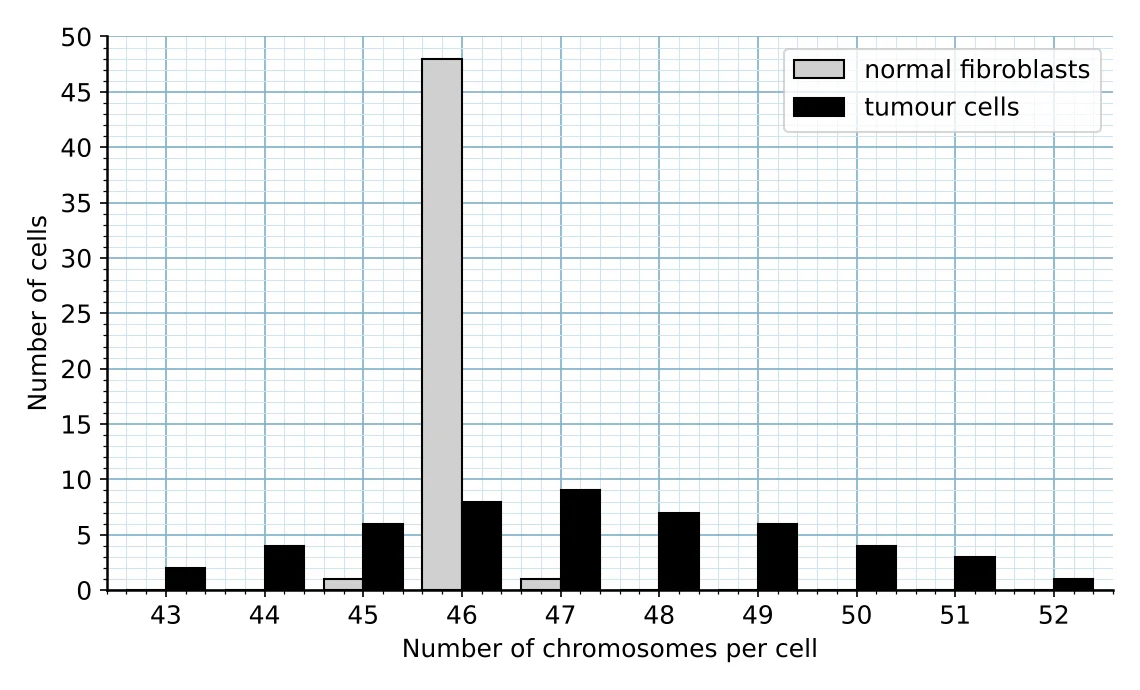
In Drosophila melanogaster the diploid number is 8. A cell from a female fly contains exactly 4 chromosomes, each of a single chromatid. Which best describes this cell?
revisionprep.com
Summary Answer
Not available for this question.
Model Answer
Not available for this question.
Marking Scheme
Not available for this question.
Examiner Insights
Not available for this question.
Mitosis vs meiosis
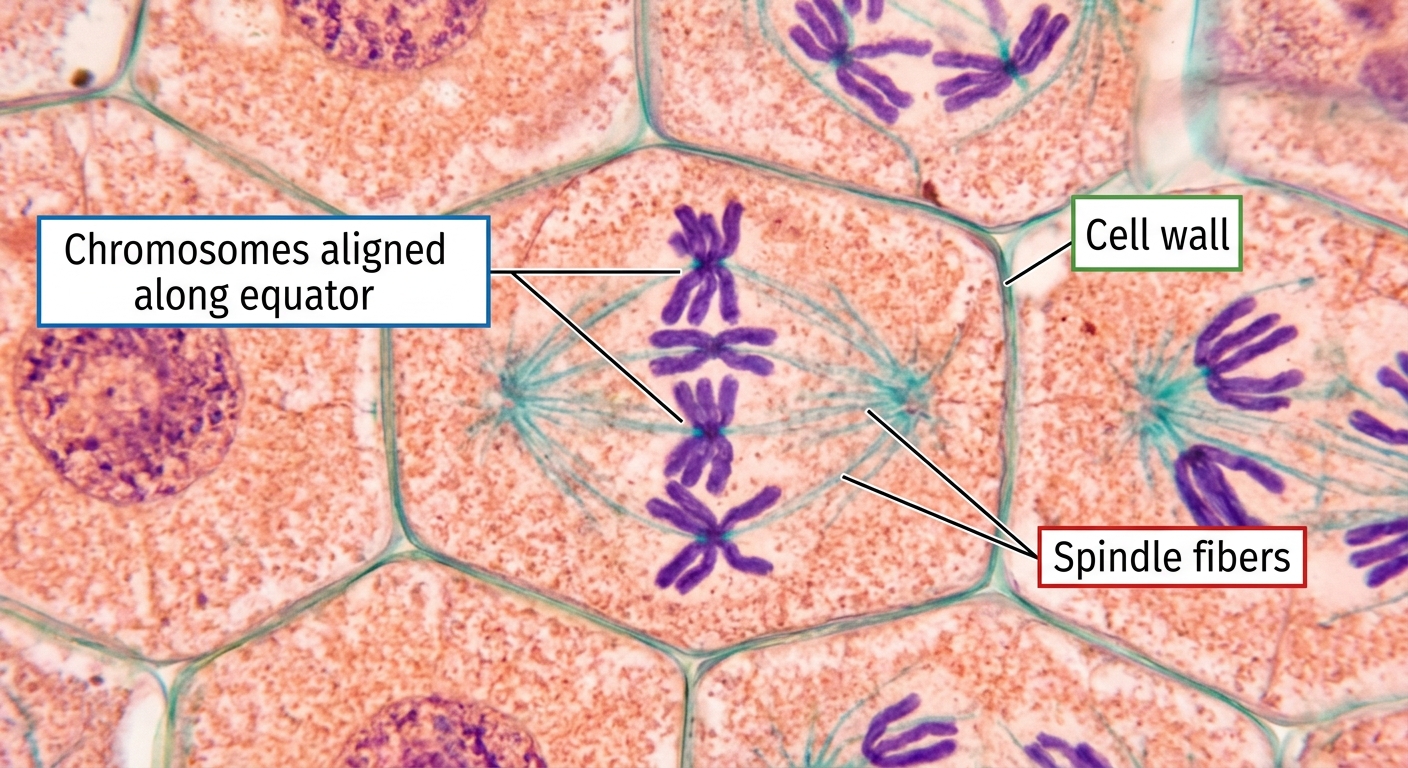
The micrograph shows cells from an onion root tip. In the cell in the centre, each chromosome consists of two sister chromatids and the chromosomes are aligned at the equator, with no pairing of homologous chromosomes. Which stage of cell division is shown?
revisionprep.com
Summary Answer
Not available for this question.
Model Answer
Not available for this question.
Marking Scheme
Not available for this question.
Examiner Insights
Not available for this question.
Chromosome number and genetic variation
In a grasshopper testis, chiasmata were counted in bivalents of different lengths at metaphase I. The results are shown in the table.
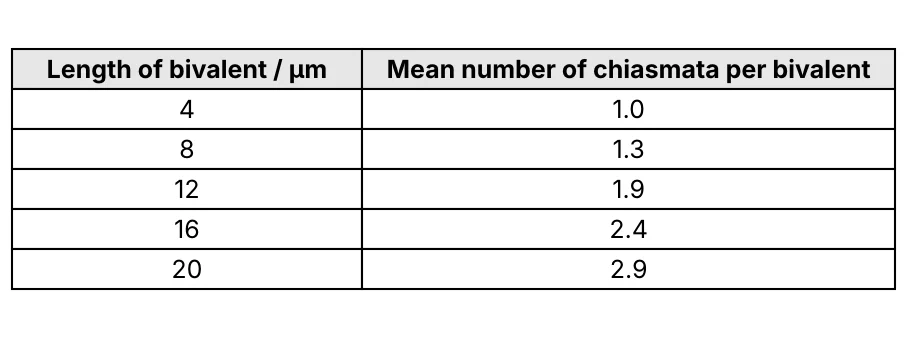
Describe the relationship between the length of a bivalent and the number of chiasmata.
State the stage of meiosis in which chiasmata form.
Explain how chiasmata increase genetic variation among gametes.
Every bivalent had at least one chiasma. Suggest why at least one chiasma per bivalent is needed for correct separation at anaphase I.
Suggest why the mean number of chiasmata was calculated from many bivalents of each length rather than counted in a single bivalent.
revisionprep.com
Summary Answer
Not available for this question.
Model Answer
Not available for this question.
Marking Scheme
Not available for this question.
Examiner Insights
Not available for this question.
Mitosis vs meiosis
Cytochalasin B stops actin filaments from forming. Human cells in culture were treated with different concentrations of cytochalasin B for 24 hours. The percentage of cells with two nuclei (binucleate cells) was recorded. The results are shown in the table.

Describe the effect of cytochalasin B on the percentage of binucleate cells.
Explain why treated cells can still complete nuclear division.
Untreated cells have 46 chromosomes. Determine the number of chromosomes in each nucleus of a binucleate cell and in the whole binucleate cell.
Predict, with a reason, whether cytochalasin B would have the same effect on dividing onion root tip cells.
revisionprep.com
Summary Answer
Not available for this question.
Model Answer
Not available for this question.
Marking Scheme
Not available for this question.
Examiner Insights
Not available for this question.
Chromosome number and genetic variation
Using DNA markers, researchers identified where the extra chromosome 21 came from in 400 children with Down syndrome. The results are shown in the table.
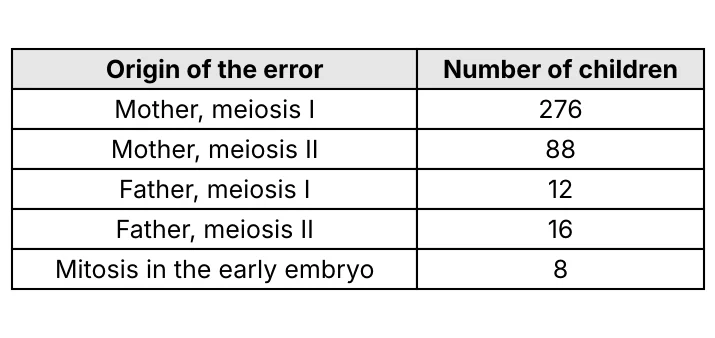
Calculate the percentage of cases in which the error happened in the mother.
Suggest why errors in the mother occur mostly at meiosis I.
Explain how an error in mitosis in the early embryo could produce a child with only some cells containing 47 chromosomes.
State the number of chromosomes in an egg produced after a meiosis I error that leads to Down syndrome.
revisionprep.com
Summary Answer
Not available for this question.
Model Answer
Not available for this question.
Marking Scheme
Not available for this question.
Examiner Insights
Not available for this question.
Mitosis vs meiosis
Normal human fibroblasts and cells from a fibrosarcoma (a malignant tumour of connective tissue) were grown in separate culture dishes. Nutrients were renewed every day. The graph shows the mean number of cells per cm² of dish surface (hypothetical data). Note the logarithmic scale.
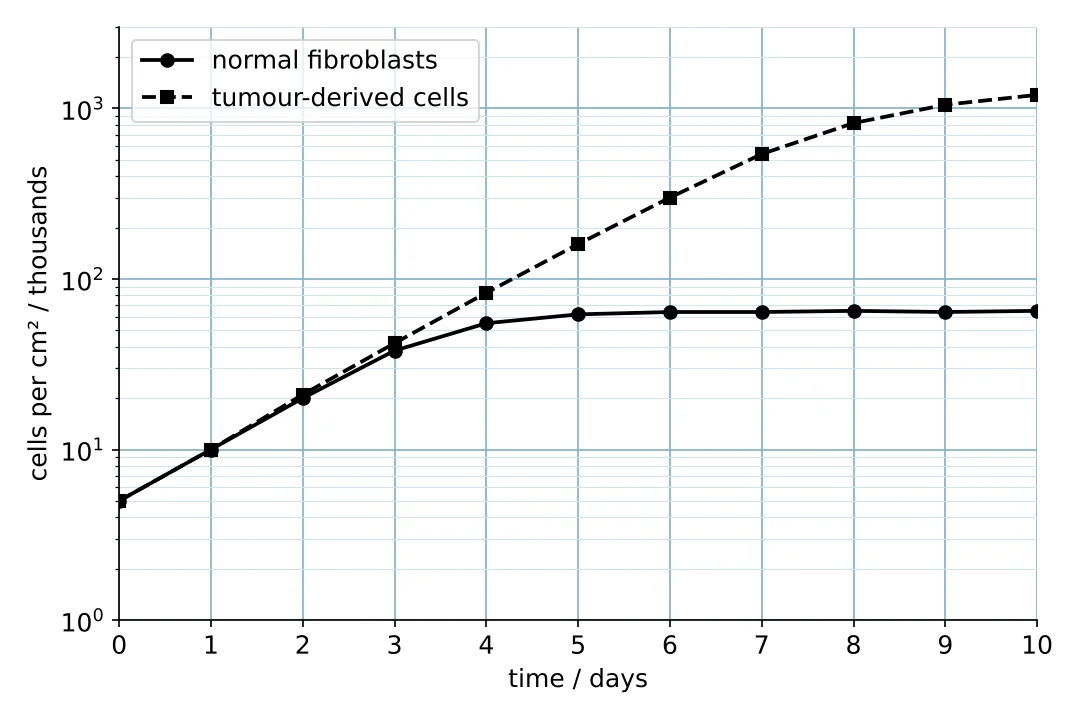
Determine the doubling time of the tumour-derived cells between day 2 and day 4.
Compare the growth of the two cell populations over the 10 days.
The normal fibroblasts stop dividing once they cover the dish surface in a single layer. Suggest how control of the cell cycle produces this effect.
Explain how mutations in proto-oncogenes and tumour-suppressor genes could produce the growth pattern of the tumour-derived cells.
State one reason for plotting these data on a logarithmic scale.
revisionprep.com
Summary Answer
Not available for this question.
Model Answer
Not available for this question.
Marking Scheme
Not available for this question.
Examiner Insights
Not available for this question.
That's every free question here — 6 of 77.
+71 more questions, plus Mock Papers & Worksheets, are waiting in Premium.