Protein Synthesis · Paper 1 — Free Biology HL Practice Questions
Free questions
Open in full, with answers, mark scheme and examiner insights.
Post-translational modifications
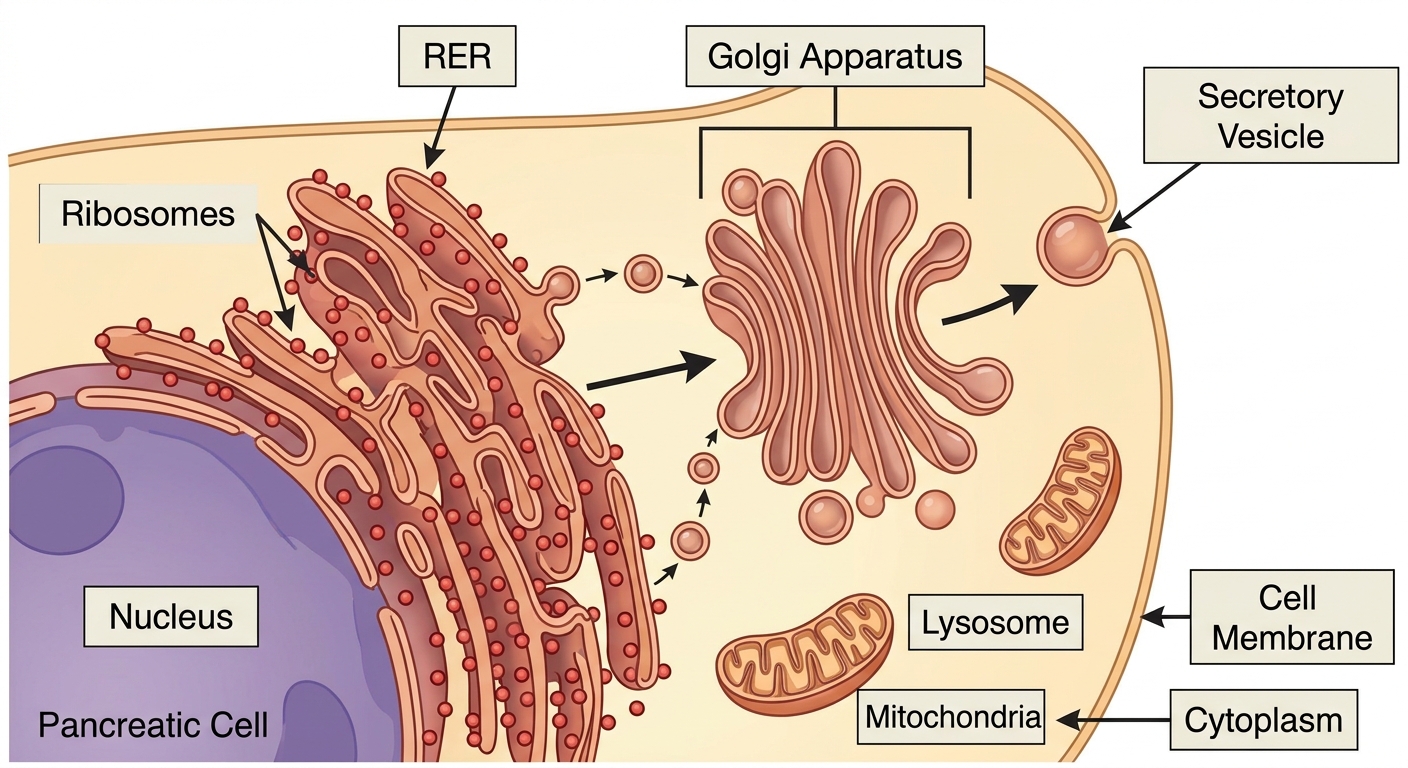
The shows a pancreatic cell that secretes insulin. Insulin is translated as pre-proinsulin, which is then modified in two steps: the signal peptide is removed, and later proinsulin is cut to give insulin. Where does each step take place?
revisionprep.com
Summary Answer
Not available for this question.
Model Answer
Not available for this question.
Marking Scheme
Not available for this question.
Examiner Insights
Not available for this question.
Transcription and translation processes
A student mixes RNA polymerase with a double-stranded DNA template, free ribonucleotides (ATP, GTP, CTP, UTP), and a suitable buffer, then incubates the mixture. Which of the following correctly describes the nucleic acid product?
revisionprep.com
Summary Answer
Not available for this question.
Model Answer
Not available for this question.
Marking Scheme
Not available for this question.
Examiner Insights
Not available for this question.
Post-translational modifications
Beta cells were given radioactive amino acids for 5 minutes and then moved to a medium with non-radioactive amino acids. At intervals the labelled insulin-related molecules were separated, and the percentage present as preproinsulin, proinsulin and insulin was measured (hypothetical data).
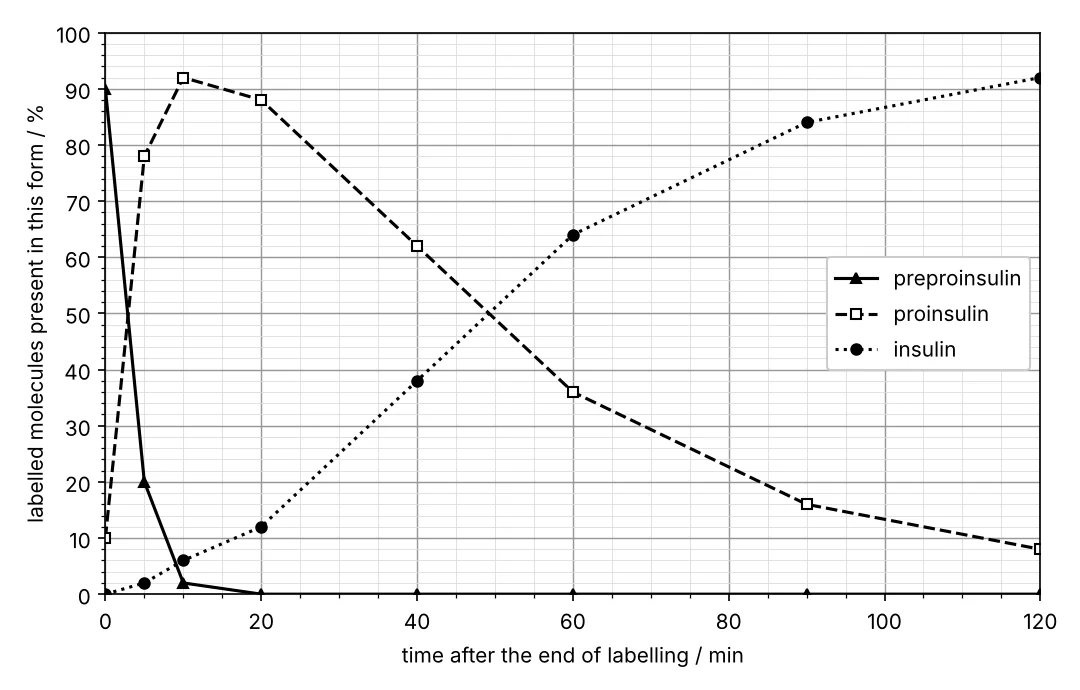
State where in the cell the signal peptide is removed from preproinsulin.
Describe the changes in labelled proinsulin over the 120 minutes.
Determine the time at which half of the labelled molecules were present as insulin.
Explain why labelled insulin appears only after a delay.
Determine the time taken for labelled proinsulin to fall from its maximum to half of its maximum.
Explain why the cells were given radioactive amino acids for only 5 minutes.
revisionprep.com
Summary Answer
Not available for this question.
Model Answer
Not available for this question.
Marking Scheme
Not available for this question.
Examiner Insights
Not available for this question.
Transcription and translation processes
Scientists tested samples of three human tissues for the DNA and the mRNA of three genes. The table shows the results.
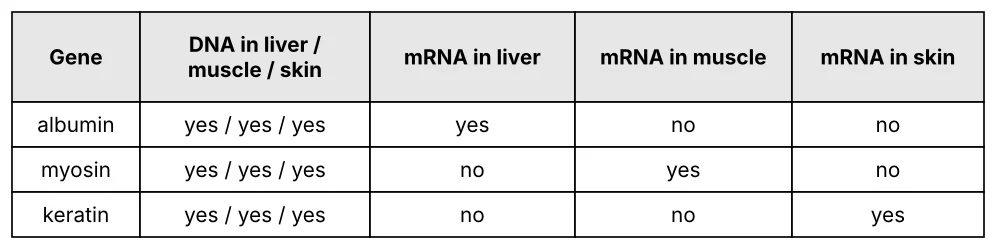
State the process that produces mRNA from a gene.
Explain why all three genes are present in every tissue.
Deduce what the data show about gene expression in different cells.
Suggest why measuring mRNA is a better indicator of which proteins a cell makes than measuring DNA.
Each tissue was sampled once, from one person. Suggest two changes to the method that would make the conclusion in (c) more reliable.
revisionprep.com
Summary Answer
Not available for this question.
Model Answer
Not available for this question.
Marking Scheme
Not available for this question.
Examiner Insights
Not available for this question.
Post-translational modifications
An enzyme of 300 amino acids has its active site around amino acid 110. Four mutant forms of its gene were studied, each with one base substitution. The table shows the change and the enzyme activity of each mutant.
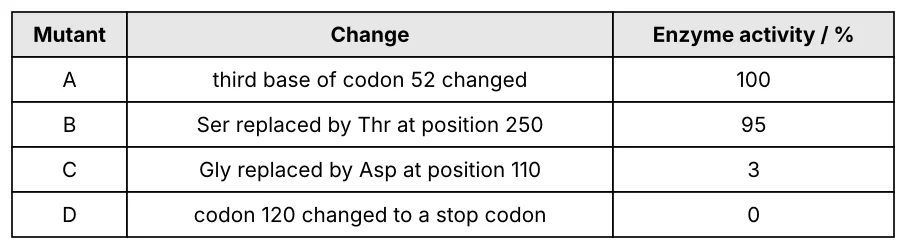
Identify the mutant in which the amino acid sequence is unchanged.
Explain the result for mutant D, and suggest what happens in the cell to the polypeptide it produces.
Explain why mutants B and C have such different activities although each changes only one amino acid.
revisionprep.com
Summary Answer
Not available for this question.
Model Answer
Not available for this question.
Marking Scheme
Not available for this question.
Examiner Insights
Not available for this question.
Transcription and translation processes
Every cell in the human body contains the gene for β-globin, a polypeptide in haemoglobin. The graph shows the amount of β-globin mRNA in four types of cell.
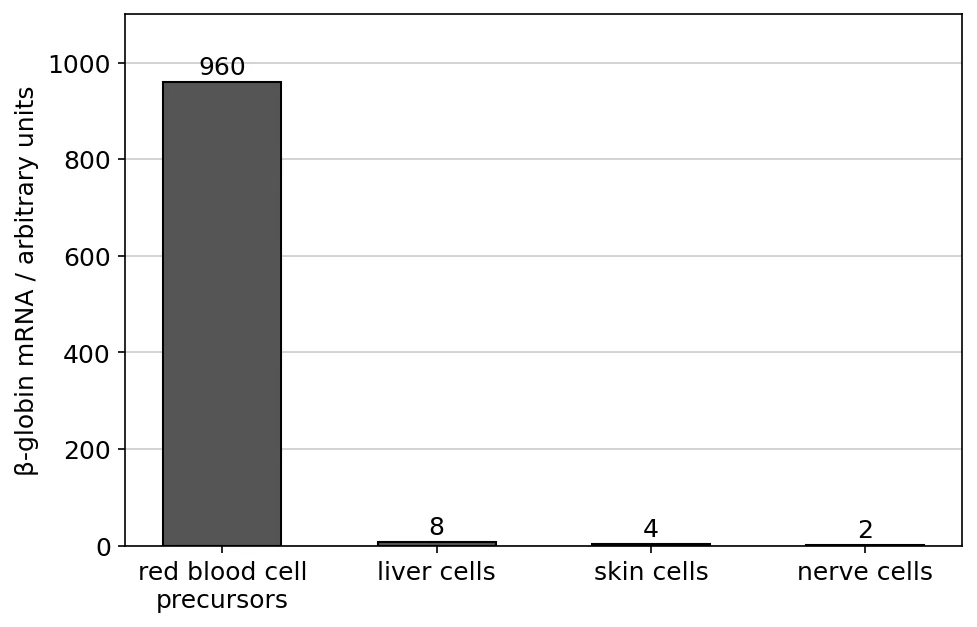
Identify the cell type with the most β-globin mRNA.
Calculate how many times more β-globin mRNA there is in red blood cell precursors than in liver cells.
Explain the differences in β-globin mRNA between the cell types.
Mature red blood cells in humans have no nucleus, but they still make β-globin for a short time. Explain how this is possible.
Each value comes from one tissue sample. Suggest two ways to make the comparison between cell types more reliable.
revisionprep.com
Summary Answer
Not available for this question.
Model Answer
Not available for this question.
Marking Scheme
Not available for this question.
Examiner Insights
Not available for this question.
That's every free question here — 6 of 93.
+87 more questions, plus Mock Papers & Worksheets, are waiting in Premium.