Water Potential · Paper 1 — Free Biology HL Practice Questions
Free questions
Open in full, with answers, mark scheme and examiner insights.
Concept of water potential in plants
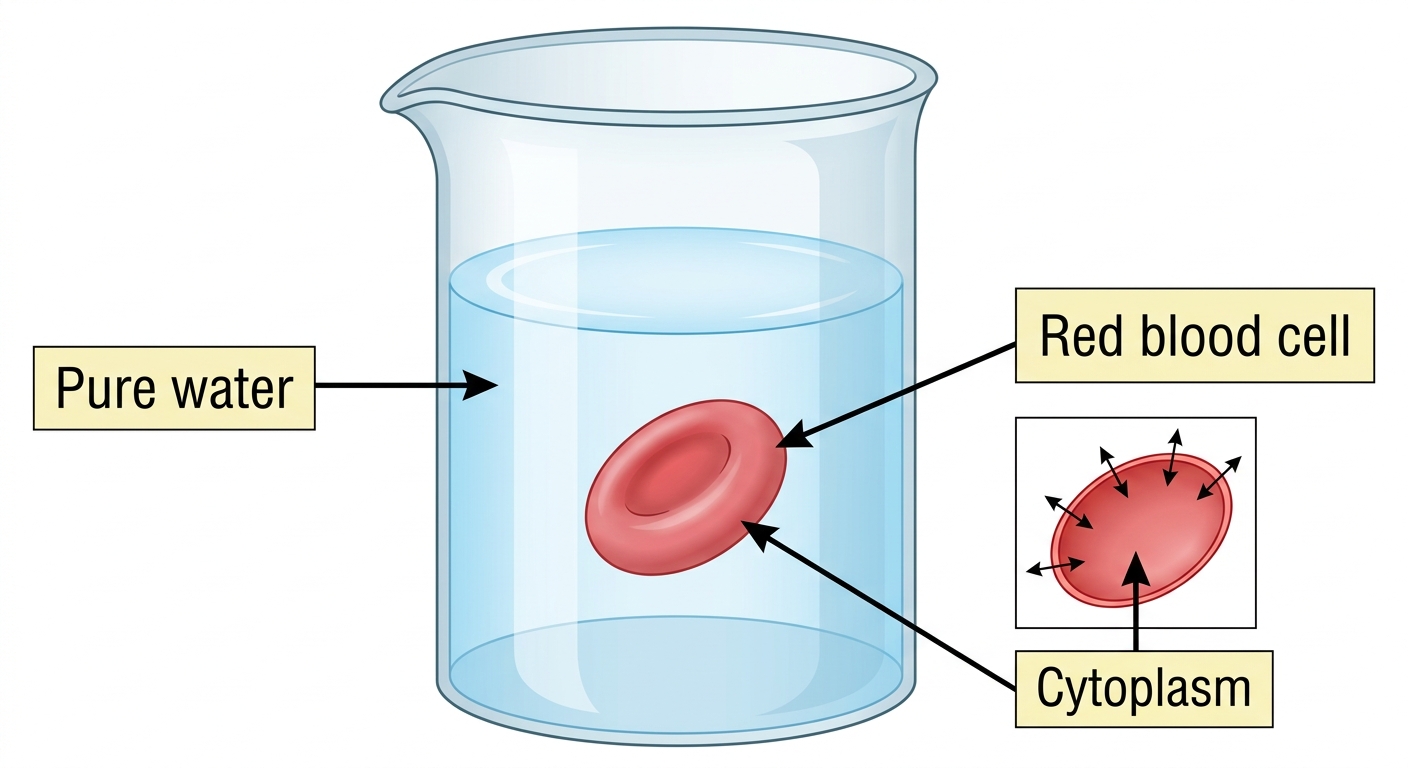
The shows a red blood cell placed in pure water.
Which statement describes what happens to the red blood cell, and to a plant cell placed in the same pure water?
revisionprep.com
Summary Answer
Not available for this question.
Model Answer
Not available for this question.
Marking Scheme
Not available for this question.
Examiner Insights
Not available for this question.
Concept of water potential in plants
Human red blood cells are placed in 0.9 % sodium chloride solution, which is isotonic with plasma. What happens to them?
revisionprep.com
Summary Answer
Not available for this question.
Model Answer
Not available for this question.
Marking Scheme
Not available for this question.
Examiner Insights
Not available for this question.
Concept of water potential in plants
Red blood cells from humans and from trout, a freshwater fish, were placed in sodium chloride solutions for 30 minutes at 20 °C. The percentage of cells that burst (haemolysed) was found from the amount of haemoglobin released, measured with a colorimeter. The graph shows the results.
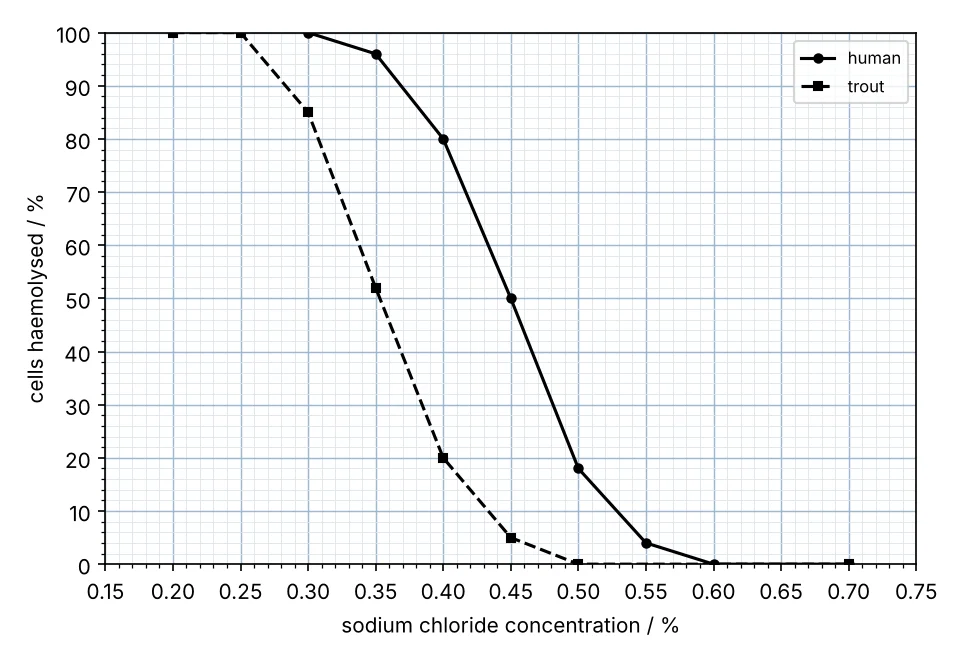
State the sodium chloride concentration at which 50% of the human red blood cells haemolyse.
Explain why more human cells haemolyse as the sodium chloride concentration falls.
Compare the results for trout and for human red blood cells, and suggest a reason for the difference.
Identify two variables, other than temperature, that should be controlled in this investigation.
Suggest why the curves are S-shaped rather than changing suddenly from 0% to 100%.
revisionprep.com
Summary Answer
Not available for this question.
Model Answer
Not available for this question.
Marking Scheme
Not available for this question.
Examiner Insights
Not available for this question.
Concept of water potential in plants
Onion bulbs are made of fleshy scale leaves. Epidermis from an outer and an inner scale leaf of the same bulb was placed in sucrose solutions for 30 minutes, and 50 cells of each sample were examined under a microscope. The results are shown in the table.

Estimate the sucrose concentration at which 50% of the cells are plasmolysed for the outer and for the inner scale leaf.
Deduce which scale leaf has the higher solute concentration in its cells. Give a reason.
Suggest why 50 cells were examined in each sample rather than a few.
Identify two variables that should be controlled in this investigation.
Explain why a cell becomes plasmolysed in a concentrated sucrose solution.
revisionprep.com
Summary Answer
Not available for this question.
Model Answer
Not available for this question.
Marking Scheme
Not available for this question.
Examiner Insights
Not available for this question.
Concept of water potential in plants
A student cut discs of turnip root and placed three discs in each of five sucrose solutions for 30 minutes. The table shows the percentage change in mass of each disc.
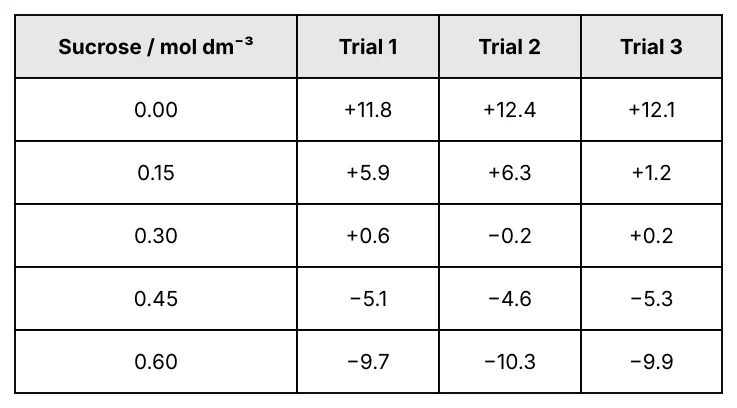
Identify the anomalous result and suggest one possible cause of it.
Calculate the mean percentage change in mass at 0.15 mol dm⁻³, excluding the anomalous result.
The student plotted the means and found that the line crossed zero at 0.31 mol dm⁻³. She concluded that 'turnip cells contain 0.31 mol dm⁻³ sucrose'. Evaluate this conclusion.
All the discs were cut from one turnip. Suggest why this was done and how it limits the conclusion.
Predict, with a reason, how the estimate of the isotonic concentration would change if the discs were left in the solutions for 24 hours instead of 30 minutes.
revisionprep.com
Summary Answer
Not available for this question.
Model Answer
Not available for this question.
Marking Scheme
Not available for this question.
Examiner Insights
Not available for this question.
Osmosis and water movement in cells
Protoplasts were made from tobacco leaf cells by digesting their cell walls with enzymes in a mannitol solution with a water potential of −800 kPa. Samples were then moved into mannitol solutions of other water potentials and their mean volume was measured after 20 minutes, relative to the volume in −800 kPa. Mannitol does not enter the cells. In −400 kPa mannitol most protoplasts burst.
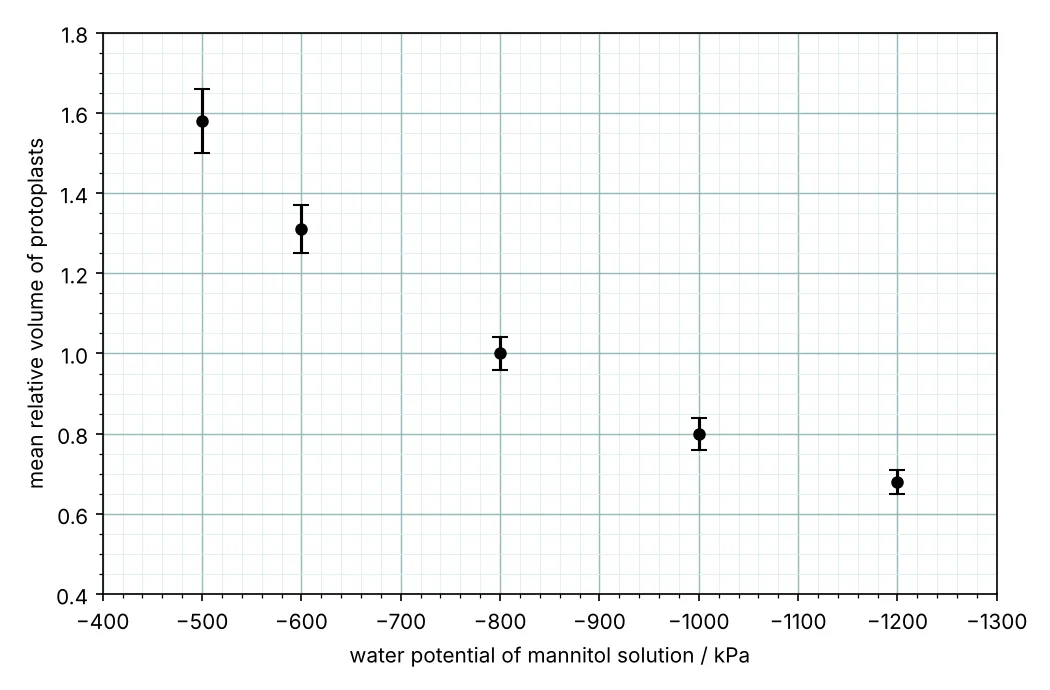
Deduce the solute potential of the protoplasts in −800 kPa mannitol. Give a reason.
Calculate the percentage increase in mean volume when the protoplasts were moved from −800 kPa to −500 kPa.
Explain why the protoplasts swell, and eventually burst, as the water potential of the solution rises.
Predict, with a reason, how the volume of intact leaf cells would change if they were moved from −800 kPa to −500 kPa.
revisionprep.com
Summary Answer
Not available for this question.
Model Answer
Not available for this question.
Marking Scheme
Not available for this question.
Examiner Insights
Not available for this question.
That's every free question here — 6 of 112.
+106 more questions, plus Mock Papers & Worksheets, are waiting in Premium.