Cell and Nuclear Division · Paper 2 — Free Biology HL Practice Questions
Free questions
Open in full, with answers, mark scheme and examiner insights.
Chromosome number and genetic variation
The diagram shows a karyotype prepared from a newborn baby.
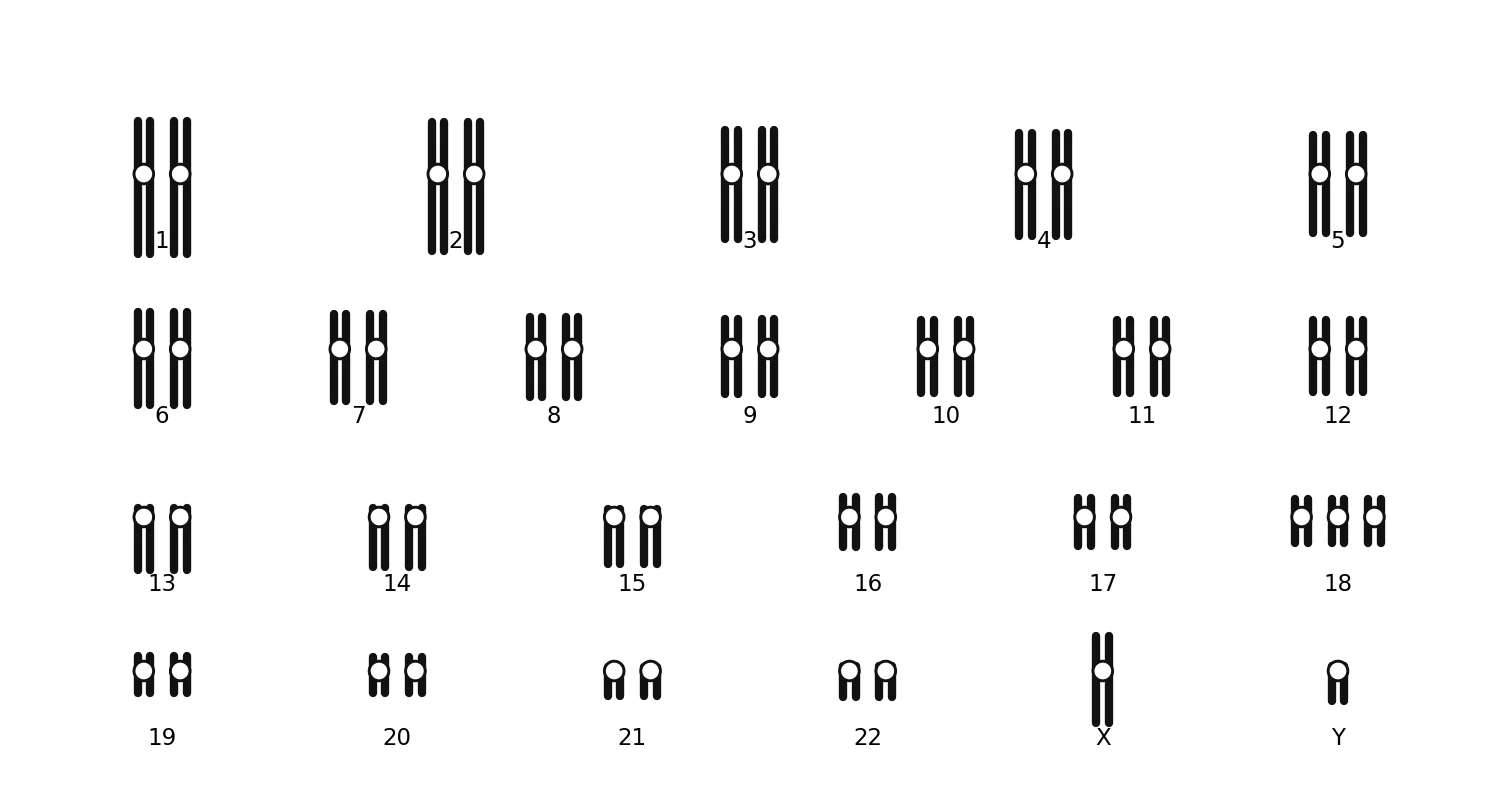
State the total number of chromosomes in the karyotype.
State the sex of the baby, giving a reason.
Identify the chromosomal abnormality shown.
Explain how non-disjunction in one parent could produce this karyotype.
Explain why karyotypes are prepared from cells in metaphase.
revisionprep.com
Summary Answer
Not available for this question.
Model Answer
Not available for this question.
Marking Scheme
Not available for this question.
Examiner Insights
Not available for this question.
Mitosis vs meiosis
The table compares mitosis and meiosis in a plant with .
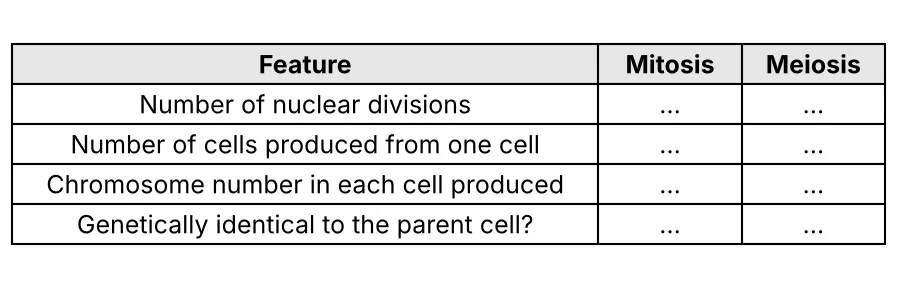
Complete the table.
Explain why DNA replication must take place before both mitosis and meiosis.
State where in a flowering plant meiosis takes place and where mitosis happens most often.
revisionprep.com
Summary Answer
Not available for this question.
Model Answer
Not available for this question.
Marking Scheme
Not available for this question.
Examiner Insights
Not available for this question.
Chromosome number and genetic variation
The graph shows the number of babies born with Down syndrome per 1000 births for mothers of different ages.
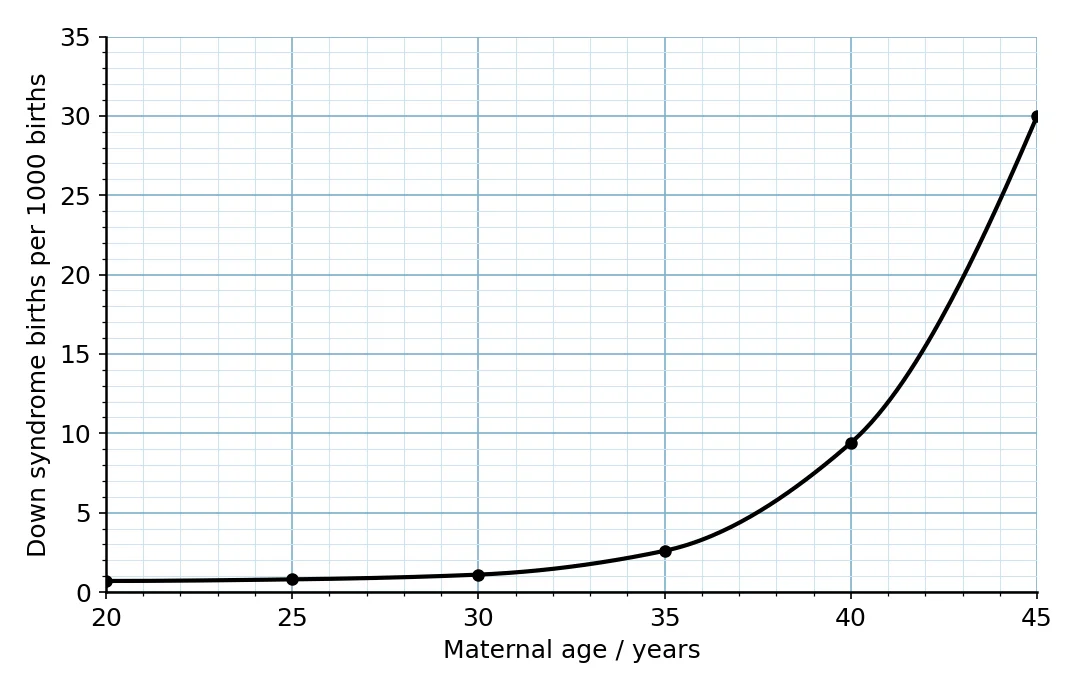
State the number of Down syndrome births per 1000 births for mothers aged 40.
Calculate how many times more likely a mother aged 45 is to have a baby with Down syndrome than a mother aged 25.
Explain how non-disjunction in the mother can lead to Down syndrome.
Suggest why the risk increases with the age of the mother.
Most babies with Down syndrome are born to mothers under 35. Suggest how this is consistent with the graph.
Outline the difference between non-disjunction at anaphase I and at anaphase II.
Suggest why the data are given per 1000 births rather than as the total number of affected births.
Discuss whether the graph shows that the age of the mother causes Down syndrome.
revisionprep.com
Summary Answer
Not available for this question.
Model Answer
Not available for this question.
Marking Scheme
Not available for this question.
Examiner Insights
Not available for this question.
Mitosis vs meiosis
The diagram shows four cells, I to IV, from the same animal (). Black and grey shading show the two chromosomes of each homologous pair.
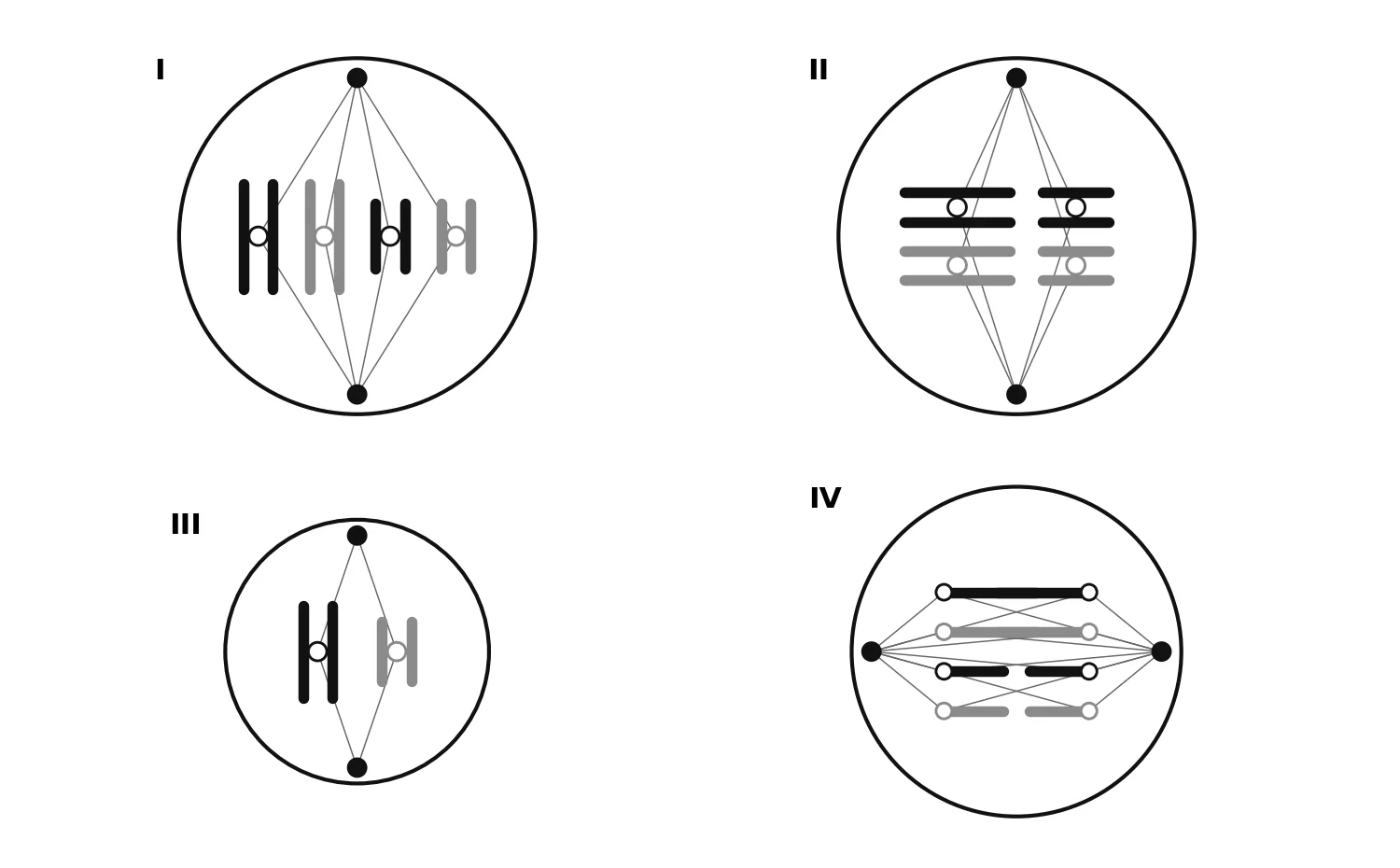
Identify the cells that are undergoing meiosis.
State the stage shown by cell II and the stage shown by cell IV.
State the number of chromatids in cell I and in cell III.
Explain why the arrangement of chromosomes in cell II leads to haploid cells but the arrangement in cell I does not.
revisionprep.com
Summary Answer
Not available for this question.
Model Answer
Not available for this question.
Marking Scheme
Not available for this question.
Examiner Insights
Not available for this question.
Chromosome number and genetic variation
Retinoblastoma is an eye tumour of young children. It starts in a retinal cell in which both alleles of the gene RB1, on chromosome 13, have lost their function. The Rb protein made from a functional allele holds the cell in one phase of the cell cycle until cyclin-CDK complexes inactivate it.
Child X inherited one non-functional RB1 allele from a parent. Child Y inherited two functional alleles.
State the phase of the cell cycle that a cell cannot leave while its Rb protein is active.
Explain why RB1 is classed as a tumour suppressor gene rather than a proto-oncogene.
In child X, the functional allele is often lost when the chromosome 13 carrying it does not reach one of the daughter nuclei during mitosis of a retinal cell. Explain how this event can produce a tumour.
Retinoblastoma in children like X usually appears earlier and more often affects both eyes than in children like Y. Explain this difference.
revisionprep.com
Summary Answer
Not available for this question.
Model Answer
Not available for this question.
Marking Scheme
Not available for this question.
Examiner Insights
Not available for this question.
Phases of mitosis and meiosis
The graph shows the concentrations of four cyclins, W, X, Y and Z, in a human cell during one cell cycle of 24 hours. The phases G1, S, G2 and M are marked.
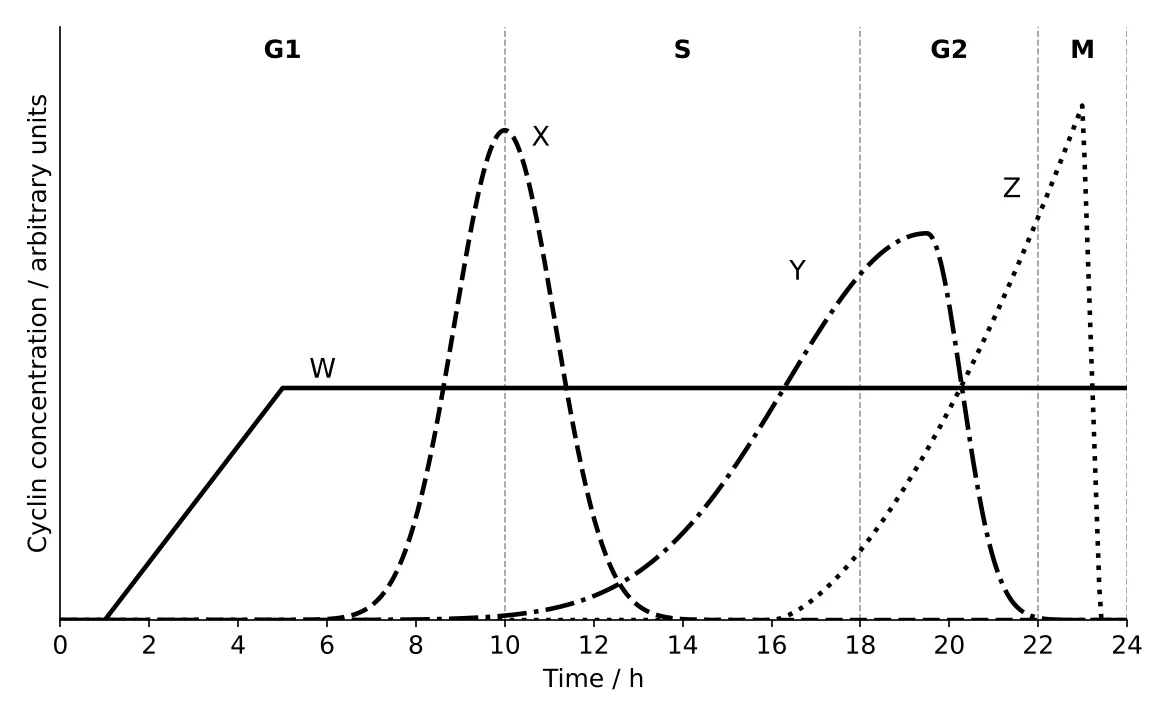
Outline how cyclins control progression through the cell cycle.
Deduce which cyclin is most likely to trigger the start of S phase, giving a reason.
Cyclin Z triggers the events of mitosis. Suggest why its rapid fall during mitosis is necessary.
Some cancer cells make cyclin X at a high level all the time. Explain why this leads to uncontrolled division.
revisionprep.com
Summary Answer
Not available for this question.
Model Answer
Not available for this question.
Marking Scheme
Not available for this question.
Examiner Insights
Not available for this question.
That's every free question here — 6 of 76.
+70 more questions, plus Mock Papers & Worksheets, are waiting in Premium.