You're viewing 2 free preview questions for Biology HL — subscribe to unlock 48 more, plus the Full Question Bank, Mock Papers & Worksheets.Upgrade
DNA Replication · Paper 2 — Free Biology HL Practice Questions
1ChallengeSAQ-LDNA structure and replication mechanism7 marksPaper 2~11 min

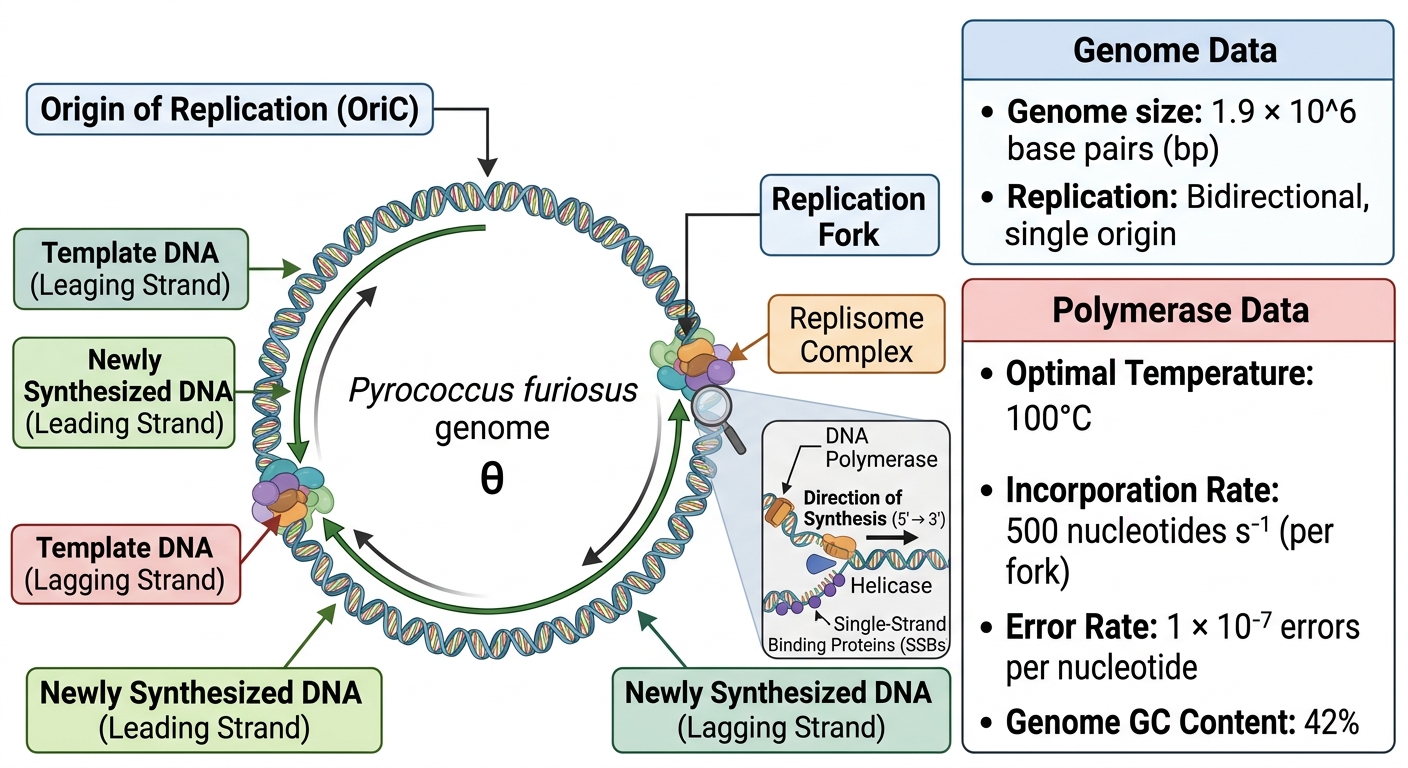
Data
- Genome size:
- Replication rate: nucleotides per fork
- Error rate of polymerase: errors per nucleotide incorporated
- GC content:
A research team studies DNA replication in thermophilic archaeon Pyrococcus furiosus, which lives at . The DNA polymerase incorporates nucleotides at nucleotides per second at . Replication is bidirectional from a single origin of replication.
(a)
Calculate the minimum time required to replicate the P. furiosus genome, assuming both replication forks operate simultaneously at maximum rate. [2 marks]
(b)
Explain two reasons why the actual replication time is longer than the minimum calculated in (a), linking each reason to a named molecular mechanism of DNA replication. [3 marks]
(c)
Evaluate the likely impact of the GC content on the stability of the DNA double helix during replication at , with reference to the molecular structure of DNA. [2 marks]

Solutions
2ChallengeSAQ-LDNA structure and replication mechanism9 marksPaper 2~14 min
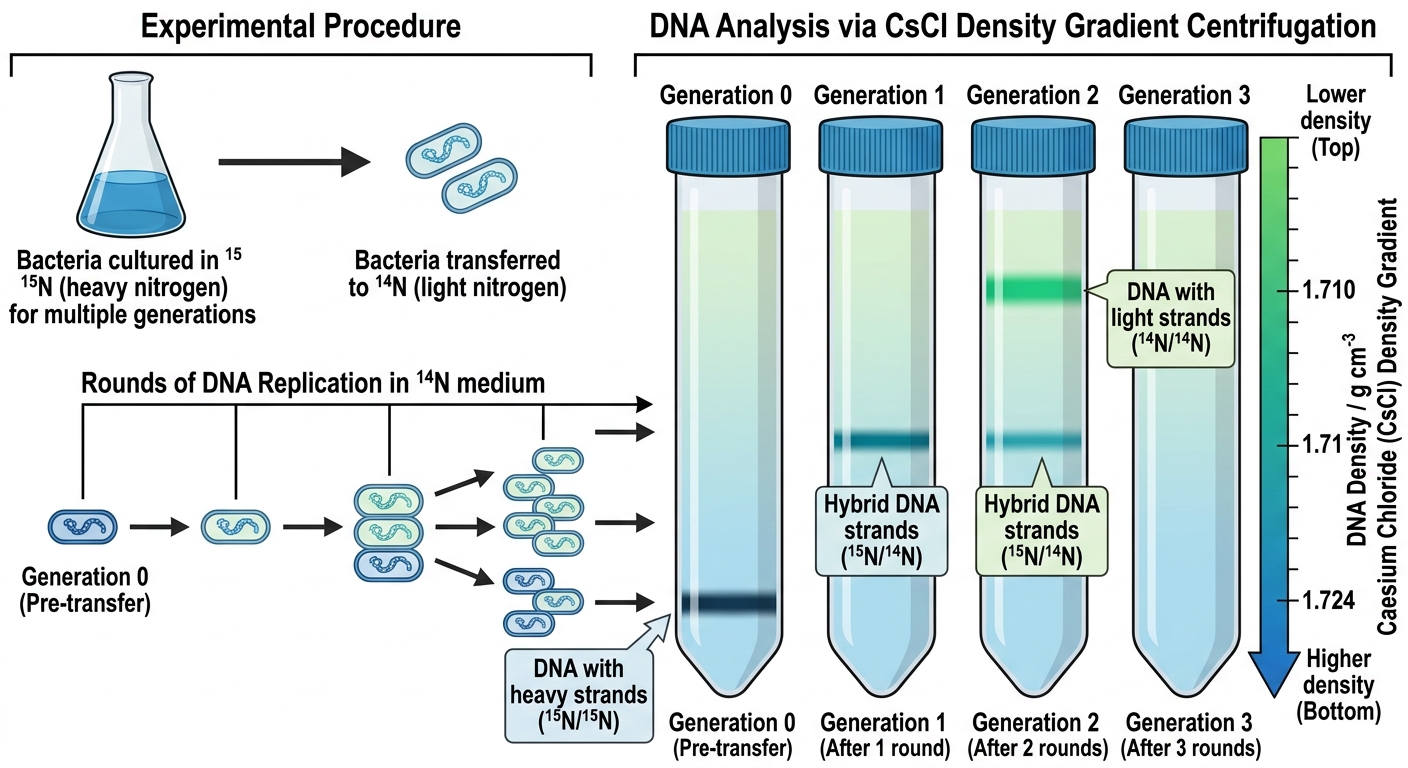
Data
- Density of N/N DNA (both strands heavy):
- Density of N/N DNA (both strands light):
- Density of hybrid N/N DNA:
- After one round of replication in N: one band at
- After two rounds of replication in N: two bands at and , of equal intensity
In 1958, Meselson and Stahl investigated the mechanism of DNA replication using E. coli. Bacteria were grown for many generations in a medium containing heavy nitrogen (N), ensuring all DNA was fully labelled. They were then transferred to a medium containing light nitrogen (N) and allowed to replicate. After each round of replication, DNA was extracted and its density analysed by caesium chloride density gradient centrifugation.
(a)
State the model of DNA replication supported by these data. [1 mark]
(b)
Calculate the expected number of bands and their densities after three rounds of replication in N, assuming the supported model is correct. [2 marks]
(c)
Explain how the observed band pattern after two rounds of replication eliminates both the conservative model and the dispersive model. [3 marks]
(d)
Evaluate the strength of the Meselson–Stahl experiment as evidence for semi-conservative replication. In your answer, identify one limitation of the experiment and explain how the full dataset (across both rounds) addresses it. [3 marks]
Solutions
That's every free question here — 2 of 50.
+48 more questions, plus Mock Papers & Worksheets, are waiting in Premium.