You're viewing 3 free preview questions for Biology HL — subscribe to unlock 84 more, plus the Full Question Bank, Mock Papers & Worksheets.Upgrade
Gene Expression · Paper 2 — Free Biology HL Practice Questions
1MasterySAQ-SOperon model (lac operon)5 marksPaper 2~8 min

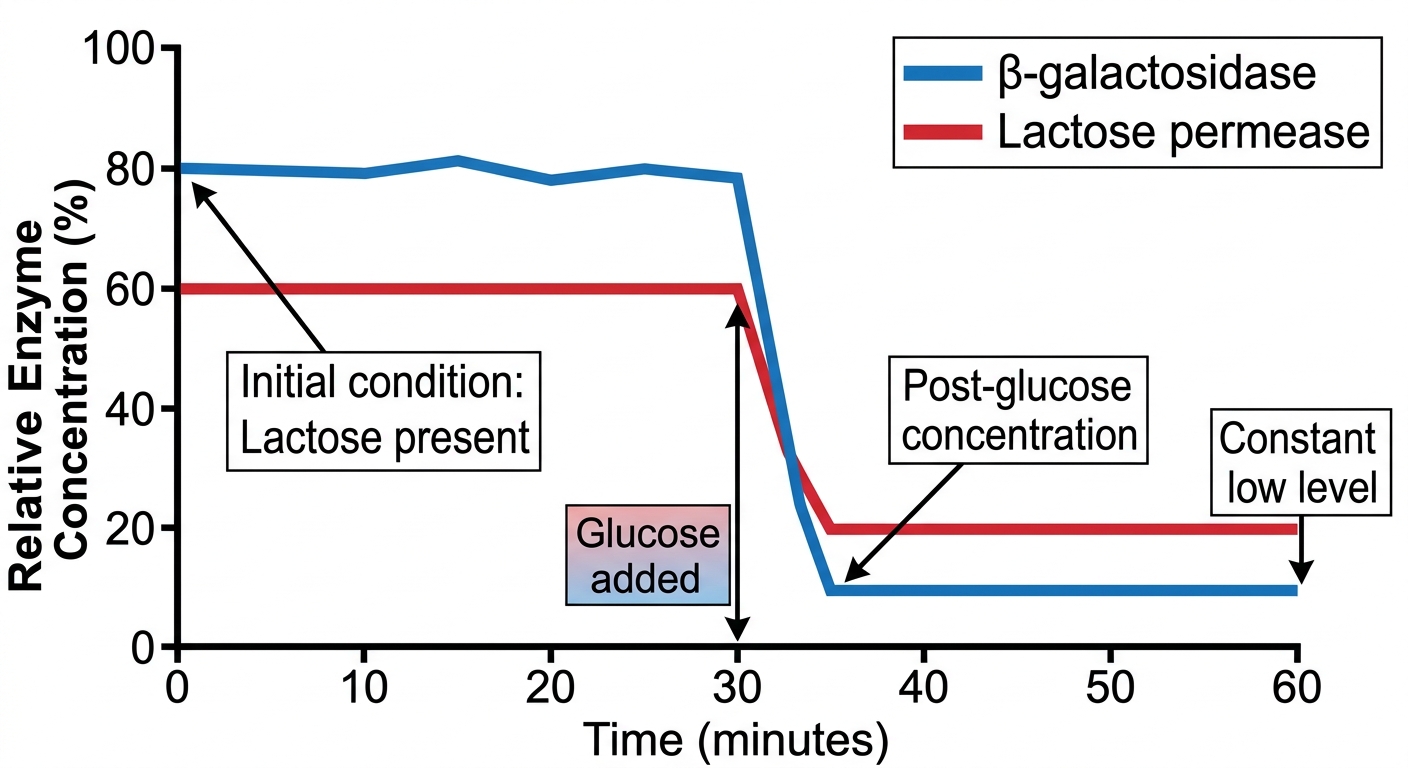
A strain of E. coli is cultured in a medium containing only lactose as a carbon source, in the absence of glucose. After minutes, glucose is added to the medium. The graph below shows the relative concentration of -galactosidase over time.
(a)
State the role of the lac repressor protein when E. coli is grown in the presence of lactose and absence of glucose. [1 mark]
(b)
Calculate the percentage decrease in -galactosidase concentration between minutes and minutes. [2 marks]
(c)
Explain the molecular mechanism by which glucose addition at minutes causes the observed decrease in -galactosidase concentration. [2 marks]

Solutions
2ChallengeSAQ-LRegulatory mechanisms of gene expression7 marksPaper 2~11 min
Alternative splicing is a key post-transcriptional regulatory mechanism in eukaryotes. The Drosophila gene dsx (doublesex) is alternatively spliced to produce two different transcription factors that control sex determination. In females, the splicing pattern includes exon 4, producing the protein, which represses male-specific genes. In males, exon 4 is skipped, producing protein, which represses female-specific genes. The splicing decision is regulated by the female-specific protein Tra (transformer), which binds to a splicing enhancer sequence in the pre-mRNA.
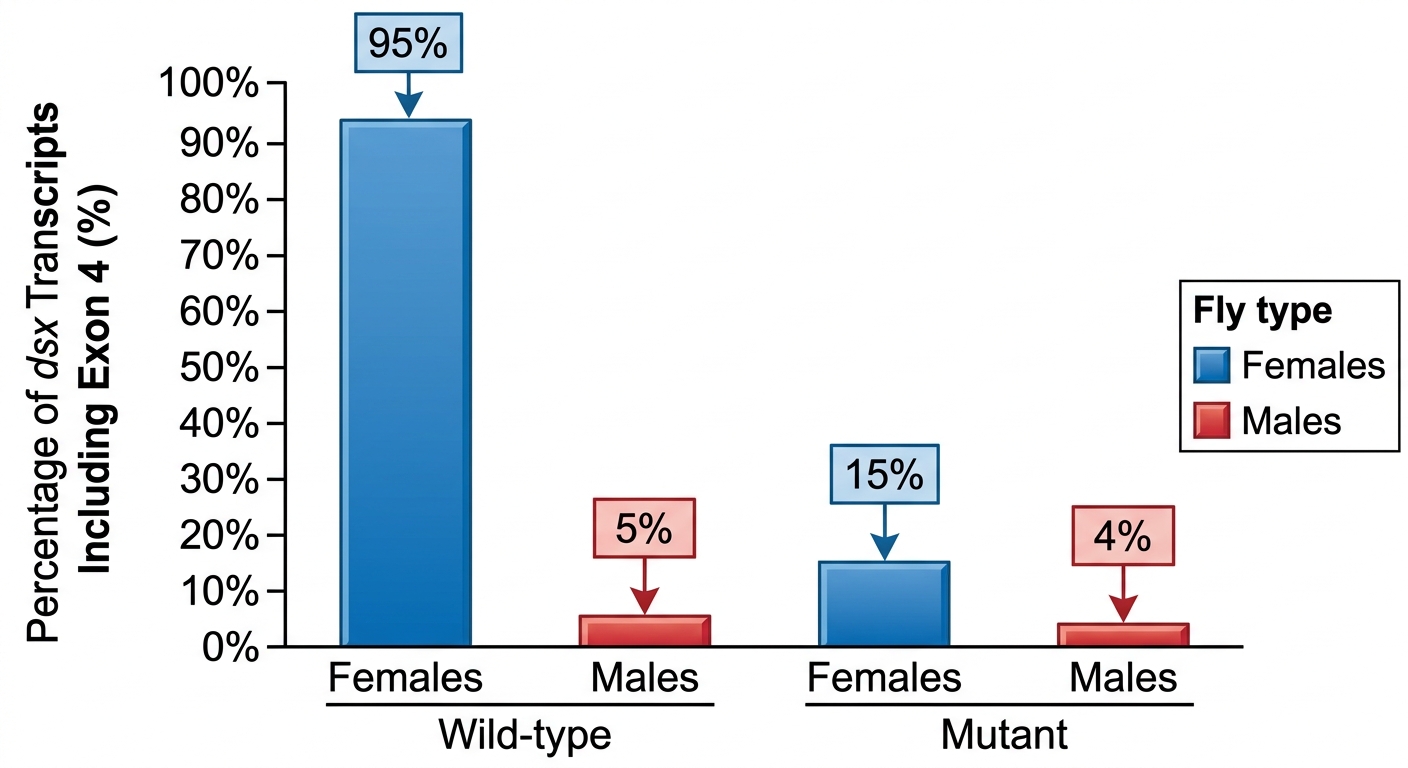
Researchers created a transgenic Drosophila line in which the splicing enhancer sequence in exon 4 was mutated so that Tra protein cannot bind. The table below summarises exon 4 inclusion data.
Genotype — Exon 4 inclusion (%)
Wild-type females — 95
Wild-type males — 5
Mutant females — 15
Mutant males — 4
(a)
Calculate the percentage of dsx transcripts in mutant females that exclude exon 4. [1 mark]
(b)
Explain the molecular mechanism by which the mutation in the splicing enhancer leads to the observed change in splicing pattern in females. [3 marks]
(c)
Evaluate whether mutant females would be expected to develop as phenotypic males, phenotypic females, or an intersex condition, justifying your answer with reference to the proportions of and produced. [3 marks]
Solutions
3ChallengeLAQRegulatory mechanisms of gene expression8 marksPaper 2~12 min
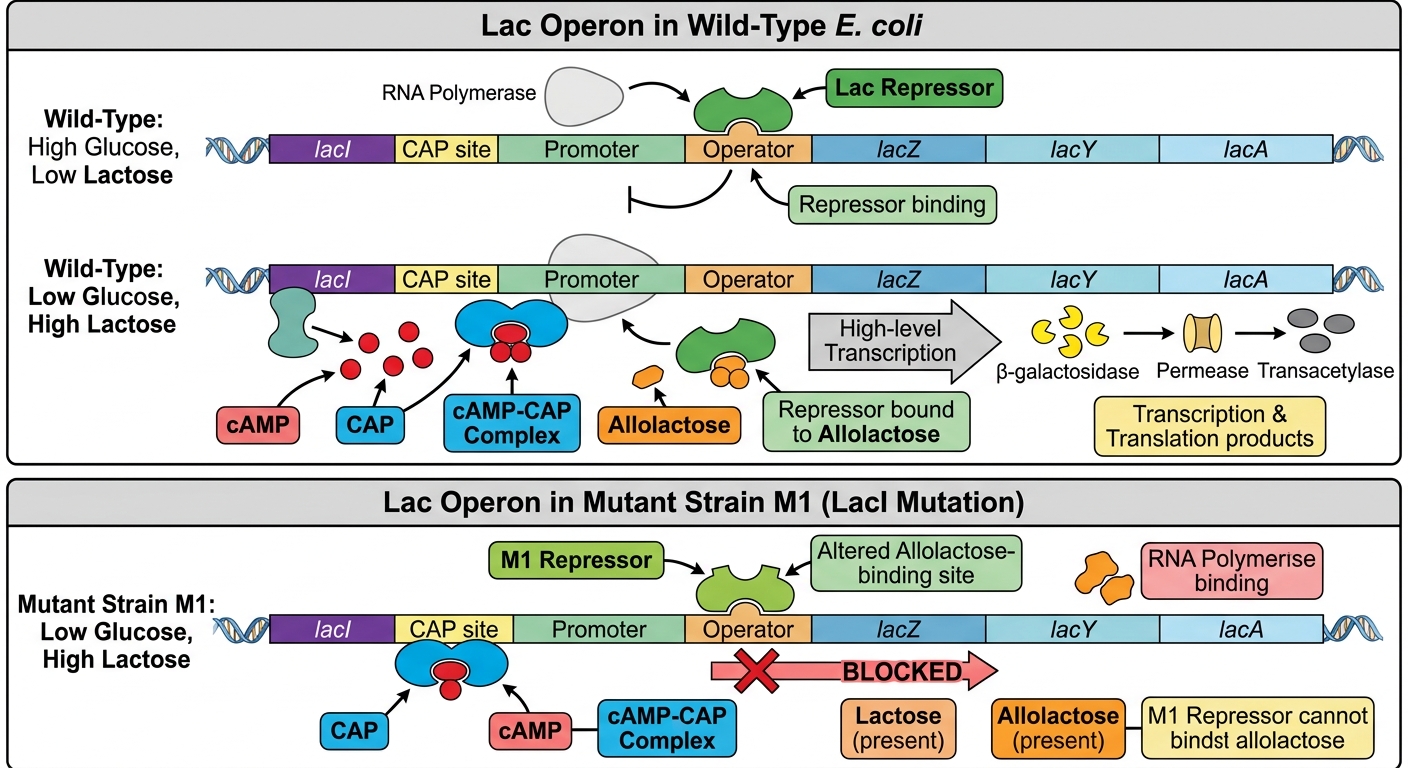
The lac operon in Escherichia coli is a classic model for transcriptional regulation. The operon contains three structural genes (lacZ, lacY, lacA) controlled by a promoter and operator region. A regulatory gene, lacI, encodes the Lac repressor. When lactose is present, allolactose (an isomer of lactose) binds to the Lac repressor, causing a conformational change that prevents operator binding, allowing transcription. Additionally, when glucose is absent, elevated intracellular cAMP binds to CAP (catabolite activator protein); the cAMP–CAP complex binds to the CAP site upstream of the promoter, enhancing RNA polymerase binding and increasing transcription rate.
A research team studied a mutant strain of E. coli (strain M1) carrying a point mutation in lacI that alters the allolactose-binding site of the repressor. The mutant repressor retains full operator-binding ability but cannot bind allolactose. -galactosidase activity (encoded by lacZ) was measured under three conditions:
- Condition A: glucose, no lactose
- Condition B: lactose, no glucose
- Condition C: glucose and lactose
Wild-type -galactosidase activity was high only in Condition B. Strain M1 showed negligible -galactosidase activity in all three conditions.
(a)
Explain the molecular mechanism by which the M1 mutation leads to negligible -galactosidase activity in Condition B, contrasting each regulatory step with the equivalent events in wild-type cells under the same condition. [5 marks]
(b)
The lac operon is described as subject to both negative and positive gene regulation.
(i) Identify the molecular component responsible for each mode of regulation and state the specific interaction through which each component acts. [2 marks]
(ii) Using the M1 mutant data from all three conditions, evaluate whether the experimental results provide evidence for both negative and positive regulation, or for only one of these modes. Justify your answer with reference to specific observations. [3 marks]
(ii) Using the M1 mutant data from all three conditions, evaluate whether the experimental results provide evidence for both negative and positive regulation, or for only one of these modes. Justify your answer with reference to specific observations. [3 marks]
Solutions
That's every free question here — 3 of 87.
+84 more questions, plus Mock Papers & Worksheets, are waiting in Premium.