Mutations and Gene Editing · Paper 2 — Free Biology HL Practice Questions
Free questions
Open in full, with answers, mark scheme and examiner insights.
Gene editing technologies (e.g. CRISPR)
Radon is a radioactive gas that seeps from some rocks into houses. It emits high-energy alpha particles. Table 1 shows estimated lifetime risk of death from lung cancer by age 75 at two radon concentrations.
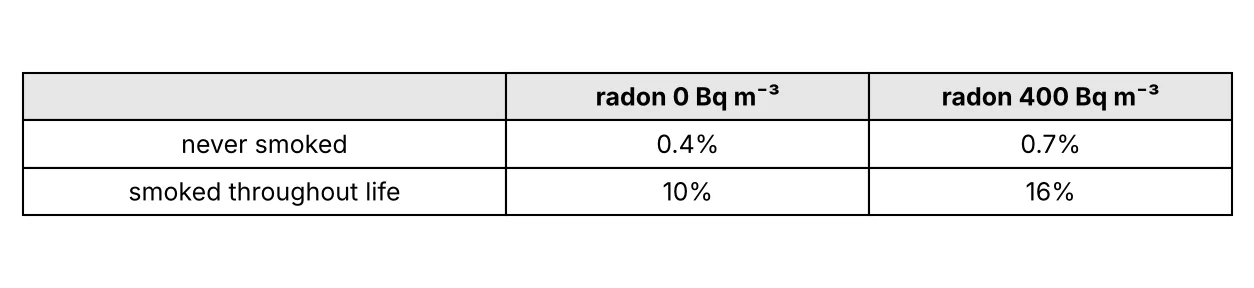
Calculate the increase in lifetime risk caused by radon at 400 Bq m⁻³ for never-smokers and for smokers.
Explain how radon in the air of a house can cause lung cancer.
Explain why radon at the same concentration adds much more risk for smokers than for never-smokers.
Suggest one action that would most reduce the lung cancer risk of a smoker living in a house with high radon.
revisionprep.com
Summary Answer
Not available for this question.
Model Answer
Not available for this question.
Marking Scheme
Not available for this question.
Examiner Insights
Not available for this question.
Gene mutations: substitutions, insertions and deletions
In one form of β-thalassaemia, codon 39 of the β-globin gene changes from CAG to TAG on the coding strand. Normal β-globin contains 146 amino acids, and codon 39 codes for the 39th amino acid.
mRNA codons: CAG = glutamine, UAG = stop.
State the change in the mRNA codon.
Calculate the number of amino acids in the polypeptide made from the mutated gene, and the number missing compared with normal β-globin.
Explain why this single base change leads to a lack of functional haemoglobin, whereas the sickle cell mutation (a substitution in codon 6) still produces haemoglobin that carries oxygen.
revisionprep.com
Summary Answer
Not available for this question.
Model Answer
Not available for this question.
Marking Scheme
Not available for this question.
Examiner Insights
Not available for this question.
Gene editing technologies (e.g. CRISPR)
Researchers introduced 1000 random single-base mutations, one per strain, into coding sequences of yeast genes and measured the growth rate of each mutant strain. Table 1 shows the results.
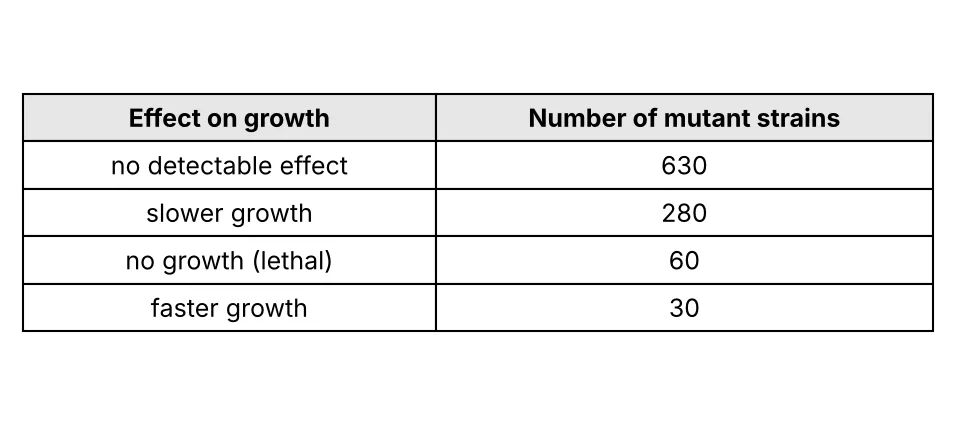
Calculate the percentage of mutations that were harmful.
Explain why so many mutations in coding sequences had no detectable effect.
Harmful mutations are common among new mutations but rare in wild yeast populations. Explain why.
Explain why mutation is essential for evolution, even though only 3% of these mutations were beneficial.
revisionprep.com
Summary Answer
Not available for this question.
Model Answer
Not available for this question.
Marking Scheme
Not available for this question.
Examiner Insights
Not available for this question.
Gene mutations: substitutions, insertions and deletions
Researchers analysed 10 000 single-base substitutions found in the coding regions of human genes. Table 1 shows the results.
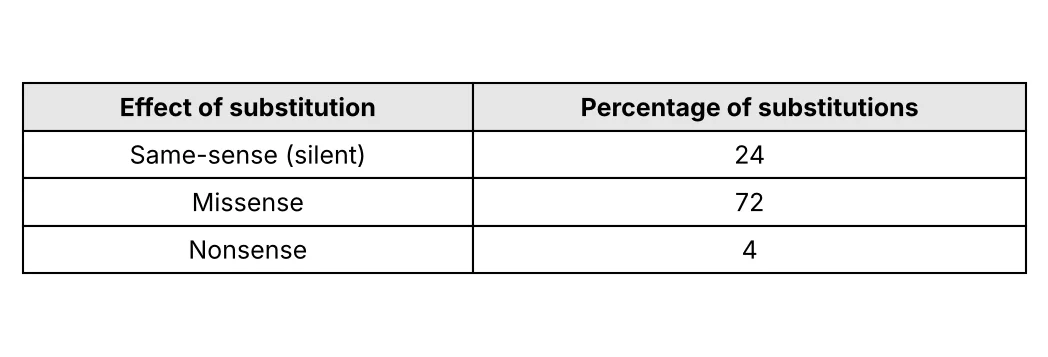
Calculate the number of substitutions that were nonsense mutations.
Explain why about a quarter of substitutions in coding regions are same-sense.
Explain why nonsense mutations usually have a greater effect on protein function than missense mutations.
Suggest why some missense mutations have no detectable effect on the function of the protein.
revisionprep.com
Summary Answer
Not available for this question.
Model Answer
Not available for this question.
Marking Scheme
Not available for this question.
Examiner Insights
Not available for this question.
Causes and effects of mutations
Researchers exposed E. coli to a new chemical, Mutagen-X, then sequenced the genomes of 1000 cells. Table 1 shows the results.
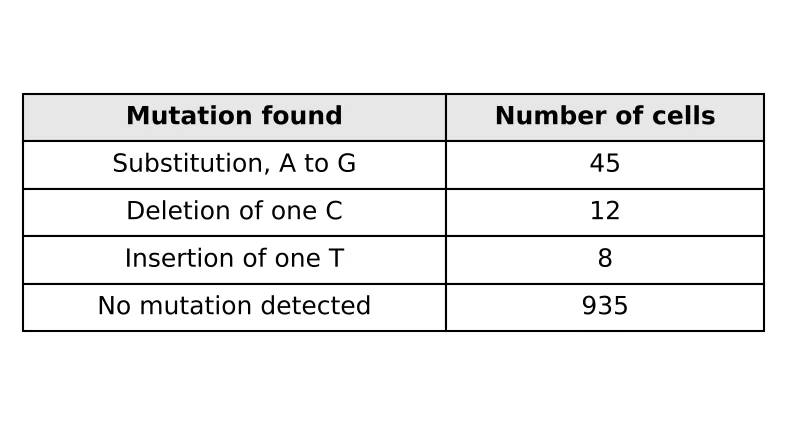
Calculate the percentage of cells with the A to G substitution.
Calculate the percentage of all detected mutations that were frameshift mutations.
Explain how a single-nucleotide deletion in a coding sequence alters the protein produced.
Evaluate the use of E. coli to predict whether Mutagen-X would cause mutations in human cells.
The researchers concluded that Mutagen-X causes mutations. Explain why they also needed to sequence 1000 cells from a culture grown in the same way without Mutagen-X.
revisionprep.com
Summary Answer
Not available for this question.
Model Answer
Not available for this question.
Marking Scheme
Not available for this question.
Examiner Insights
Not available for this question.
Gene mutations: substitutions, insertions and deletions
In haemoglobin Constant Spring, a substitution changes the stop codon of the α-globin gene from UAA to CAA in the mRNA. CAA codes for glutamine. Normal α-globin contains 141 amino acids; the mutant α-globin contains 172 amino acids. Assume codon 1 codes for the first amino acid of each polypeptide.
State the type of gene mutation that has occurred.
Explain why the mutant α-globin is longer than normal α-globin.
Calculate the number of extra amino acids, and deduce the codon number of the next in-frame stop codon.
revisionprep.com
Summary Answer
Not available for this question.
Model Answer
Not available for this question.
Marking Scheme
Not available for this question.
Examiner Insights
Not available for this question.
That's every free question here — 6 of 79.
+73 more questions, plus Mock Papers & Worksheets, are waiting in Premium.