You're viewing 2 free preview questions for Biology HL — subscribe to unlock 46 more, plus the Full Question Bank, Mock Papers & Worksheets.Upgrade
Protein Synthesis · Paper 2 — Free Biology HL Practice Questions
1ChallengeSAQ-LPost-translational modifications7 marksPaper 2~11 min

Data
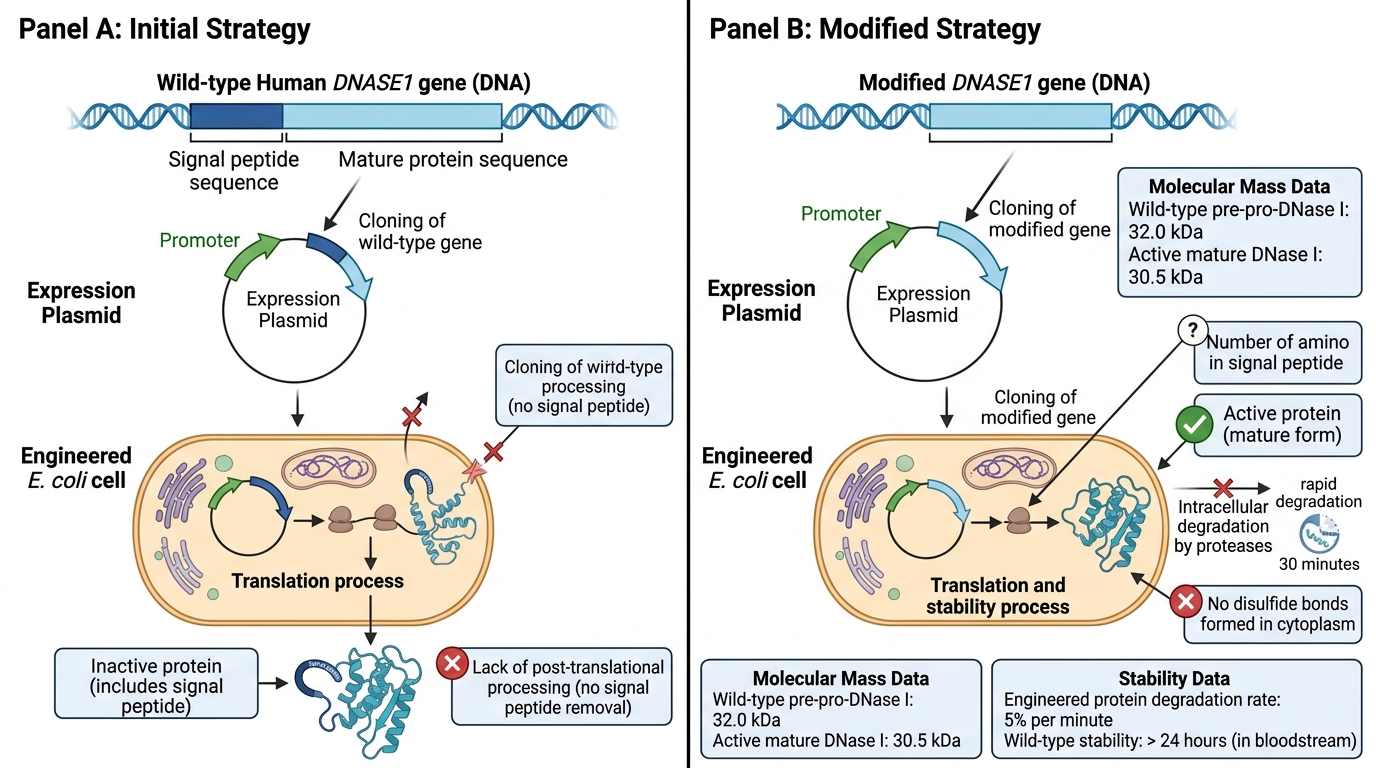
- Molecular mass of wild-type pre-DNase I (including signal peptide):
- Molecular mass of active, mature DNase I (after signal peptide removal):
- Average molecular mass of one amino acid:
- Rate of intracellular degradation of engineered DNase I in E. coli: of total protein per minute
- Human wild-type DNase I is stabilized by two disulfide bonds between cysteine residues; the engineered E. coli protein does not form these bonds
A research team investigates the production of a therapeutic enzyme, human deoxyribonuclease I (DNase I), in E. coli bacteria. The wild-type human DNASE1 gene is inserted into a bacterial expression plasmid. The protein produced is enzymatically inactive despite being successfully translated. Analysis reveals that the recombinant DNase I lacks removal of an N-terminal signal peptide that targets the protein for secretion in human cells.
The team engineers a modified DNASE1 gene coding directly for the mature form of the protein (without the signal peptide). This modified gene is expressed in E. coli. The resulting protein is active but is degraded by intracellular proteases within 30 minutes, whereas human wild-type DNase I is stable for over 24 hours in the bloodstream.
(a)
Calculate the number of amino acids in the signal peptide. [2 marks]
(b)
Explain why the absence of disulfide bonds leads to rapid degradation of the engineered DNase I in E. coli. [3 marks]
(c)
Evaluate the effectiveness of the team's genetic engineering strategy for producing a stable, active therapeutic enzyme, and propose one further modification that could improve protein stability, justifying your answer. [3] (formerly ) [2 marks]

Solutions
2ChallengeSAQ-LPost-translational modifications7 marksPaper 2~11 min
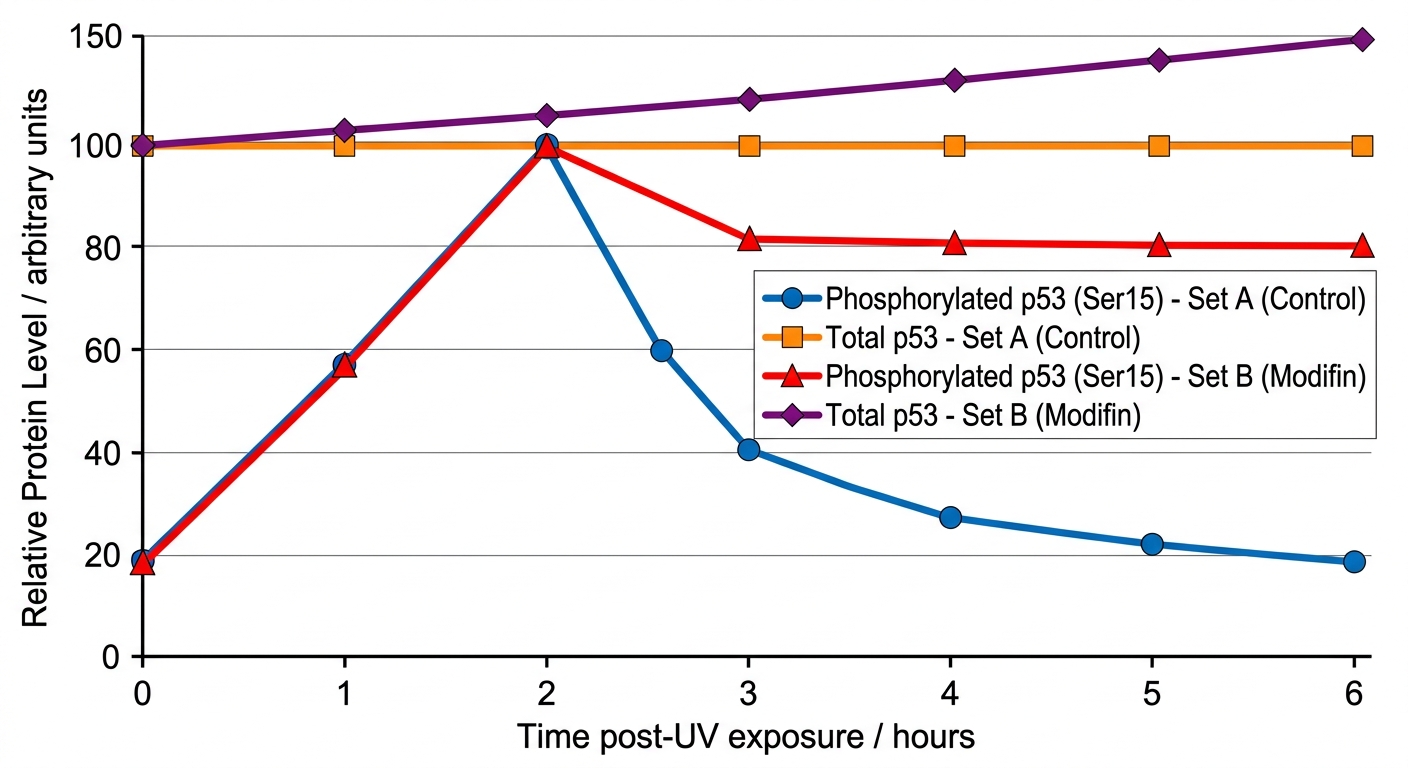
A group of students studies the effects of a novel drug, Modifin, on post-translational modification of the tumour suppressor protein p53 in human cell cultures. p53 is activated by phosphorylation at serine residues in response to DNA damage. Two sets of cells are exposed to UV radiation. Set A receives no Modifin. Set B receives Modifin immediately after UV exposure. Phosphorylated p53 (detected at serine 15) and total p53 are measured over 6 hours.
- Set A (control): phosphorylated p53 peaks at 2 hours (), declines to baseline by 6 hours; total p53 remains constant at throughout.
- Set B (Modifin-treated): phosphorylated p53 peaks at 2 hours (), remains at at 6 hours; total p53 increases by over 6 hours.
- Modifin specifically inhibits phosphatase PP2A, which removes phosphate groups from proteins.
- Rate of p53 translation is constant and identical in both sets.
(a)
Calculate the percentage of total p53 that is phosphorylated at serine 15 at the 6-hour time point in Set B. Assume the initial total p53 level is and the increase in total p53 is due entirely to reduced degradation. [2 marks]
(b)
Explain how inhibition of PP2A by Modifin leads to the observed changes in phosphorylated p53 levels in Set B. [3 marks]
(c)
Using the data and your knowledge of p53's role in the cell cycle, evaluate whether the sustained phosphorylation of p53 observed in Set B is likely to beneficial or harmful to the cell. Justify your conclusion. [2 marks]
Solutions
That's every free question here — 2 of 48.
+46 more questions, plus Mock Papers & Worksheets, are waiting in Premium.