Stability and Change · Paper 2 — Free Biology HL Practice Questions
Free questions
Open in full, with answers, mark scheme and examiner insights.
Renewable resources and ecological conservation
Peat forms in bogs from partly decomposed plant material at about per year. In one bog, a layer deep is cut each year for garden compost.
Calculate how many years it would take for of new peat to form.
State, with a reason, whether peat harvested in this way is a renewable resource.
Outline two ecological consequences of draining and cutting a peat bog.
revisionprep.com
Summary Answer
Not available for this question.
Model Answer
Not available for this question.
Marking Scheme
Not available for this question.
Examiner Insights
Not available for this question.
Sustainable agricultural practices
The table shows estimated greenhouse gas emissions for producing protein by three farming systems.
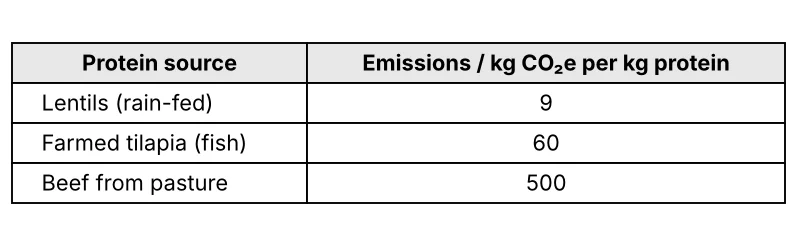
State which protein source has the smallest carbon footprint.
Calculate how many times greater the carbon footprint of beef protein is than that of lentil protein.
Explain two reasons why the carbon footprint of beef is so large.
Suggest why lentil production needs very little nitrogen fertilizer.
revisionprep.com
Summary Answer
Not available for this question.
Model Answer
Not available for this question.
Marking Scheme
Not available for this question.
Examiner Insights
Not available for this question.
Impact of human activity on the environment
Climate records from regions of the Amazon basin with different amounts of forest clearance gave these results.
The data are shown in the table.
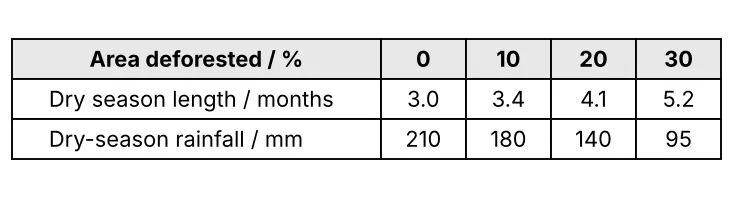
Describe how dry-season rainfall changes with the percentage of area deforested.
Calculate the percentage decrease in dry-season rainfall between 0% and 30% deforestation.
Explain why deforestation reduces rainfall in the region.
Using the data, explain why scientists describe deforestation of the Amazon as a possible tipping point.
revisionprep.com
Summary Answer
Not available for this question.
Model Answer
Not available for this question.
Marking Scheme
Not available for this question.
Examiner Insights
Not available for this question.
Sustainable agricultural practices
A farmer in a temperate region compares two ways of growing wheat over 10 years.
- Practice A: deep ploughing every year, wheat monoculture, synthetic nitrogen fertilizer at - Practice B: no-till seeding, rotation with legumes, composted manure supplying
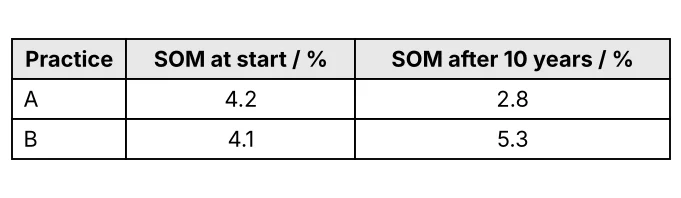
Soil organic matter (SOM) was measured at the start and after 10 years.
The data are shown in the table.
Identify one feature of Practice A that is likely to cause the fall in SOM, and outline how it does so.
Calculate the percentage change in SOM for Practice B over the 10 years.
Evaluate the sustainability of each practice, using the SOM data.
revisionprep.com
Summary Answer
Not available for this question.
Model Answer
Not available for this question.
Marking Scheme
Not available for this question.
Examiner Insights
Not available for this question.
Impact of human activity on the environment
A river carries phosphate from farmland into a lake. The diagram shows measurements taken in summer.
Mass per day (kg)
The critical phosphate concentration for algal blooms is .
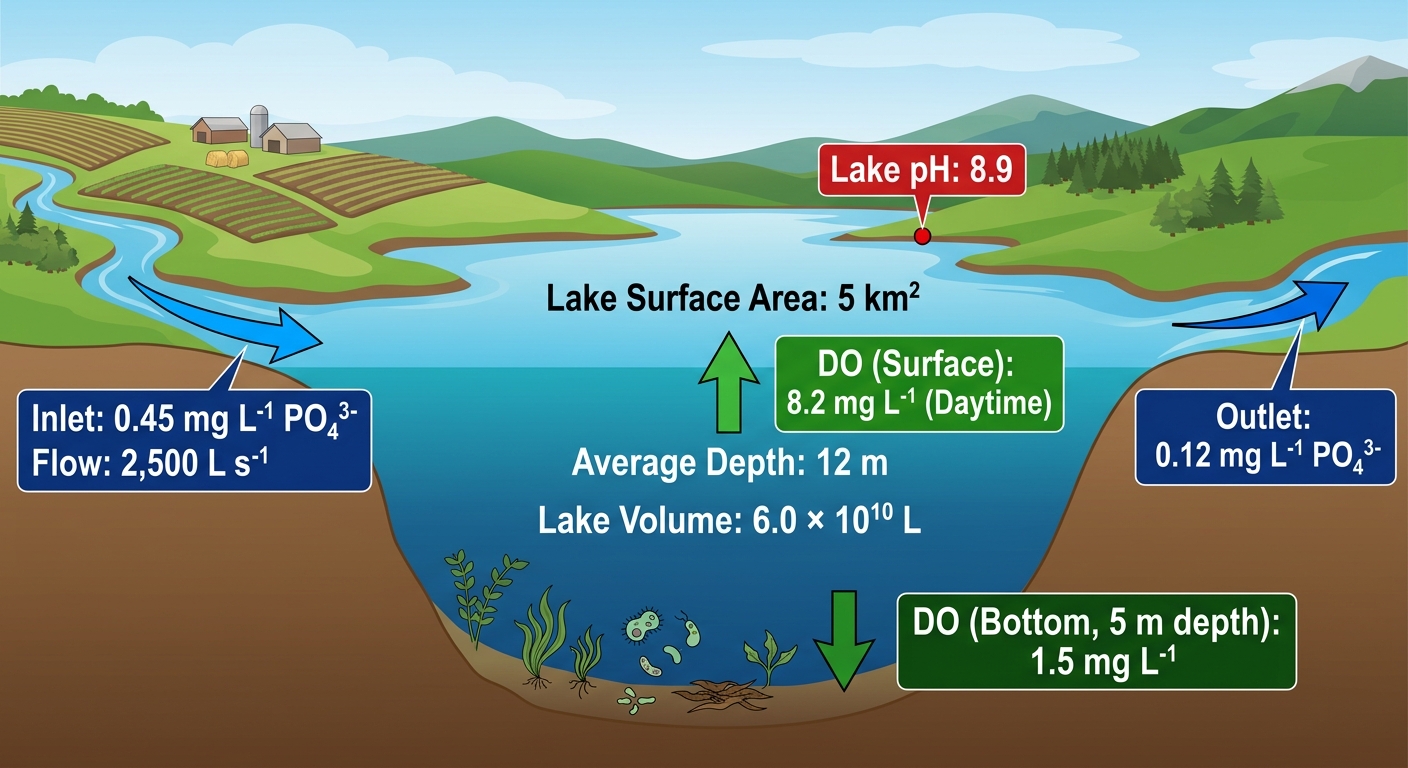
Calculate the mass of phosphate entering the lake from the river each day.
The outlet flow is also . Calculate the mass of phosphate retained in the lake each day.
Explain the difference in dissolved oxygen between the surface and the bottom of the lake.
Evaluate whether the lake is eutrophic, using the data, and identify one further measurement that would support your conclusion.
Suggest three measures on the farmland that would reduce the mass of phosphate reaching the lake, explaining how each works.
revisionprep.com
Summary Answer
Not available for this question.
Model Answer
Not available for this question.
Marking Scheme
Not available for this question.
Examiner Insights
Not available for this question.
Primary, secondary and cyclical succession (AHL)
An arable field in southern England was abandoned in 1990 and surveyed every 10 years using random quadrats. The graphs show the total number of plant species, and the mean density of nettle, Urtica dioica; bramble, Rubus fruticosus; and oak, Quercus robur (seedlings and saplings included).
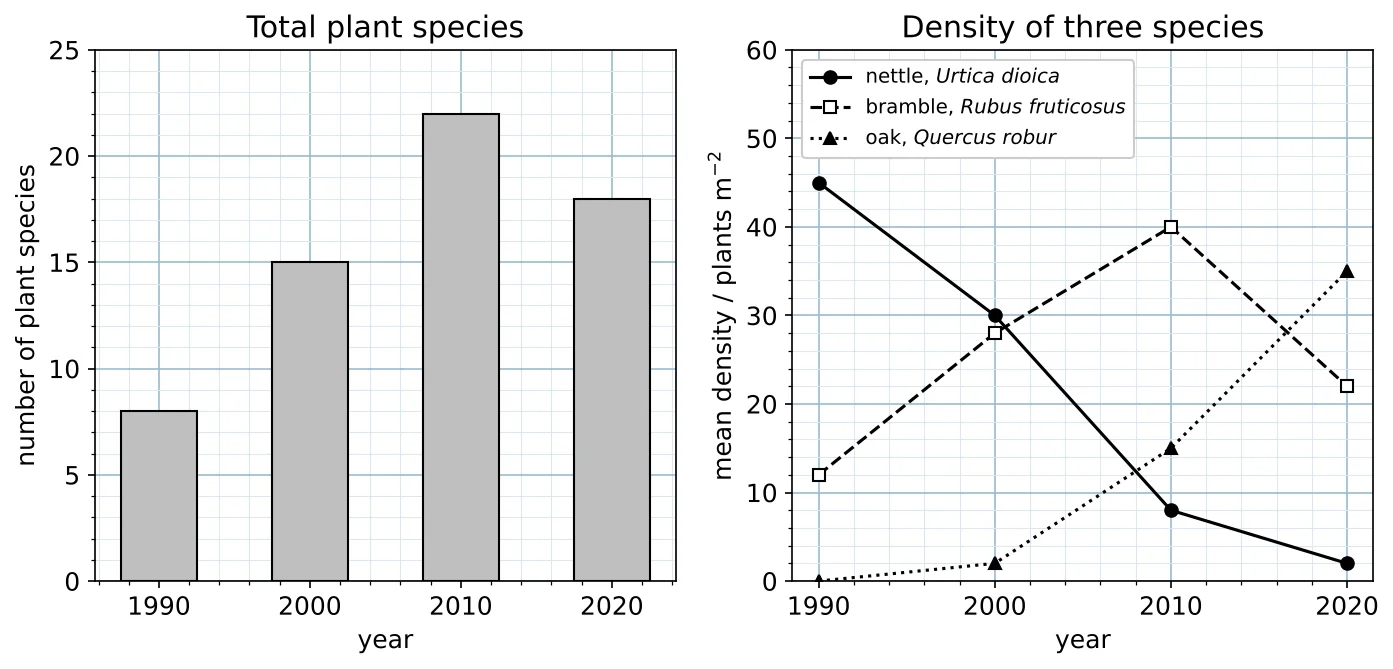
Calculate the percentage decrease in nettle density between 1990 and 2010.
State the type of succession taking place in the field, giving a reason.
Explain the changes in the densities of nettle, bramble and oak as stages of succession.
Suggest why the number of plant species fell between 2010 and 2020.
Predict the community in the field in 2100 if it is left unmanaged, and identify one way in which succession could be arrested.
revisionprep.com
Summary Answer
Not available for this question.
Model Answer
Not available for this question.
Marking Scheme
Not available for this question.
Examiner Insights
Not available for this question.
That's every free question here — 6 of 75.
+69 more questions, plus Mock Papers & Worksheets, are waiting in Premium.