Water Potential · Paper 2 — Free Biology HL Practice Questions
Free questions
Open in full, with answers, mark scheme and examiner insights.
Concept of water potential in plants
Gardeners sometimes sprinkle salt on slugs. The salt dissolves in the slug's mucus and the slug soon shrivels.
Explain why the slug loses water.
Suggest why slugs are much more affected by salt than beetles are.
Suggest why slugs are mostly active at night and in wet weather.
revisionprep.com
Summary Answer
Not available for this question.
Model Answer
Not available for this question.
Marking Scheme
Not available for this question.
Examiner Insights
Not available for this question.
Concept of water potential in plants
Cucumbers are pickled in brine, a concentrated salt solution. After a few days they have shrunk and become soft and limp.
Explain why the cucumbers shrink.
Describe the state of the cucumber cells after pickling.
Suggest why brine also helps to stop bacteria growing on the cucumbers.
revisionprep.com
Summary Answer
Not available for this question.
Model Answer
Not available for this question.
Marking Scheme
Not available for this question.
Examiner Insights
Not available for this question.
Concept of water potential in plants
Cylinders of potato tissue of similar mass were placed in sodium chloride solutions of different concentrations for 60 minutes. The graph shows the mean percentage change in mass.
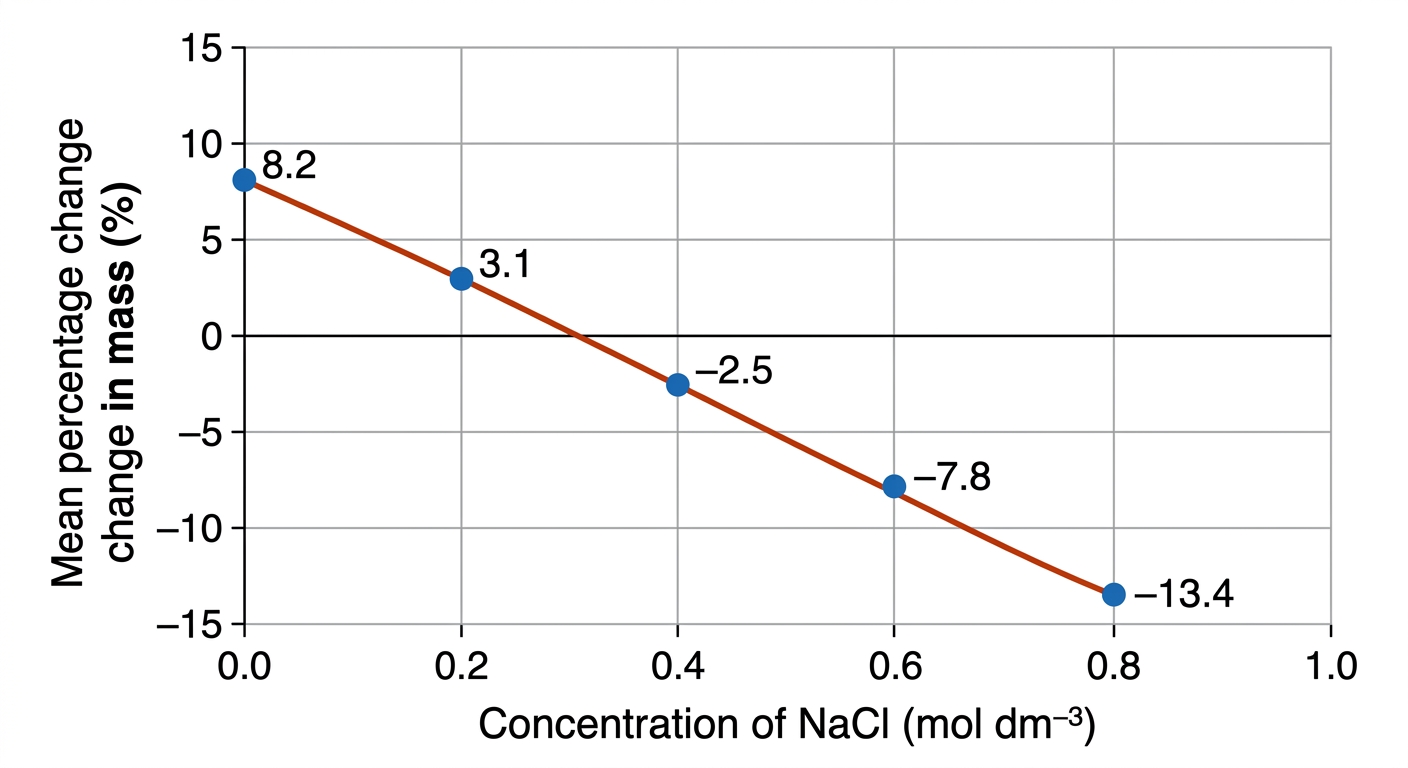
Describe the relationship between NaCl concentration and the percentage change in mass.
Determine, from the graph, the NaCl concentration that has the same water potential as the potato tissue.
Explain why the cylinders in 0.0 mol dm⁻³ NaCl gained mass.
Outline why percentage change in mass, rather than change in mass, is used.
revisionprep.com
Summary Answer
Not available for this question.
Model Answer
Not available for this question.
Marking Scheme
Not available for this question.
Examiner Insights
Not available for this question.
Concept of water potential in plants
Spider crabs live only in the open sea. Shore crabs also live in estuaries, where river water dilutes the sea. Crabs of both species were kept in water of different solute concentrations, and the solute concentration of their body fluid was measured after 24 hours. The graph shows the results. Full-strength seawater is about 1000 mosmol dm⁻³.
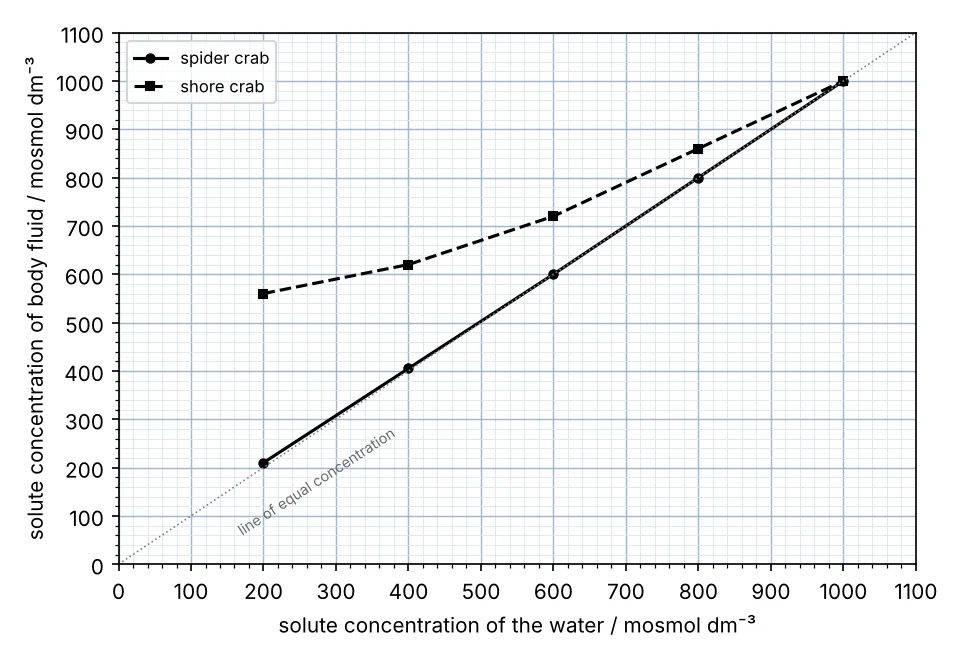
Describe the results for the spider crab.
State the solute concentration of the water at which the body fluid of the shore crab is isotonic with the water.
Calculate the difference between the solute concentration of the body fluid of the shore crab and that of the water at 400 mosmol dm⁻³.
Explain the effect on the cells of a spider crab if its body fluid were suddenly diluted to 400 mosmol dm⁻³ while its cells stayed at 1000 mosmol dm⁻³.
Suggest how the ability shown by the shore crab helps it to live in estuaries.
In dilute water, water enters the shore crab by osmosis and salts are lost. Suggest how the shore crab keeps its body fluid more concentrated than the water, and why this needs energy.
Predict what would happen to a spider crab placed in fresh water. Explain your prediction.
revisionprep.com
Summary Answer
Not available for this question.
Model Answer
Not available for this question.
Marking Scheme
Not available for this question.
Examiner Insights
Not available for this question.
Importance in plant hydration and transport
Tomato plants were grown with their roots in nutrient solution. For one group air was bubbled through the solution; for the other it was not, so the oxygen concentration fell. Figure 1 shows water uptake by the roots and Figure 2 shows the potassium ion concentration in the root cells over 48 hours.
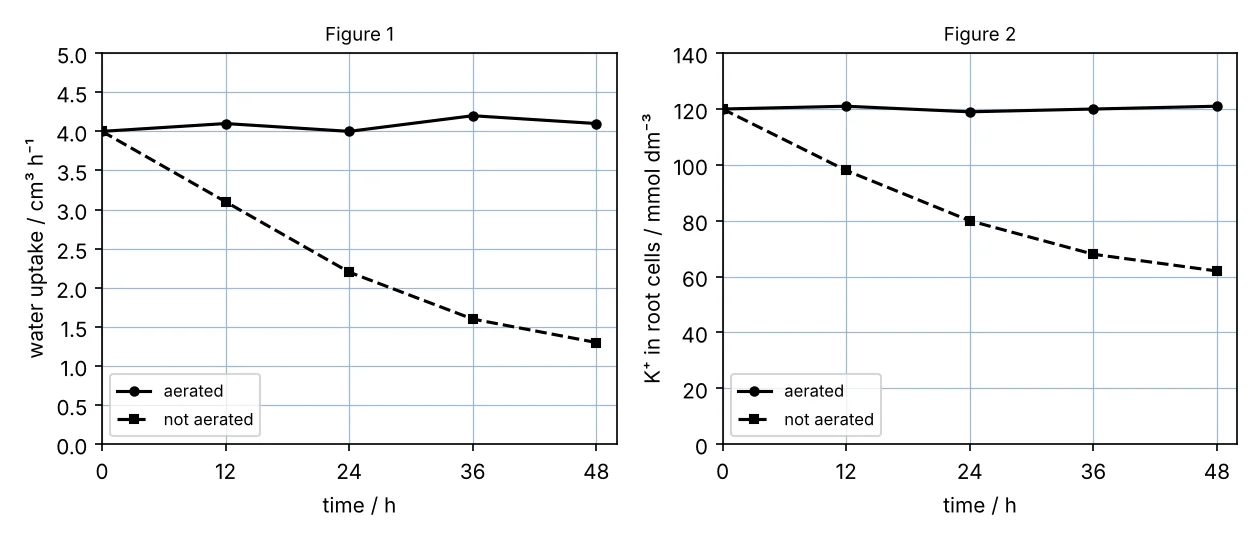
Compare the water uptake of the two groups over 48 hours.
Calculate the percentage decrease in water uptake of the non-aerated plants between 0 and 48 hours.
Explain how the lack of oxygen leads to the changes shown in Figures 1 and 2.
Suggest why water uptake by the non-aerated plants does not fall to zero.
Predict the effect on Figures 1 and 2 of adding a respiratory inhibitor to the aerated solution.
A gardener says that 'plants in waterlogged soil wilt because the soil is too wet'. Evaluate this statement using the data.
revisionprep.com
Summary Answer
Not available for this question.
Model Answer
Not available for this question.
Marking Scheme
Not available for this question.
Examiner Insights
Not available for this question.
Osmosis and water movement in cells
Human egg cells (oocytes) are frozen for fertility treatment in a solution containing glycerol, which protects the cells from ice damage. Glycerol crosses the plasma membrane, but much more slowly than water. The graph shows the volume of an oocyte after it was moved from an isotonic salt solution into the same solution with glycerol added, relative to its starting volume.
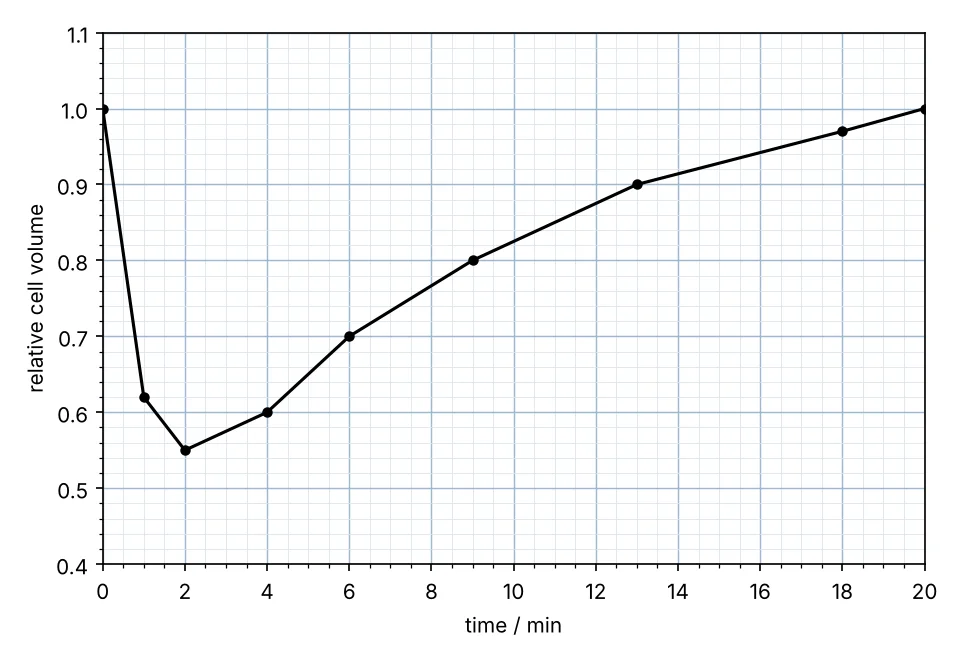
Describe the changes in the volume of the oocyte over 20 minutes.
Calculate the percentage decrease in volume from the start to the minimum.
Explain the change in volume during the first 2 minutes.
Explain why the volume then returns towards its starting value.
After thawing, the oocyte contains a high concentration of glycerol. Explain why it must not be placed directly into an isotonic salt solution, and suggest how it could be returned safely.
Suggest why sucrose added to the outside solution does not protect the inside of the cell in the same way as glycerol.
revisionprep.com
Summary Answer
Not available for this question.
Model Answer
Not available for this question.
Marking Scheme
Not available for this question.
Examiner Insights
Not available for this question.
That's every free question here — 6 of 111.
+105 more questions, plus Mock Papers & Worksheets, are waiting in Premium.