Adaptation to Environment · Paper 1 — Free Biology HL Practice Questions
Free questions
Open in full, with answers, mark scheme and examiner insights.
Habitats and adaptations to abiotic factors
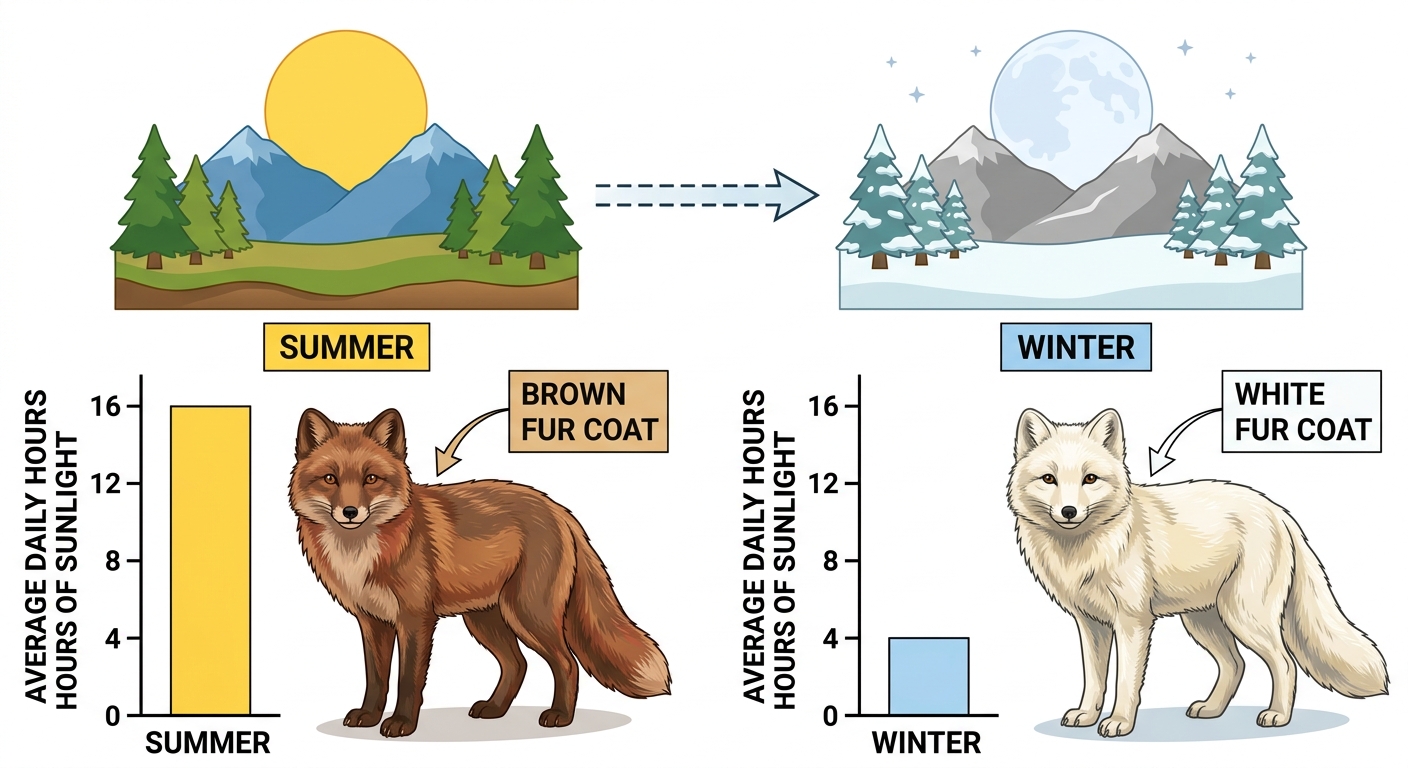
The figure shows the daily hours of sunlight in summer and winter in the Arctic fox's habitat. By about how many hours does the daily sunlight change between summer and winter?
revisionprep.com
Summary Answer
Not available for this question.
Model Answer
Not available for this question.
Marking Scheme
Not available for this question.
Examiner Insights
Not available for this question.
Biomes, climate and ecosystem distribution
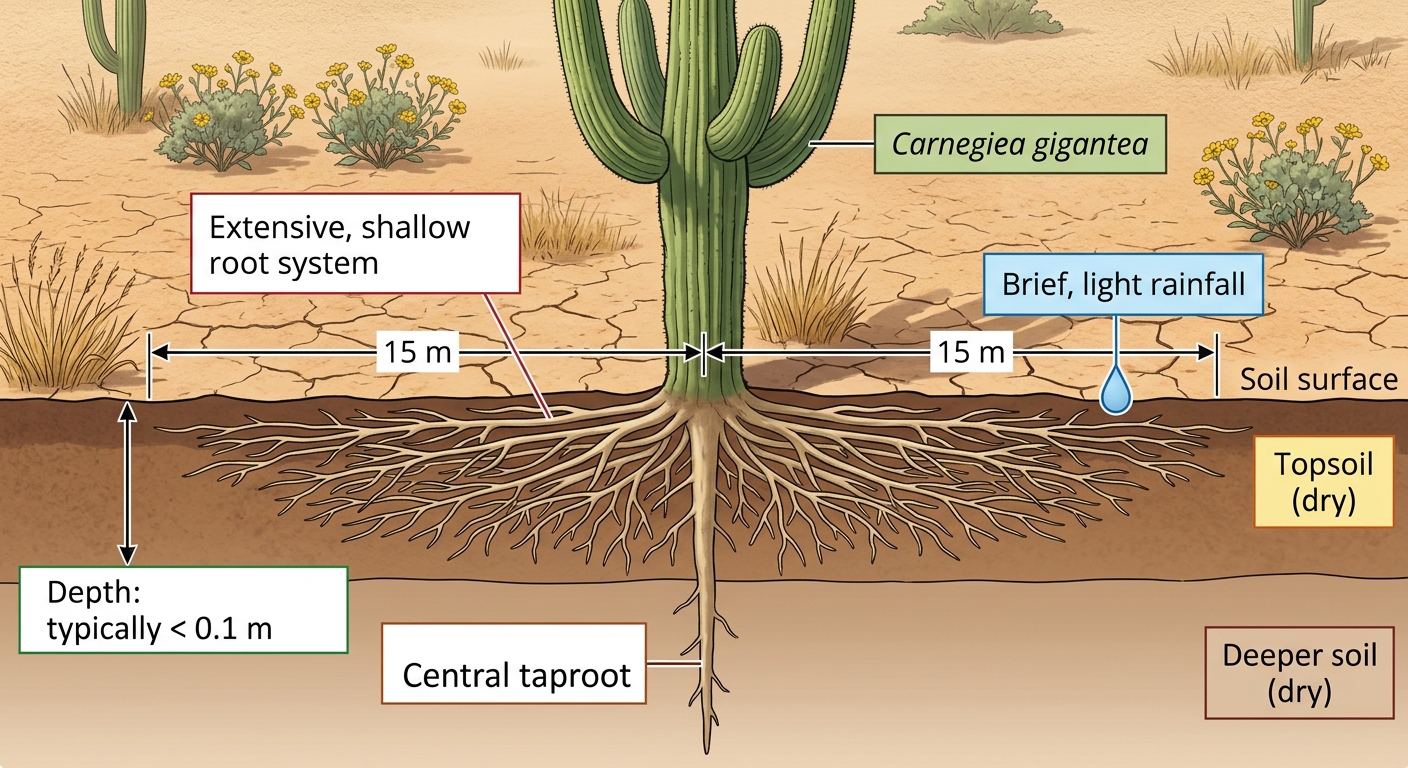
The saguaro cactus (Carnegiea gigantea) grows in the Sonoran Desert, where annual rainfall is less than 250 mm and falls in brief, unpredictable showers. Its root system is shallow (less than 10 cm deep) and radiates up to 15 m from the trunk. Which of the following best explains how this root morphology increases survival in this habitat?
revisionprep.com
Summary Answer
Not available for this question.
Model Answer
Not available for this question.
Marking Scheme
Not available for this question.
Examiner Insights
Not available for this question.
Habitats and adaptations to abiotic factors
The Arctic cod (Boreogadus saida) produces antifreeze proteins (AFPs) that bind to small ice crystals in its blood and stop them growing. A researcher kept groups of cod in water at three temperatures and measured plasma AFP concentration and the freezing point depression of the blood (how far below 0 °C the blood freezes). The table shows the results.

State the relationship between water temperature and plasma AFP concentration.
Calculate the percentage increase in AFP concentration when water temperature decreases from 0 °C to −1.5 °C.
Deduce, using the data, whether the blood of cod kept at −1.5 °C would freeze.
State one variable that should be kept the same for the three groups of cod.
revisionprep.com
Summary Answer
Not available for this question.
Model Answer
Not available for this question.
Marking Scheme
Not available for this question.
Examiner Insights
Not available for this question.
Adaptations in sand dunes, marshes and deserts
A student measured the percentage cover of marram grass (Ammophila arenaria) in quadrats along a transect from the high tide line to the back of a sand dune system. The depth of sand moved by wind each year was also measured at each point. The graph shows the results.
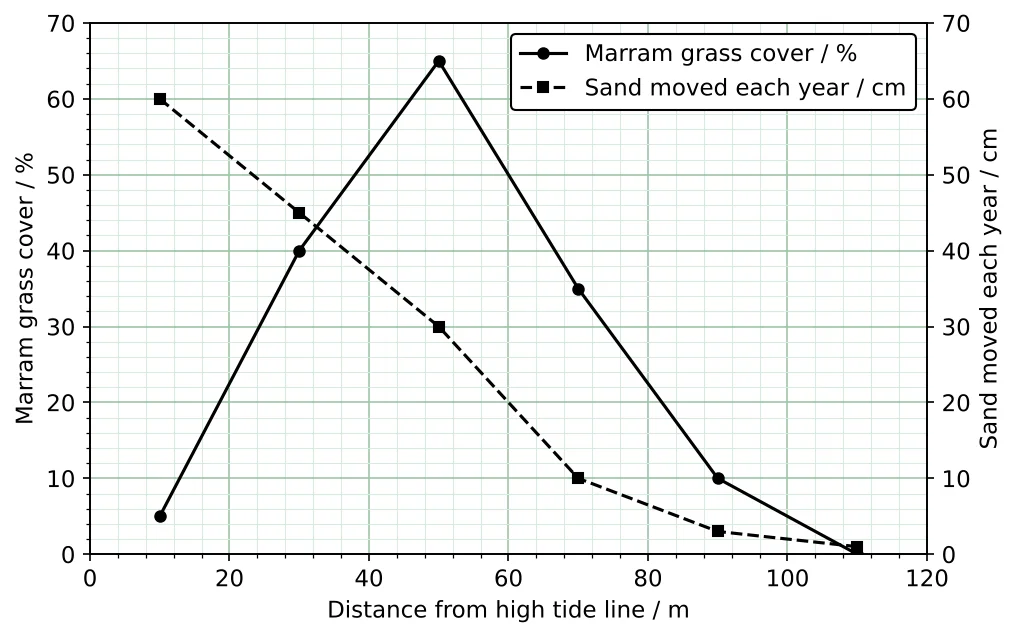
State the distance at which marram grass cover was greatest.
Describe the relationship between marram grass cover and distance from the high tide line.
Suggest why marram grass cover is low at 10 m.
Suggest why marram grass cover falls beyond 50 m, where the sand is more stable.
Outline how the quadrats should be placed along the transect.
Suggest one way of making the results of this investigation more reliable.
revisionprep.com
Summary Answer
Not available for this question.
Model Answer
Not available for this question.
Marking Scheme
Not available for this question.
Examiner Insights
Not available for this question.
Habitats and adaptations to abiotic factors
Dog's mercury (Mercurialis perennis) is a perennial herb of shady woodland. Students laid a transect from inside a wood into open grassland. Every 5 m they estimated the percentage cover of dog's mercury in a quadrat and measured light intensity with a light sensor, expressed as a percentage of the light in the open field. The graph shows the results.
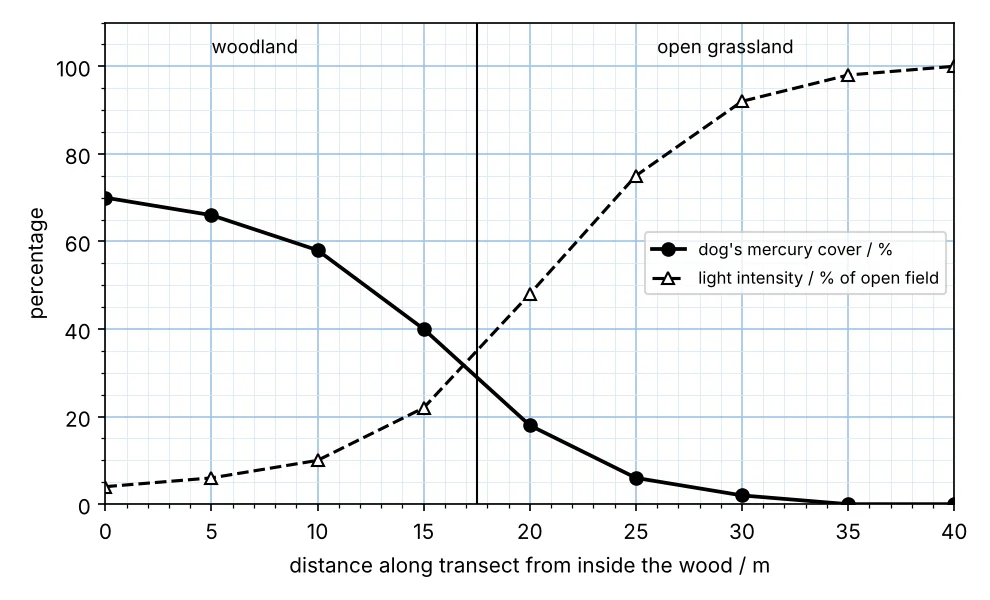
Determine the percentage cover of dog's mercury where light intensity was 22 % of that in the open field.
Describe the relationship between light intensity and the cover of dog's mercury.
A student concluded that high light intensity limits the distribution of dog's mercury. Suggest two other abiotic variables that change from the wood into the grassland and could explain the pattern.
Outline an experiment to test whether light intensity limits the growth of dog's mercury.
revisionprep.com
Summary Answer
Not available for this question.
Model Answer
Not available for this question.
Marking Scheme
Not available for this question.
Examiner Insights
Not available for this question.
Adaptations in sand dunes, marshes and deserts
A study compared a shallow-rooted cactus (roots spreading 5 m but only 10 cm deep) with a deep-rooted desert shrub (taproot reaching 4 m). After natural rainfall events of different sizes, the volume of water each plant absorbed in the following 48 hours was estimated. Each value is from one plant of each species. The graph shows the (hypothetical) results.
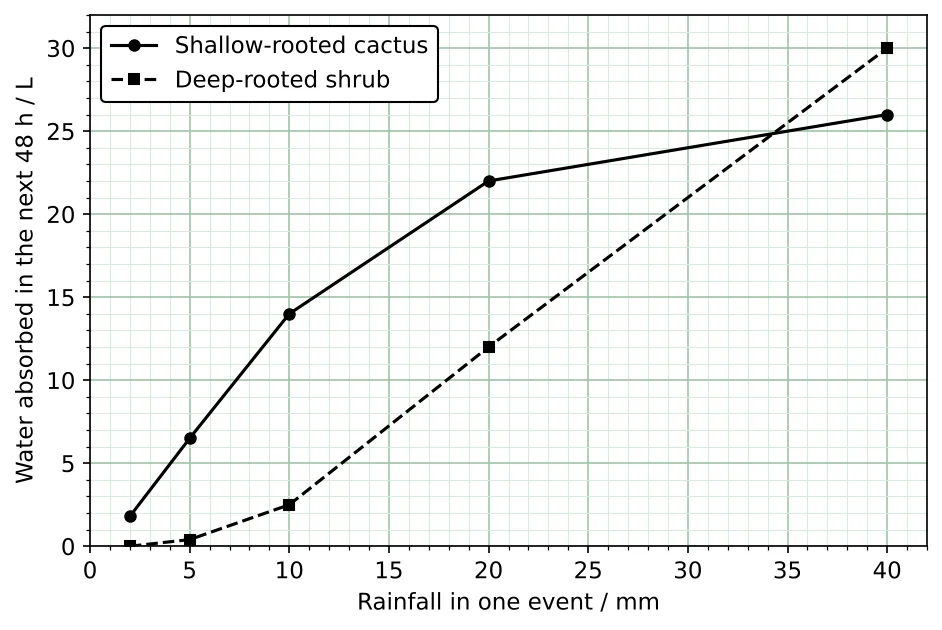
State the volume of water absorbed by each plant after a 5 mm rainfall event.
Calculate how many times more water the cactus absorbed than the shrub after a 10 mm rainfall event.
Explain why the cactus absorbs more water than the shrub after light rainfall.
Suggest why the shrub absorbed more water than the cactus after a 40 mm rainfall event.
Evaluate the design of this study and suggest one improvement.
revisionprep.com
Summary Answer
Not available for this question.
Model Answer
Not available for this question.
Marking Scheme
Not available for this question.
Examiner Insights
Not available for this question.
That's every free question here — 6 of 80.
+74 more questions, plus Mock Papers & Worksheets, are waiting in Premium.