Proteins · Paper 1 — Free Biology HL Practice Questions
Free questions
Open in full, with answers, mark scheme and examiner insights.
Functions of proteins in cells
Which statement describes an integral protein in a plasma membrane?
revisionprep.com
Summary Answer
Not available for this question.
Model Answer
Not available for this question.
Marking Scheme
Not available for this question.
Examiner Insights
Not available for this question.
Structure of proteins: Primary to quaternary structure
All amino acids share the same basic structure. Which part of the molecule differs from one amino acid to another?
revisionprep.com
Summary Answer
Not available for this question.
Model Answer
Not available for this question.
Marking Scheme
Not available for this question.
Examiner Insights
Not available for this question.
Functions of proteins in cells
Frog eggs normally let very little water cross their membranes. Some eggs were injected with mRNA so that they made aquaporin, a water channel protein. Eggs with and without aquaporin were placed in a dilute (hypotonic) solution and their volume measured. The graph shows the results; eggs with aquaporin burst before 90 s.
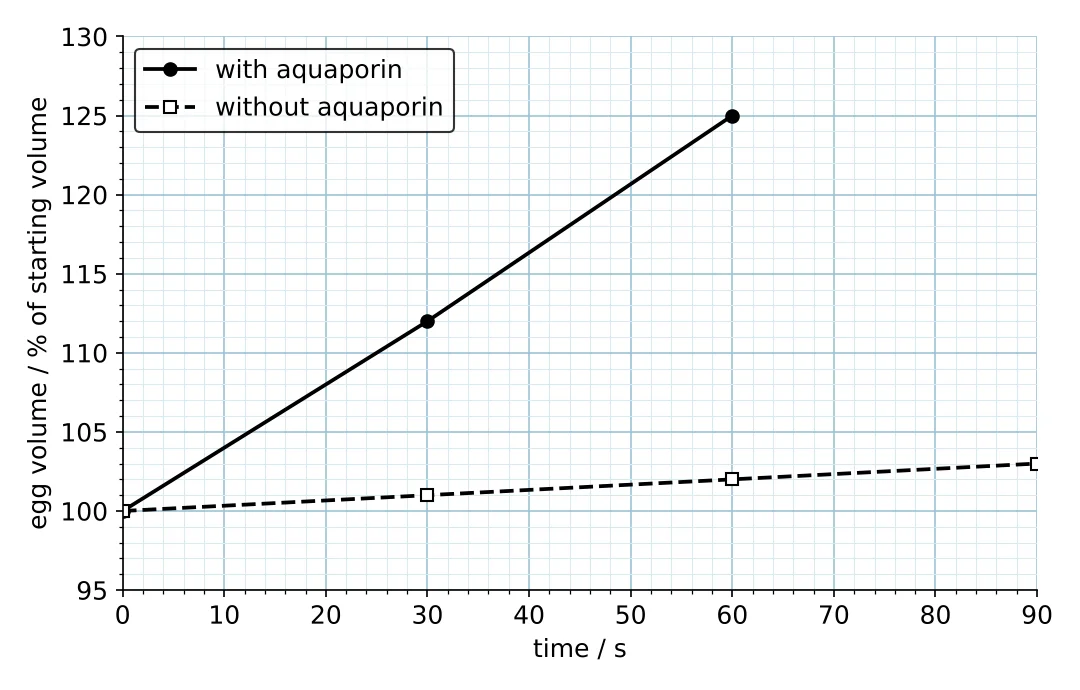
State the function of aquaporins.
Calculate the mean rate of increase in volume of eggs with aquaporin during the first 60 seconds.
Explain the difference between the two types of egg.
Suggest a suitable control for the eggs injected with aquaporin mRNA.
Suggest one reason why the results of a single egg of each type may not be reliable.
Suggest why cells lining kidney tubules that reabsorb water have many aquaporins.
revisionprep.com
Summary Answer
Not available for this question.
Model Answer
Not available for this question.
Marking Scheme
Not available for this question.
Examiner Insights
Not available for this question.
Structure of proteins: Primary to quaternary structure
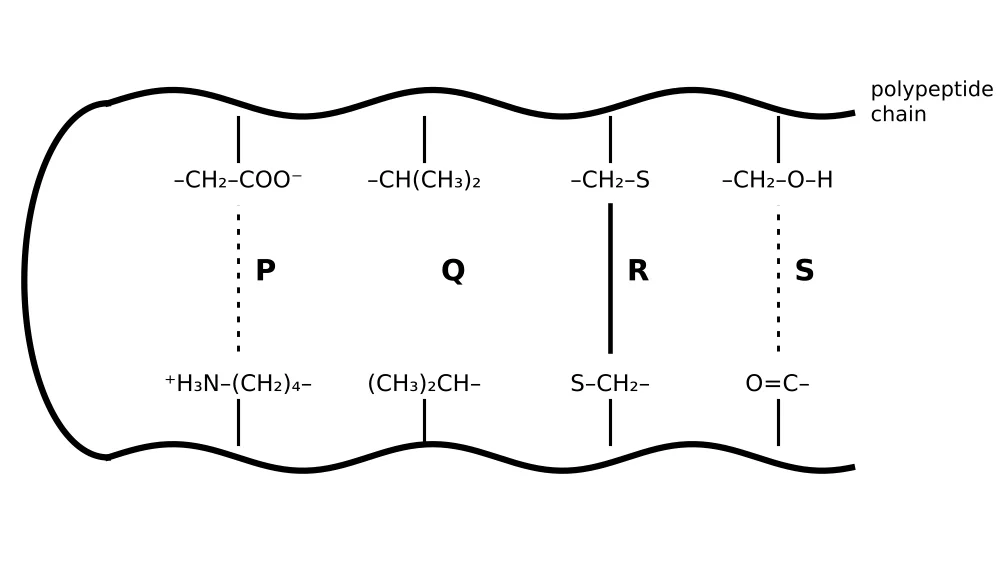
The shows four interactions, P, Q, R and S, between R-groups in a folded polypeptide. The protein is treated with a reagent that breaks covalent bonds between sulfur atoms but has no effect on the other interactions. Which interaction is broken?
revisionprep.com
Summary Answer
Not available for this question.
Model Answer
Not available for this question.
Marking Scheme
Not available for this question.
Examiner Insights
Not available for this question.
Functions of proteins in cells
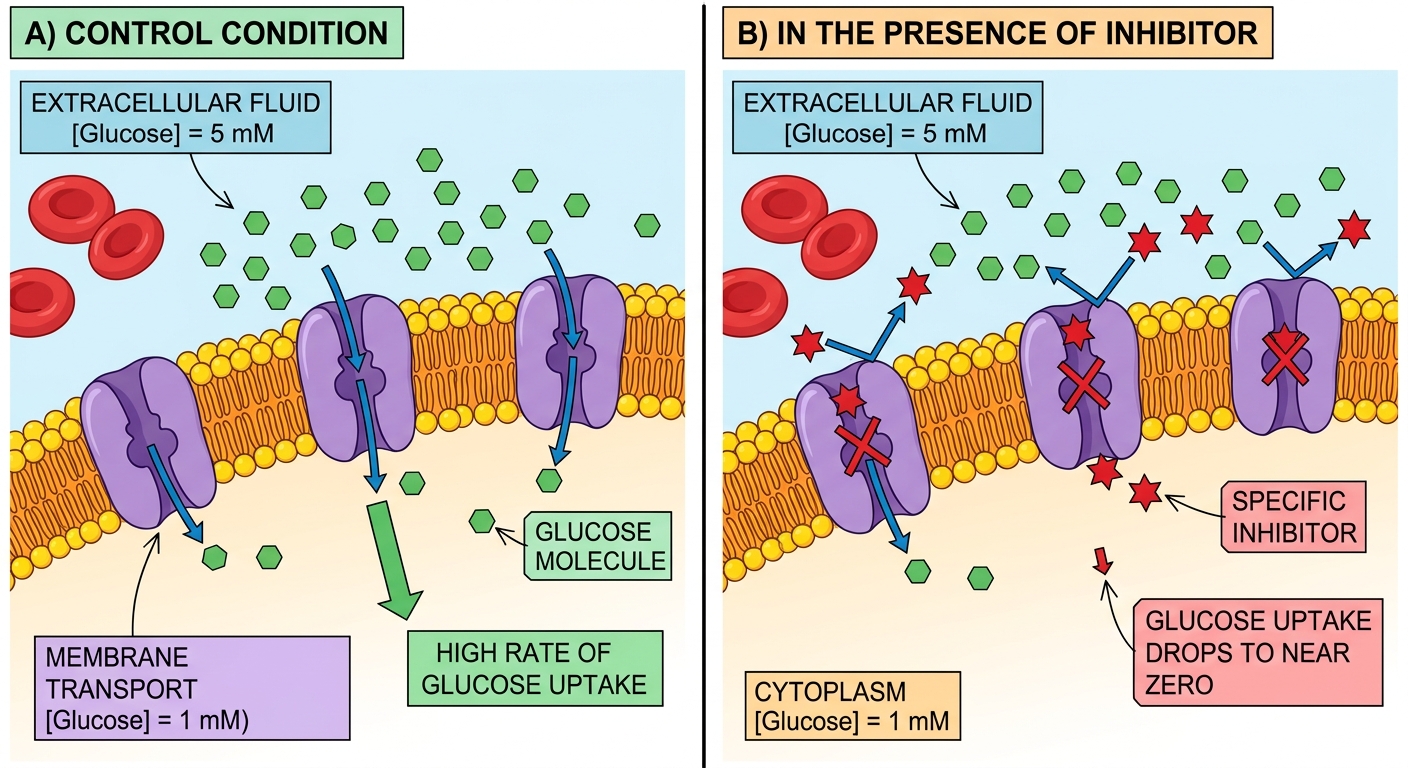
The shows glucose entering red blood cells through transport proteins (A) and the effect of a specific inhibitor that binds to the transport proteins (B). The glucose concentration is 5 mM outside the cells and 1 mM inside. Which observation would best show that the transport protein carries out facilitated diffusion rather than active transport?
revisionprep.com
Summary Answer
Not available for this question.
Model Answer
Not available for this question.
Marking Scheme
Not available for this question.
Examiner Insights
Not available for this question.
Structure of proteins: Primary to quaternary structure
The table shows the number of amino acids and the relative molecular mass of four hypothetical polypeptides, P, Q, R and S. Each is a single unbranched chain. Assume the mean relative molecular mass of the free amino acids is 128. (Relative molecular mass of water = 18)
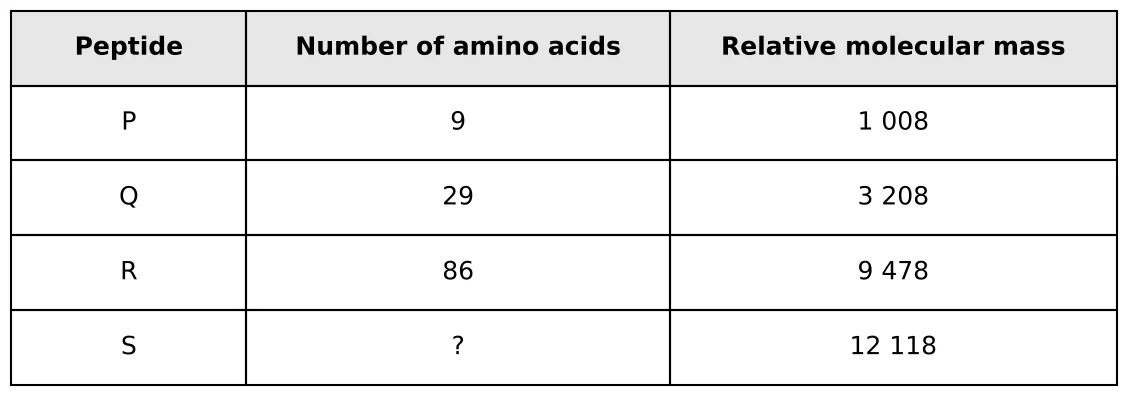
State the number of peptide bonds in polypeptide Q.
Show that the relative molecular mass of P is consistent with a mean free amino acid mass of 128.
Calculate the number of amino acids in polypeptide S.
Explain why the relative molecular mass of a polypeptide is not equal to the number of amino acids multiplied by 128.
Suggest why the number of amino acids calculated in this way for a real protein is only an estimate.
revisionprep.com
Summary Answer
Not available for this question.
Model Answer
Not available for this question.
Marking Scheme
Not available for this question.
Examiner Insights
Not available for this question.
That's every free question here — 6 of 102.
+96 more questions, plus Mock Papers & Worksheets, are waiting in Premium.