Carbohydrates and Lipids · Paper 2 — Free Biology HL Practice Questions
Free questions
Open in full, with answers, mark scheme and examiner insights.
Glycoproteins and cell–cell recognition
The diagram shows part of a plasma membrane.
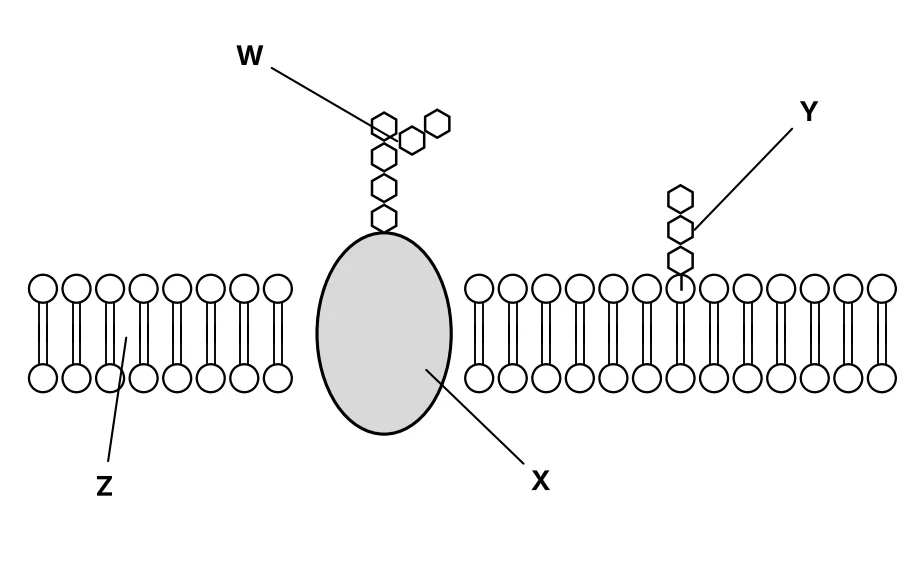
Identify the structures labelled W, X and Y.
State which surface of the membrane, upper or lower, faces the outside of the cell, giving a reason.
State the type of bond that links the monosaccharides in W.
Outline how W allows the cell to be recognised by other cells.
revisionprep.com
Summary Answer
Not available for this question.
Model Answer
Not available for this question.
Marking Scheme
Not available for this question.
Examiner Insights
Not available for this question.
Monosaccharides, condensation and polysaccharides
The diagrams show the ring structures of two monosaccharides, P and Q.
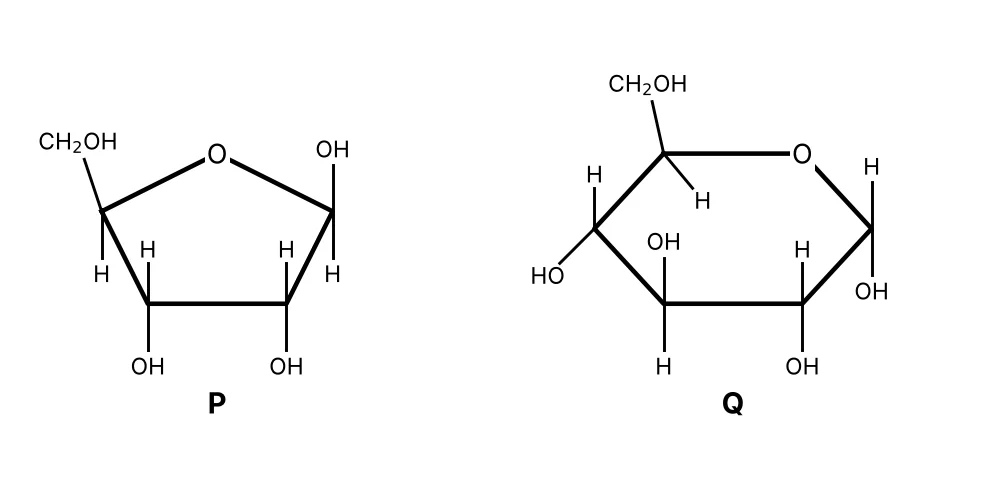
Identify which monosaccharide is a pentose and which is a hexose, giving a reason.
Q is α-glucose. State how a molecule of β-glucose differs from Q.
Outline two properties of glucose that make it suitable as a transported energy source.
revisionprep.com
Summary Answer
Not available for this question.
Model Answer
Not available for this question.
Marking Scheme
Not available for this question.
Examiner Insights
Not available for this question.
Lipids: triglycerides, phospholipids, steroids; energy storage and insulation
Bacteria that cause bladder infections attach to bladder cells using proteins that bind mannose, a monosaccharide at the ends of the carbohydrate chains of glycoproteins on the bladder cells. Bladder cells grown in culture were exposed to the bacteria in solutions containing different concentrations of free mannose or of free glucose. The graph shows the mean number of bacteria attached per bladder cell. Glucose and mannose have the same molecular formula.
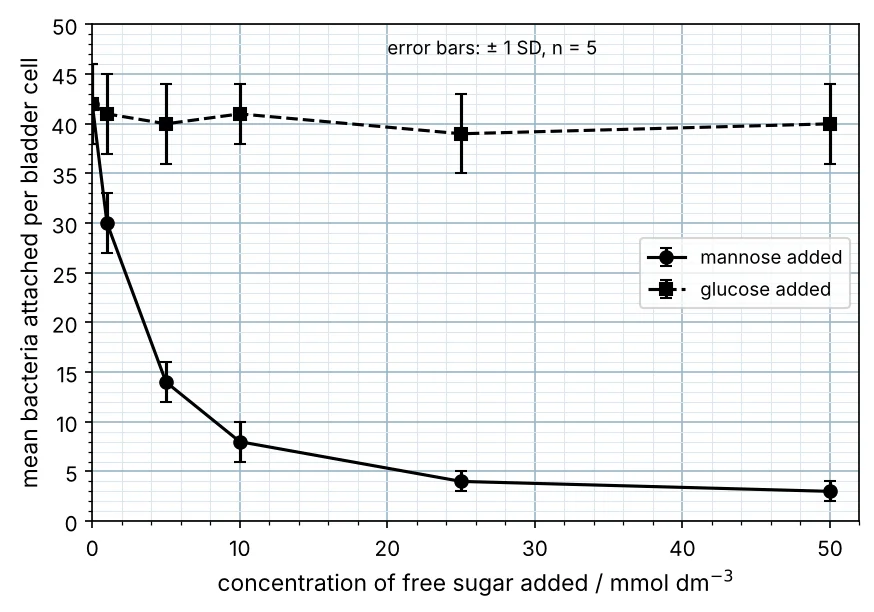
State the mean number of bacteria attached per cell when no sugar was added.
Calculate the percentage decrease in attachment when mannose was added.
Compare the effects of mannose and glucose on attachment.
Explain the effect of free mannose on attachment.
Explain why glucose has no effect.
Suggest why reduced attachment could lower the risk of infection, and give one limitation of applying these results to patients.
revisionprep.com
Summary Answer
Not available for this question.
Model Answer
Not available for this question.
Marking Scheme
Not available for this question.
Examiner Insights
Not available for this question.
Monosaccharides, condensation and polysaccharides
A sports scientist measures a runner's glycogen and triglyceride stores before and after a training run. The bar charts show the results.
Glycogen: initial mass , final mass Triglyceride: initial mass , final mass
Energy released on oxidation: glycogen ; triglyceride .
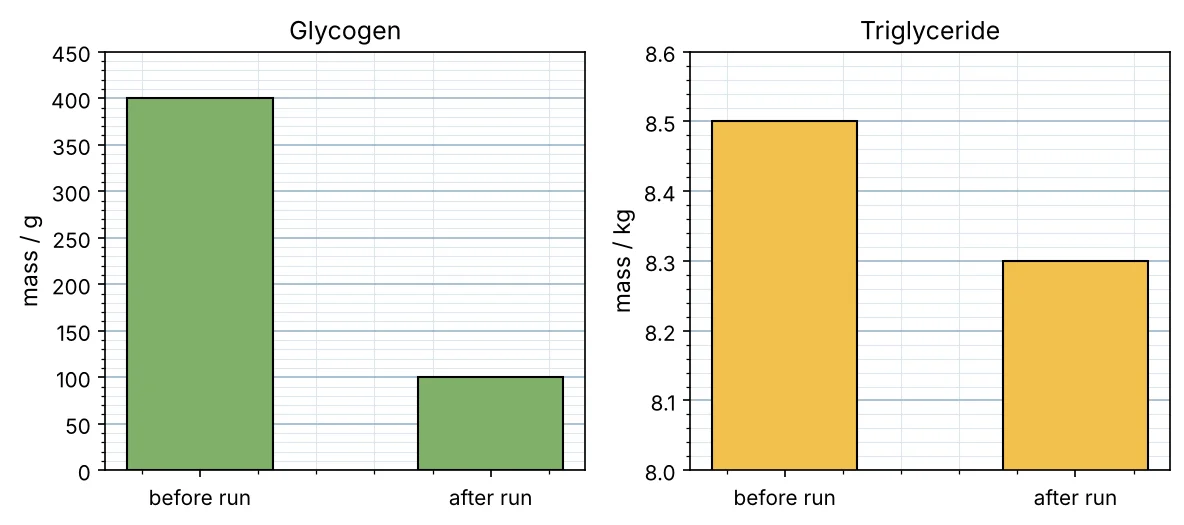
Calculate the energy released from glycogen and from triglyceride during the run.
Calculate the percentage of the total energy that came from glycogen.
Explain why glycogen is suited to supplying energy rapidly during intense exercise.
Explain why the body stores far more energy as triglyceride than as glycogen.
Suggest why the percentage of energy obtained from glycogen would be higher in a 1 km sprint than in this run.
Outline how glucose is released from glycogen.
revisionprep.com
Summary Answer
Not available for this question.
Model Answer
Not available for this question.
Marking Scheme
Not available for this question.
Examiner Insights
Not available for this question.
Lipids: triglycerides, phospholipids, steroids; energy storage and insulation
The table gives data for the energy stores of a adult.
Mass of triglyceride stored: ; energy density ; stored without water Mass of glycogen stored: ; energy density ; stored with of water per gram Daily energy use at rest:
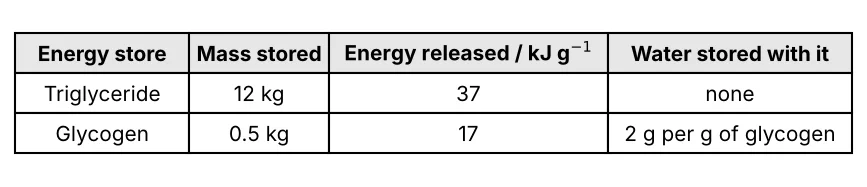
Calculate the energy stored as triglyceride and as glycogen.
Calculate how many days each store would last if it were the only energy source at rest.
Calculate the total mass of glycogen and water that would be needed to store the same energy as the triglyceride, and comment on your answer.
Evaluate the claim that lipids are the best energy store for all organisms.
Explain why a large triglyceride store does not disturb the water balance of adipose cells.
Adipose tissue is found under the skin. Explain one benefit of this position.
revisionprep.com
Summary Answer
Not available for this question.
Model Answer
Not available for this question.
Marking Scheme
Not available for this question.
Examiner Insights
Not available for this question.
Monosaccharides, condensation and polysaccharides
Distinguish between the structures of amylose, amylopectin and glycogen.
Outline the properties of glucose that make it suitable as the carbohydrate transported in blood and used in respiration.
Discuss why plants store most of their energy reserve as starch, whereas animals store most of theirs as triglycerides but also keep some glycogen.
revisionprep.com
Summary Answer
Not available for this question.
Model Answer
Not available for this question.
Marking Scheme
Not available for this question.
Examiner Insights
Not available for this question.
That's every free question here — 6 of 76.
+70 more questions, plus Mock Papers & Worksheets, are waiting in Premium.