Ecological Niches · Paper 2 — Free Biology HL Practice Questions
Free questions
Open in full, with answers, mark scheme and examiner insights.
Ecological niche concept
Light intensity was measured at three heights in a tropical rainforest at midday. The results are shown in the table.
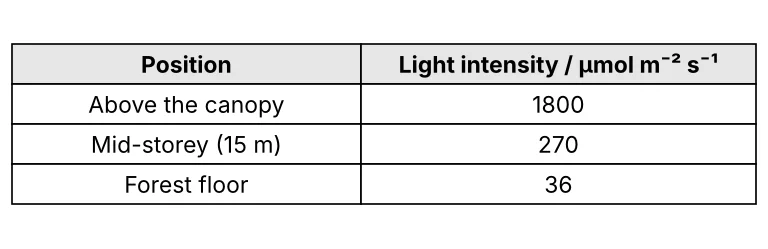
Calculate the percentage of the light above the canopy that reaches the forest floor.
Explain how shade-tolerant herbs on the forest floor are adapted to these conditions.
Explain how lianas and epiphytes obtain more light than forest-floor herbs.
Suggest why fast-growing, light-demanding plants appear when a large tree falls.
revisionprep.com
Summary Answer
Not available for this question.
Model Answer
Not available for this question.
Marking Scheme
Not available for this question.
Examiner Insights
Not available for this question.
Fundamental vs realized niches
A sheep has no incisors in its upper jaw; instead there is a hard dental pad. Its lower incisors press grass against the pad. There is a gap (diastema) between the incisors and the cheek teeth. The cheek teeth (premolars and molars) have ridges of enamel, and the lower jaw moves from side to side as the sheep chews.
Explain how the incisors and dental pad are used in feeding.
Suggest the function of the diastema.
Explain how ridged cheek teeth and side-to-side jaw movement adapt the sheep to its diet.
State the mode of nutrition of the sheep.
revisionprep.com
Summary Answer
Not available for this question.
Model Answer
Not available for this question.
Marking Scheme
Not available for this question.
Examiner Insights
Not available for this question.
Role of organisms in ecosystems
In a lake that is layered in summer, cyanobacteria are most abundant near the surface, while purple sulfur bacteria form a dense layer at about 8–9 m. Purple sulfur bacteria use light energy to make organic compounds, but they use hydrogen sulfide instead of water and do not release oxygen. The graph shows their distribution, the light intensity and the conditions at different depths.
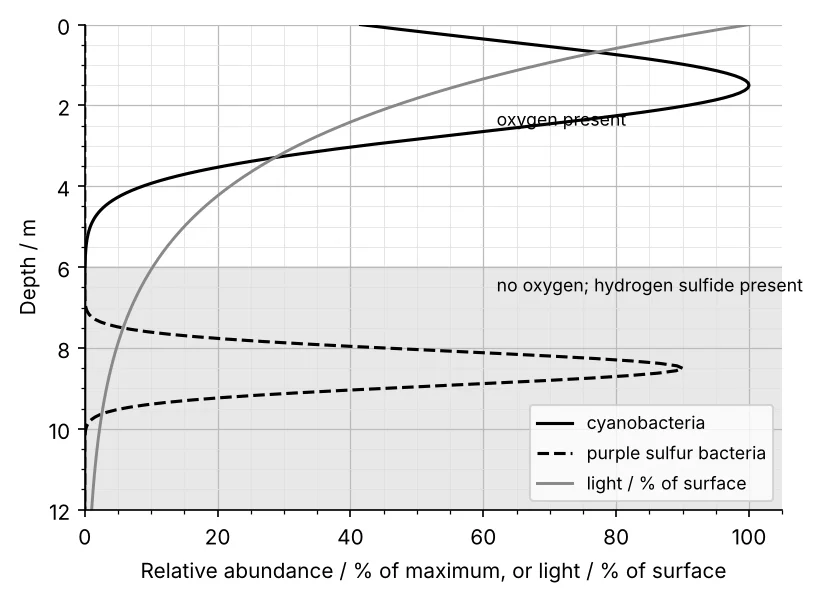
State the mode of nutrition shared by both groups of bacteria.
Distinguish between photosynthesis in cyanobacteria and in purple sulfur bacteria.
Suggest why the purple sulfur bacteria form a layer at 8–9 m rather than near the surface.
Suggest why there are almost no purple sulfur bacteria below 10 m.
revisionprep.com
Summary Answer
Not available for this question.
Model Answer
Not available for this question.
Marking Scheme
Not available for this question.
Examiner Insights
Not available for this question.
Competitive exclusion (AHL)
Grey squirrels were introduced to Britain from North America. The graph shows the percentage of woodland survey squares in one region of broadleaf woodland occupied by each species (hypothetical data). Feeding trials showed that grey squirrels gain about 60% of the energy in acorns, red squirrels only about 30%, because tannins in acorns reduce digestion more in red squirrels.
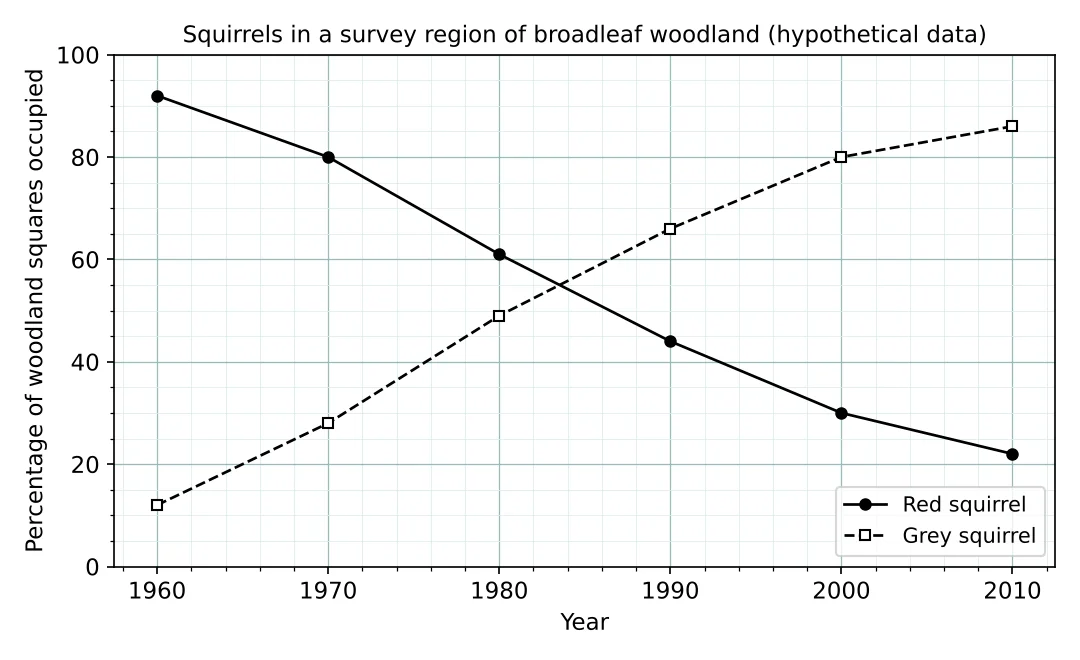
Describe the changes in the distribution of the two species between 1960 and 2010.
Calculate the mean rate of decrease in the percentage of squares occupied by red squirrels between 1960 and 2010.
Explain how the feeding data could account for the changes shown.
Explain why the graph alone does not prove that competition caused the decline of red squirrels.
Red squirrels persist in large conifer forests. Suggest reasons for this.
Discuss whether this is an example of competitive exclusion.
revisionprep.com
Summary Answer
Not available for this question.
Model Answer
Not available for this question.
Marking Scheme
Not available for this question.
Examiner Insights
Not available for this question.
Ecological niche concept
Marine iguanas of the Galápagos Islands feed on algae growing on rocks under the sea. They are ectotherms: their body temperature depends on their surroundings. Before diving they bask on dark rocks to warm up. The table shows the mean duration of feeding dives at different water temperatures.
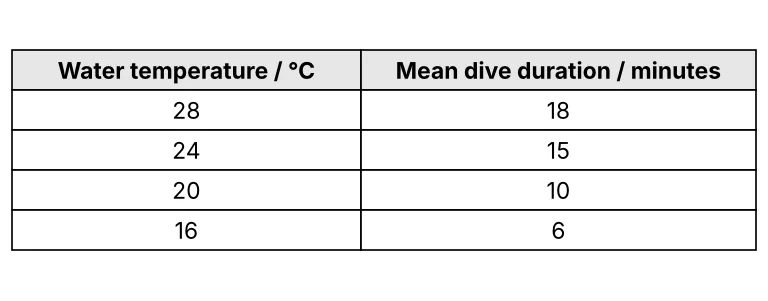
Describe the relationship between water temperature and dive duration.
Calculate the percentage decrease in dive duration from 28 °C to 16 °C.
Explain why water temperature is part of the niche of the marine iguana.
In El Niño years the sea warms and the red and green algae that iguanas prefer die back, and many iguanas starve. Explain what this shows about the biotic and abiotic parts of their niche.
Marine iguanas feed mainly around midday at low tide. Suggest why.
Outline the mode of nutrition of the marine iguana.
revisionprep.com
Summary Answer
Not available for this question.
Model Answer
Not available for this question.
Marking Scheme
Not available for this question.
Examiner Insights
Not available for this question.
Role of organisms in ecosystems
In a salt marsh, periwinkle snails graze on fungi that grow on cordgrass leaves, fiddler crabs feed on detritus and small invertebrates in the mud, and clapper rails (birds) eat both snails and crabs. The figure shows population densities in two consecutive years and the cordgrass biomass consumed each year.
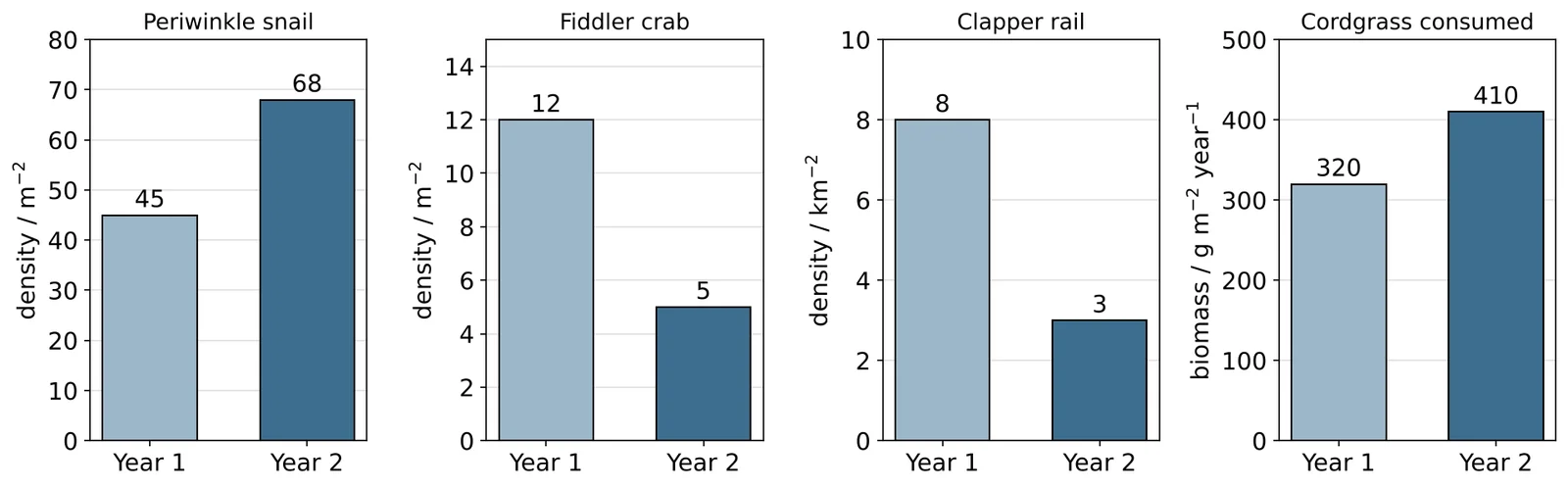
Calculate the percentage change in snail density from Year 1 to Year 2.
Suggest a reason for the change in snail density, using the data.
Distinguish between the nutrition of the fiddler crab and that of the fungi on the cordgrass leaves.
The snails rasp the leaves while grazing, and fungi grow in the wounds. Explain how this could account for the increase in cordgrass consumed.
State the trophic level of the clapper rail when it eats fiddler crabs.
Evaluate the claim that the fall in clapper rails caused the increase in cordgrass consumed.
revisionprep.com
Summary Answer
Not available for this question.
Model Answer
Not available for this question.
Marking Scheme
Not available for this question.
Examiner Insights
Not available for this question.
That's every free question here — 6 of 128.
+122 more questions, plus Mock Papers & Worksheets, are waiting in Premium.