Gas Exchange · Paper 2 — Free Biology HL Practice Questions
Free questions
Open in full, with answers, mark scheme and examiner insights.
Human respiratory system
A researcher measures the partial pressure of oxygen () in the blood entering and leaving the lungs of a healthy individual at rest.
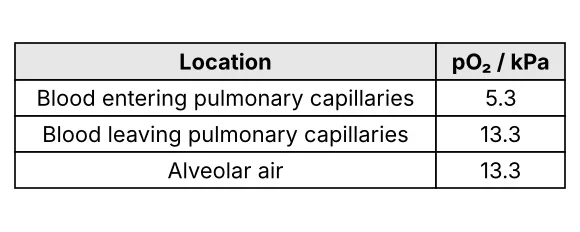
State the process by which oxygen moves from the alveoli into the blood.
Calculate the difference in between the alveolar air and the blood entering the pulmonary capillaries.
Explain, using your answer to (b), why oxygen moves from the alveoli into the blood.
Explain why the of blood leaving the pulmonary capillaries equals that of alveolar air.
revisionprep.com
Summary Answer
Not available for this question.
Model Answer
Not available for this question.
Marking Scheme
Not available for this question.
Examiner Insights
Not available for this question.
Respiratory structures in animals and plants
Fish gills and the haemoglobin in fish blood together supply oxygen to the tissues.
State two features of the gill lamellae that increase the rate of gas exchange.
Outline how countercurrent flow increases the uptake of oxygen at the gills.
State what is meant by the affinity of haemoglobin for oxygen.
Outline why fish living in water that is low in oxygen often have haemoglobin with a high affinity for oxygen.
revisionprep.com
Summary Answer
Not available for this question.
Model Answer
Not available for this question.
Marking Scheme
Not available for this question.
Examiner Insights
Not available for this question.
Properties of gas-exchange surfaces; maintaining concentration gradients
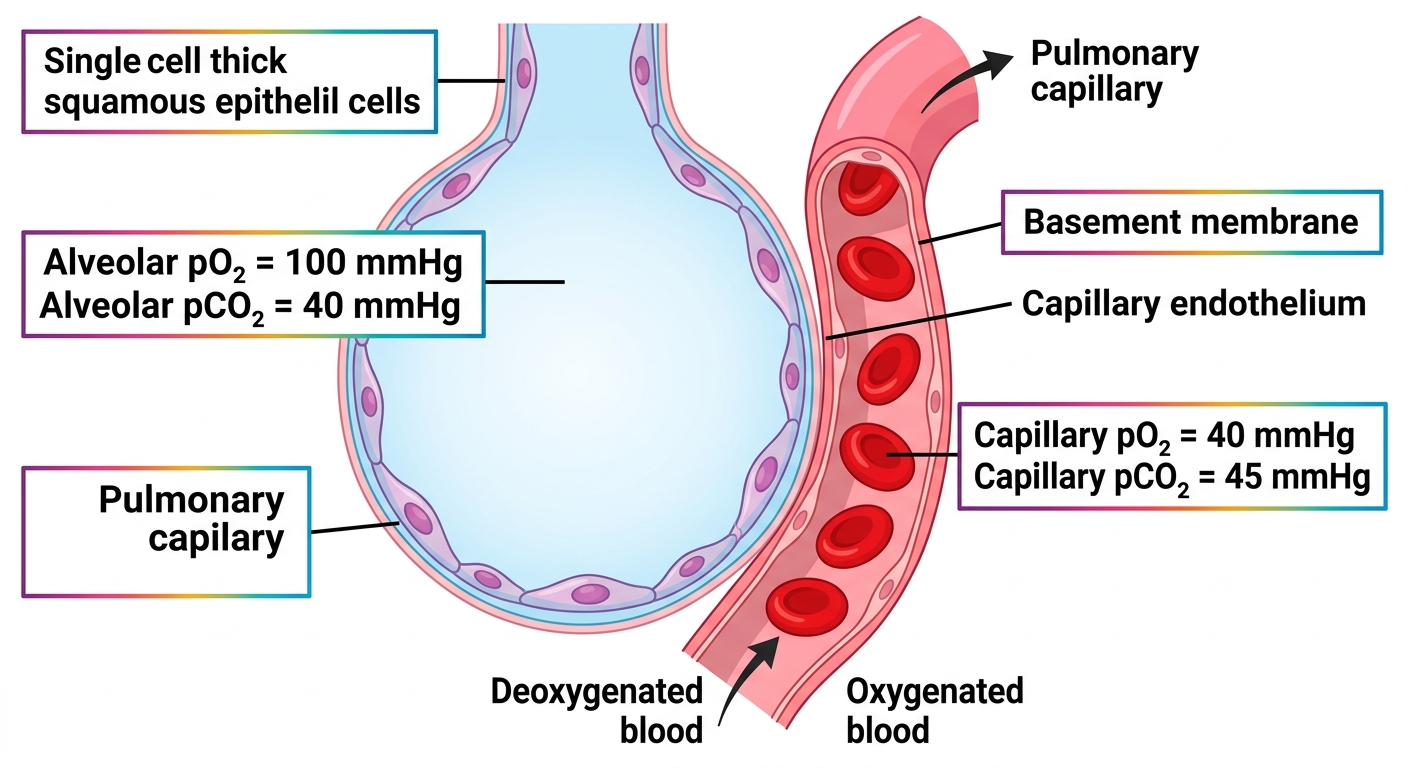
Outline how photosynthesis and respiration create concentration gradients for carbon dioxide and oxygen between a leaf and the air around it.
Explain why gas-exchange surfaces must be thin, permeable and moist.
Explain how the structure of a leaf provides a large surface for gas exchange and maintains concentration gradients.
revisionprep.com
Summary Answer
Not available for this question.
Model Answer
Not available for this question.
Marking Scheme
Not available for this question.
Examiner Insights
Not available for this question.
Haemoglobin, oxygen dissociation curves and the Bohr shift (AHL)
The graph shows the oxygen dissociation curves of fetal haemoglobin and adult haemoglobin, measured under the same conditions.
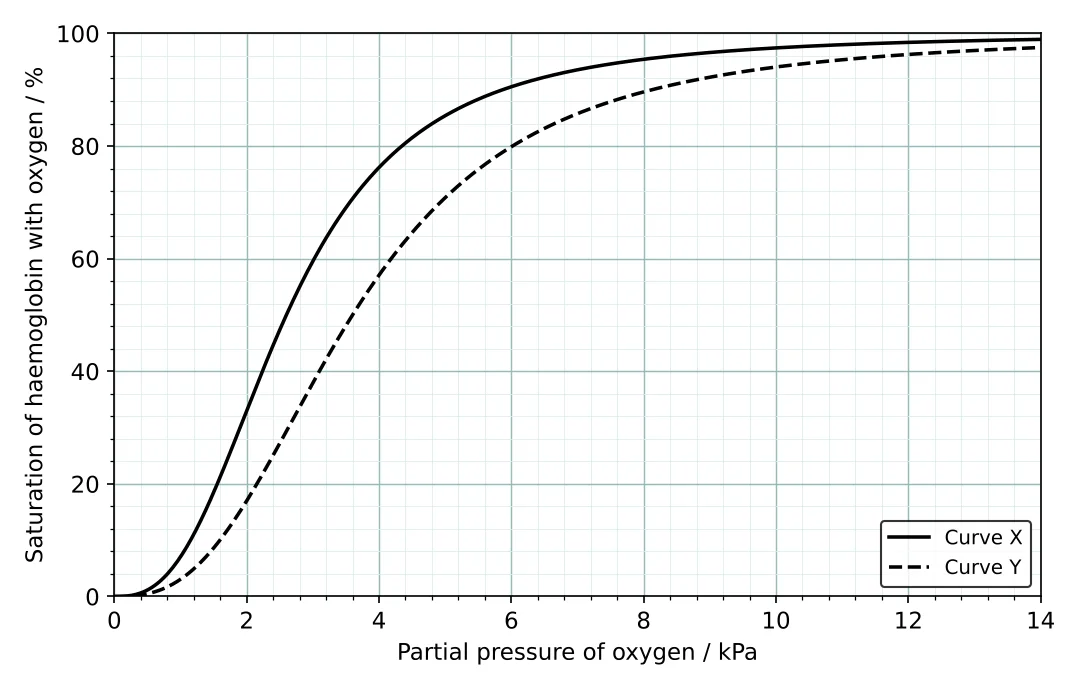
Identify, with a reason, which curve shows fetal haemoglobin.
Explain why the curve of fetal haemoglobin is an advantage to the fetus.
Using the graph, state the difference in P₅₀ between the two types of haemoglobin.
revisionprep.com
Summary Answer
Not available for this question.
Model Answer
Not available for this question.
Marking Scheme
Not available for this question.
Examiner Insights
Not available for this question.
Human respiratory system
Data
A researcher investigates gas exchange efficiency in the human respiratory system. She measures the partial pressure of oxygen () in the alveoli and pulmonary capillaries of a healthy adult at rest.
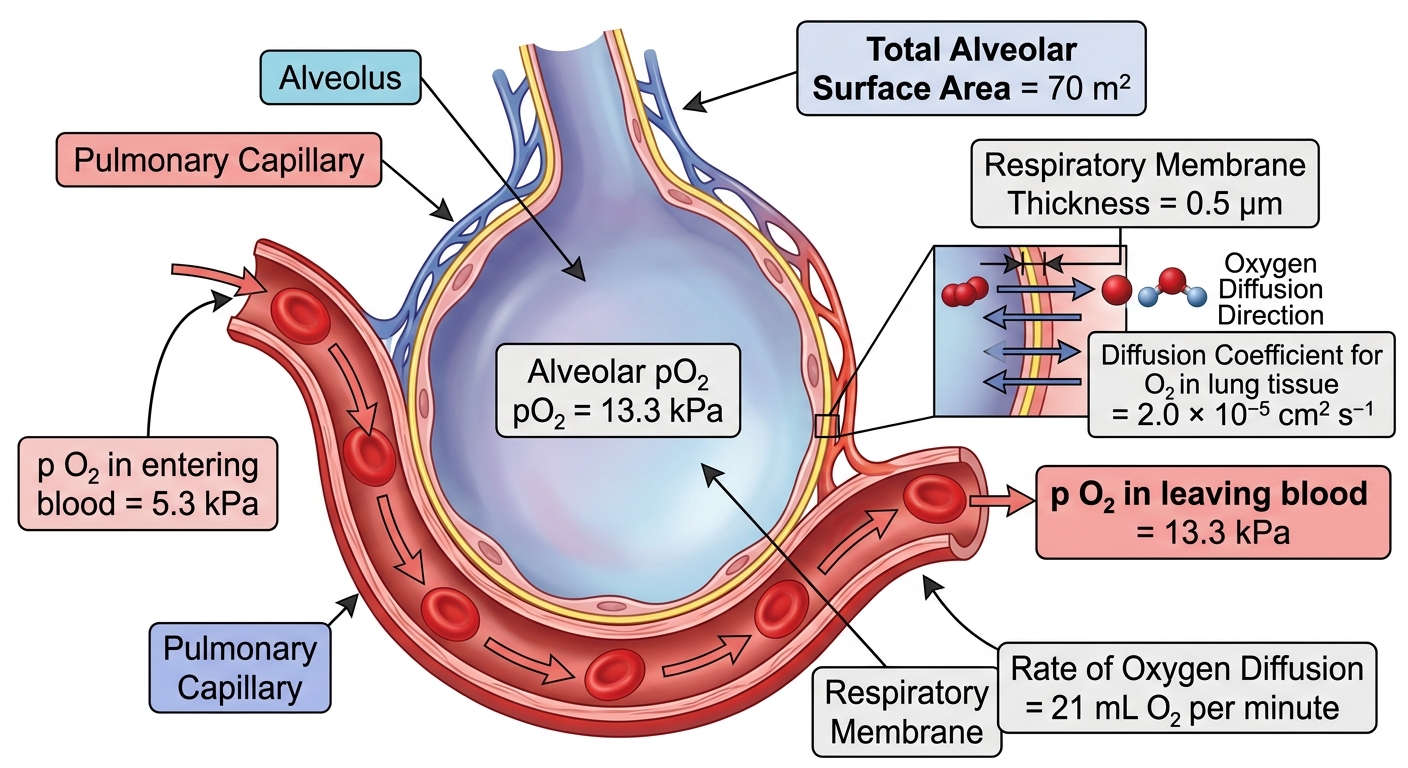
Calculate the pO₂ gradient between alveolar air and blood at the start and at the end of the capillary, and the mean of these two values.
Explain why the mean gradient describes the driving force for diffusion along the capillary better than the starting gradient alone.
Using Fick's law and the data provided, calculate the constant in rate of diffusion , with in cm², in cm, as your mean value in kPa and the rate in cm³ s⁻¹. State one assumption made in this calculation.
Explain how two structural features of the alveoli maximise the rate of gas exchange, linking each feature to a factor in Fick's law.
Evaluate how well the human respiratory system maintains a steep oxygen gradient during vigorous exercise, referring to ventilation, blood flow and a limitation at very high exercise intensities.
revisionprep.com
Summary Answer
Not available for this question.
Model Answer
Not available for this question.
Marking Scheme
Not available for this question.
Examiner Insights
Not available for this question.
Plant gas exchange: Stomata, leaf structure
Data
Nerium oleander (oleander) is a xerophyte with sunken stomata located in epidermal crypts. Tradescantia zebrina is a mesophyte with stomata confined to the lower epidermis only. A student uses a potometer to measure water uptake as a proxy for transpiration rate under controlled conditions.
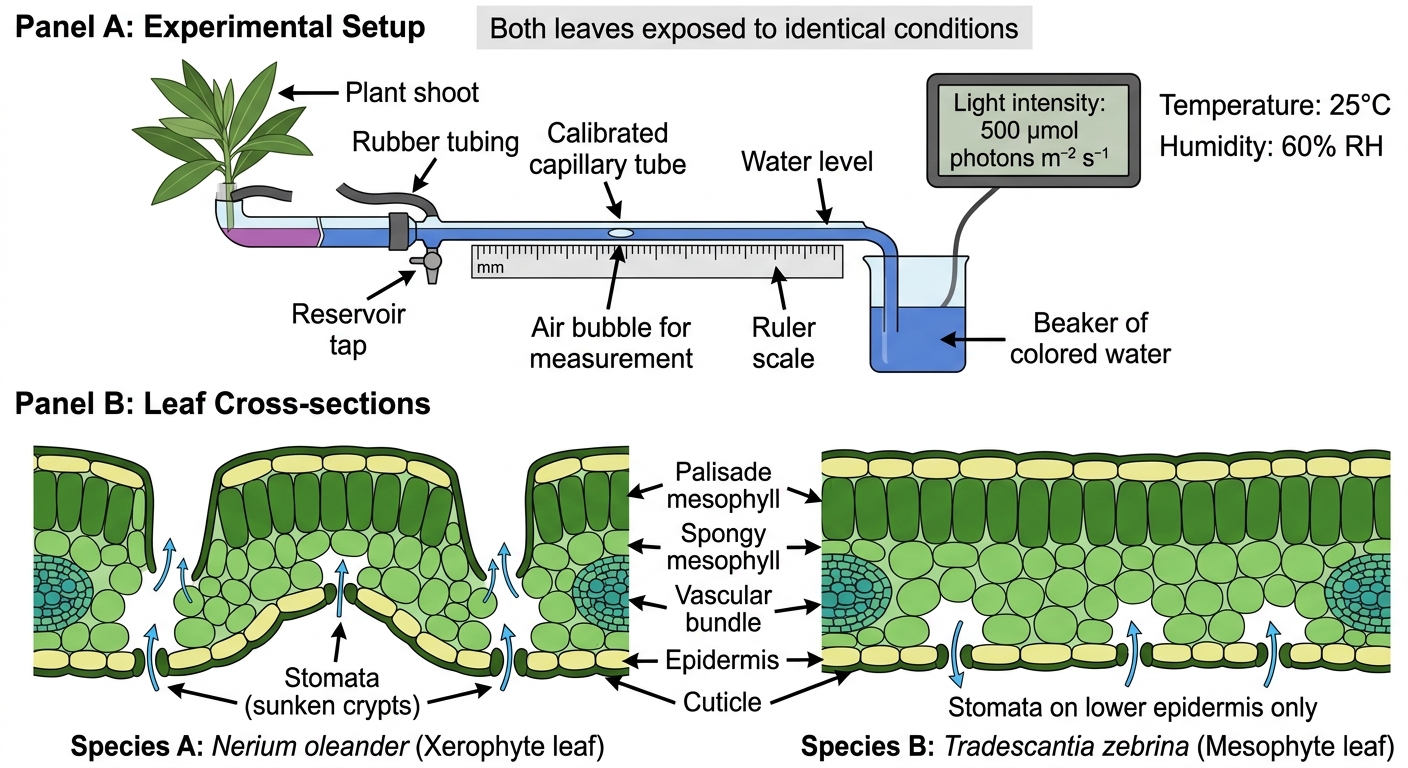
Calculate the total potential stomatal pore area, in , for each leaf, assuming all stomata are fully open.
Explain why the sunken crypt anatomy of Leaf A reduces its transpiration rate below the level predicted by total pore area alone.
A researcher claims that the higher stomatal density of Leaf B is the sole cause of its greater transpiration rate. Evaluate this claim using the data provided and your knowledge of leaf structure.
State why water uptake measured with a potometer is only an estimate of the rate of transpiration.
revisionprep.com
Summary Answer
Not available for this question.
Model Answer
Not available for this question.
Marking Scheme
Not available for this question.
Examiner Insights
Not available for this question.
That's every free question here — 6 of 133.
+127 more questions, plus Mock Papers & Worksheets, are waiting in Premium.