Membranes and Membrane Transport · Paper 2 — Free Biology HL Practice Questions
Free questions
Open in full, with answers, mark scheme and examiner insights.
Simple diffusion, osmosis and channel proteins
Dialysis (Visking) tubing is partially permeable. A tube containing a mixture of starch and glucose was placed in a beaker of water. After 30 minutes the water in the beaker was tested. The results are shown in the table.
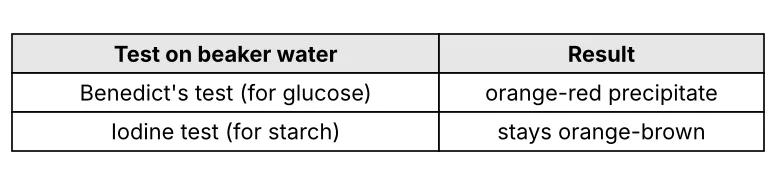
State what the results show about the movement of glucose and starch.
Explain these results in terms of the tubing.
Predict, with a reason, what happens to the volume of liquid inside the tubing.
revisionprep.com
Summary Answer
Not available for this question.
Model Answer
Not available for this question.
Marking Scheme
Not available for this question.
Examiner Insights
Not available for this question.
Fluid mosaic model
The table shows the permeability of an artificial phospholipid bilayer (no proteins) to five substances.
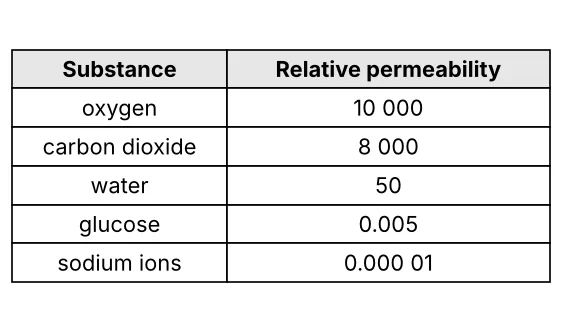
Identify the property shared by the two substances that cross most easily.
Calculate how many times more permeable the bilayer is to oxygen than to water.
Explain why the bilayer is almost impermeable to sodium ions.
Real cell membranes are far more permeable to water and glucose than this bilayer. Explain how.
revisionprep.com
Summary Answer
Not available for this question.
Model Answer
Not available for this question.
Marking Scheme
Not available for this question.
Examiner Insights
Not available for this question.
Active transport, pumps, endocytosis and exocytosis
The giant alga Nitella lives in pond water. The concentrations of three ions inside its cells and in the pond water are shown. The results are shown in the table.
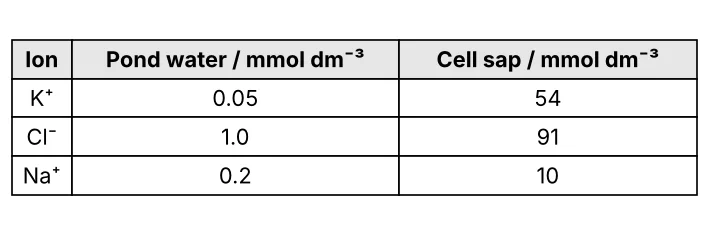
Calculate how many times more concentrated K⁺ is inside the cell than outside.
Deduce, with a reason, how these ions enter the cells.
Explain why this uptake would stop if the cells were kept in the dark for several days with no oxygen.
Suggest why the cell does not simply let these ions diffuse back out.
revisionprep.com
Summary Answer
Not available for this question.
Model Answer
Not available for this question.
Marking Scheme
Not available for this question.
Examiner Insights
Not available for this question.
Membrane fluidity, gated channels, Na⁺–K⁺ pump, cotransport and cell adhesion (AHL)
The fluidity of brain membranes from an Antarctic fish (habitat temperature −1.9 °C) and a tropical fish (habitat temperature 28 °C) was measured at temperatures from 0 °C to 35 °C. The results are shown in the graph.
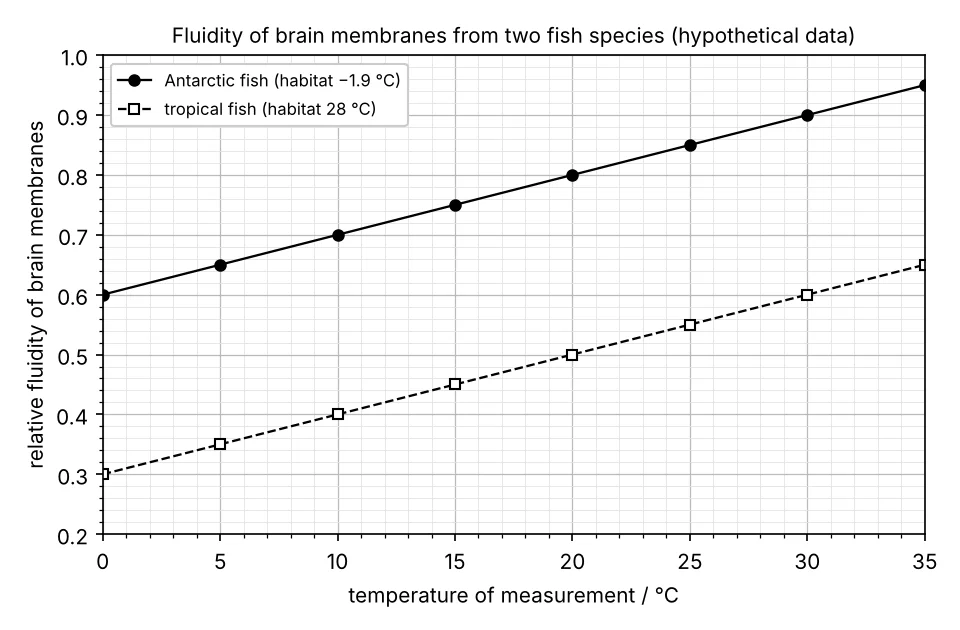
State the relative fluidity of each membrane at 0 °C.
Determine the temperature at which the tropical fish membrane has the same fluidity as the Antarctic fish membrane at 0 °C.
Suggest how the fatty-acid composition of the two membranes differs.
Explain the importance of this difference for nerve function in the Antarctic fish.
Predict the effect on the membranes of the Antarctic fish of warming its water to 25 °C.
Evaluate whether these data show that fatty-acid composition causes the difference in fluidity.
revisionprep.com
Summary Answer
Not available for this question.
Model Answer
Not available for this question.
Marking Scheme
Not available for this question.
Examiner Insights
Not available for this question.
Simple diffusion, osmosis and channel proteins
Strips of onion epidermis were placed in sucrose solutions for 20 minutes and examined under a microscope. The percentage of cells that were plasmolysed (membrane pulled away from the wall) was counted. The results are shown in the table.

Estimate the sucrose concentration at which 50 % of cells are plasmolysed.
Describe what happens to a cell placed in 0.6 mol dm⁻³ sucrose.
Explain why no cells are plasmolysed in 0.2 mol dm⁻³ sucrose.
Suggest why not all cells plasmolyse at the same concentration.
State one variable that must be controlled.
Explain why the concentration at which 50 % of cells are plasmolysed is used as an estimate of the solute concentration of the cell sap.
Suggest two ways in which the estimate could be made more precise.
State why the cells must be examined after the same length of time in every solution.
revisionprep.com
Summary Answer
Not available for this question.
Model Answer
Not available for this question.
Marking Scheme
Not available for this question.
Examiner Insights
Not available for this question.
Lipid bilayer and membrane proteins
The permeability of a membrane to a series of alcohols was measured. Lipid solubility increases with the length of the carbon chain. The results are shown in the table.
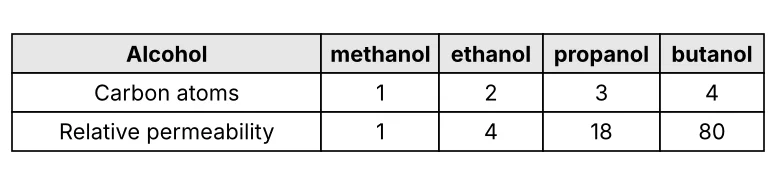
Calculate how many times more permeable the membrane is to butanol than to ethanol.
Describe the relationship between chain length and permeability.
Explain this relationship using the structure of the membrane.
Predict, with a reason, how the permeability to glucose would compare with these alcohols.
State the method by which these alcohols cross the membrane.
Predict the relative permeability of the membrane to pentanol, which has five carbon atoms. Give a reason based on the data.
Water is much less lipid-soluble than methanol but crosses many plasma membranes rapidly. Suggest why.
revisionprep.com
Summary Answer
Not available for this question.
Model Answer
Not available for this question.
Marking Scheme
Not available for this question.
Examiner Insights
Not available for this question.
That's every free question here — 6 of 172.
+166 more questions, plus Mock Papers & Worksheets, are waiting in Premium.