Cell Respiration · Paper 1 — Free Biology HL Practice Questions
Free questions
Open in full, with answers, mark scheme and examiner insights.
Glycolysis, Krebs cycle, and oxidative phosphorylation
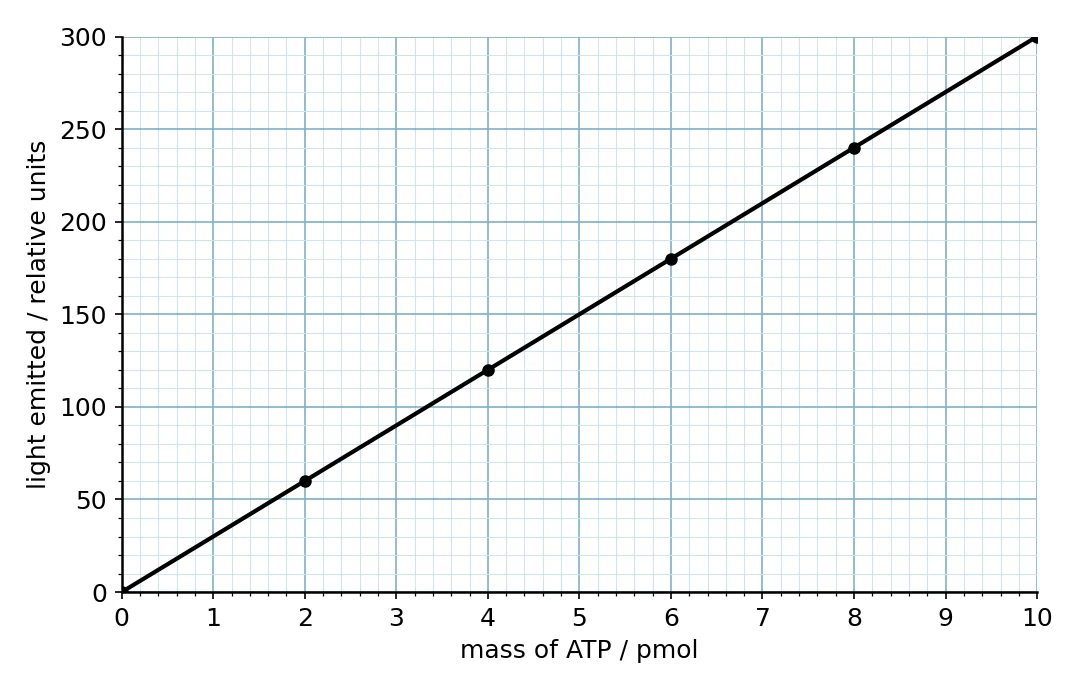
Food inspectors test surfaces using an enzyme that emits light when it reacts with ATP. The graph shows the light emitted by known masses of ATP.
Explain why the presence of ATP indicates that living cells are present.
A swab from a chopping board gives a reading of 165 relative units. Use the graph to determine the mass of ATP on the swab.
After cleaning, a swab from the same board gives 45 relative units. Calculate the percentage decrease in ATP on the board.
Suggest why the swab must be tested soon after it is taken.
revisionprep.com
Summary Answer
Not available for this question.
Model Answer
Not available for this question.
Marking Scheme
Not available for this question.
Examiner Insights
Not available for this question.
Role of mitochondria in energy production
Where in a mitochondrion are the ATP synthase molecules located?
revisionprep.com
Summary Answer
Not available for this question.
Model Answer
Not available for this question.
Marking Scheme
Not available for this question.
Examiner Insights
Not available for this question.
Glycolysis, Krebs cycle, and oxidative phosphorylation
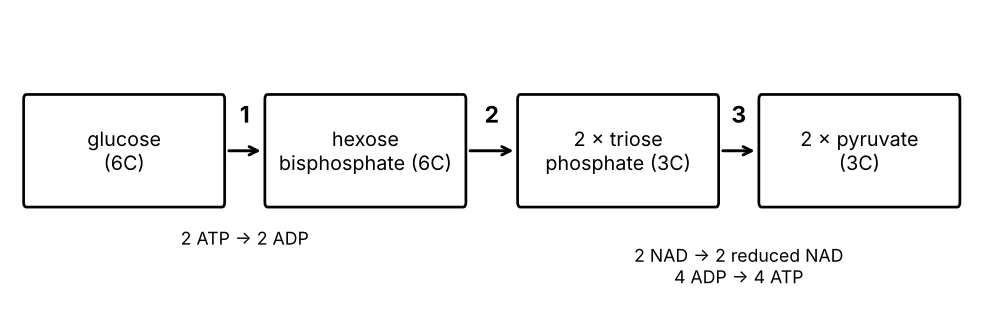
The shows glycolysis. Which numbered step includes the oxidation of triose phosphate?
revisionprep.com
Summary Answer
Not available for this question.
Model Answer
Not available for this question.
Marking Scheme
Not available for this question.
Examiner Insights
Not available for this question.
Role of mitochondria in energy production
Mitochondria from liver cells were placed in a sealed chamber of buffer at 30 °C, with an electrode recording the oxygen concentration. A respiratory substrate was added at 2 minutes and a respiratory inhibitor at 8 minutes. The graph shows the results.
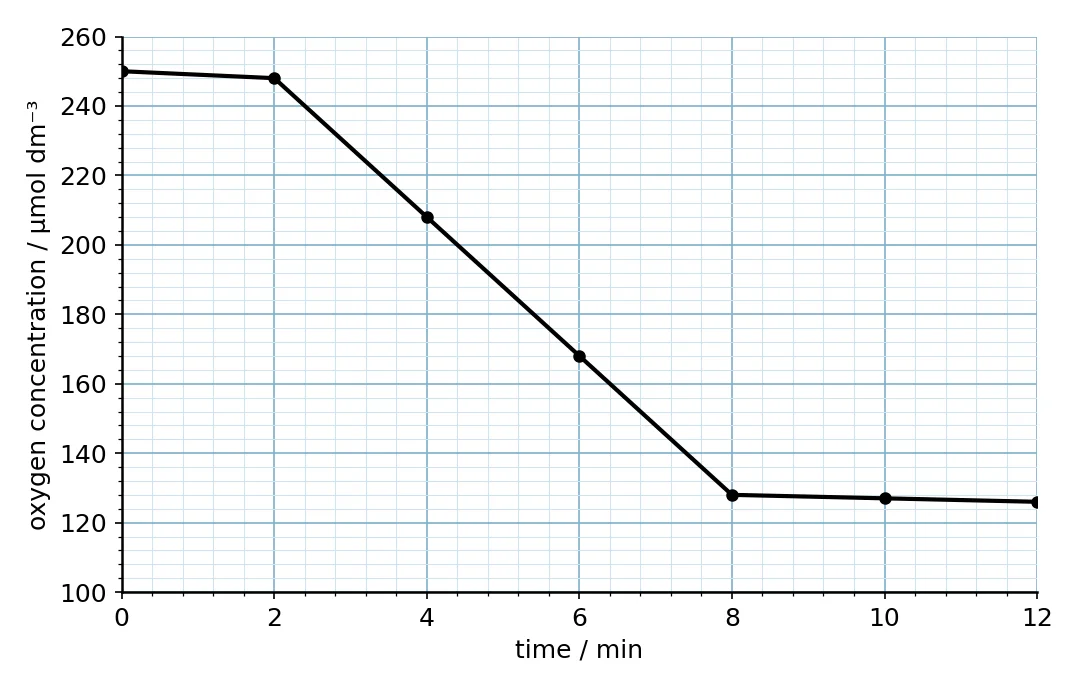
Calculate the mean rate of oxygen consumption between 2 and 8 minutes.
Explain why the oxygen concentration fell only after the substrate was added.
Describe and explain the effect of the inhibitor.
Suggest why the chamber was kept at a constant temperature.
revisionprep.com
Summary Answer
Not available for this question.
Model Answer
Not available for this question.
Marking Scheme
Not available for this question.
Examiner Insights
Not available for this question.
Glycolysis, Krebs cycle, and oxidative phosphorylation
Discs of carrot tissue were placed in an aerated solution of potassium ions at 25 °C. The potassium concentration inside the cells was higher than in the solution. The graph shows the potassium absorbed by the discs. In one set of discs (dashed line), a respiratory inhibitor was added at 3 hours.
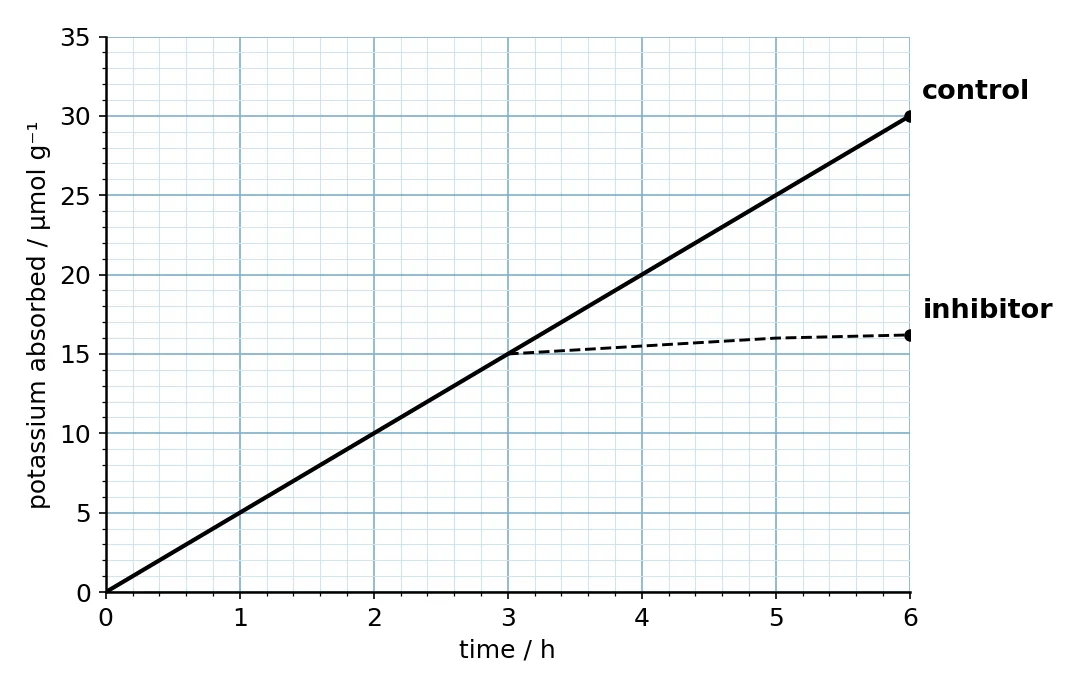
Calculate the mean rate of potassium uptake by the control discs over the 6 hours.
Describe the effect of the respiratory inhibitor on potassium uptake.
Explain the effect of the inhibitor on potassium uptake.
Predict, with a reason, how the rate of uptake by control discs at 5 °C would compare with that at 25 °C.
revisionprep.com
Summary Answer
Not available for this question.
Model Answer
Not available for this question.
Marking Scheme
Not available for this question.
Examiner Insights
Not available for this question.
Role of mitochondria in energy production
UCP1 is a protein in the inner mitochondrial membrane of brown fat cells. It lets protons flow back into the matrix without passing through ATP synthase. Wild-type mice and mice in which the UCP1 gene had been knocked out were moved from 22 °C to 4 °C, and their body temperature was recorded for 6 hours. Each point is the mean for six mice; the error bars show ± one standard deviation. The data are hypothetical.
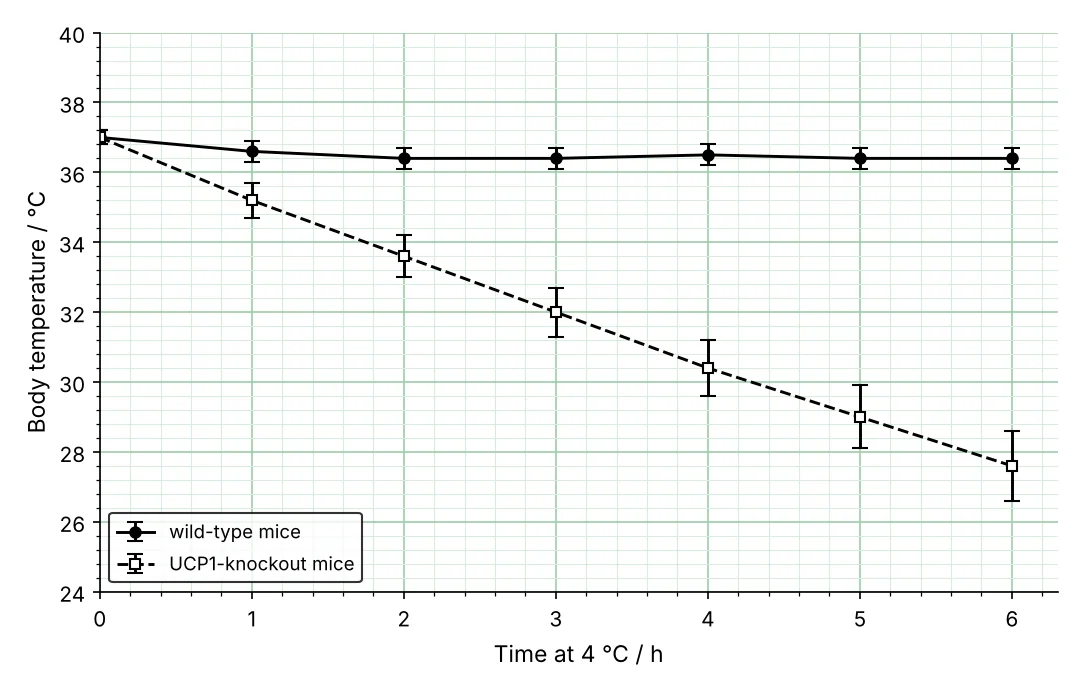
Calculate the mean rate of fall in body temperature of the knockout mice over the 6 hours.
Explain how UCP1 allows the wild-type mice to keep their body temperature almost constant at 4 °C.
Predict, with a reason, how the rate of oxygen consumption of brown fat in wild-type mice at 4 °C would compare with that in knockout mice.
Evaluate the claim that UCP1 is the only means by which mice produce heat in the cold.
revisionprep.com
Summary Answer
Not available for this question.
Model Answer
Not available for this question.
Marking Scheme
Not available for this question.
Examiner Insights
Not available for this question.
That's every free question here — 6 of 147.
+141 more questions, plus Mock Papers & Worksheets, are waiting in Premium.