Integration of Body Systems · Paper 1 — Free Biology HL Practice Questions
Free questions
Open in full, with answers, mark scheme and examiner insights.
Endocrine and nervous system integration
Volunteers stood on one foot with eyes closed, before and after drinking alcohol. The time each could balance was recorded, along with the number of errors in a finger-to-nose test (touching their nose with a fingertip from arm's length).
The results are shown in the table.
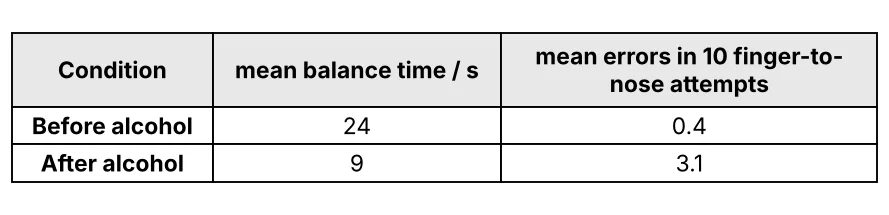
Calculate the percentage decrease in mean balance time after alcohol.
State the part of the brain most likely to be affected by alcohol in these tests.
Explain how this part of the brain normally allows a person to balance and to touch their nose accurately.
revisionprep.com
Summary Answer
Not available for this question.
Model Answer
Not available for this question.
Marking Scheme
Not available for this question.
Examiner Insights
Not available for this question.
Homeostasis and feedback mechanisms
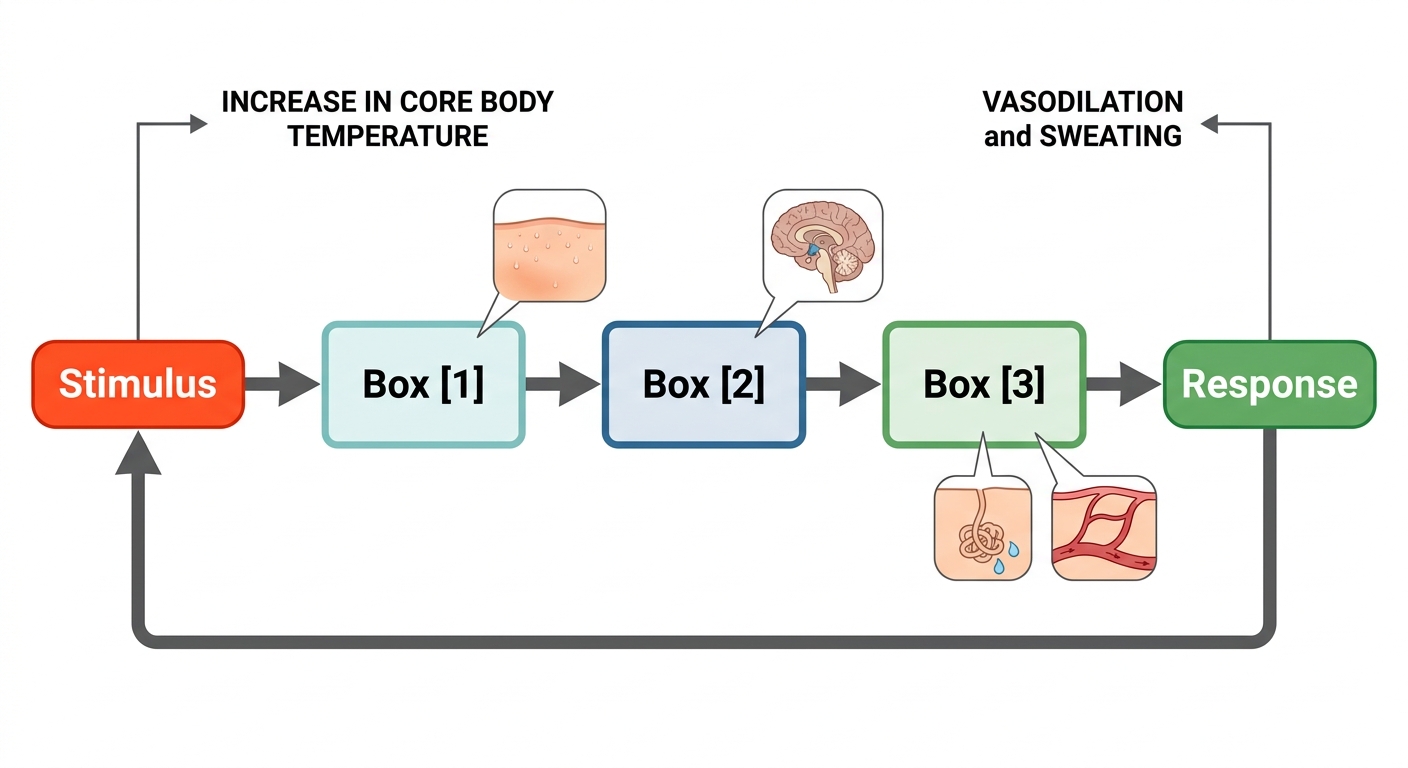
In a homeostatic control system, an increase in core body temperature is detected and corrected, resulting in vasodilation and sweating. A flow represents this process as: Stimulus → Box 1 → Box 2 → Box 3 → Response. Which row correctly identifies the components in Boxes 1, 2, and 3?
revisionprep.com
Summary Answer
Not available for this question.
Model Answer
Not available for this question.
Marking Scheme
Not available for this question.
Examiner Insights
Not available for this question.
Endocrine and nervous system integration
A researcher studies the fight-or-flight response in mice. She measures the concentration of glucose in the blood and the concentration of adrenaline in the plasma after exposing the mice to fox odour for minutes. The results are given in the table.

State the endocrine gland that releases adrenaline during the fight-or-flight response.
Calculate the percentage increase in plasma adrenaline concentration from resting state to after odour exposure.
Explain how adrenaline causes the observed increase in blood glucose concentration.
Evaluate the consequences for the mouse if only the nervous system, and not the endocrine system, were activated during the threat.
revisionprep.com
Summary Answer
Not available for this question.
Model Answer
Not available for this question.
Marking Scheme
Not available for this question.
Examiner Insights
Not available for this question.
Homeostasis and feedback mechanisms
Five young adults (Group A) and five adults aged over 75 (Group B) sat lightly clothed in a room at 35 °C for 30 minutes. The room was then cooled to 10 °C for a further 30 minutes. Mean core temperature, sweat rate and the time taken to start shivering were recorded. The results are shown in the table.

Calculate the percentage by which the mean sweat rate of Group B was lower than that of Group A.
Compare the changes in core temperature of the two groups during the cold phase.
Explain how the hypothalamus limits the fall in core temperature of Group A during the cold phase.
Using the data, suggest why older people are at greater risk during a heatwave.
Evaluate the design of this investigation.
revisionprep.com
Summary Answer
Not available for this question.
Model Answer
Not available for this question.
Marking Scheme
Not available for this question.
Examiner Insights
Not available for this question.
Endocrine and nervous system integration
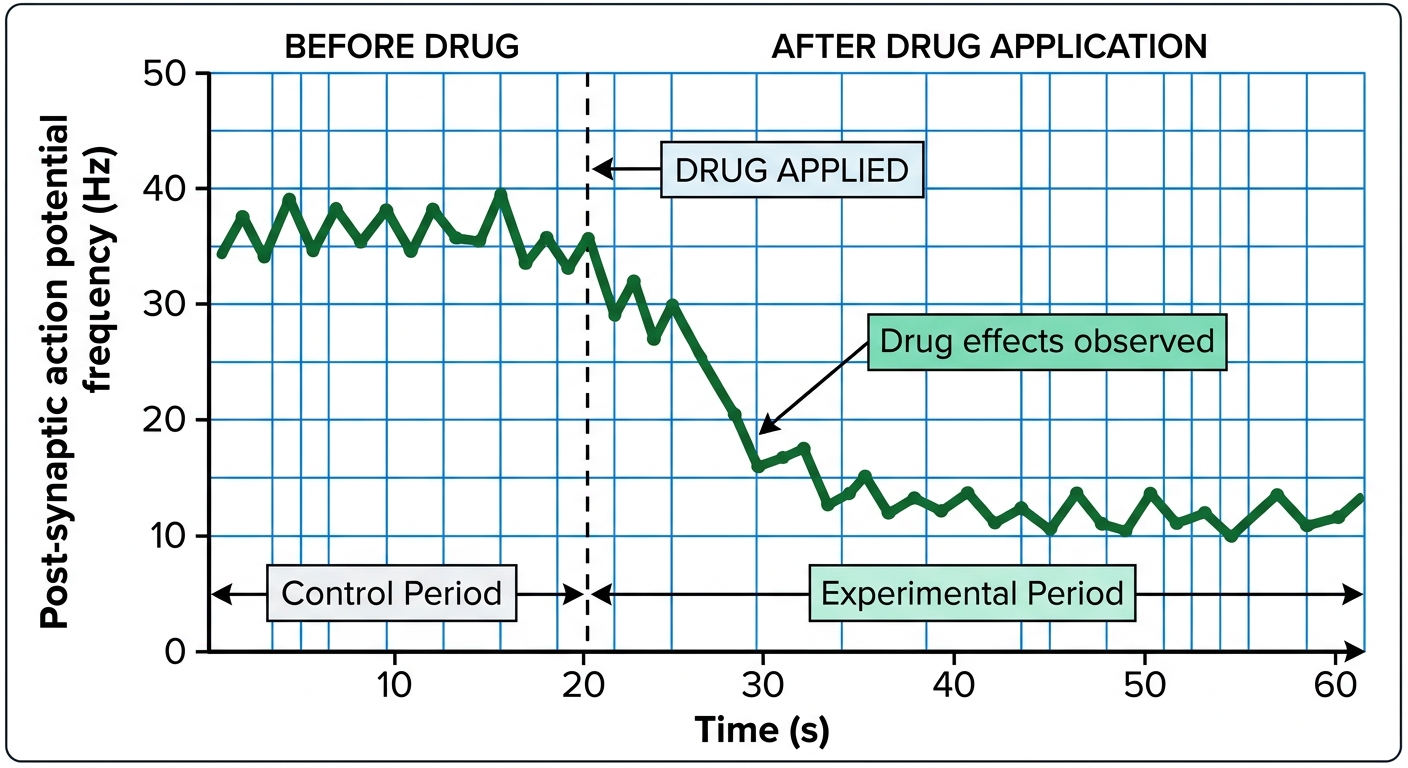
A drug is applied to a synapse between two neurons. The graph shows the frequency of action potentials in the post-synaptic neuron before and after the drug was applied. Which mode of action explains the result?
revisionprep.com
Summary Answer
Not available for this question.
Model Answer
Not available for this question.
Marking Scheme
Not available for this question.
Examiner Insights
Not available for this question.
Homeostasis and feedback mechanisms
An open-water swimmer swims for 40 minutes in water at 14 °C. Her core temperature, skin temperature and oxygen uptake are recorded.
The results are shown in the table.
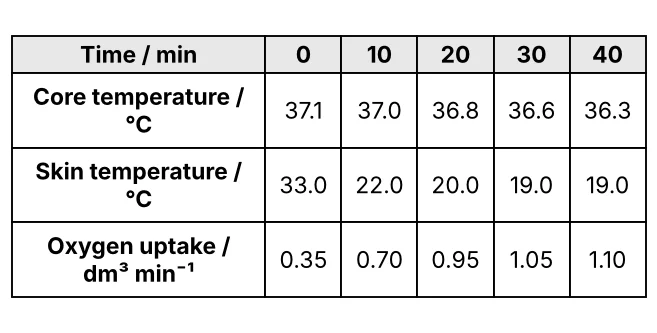
Describe the changes in skin temperature during the swim.
Calculate the percentage increase in oxygen uptake from 0 to 40 minutes.
Explain why the swimmer's oxygen uptake increases as she is cooled.
Suggest why core temperature continues to fall despite this response.
revisionprep.com
Summary Answer
Not available for this question.
Model Answer
Not available for this question.
Marking Scheme
Not available for this question.
Examiner Insights
Not available for this question.
That's every free question here — 6 of 110.
+104 more questions, plus Mock Papers & Worksheets, are waiting in Premium.