You're viewing 2 free preview questions for Biology HL — subscribe to unlock 62 more, plus the Full Question Bank, Mock Papers & Worksheets.Upgrade
Cell Respiration · Paper 2 — Free Biology HL Practice Questions
1MasterySAQ-SRole of mitochondria in energy production5 marksPaper 2~8 min

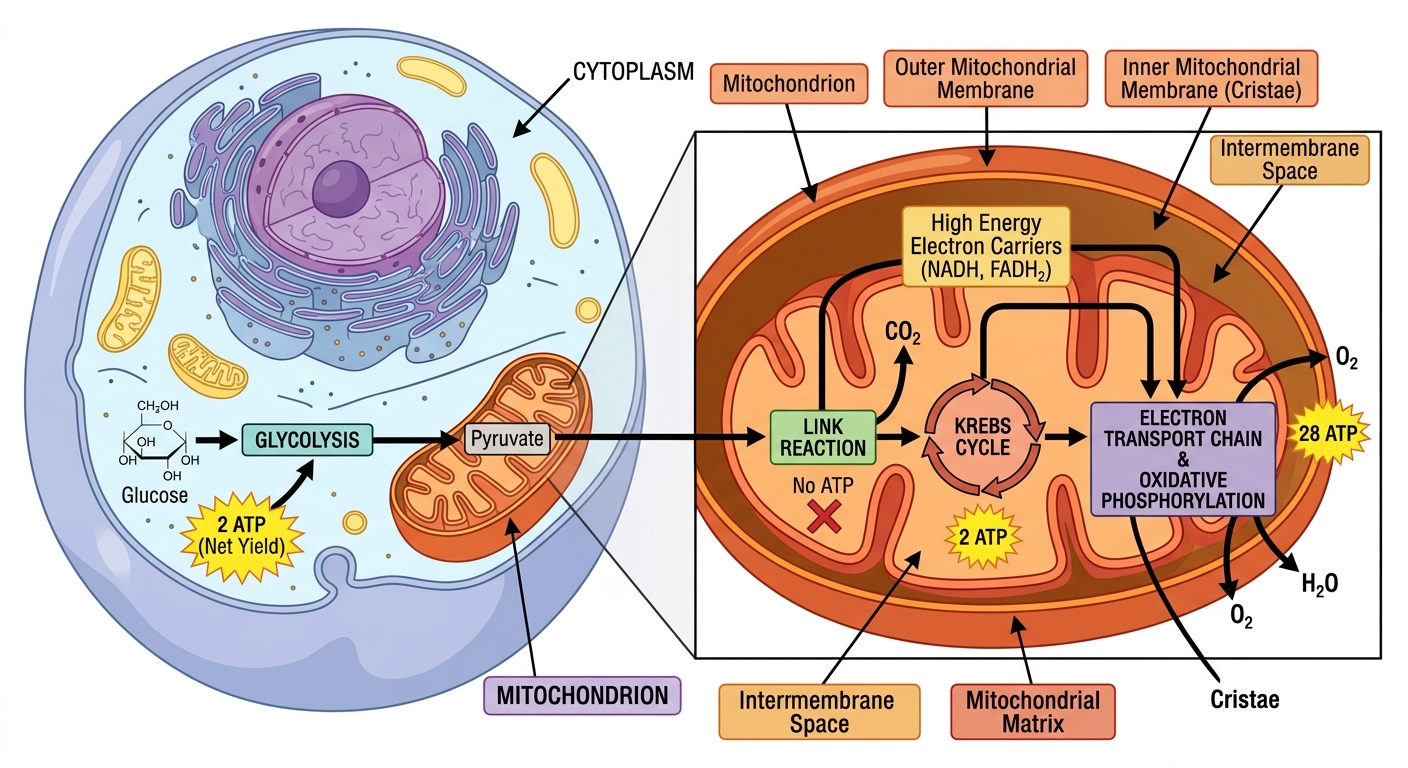
The below shows a simplified overview of aerobic respiration in a eukaryotic cell.
Use the following ATP yields for parts (b) and (c): glycolysis ; link reaction ; Krebs cycle ; oxidative phosphorylation .
(a)
State the location of the Krebs cycle within the mitochondrion. [1 mark]
(b)
Calculate the percentage of the total ATP yield, from one glucose molecule, that is produced inside the mitochondrion (Krebs cycle and oxidative phosphorylation combined). Show your working. [2 marks]
(c)
Explain why the link reaction and Krebs cycle are essential for the high ATP yield of aerobic respiration, even though they produce little ATP directly. [2 marks]

Solutions
2MasterySAQ-SRole of mitochondria in energy production7 marksPaper 2~11 min
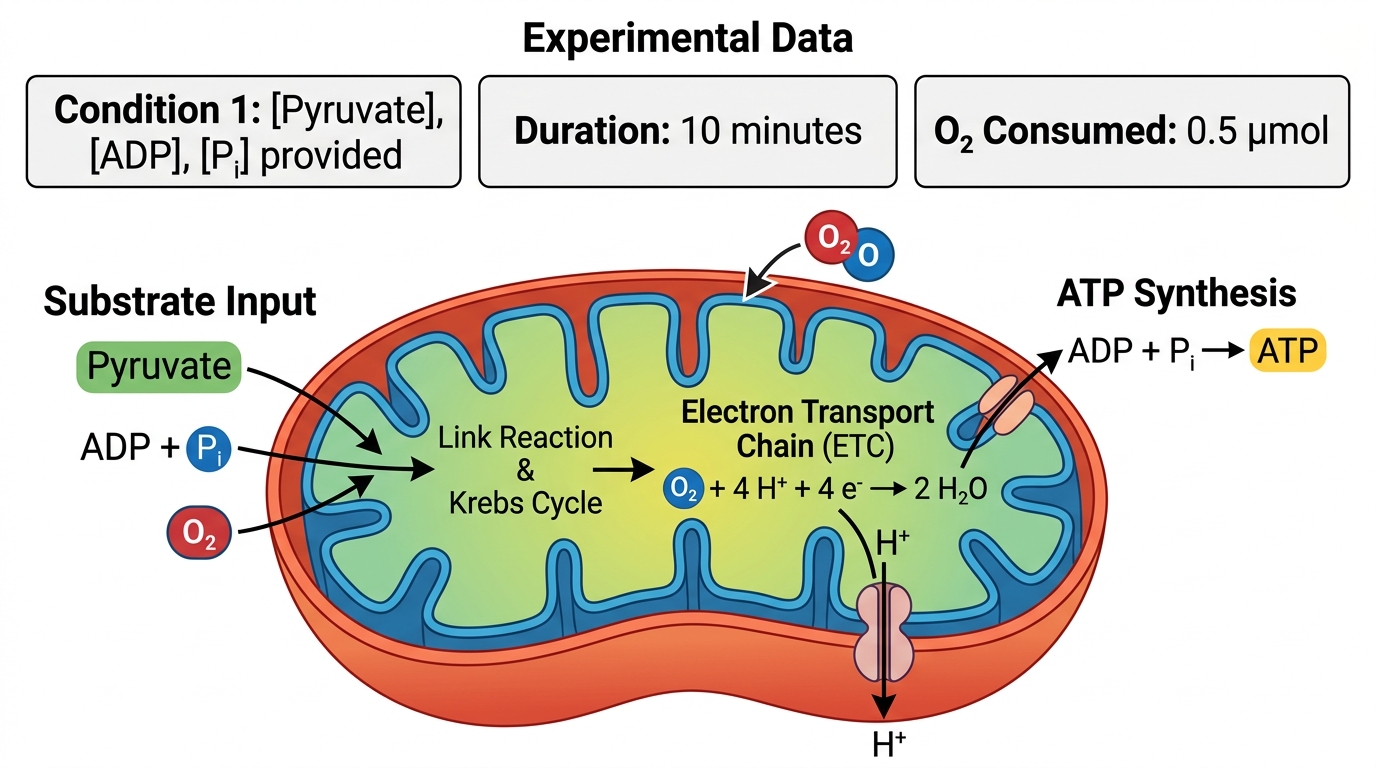
A researcher investigates aerobic cell respiration using isolated rat liver mitochondria. The mitochondria are supplied with pyruvate, ADP, and inorganic phosphate (). Oxygen consumption is measured over 10 minutes; of is consumed.
Assume: complete oxidation of one pyruvate via the link reaction and Krebs cycle yields , , and (substrate-level phosphorylation). Each NADH yields ; each FADH₂ yields . Each molecule accepts electrons; each NADH or FADH₂ donates electrons to the electron transport chain.
(a)
State the role of the inner mitochondrial membrane in the reaction that directly consumes oxygen. [1 mark]
(b)
Determine the number of moles of pyruvate oxidised from the oxygen consumption data. Show all working. [2 marks]
(c)
Calculate the maximum amount of ATP, in , that could be synthesised. Show all working. [2 marks]
(d)
Explain why the actual ATP yield in a living cell is lower than the value calculated in (c). [2 marks]
Solutions
That's every free question here — 2 of 64.
+62 more questions, plus Mock Papers & Worksheets, are waiting in Premium.