Chemical Signalling · Paper 2 — Free Biology HL Practice Questions
Free questions
Open in full, with answers, mark scheme and examiner insights.
Receptors and signalling chemicals
Signalling chemicals may act on cells close by or far away.
Distinguish between the localised and distant effects of signalling chemicals.
For each of the following, state whether its effect is localised or distant, giving a reason: an interleukin released at a site of infection; thyroxine released by the thyroid gland.
revisionprep.com
Summary Answer
Not available for this question.
Model Answer
Not available for this question.
Marking Scheme
Not available for this question.
Examiner Insights
Not available for this question.
Intracellular receptors and steroid hormones
Progesterone acts on cells of the endometrium.
State the source of progesterone in the second half of the menstrual cycle.
State two effects of progesterone on the endometrium.
State why endometrial cells respond to progesterone while most skin cells do not.
State what happens to the endometrium when progesterone falls at the end of the cycle.
revisionprep.com
Summary Answer
Not available for this question.
Model Answer
Not available for this question.
Marking Scheme
Not available for this question.
Examiner Insights
Not available for this question.
Cell communication and signaling
Liver cells were treated with a range of adrenaline concentrations. The cAMP concentration and the rate of glucose release were measured after 5 minutes. Glucose release was also measured in the presence of drug B, which binds the adrenaline receptor (hypothetical data).
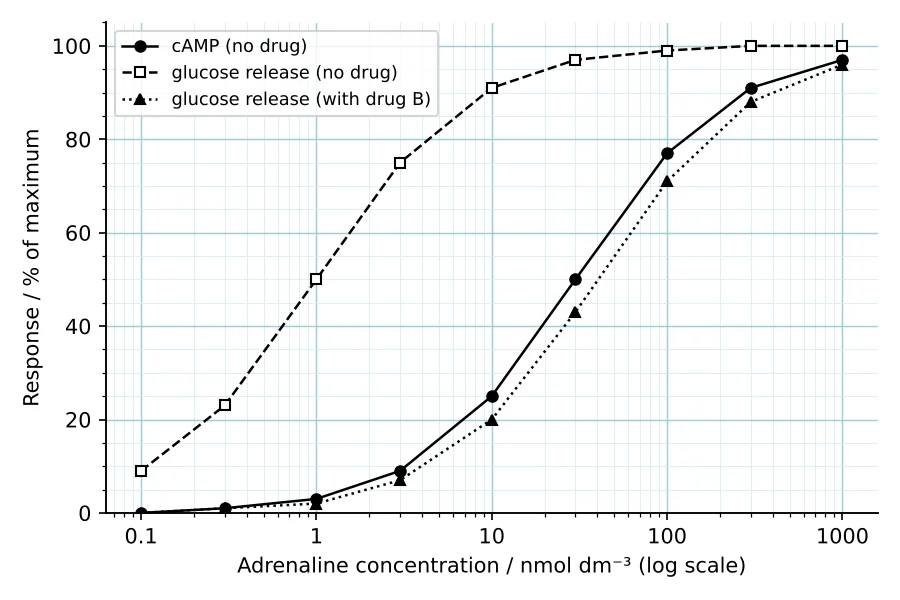
State the adrenaline concentration that gives 50% of the maximum cAMP response.
Compare the cAMP and glucose release curves without drug B.
Explain why glucose release reaches its maximum at a lower adrenaline concentration than cAMP does.
Describe the effect of drug B on glucose release.
Explain the effect of drug B.
Suggest why glucose release with drug B still reaches nearly 100% at the highest adrenaline concentration.
Outline how an increase in cAMP leads to glucose release.
revisionprep.com
Summary Answer
Not available for this question.
Model Answer
Not available for this question.
Marking Scheme
Not available for this question.
Examiner Insights
Not available for this question.
Quorum sensing
To test how quorum sensing controls light emission, three cultures of Vibrio fischeri were grown in identical flasks for 16 hours: wild type; wild type diluted with fresh medium every 2 hours to keep its density low; and a luxI mutant to which AHL was added at time 0, at a concentration above the threshold. The wild type and the mutant grew at the same rate (hypothetical data).
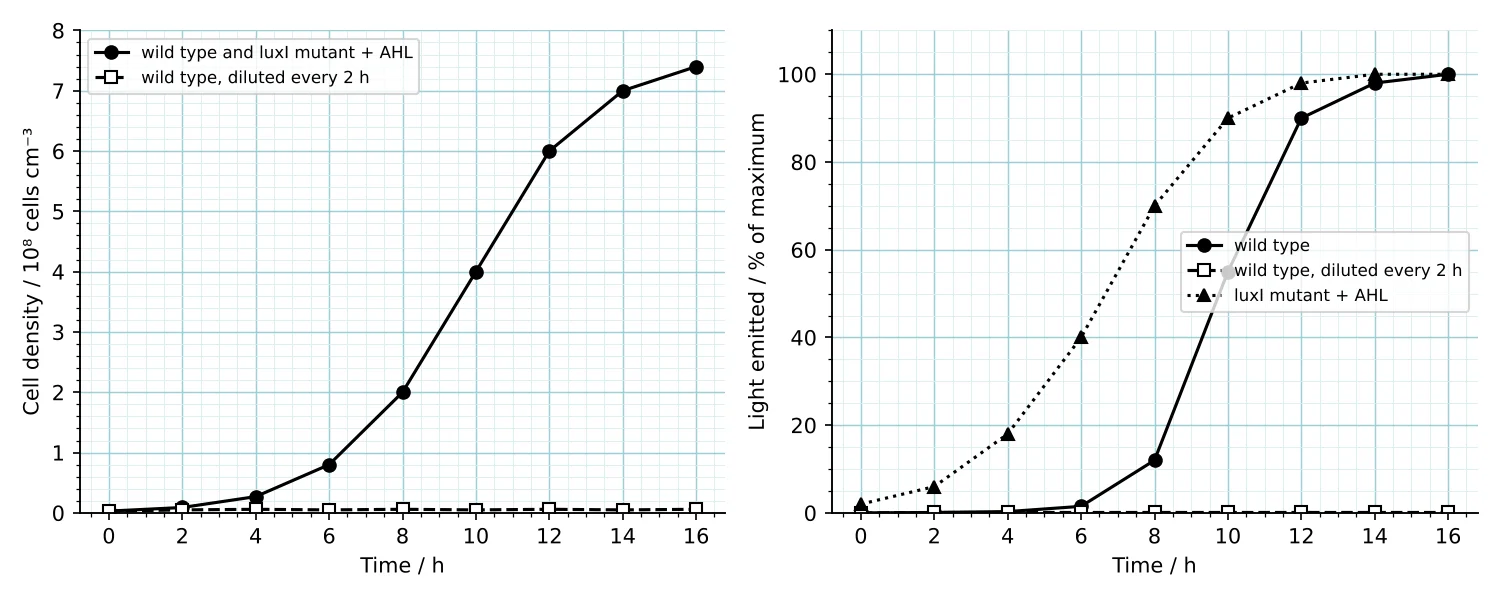
Describe the relationship between cell density and light emission in the undiluted wild type.
State the approximate cell density at which light emission by the wild type begins to rise steeply.
Explain why the diluted culture emits almost no light.
Explain why the luxI mutant with added AHL emits light from the start.
Calculate the light emitted per 10⁸ cells cm⁻³ at 6 hours by the wild type and by the luxI mutant with AHL, and comment on the difference.
Evaluate the conclusion that cell density, rather than time, controls light emission.
State one variable that should be controlled.
revisionprep.com
Summary Answer
Not available for this question.
Model Answer
Not available for this question.
Marking Scheme
Not available for this question.
Examiner Insights
Not available for this question.
Receptors and signalling chemicals
Cytokine X was injected into the muscle of one hind leg of mice, at a low dose or a high dose (eight mice per dose). Two hours later the concentration of X was measured in tissue from the injected leg, the opposite leg and the blood plasma. Six hours after injection the number of neutrophils (phagocytic white blood cells) in each leg was counted (hypothetical data).
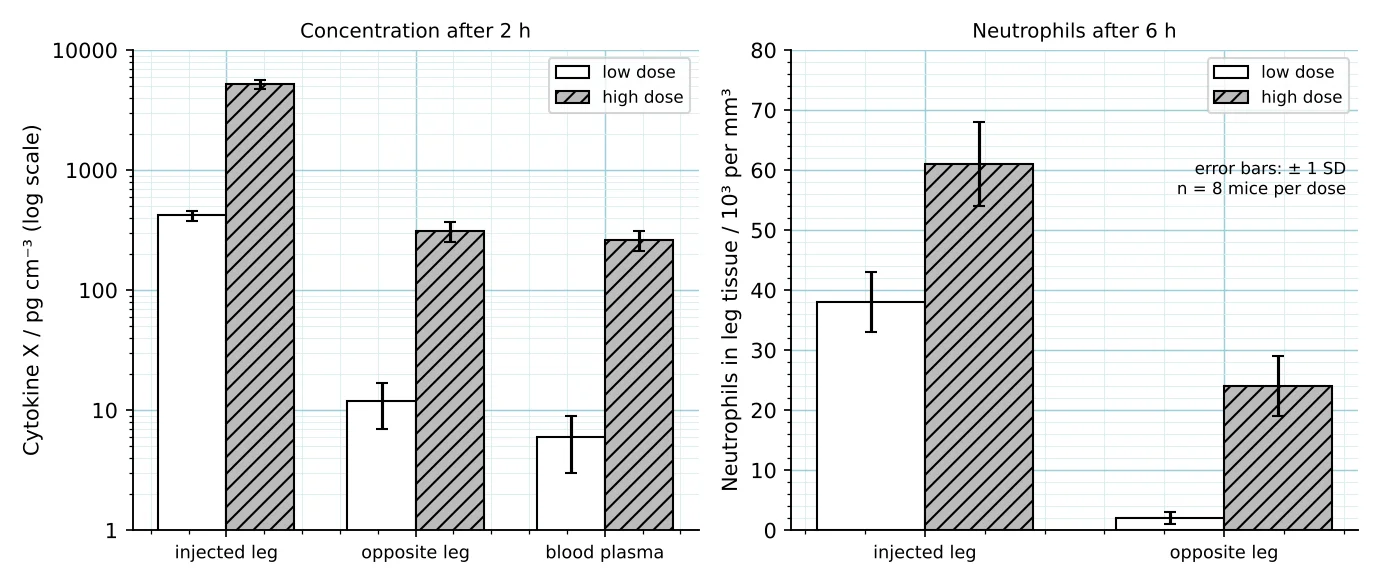
Calculate the ratio of the concentration of X in the injected leg to that in the opposite leg at the high dose.
Compare the distribution of cytokine X at the low and high doses.
Deduce whether X has localised or distant effects at each dose, using both sets of data.
Explain why neutrophils gather only in the injected leg at the low dose.
Evaluate the design of this experiment and suggest one improvement.
Suggest how a high level of a cytokine can cause effects throughout the body.
revisionprep.com
Summary Answer
Not available for this question.
Model Answer
Not available for this question.
Marking Scheme
Not available for this question.
Examiner Insights
Not available for this question.
Cell communication and signaling
In a TRH stimulation test, the hormone TRH is injected into a vein and plasma TSH is measured. TRH binds G protein-coupled receptors on pituitary cells, and TSH stimulates thyroxine secretion; thyroxine inhibits TSH secretion. The graph shows results for five groups of patients: group 1 healthy; group 2 with thyroid failure; group 3 with pituitary failure; group 4 with failure of the hypothalamus; group 5 taking high doses of thyroxine tablets (hypothetical data).
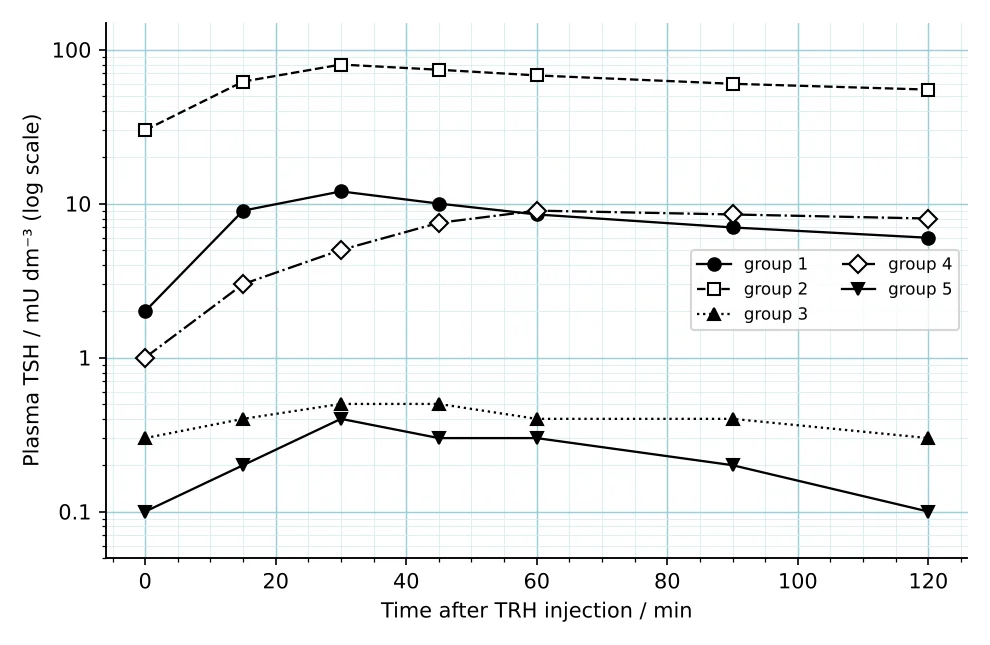
Calculate the increase in TSH in group 1 between 0 and 30 minutes.
Explain how TRH injection increases TSH secretion in group 1.
Explain why group 2 has a high TSH before the injection and an exaggerated response to TRH.
Explain the results for group 3.
Suggest why group 4 responds to injected TRH, although its response is delayed.
Explain why group 5 shows almost no response to TRH.
Evaluate the usefulness of this test for finding where a fault lies in the control of thyroxine.
revisionprep.com
Summary Answer
Not available for this question.
Model Answer
Not available for this question.
Marking Scheme
Not available for this question.
Examiner Insights
Not available for this question.
That's every free question here — 6 of 125.
+119 more questions, plus Mock Papers & Worksheets, are waiting in Premium.