You're viewing 2 free preview questions for Biology HL — subscribe to unlock 61 more, plus the Full Question Bank, Mock Papers & Worksheets.Upgrade
Defence Against Disease · Paper 2 — Free Biology HL Practice Questions
1ChallengeSAQ-LVaccines and immunity12 marksPaper 2~18 min

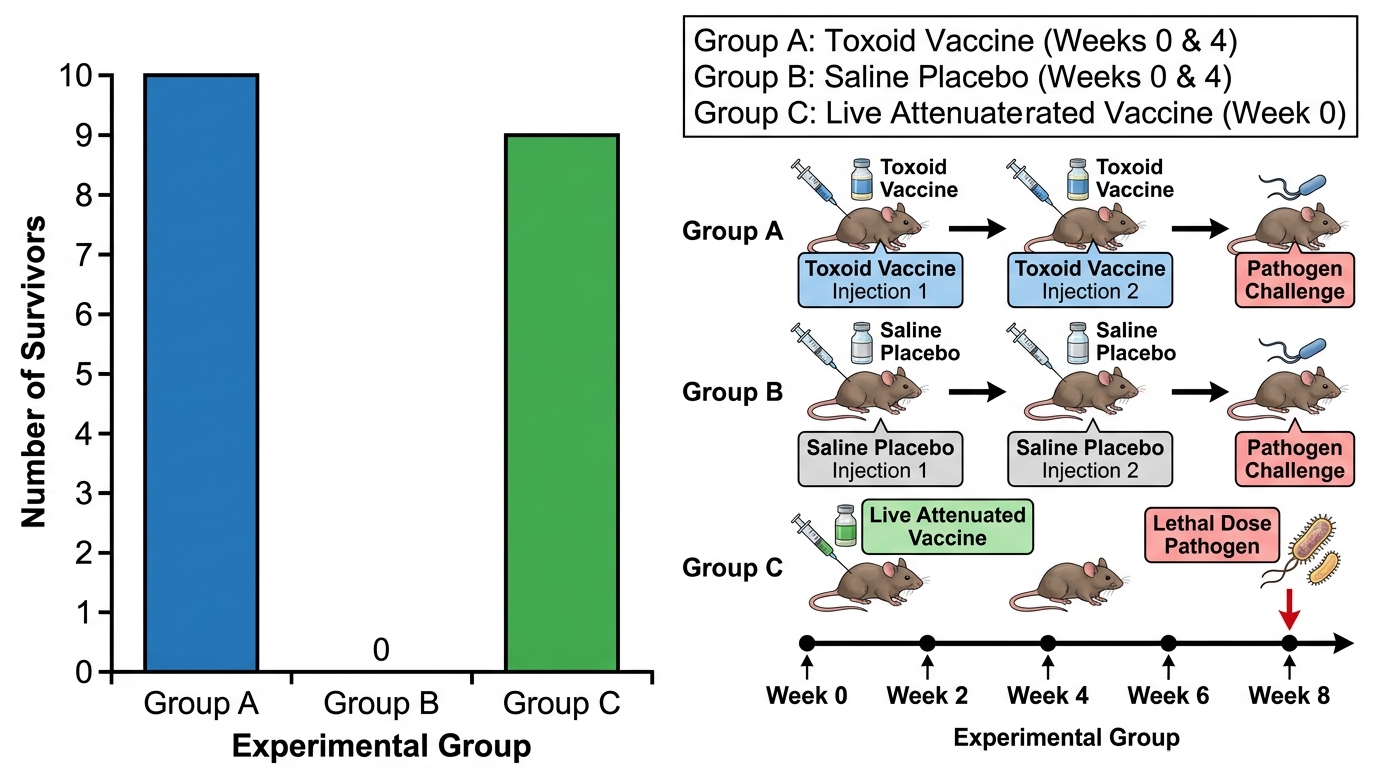
A researcher studies the effectiveness of two experimental vaccines against a bacterial pathogen that produces a potent exotoxin. The vaccines are tested in three groups of ten mice each:
- Group A: vaccinated with a chemically inactivated exotoxin (toxoid) at week 0 and week 4.
- Group B: injected with a saline placebo at week 0 and week 4.
- Group C: injected with a single dose of a live attenuated bacterial vaccine at week 0.
At week 8, all mice are challenged with a lethal dose of the live pathogen. Results are shown below.
Group — Survival — Time to symptom onset — Outcome
A — 10/10 — 48 hours — Resolved by 72 hours
B — 0/10 — 12 hours — Death by 24 hours
C — 9/10 — 36 hours — Resolved by 60 hours; one mouse died at 30 hours
(a)
Calculate the percentage survival rate for Groups A, B, and C. [1 mark]
(b)
Explain how the immune response to the toxoid vaccine in Group A differs mechanistically from the immune response to the live attenuated vaccine in Group C, with reference to the types of antigens presented and the branches of the immune system activated. [3 marks]
(c)
Using the data and your knowledge of vaccine mechanisms, evaluate whether the toxoid vaccine or the live attenuated vaccine provides more effective and safer long-term protection against this pathogen. In your answer, consider survival data, time to symptom onset, and the limitations of each vaccine strategy. [4]
Total:
(Note: total adjusted to 8 to match recalibrated sub-part marks: 1 + 3 + 4) [8 marks]

Solutions
2ChallengeSAQ-LDisorders of the immune system (e.g. autoimmune diseases)7 marksPaper 2~11 min
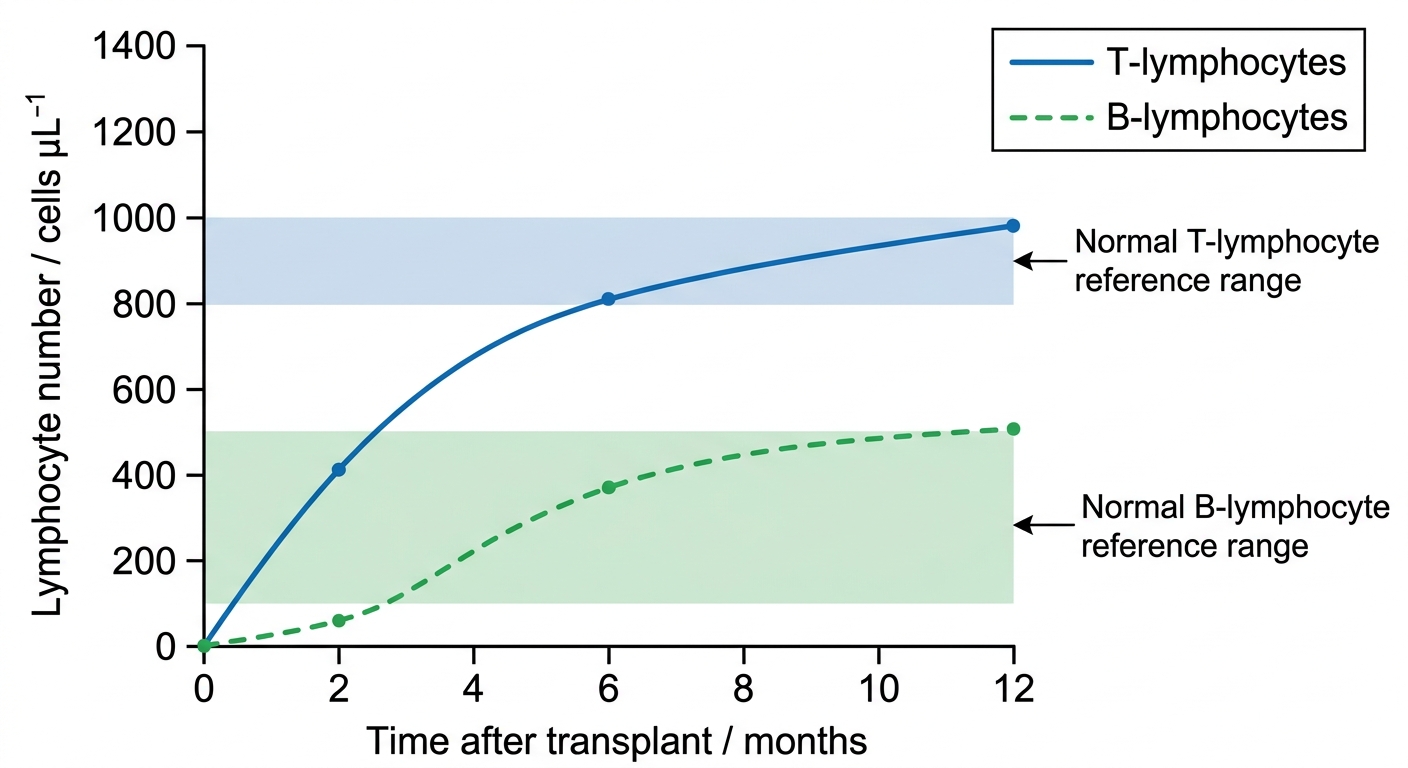
Severe combined immunodeficiency (SCID) is a genetic disorder in which both B-lymphocytes and T-lymphocytes are absent or non-functional. A patient with SCID received a bone marrow transplant from a healthy sibling. The table below shows lymphocyte counts in the patient's blood over 12 months following the transplant, alongside normal reference ranges.
Time (months) — T-cells — B-cells
0 — 0
6 — 800 — 200
1200 — 600
Normal range — 800–2000 — 100–500
(a)
Calculate the rate of increase in T-cell count between month 0 and month 6. Give your answer in . [2 marks]
(b)
Explain why rising T-cell numbers alone are insufficient to protect the patient against bacterial infections in the weeks following the transplant. [2 marks]
(c)
Using the data and your knowledge of immunology, evaluate whether bone marrow transplantation constitutes a permanent cure for SCID. Your answer must include a justified conclusion. [3 marks]
Solutions
That's every free question here — 2 of 63.
+61 more questions, plus Mock Papers & Worksheets, are waiting in Premium.