You're viewing 2 free preview questions for Biology HL — subscribe to unlock 55 more, plus the Full Question Bank, Mock Papers & Worksheets.Upgrade
Enzymes and Metabolism · Paper 2 — Free Biology HL Practice Questions
1MasterySAQ-SMetabolic pathways: Anabolism and catabolism5 marksPaper 2~8 min

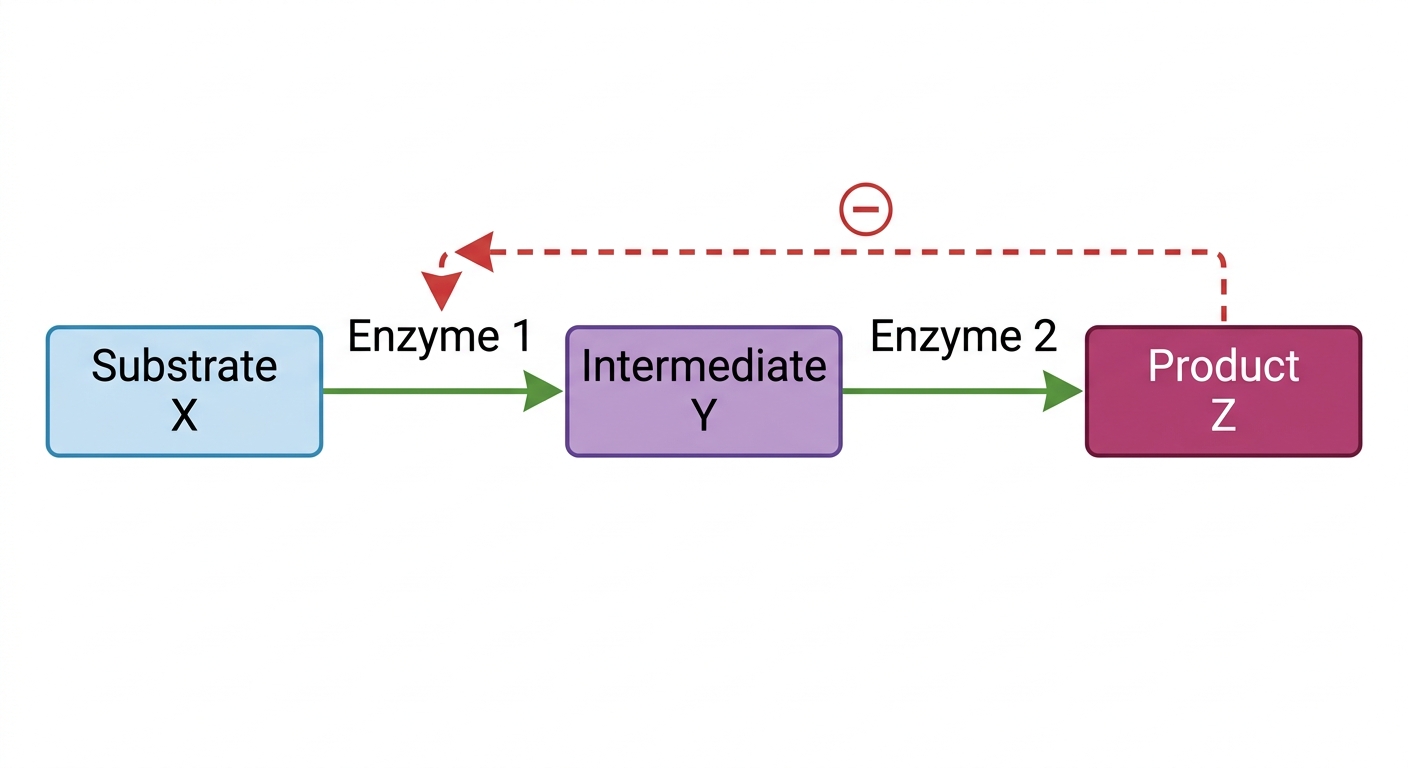
The shows a metabolic pathway in Escherichia coli that synthesises product Z from substrate X via intermediate Y.
(a)
Identify the site at which product Z acts and state the term for this type of enzyme regulation. [2 marks]
(b)
Describe how end-product inhibition controls the concentration of product Z in the cell. [2 marks]
(c)
Evaluate the advantage of regulating Enzyme 1 rather than Enzyme 2 in this pathway. [1 mark]

Solutions
2ChallengeSAQ-LEnzyme kinetics and inhibition10 marksPaper 2~15 min
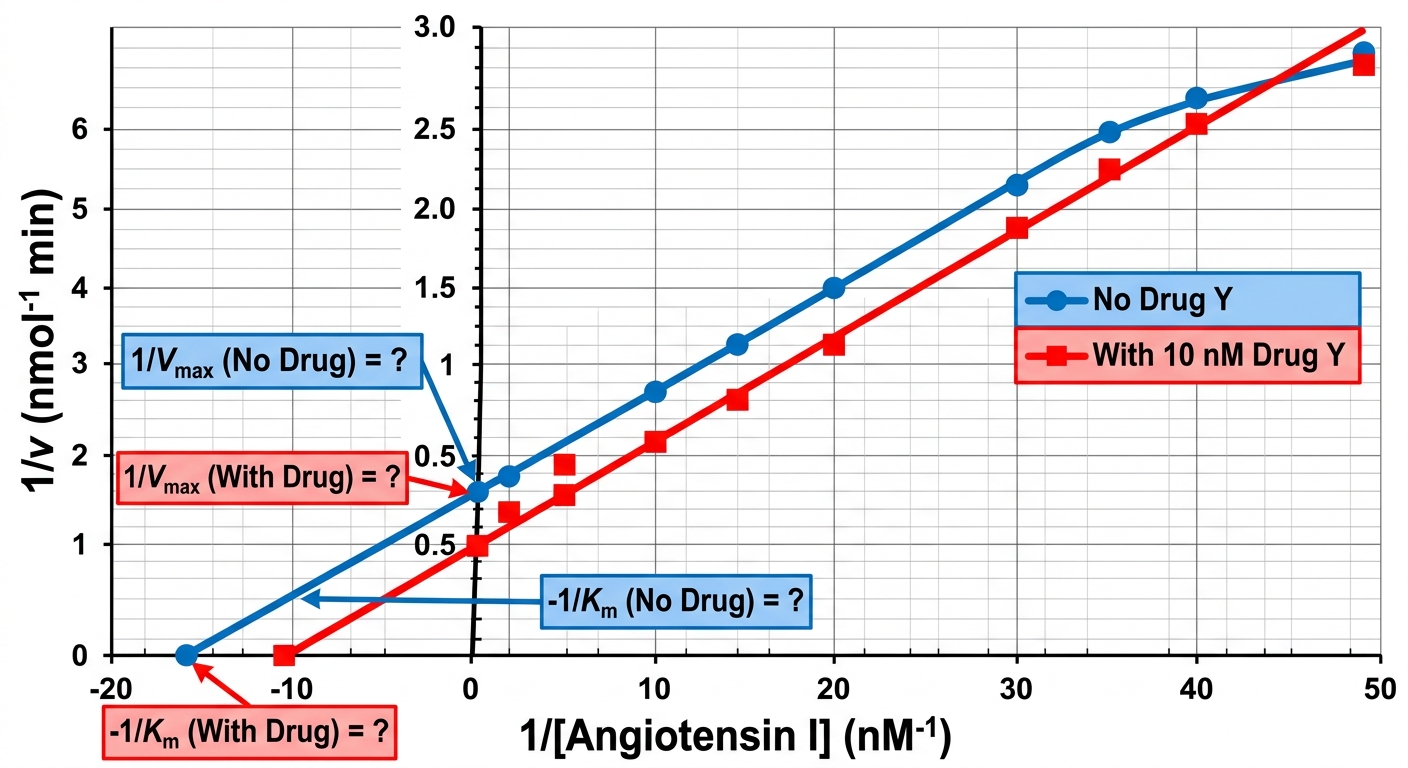
A pharmaceutical company is testing drug Y as a potential treatment for hypertension. Drug Y inhibits angiotensin-converting enzyme (ACE), which converts angiotensin I to angiotensin II. The kinetics of ACE were studied in vitro at fixed enzyme concentration.
— — no drug — — with drug Y
— —
— —
— —
— —
— —
(a)
Using the Lineweaver–Burk linearisation, calculate and for ACE both in the absence and in the presence of drug Y. [4 marks]
(b)
Using your values from (a), deduce whether drug Y acts a competitive or non-competitive inhibitor of ACE. [2 marks]
(c)
Evaluate the use of non-competitive ACE inhibitors antihypertensive drugs, considering both their pharmacological advantages over competitive inhibitors and the limitations arising from their mechanism of action. [4 marks]
Solutions
That's every free question here — 2 of 57.
+55 more questions, plus Mock Papers & Worksheets, are waiting in Premium.