You're viewing 2 free preview questions for Biology HL — subscribe to unlock 69 more, plus the Full Question Bank, Mock Papers & Worksheets.Upgrade
Integration of Body Systems · Paper 2 — Free Biology HL Practice Questions
1MasterySAQ-SHomeostasis and feedback mechanisms5 marksPaper 2~8 min

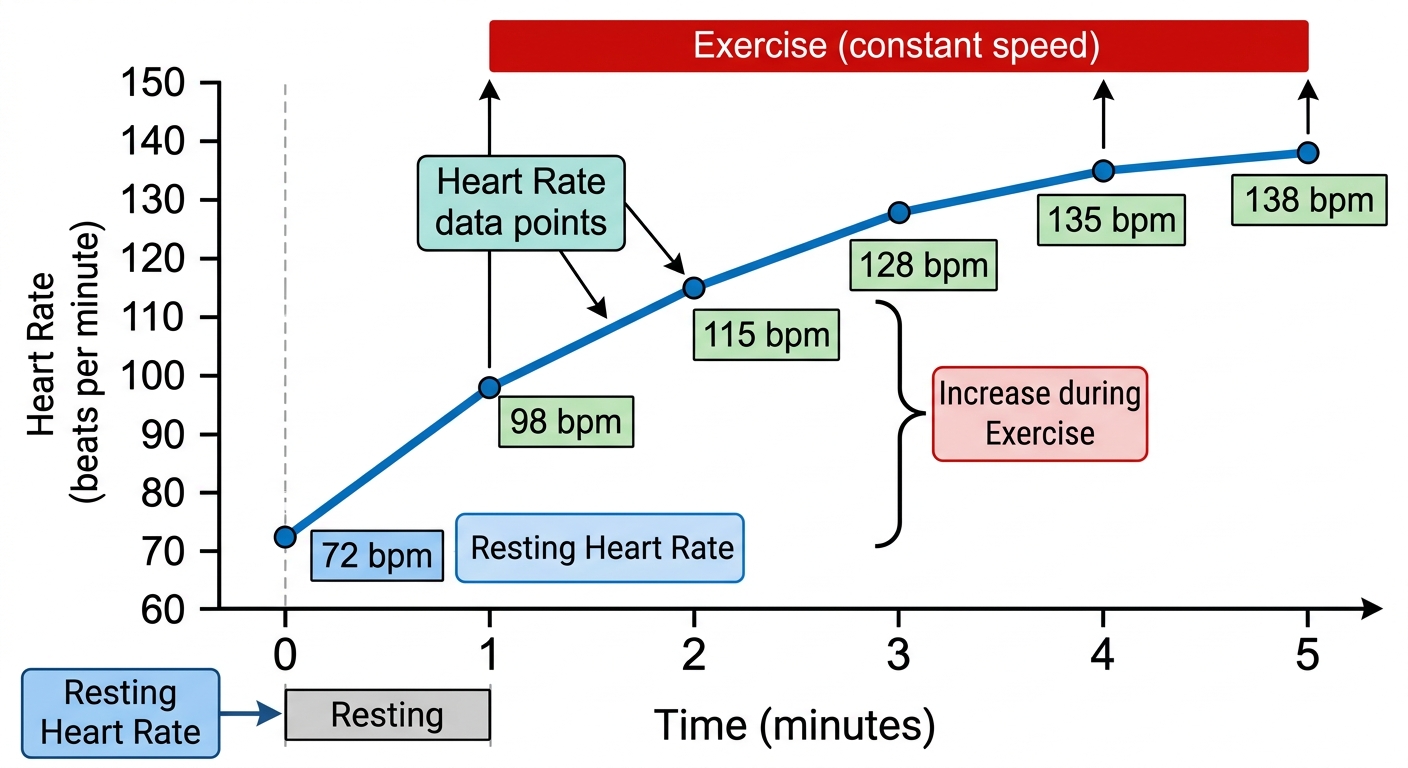
A student investigates the effect of exercise on heart rate. She measures her resting heart rate, then runs on a treadmill for 5 minutes at a constant speed, recording her heart rate every minute.
Time — Heart rate / bpm
Rest (0 min) — 72
1 min — 98
2 min — 115
3 min — 128
4 min — 135
5 min — 138
(a)
State the chemical stimulus detected by chemoreceptors that triggers the increase in heart rate during exercise. [1 mark]
(b)
Explain the role of the coordinating centre and the effector in the homeostatic feedback mechanism that causes heart rate to increase during exercise. [2 marks]
(c)
Calculate the percentage increase in heart rate from rest to the end of 5 minutes of exercise. [1 mark]
(d)
The rate of increase in heart rate slows between minutes 3 and 5. Deduce what this pattern suggests about the physiological state of the student at 5 minutes of exercise. [1 mark]

Solutions
2ChallengeSAQ-LEndocrine and nervous system integration7 marksPaper 2~11 min
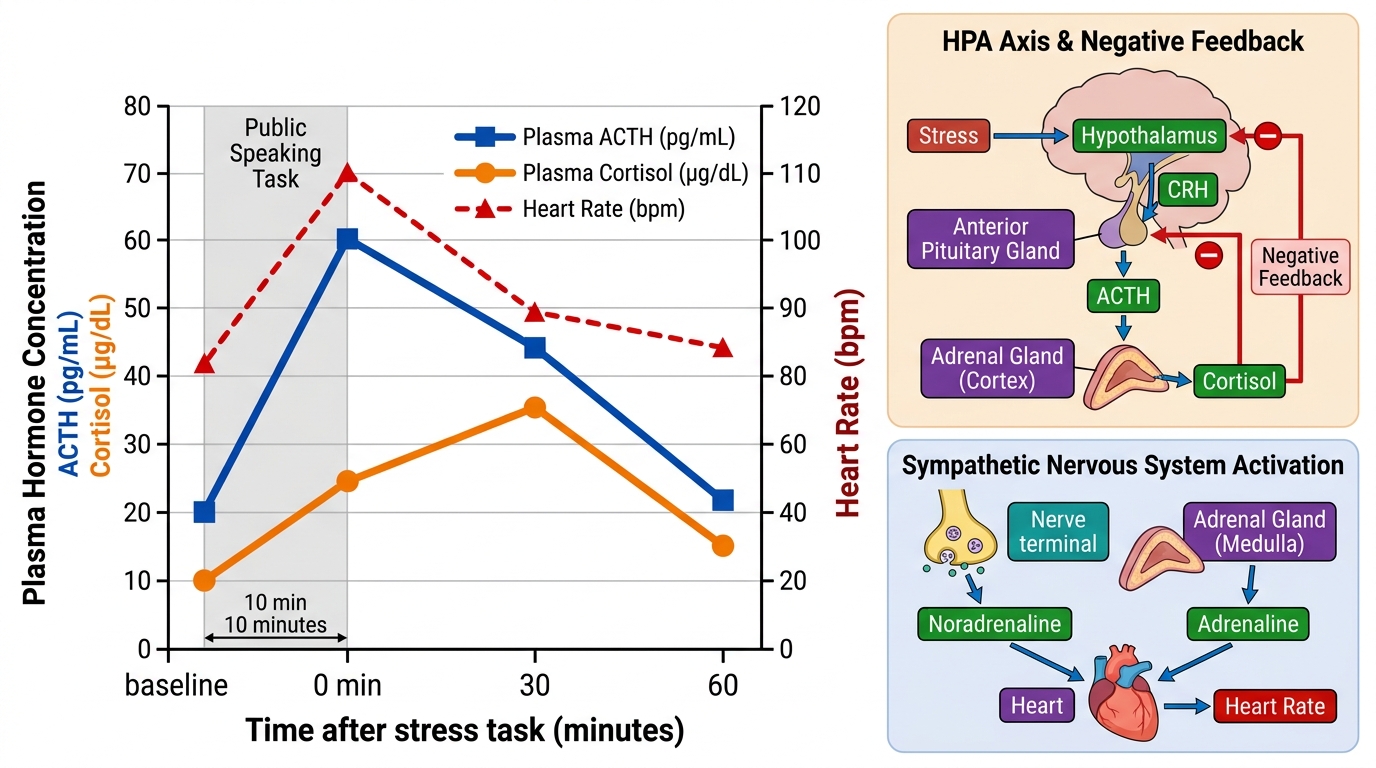
A clinical study investigates the role of the hypothalamus–pituitary–adrenal (HPA) axis integrating nervous and endocrine responses to acute psychological stress. Twenty healthy volunteers perform a 10-minute public speaking task. Blood samples are taken before the task (baseline), immediately after (0 min), and at 30 and 60 minutes after the task.
Time point — Plasma cortisol () — Plasma ACTH (pg/mL) — Heart rate (bpm)
Baseline — 10 — 20 — 70
0 min — 25 — 60 — 110
30 min — 35 — 45 — 80
60 min — 15 — 22 — 72
Additional information:
- HPA axis pathway: stress hypothalamus releases CRH anterior pituitary releases ACTH adrenal cortex releases cortisol; cortisol exerts negative feedback on the hypothalamus and anterior pituitary.
- The sympathetic nervous system is activated during stress, releasing noradrenaline from nerve terminals and adrenaline from the adrenal medulla.
(a)
Determine the time lag between the peak plasma ACTH concentration and the peak plasma cortisol concentration. [1 mark]
(b)
Explain how the nervous system integrates with the endocrine system to produce the observed cortisol response, and how negative feedback regulates this response. [4 marks]
(c)
Using the data in the table, evaluate the statement: 'The rise in heart rate immediately after the stress task is primarily caused by cortisol, not by the sympathetic nervous system.' [2 marks]
Solutions
That's every free question here — 2 of 71.
+69 more questions, plus Mock Papers & Worksheets, are waiting in Premium.