Neural Signaling · Paper 2 — Free Biology HL Practice Questions
Free questions
Open in full, with answers, mark scheme and examiner insights.
Nervous system coordination and reflex arcs
This question is about the pain withdrawal reflex.
Draw a labelled diagram of a pain withdrawal reflex arc, from receptor to effector.
Outline the role of each type of neuron in the pain withdrawal reflex arc.
Describe the events in the pain withdrawal reflex when a finger touches a sharp object, and explain why it is an advantage for this response to be involuntary.
revisionprep.com
Summary Answer
Not available for this question.
Model Answer
Not available for this question.
Marking Scheme
Not available for this question.
Examiner Insights
Not available for this question.
Synaptic transmission
Synapses are found between neurons and also between neurons and effector cells.
State two types of effector cell with which neurons form synapses.
State the neurotransmitter released at a neuromuscular junction.
Outline what happens at the membrane of a muscle fibre when this neurotransmitter binds to it.
revisionprep.com
Summary Answer
Not available for this question.
Model Answer
Not available for this question.
Marking Scheme
Not available for this question.
Examiner Insights
Not available for this question.
Structure of neurons
The diagrams compare a squid giant axon (diameter , unmyelinated) with a human myelinated axon (diameter ). The squid axon conducts at and the human axon at .
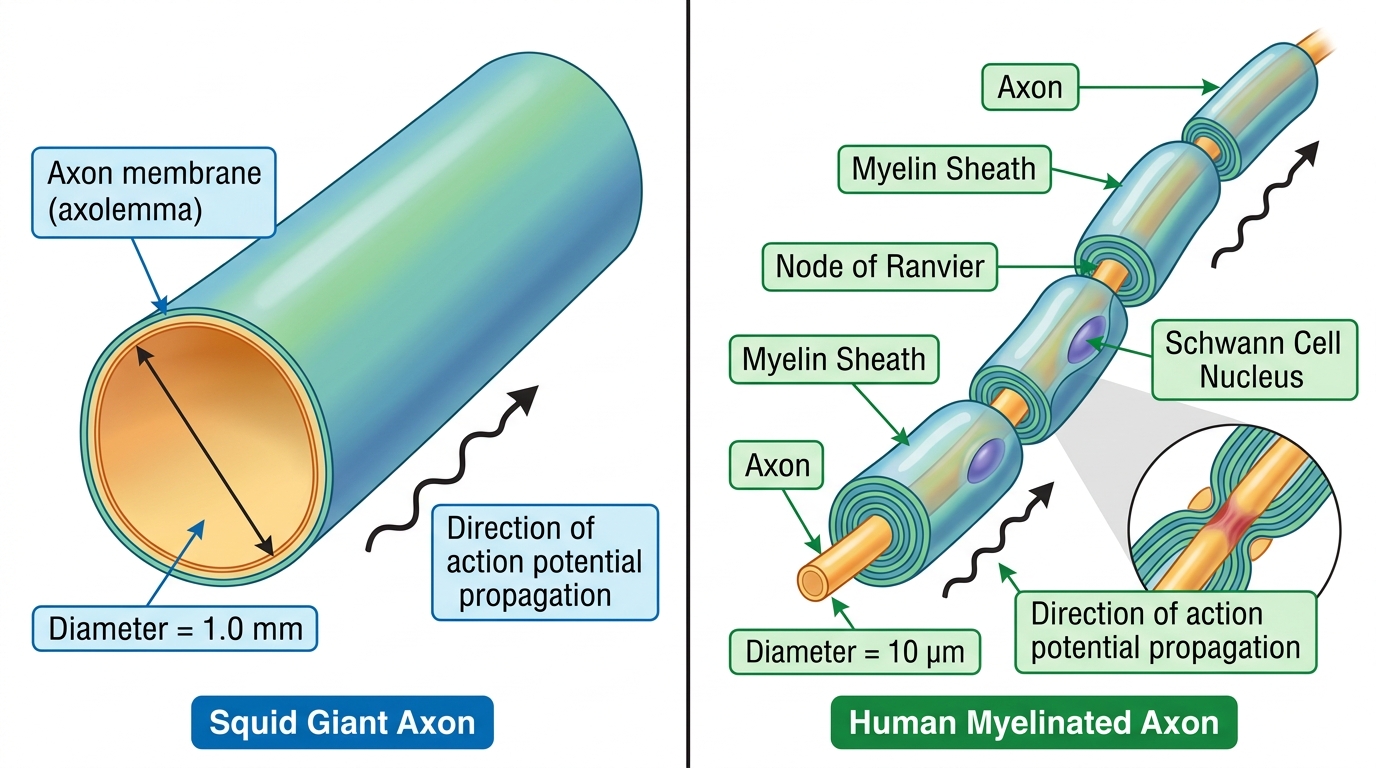
State the feature of the squid giant axon that increases its conduction speed.
Calculate how many times wider the squid axon is than the human axon.
Calculate how many times faster the human axon conducts than the squid axon.
Using your answers to (b) and (c), evaluate which is the more effective way to increase conduction speed.
revisionprep.com
Summary Answer
Not available for this question.
Model Answer
Not available for this question.
Marking Scheme
Not available for this question.
Examiner Insights
Not available for this question.
Inhibitory synapses, summation and pain perception (AHL)
The trace shows the membrane potential at the axon hillock of a postsynaptic neuron. Excitatory neurons E1 and E2 and inhibitory neuron I synapse with it. The arrows show the times at which neurons were stimulated once.
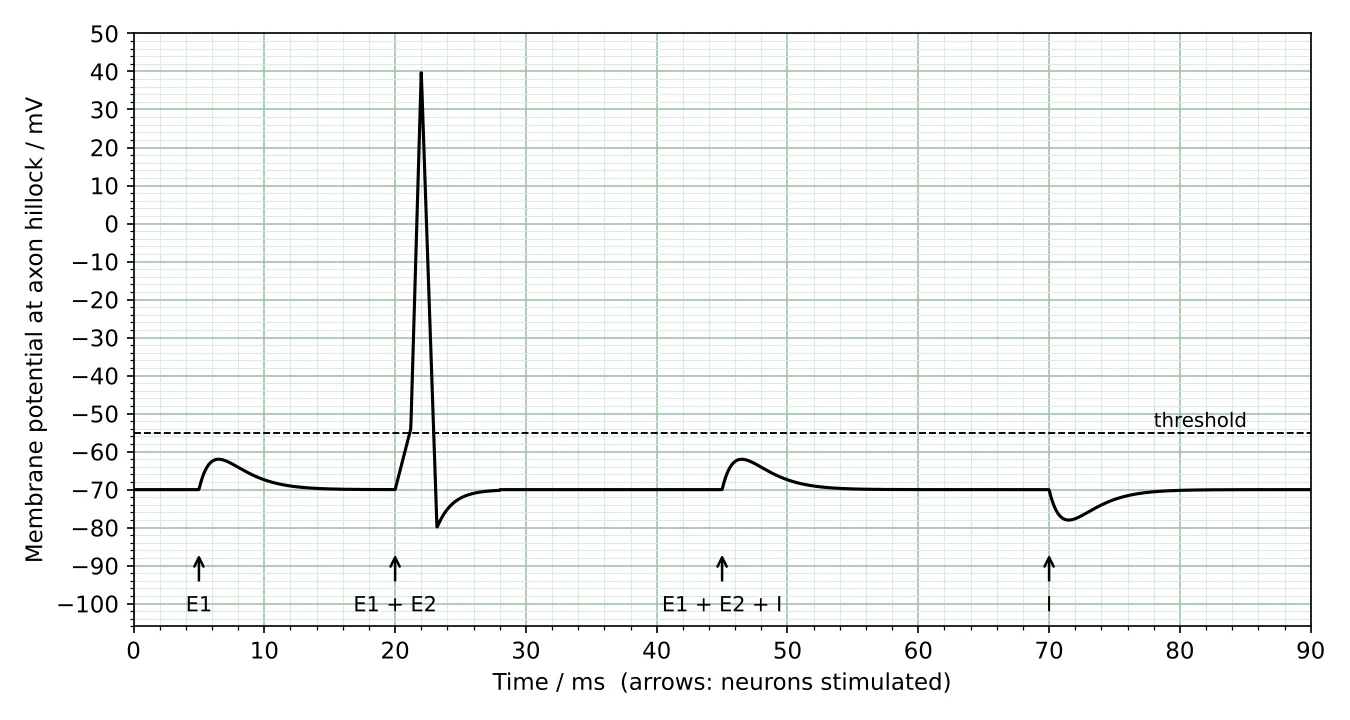
State the resting potential of the postsynaptic neuron.
Determine the size of the EPSP produced when E1 alone was stimulated.
Explain the response when E1 and E2 were stimulated together.
Explain the response when E1, E2 and I were stimulated together.
revisionprep.com
Summary Answer
Not available for this question.
Model Answer
Not available for this question.
Marking Scheme
Not available for this question.
Examiner Insights
Not available for this question.
Action potential and neurotransmission
Tetraethylammonium (TEA) blocks voltage-gated K⁺ channels. The graph shows action potentials recorded from an axon before and after TEA was applied.
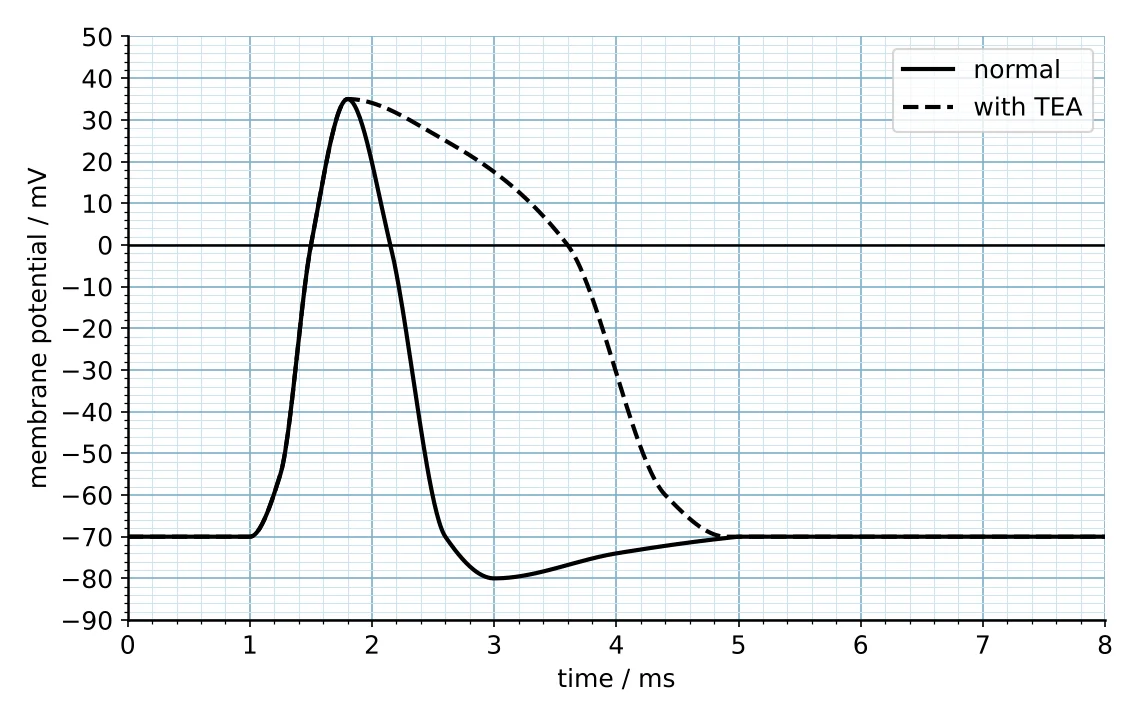
Compare the two action potentials.
Explain the effect of TEA on the falling phase of the action potential.
Suggest why the rising phase is not affected by TEA.
Predict, with a reason, the effect of TEA on the maximum frequency of impulses.
Tetrodotoxin (TTX) blocks voltage-gated Na⁺ channels. Predict the recording if the axon is stimulated after TTX is applied.
revisionprep.com
Summary Answer
Not available for this question.
Model Answer
Not available for this question.
Marking Scheme
Not available for this question.
Examiner Insights
Not available for this question.
Nervous system coordination and reflex arcs
When the patellar tendon is tapped, sensory neurons from the quadriceps excite motor neuron P, which supplies the quadriceps. The same sensory neurons also synapse with an inhibitory relay neuron, which synapses with motor neuron Q, supplying the hamstrings (the antagonistic muscle). The graphs show the membrane potentials of P and Q.
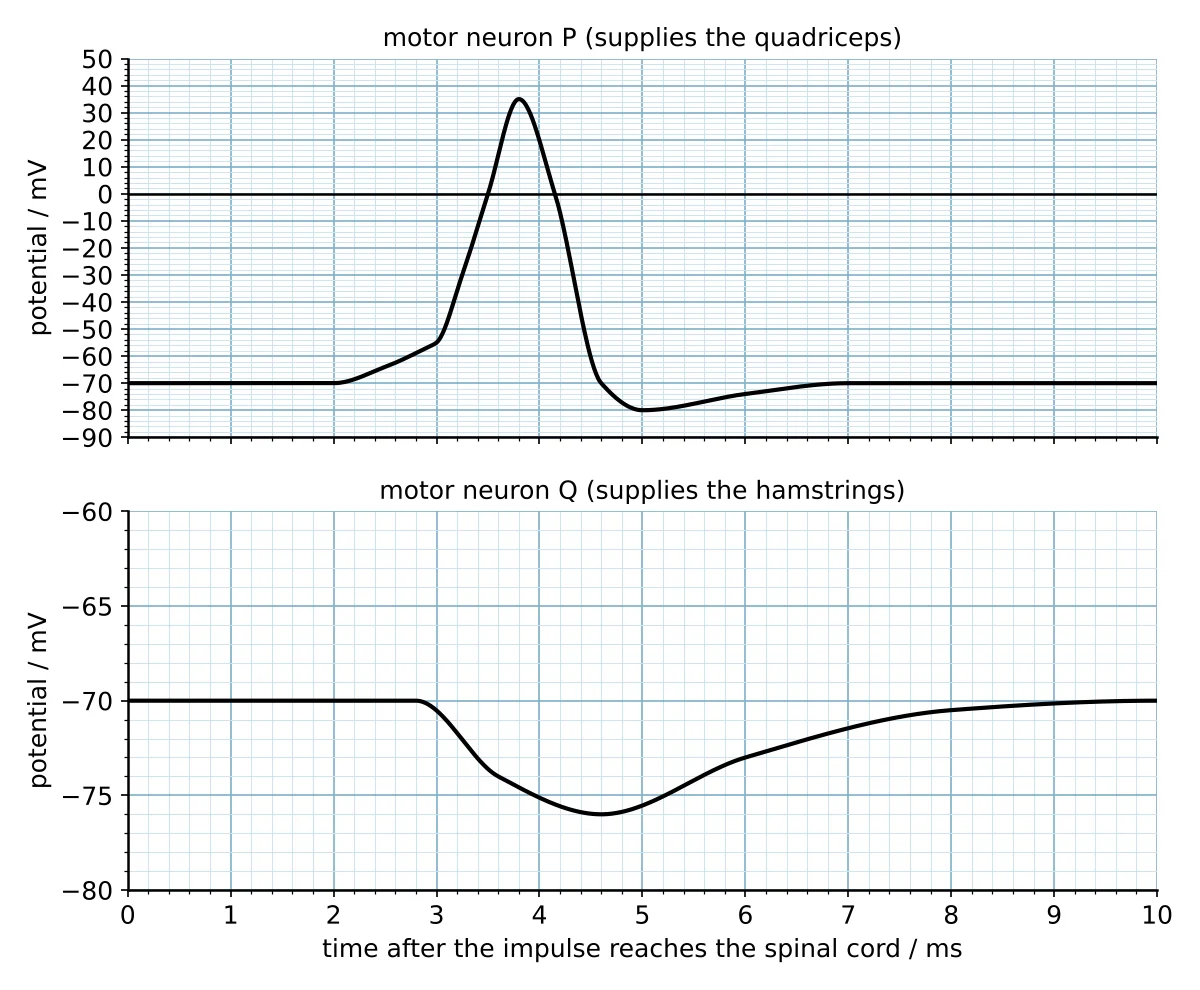
State the resting potential of motor neuron P.
Determine the membrane potential at which P reached threshold.
Describe the change in the membrane potential of Q.
Explain how the inhibitory relay neuron causes the change in Q.
The change in Q begins later than the change in P. Suggest a reason.
Suggest how this arrangement makes the knee-jerk reflex more effective.
revisionprep.com
Summary Answer
Not available for this question.
Model Answer
Not available for this question.
Marking Scheme
Not available for this question.
Examiner Insights
Not available for this question.
That's every free question here — 6 of 163.
+157 more questions, plus Mock Papers & Worksheets, are waiting in Premium.