You're viewing 3 free preview questions for Biology HL — subscribe to unlock 107 more, plus the Full Question Bank, Mock Papers & Worksheets.Upgrade
Photosynthesis · Paper 2 — Free Biology HL Practice Questions
1MasterySAQ-STypes of chemical signals: Hormones, neurotransmitters5 marksPaper 2~8 min

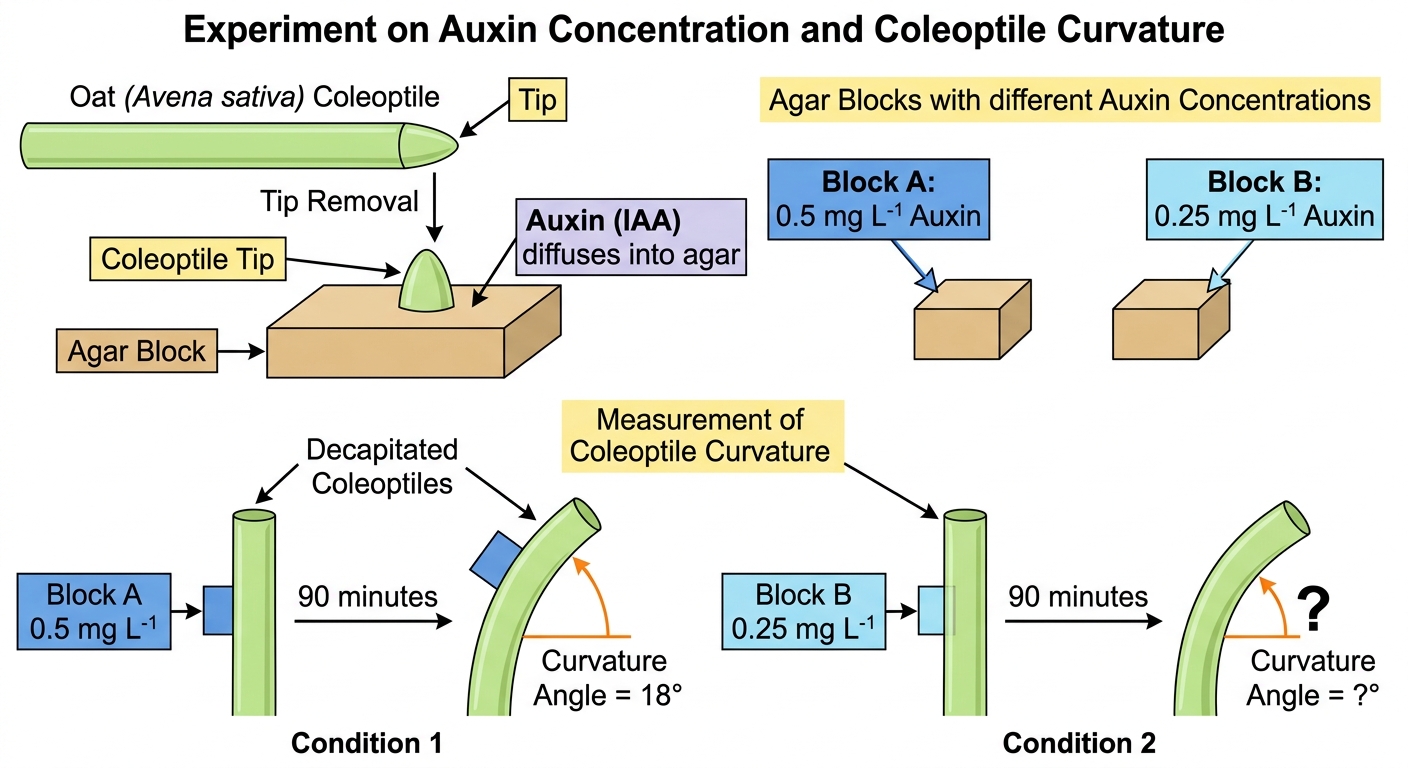
Auxin (indole-3-acetic acid, IAA) is a plant hormone that regulates phototropism. In a classic experiment, coleoptile tips of oat (Avena sativa) were removed and placed on agar blocks. The blocks were then placed asymmetrically on decapitated coleoptiles, and the angle of curvature was measured.
(a)
State the chemical property of auxin that allows it to move by polar transport. [1 mark]
(b)
An agar block containing auxin was placed on the left side of a decapitated coleoptile. The coleoptile curved to the right by after 90 minutes. A second block containing auxin was placed on the left side of another decapitated coleoptile under identical conditions. Calculate the expected angle of curvature after 90 minutes, assuming direct proportionality between auxin concentration and curvature angle. [2 marks]
(c)
A coleoptile tip is replaced an opaque cap is placed over the tip on the illuminated (left) side only, with unilateral light coming from the left. Predict and explain the resulting curvature. [2 marks]

Solutions
2MasterySAQ-STypes of chemical signals: Hormones, neurotransmitters6 marksPaper 2~9 min
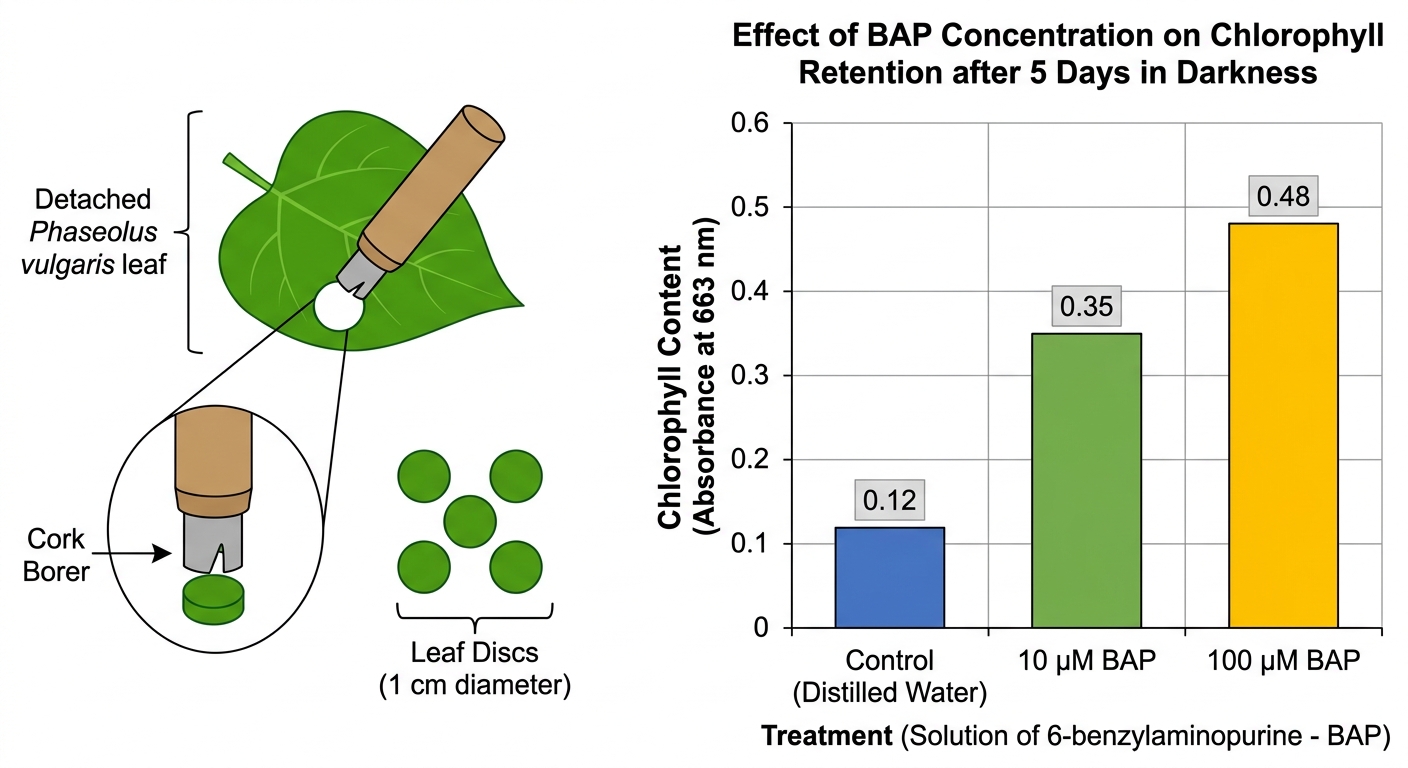
Cytokinins are plant hormones that promote cell division and delay senescence. They are produced primarily in roots and transported to shoots. A research team investigated the effect of the synthetic cytokinin 6-benzylaminopurine (BAP) on chlorophyll retention in detached leaves of Phaseolus vulgaris (bean).
- Leaf discs ( diameter) were floated on BAP solutions of varying concentration.
- After 5 days in darkness, chlorophyll content was measured spectrophotometrically at .
Treatment — Absorbance at
Control (distilled water) —
BAP —
BAP —
(a)
State the location of cytokinin receptors in target cells. [1 mark]
(b)
Deduce the relationship between BAP concentration and chlorophyll retention, using the data in the table. [2 marks]
(c)
Explain the mechanism by which cytokinins delay senescence in leaves. [3 marks]
Solutions
3ChallengeLAQTypes of chemical signals: Hormones, neurotransmitters12 marksPaper 2~18 min
Endocrine disruptors are environmental chemicals that interfere with hormone signalling pathways. Bisphenol A (BPA) is a monomer used in polycarbonate plastics that leaches from plastic waste into aquatic ecosystems. BPA is structurally similar to oestradiol, a lipid-soluble steroid hormone that crosses the plasma membrane and binds to an intracellular receptor; the resulting hormone–receptor complex acts a transcription factor.
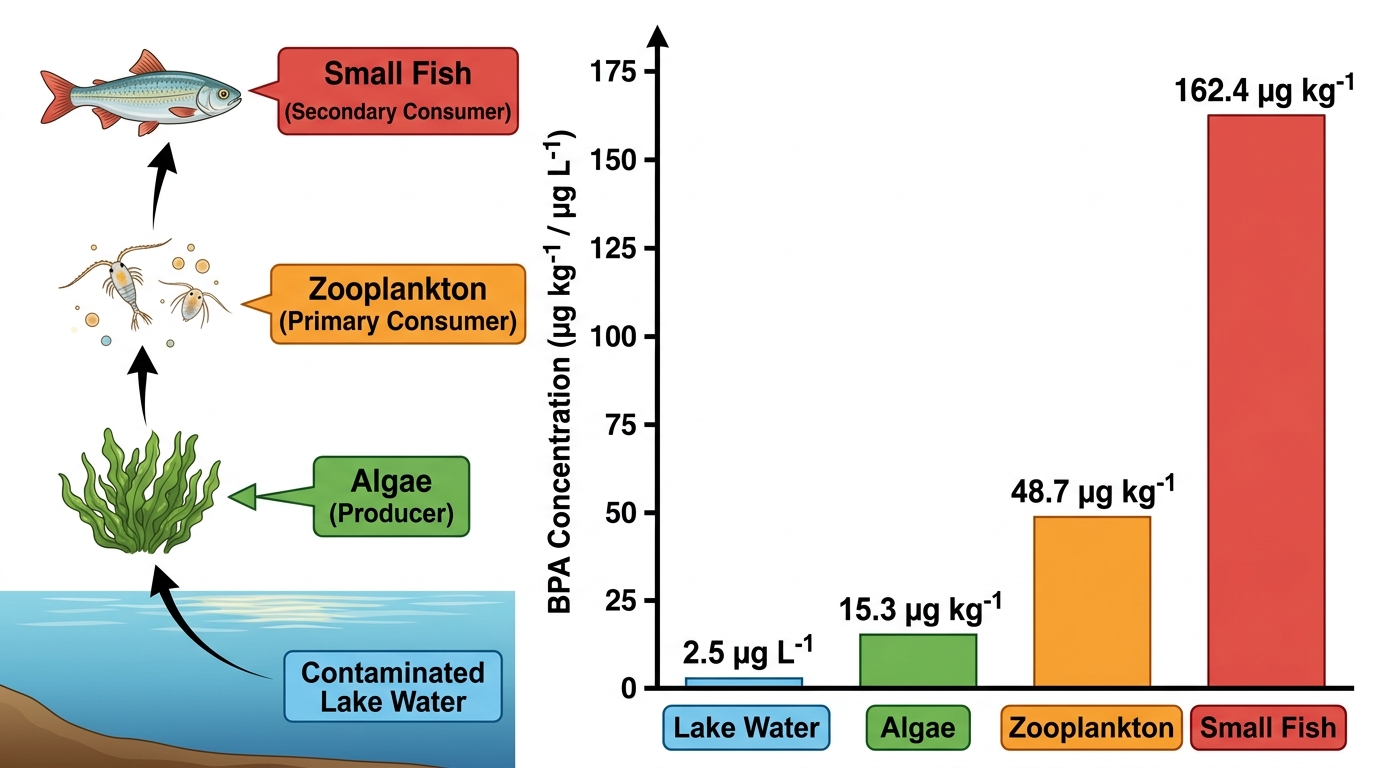
Researchers measured BPA concentration in water and in the tissues of organisms at successive trophic levels in a contaminated lake.
Sample — BPA concentration
Lake water —
Algal tissue —
Zooplankton tissue —
Small fish tissue —
Additional information:
- BPA has a lower binding affinity for oestradiol receptors than oestradiol itself.
- BPA is more resistant to metabolic breakdown in animal tissues than oestradiol.
(a)
Analyse the pattern of BPA concentration across the trophic levels shown in the table. Explain the biological mechanism responsible for this pattern, relating it to the chemical properties of BPA. [4 marks]
(b)
BPA acts a hormone mimic at oestradiol receptors. Compare the mechanism of cell signalling produced by BPA with that produced by acetylcholine at a neuromuscular junction. [3 marks]
(c)
Using the additional information provided, evaluate whether BPA or oestradiol is likely to produce a greater long-term disruption to gene expression in small fish. [3 marks]
(d)
Discuss the limitations of using only the data in the table to predict the long-term ecological consequences of BPA exposure in this lake ecosystem.
Total: 12 marks [2 marks]
Solutions
That's every free question here — 3 of 110.
+107 more questions, plus Mock Papers & Worksheets, are waiting in Premium.