You're viewing 2 free preview questions for Biology HL — subscribe to unlock 46 more, plus the Full Question Bank, Mock Papers & Worksheets.Upgrade
Transfer of Energy and Matter · Paper 2 — Free Biology HL Practice Questions
1MasterySAQ-SBiogeochemical cycles: Carbon, nitrogen, and water cycles5 marksPaper 2~8 min

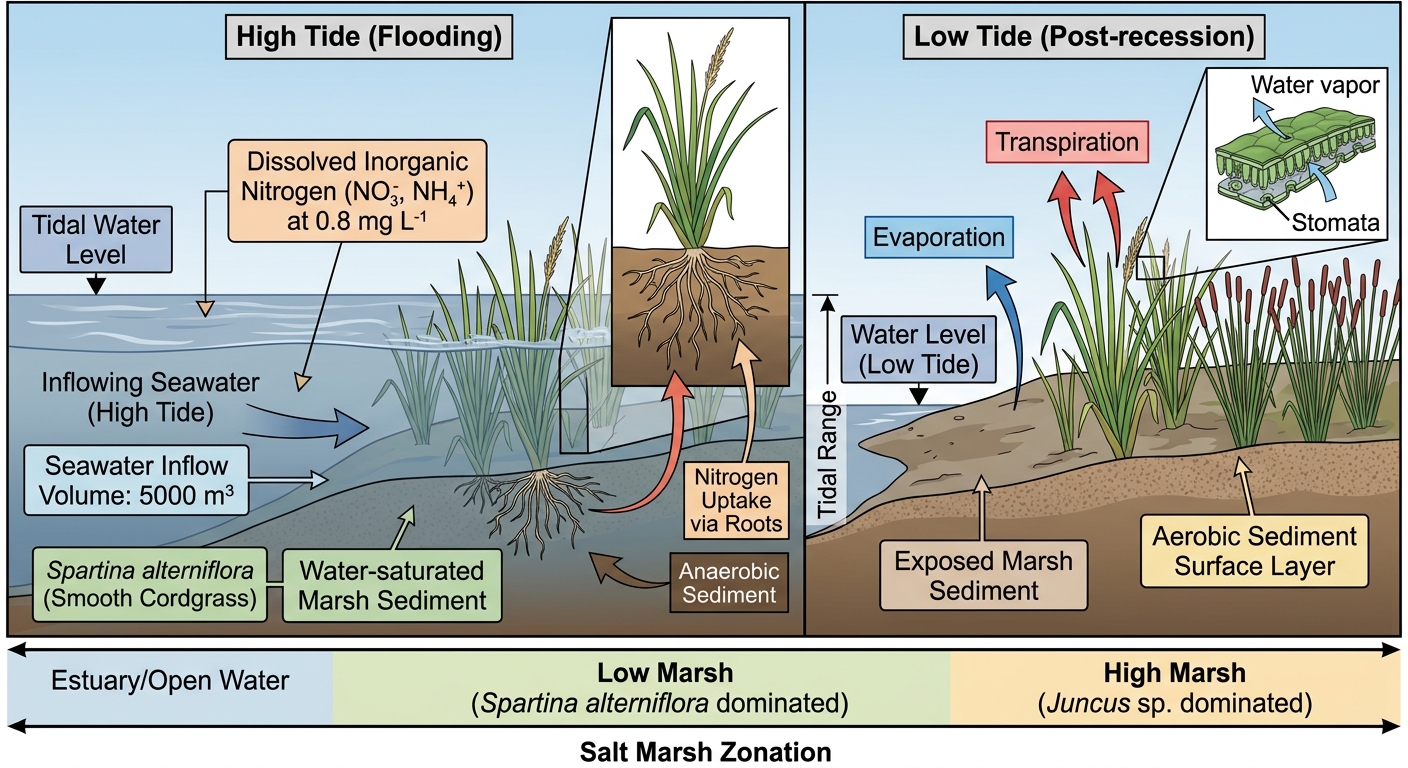
In a coastal salt marsh ecosystem, the water cycle and nitrogen cycle interact closely. During a spring tide, seawater floods the marsh, depositing dissolved inorganic nitrogen (mainly and ) at a concentration of . The total volume of seawater flooding the marsh is . The marsh plants, primarily Spartina alterniflora, take up this nitrogen for growth. After the tide recedes, evaporation and plant transpiration remove water from the marsh soil.
(a)
State the process by which water moves from the soil to the atmosphere through Spartina alterniflora. [1 mark]
(b)
Calculate the total mass, in kg, of dissolved inorganic nitrogen deposited by the tide. [2 marks]
(c)
Explain how the removal of water by transpiration and evaporation affects the concentration of nitrogen in the marsh soil after the tide recedes. [2 marks]

Solutions
2ChallengeSAQ-LEnergy flow in ecosystems: Trophic levels and food webs7 marksPaper 2~11 min
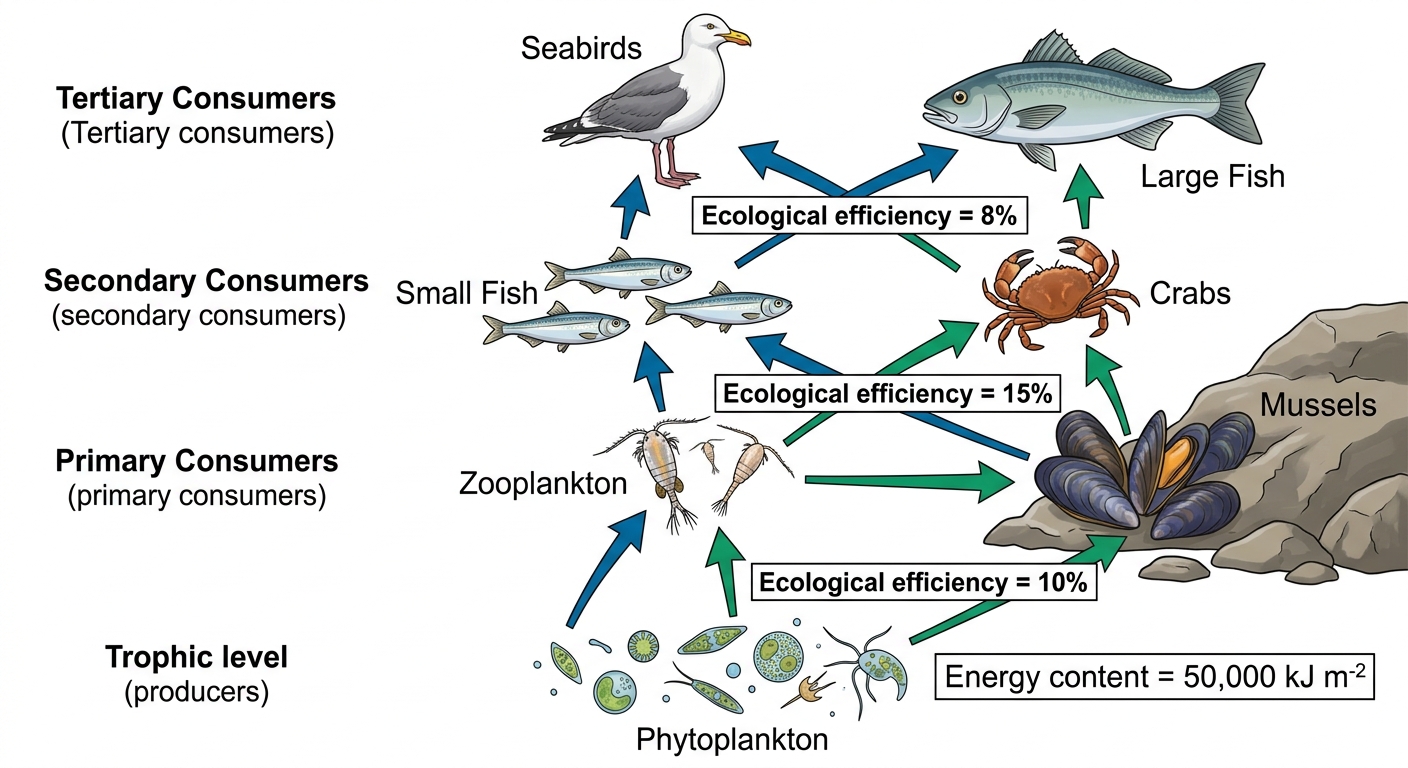
A coastal marine ecosystem contains the following organisms:
- Phytoplankton (primary producers)
- Zooplankton and mussels (primary consumers)
- Small fish and crabs (secondary consumers; crabs eat mussels and zooplankton; small fish eat zooplankton)
- Seabirds and large fish (tertiary consumers; both eat small fish and crabs)
The total energy stored in phytoplankton biomass is . Ecological efficiencies are: phytoplankton → primary consumers ; primary consumers → secondary consumers ; secondary consumers → tertiary consumers . Assume primary consumers collectively consume all available phytoplankton energy.
(a)
Calculate the total energy available to the secondary consumers. [2 marks]
(b)
Overfishing causes a drastic decline in the small fish population. Evaluate the likely net effect on the total energy available to seabirds, referring to at least two energy pathways in your answer. [3 marks]
(c)
State two reasons why ecological efficiency between trophic levels is always less than . [2 marks]
Solutions
That's every free question here — 2 of 48.
+46 more questions, plus Mock Papers & Worksheets, are waiting in Premium.