Cell Structure · Paper 1 — Free Biology HL Practice Questions
Free questions
Open in full, with answers, mark scheme and examiner insights.
Prokaryotic vs eukaryotic cells
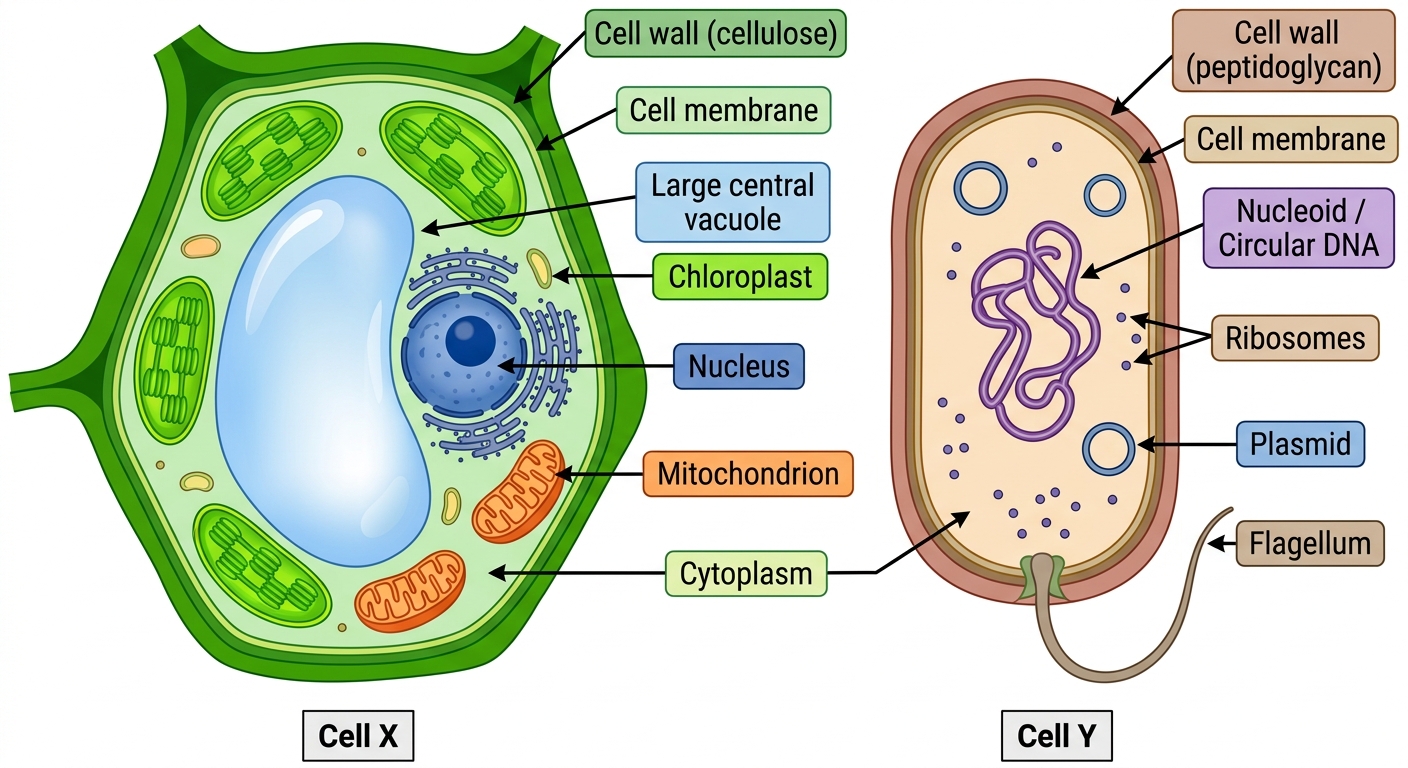
Cell X contains a large central vacuole and chloroplasts. Cell Y has a cell wall composed of peptidoglycan and lacks membrane-bound organelles. Which row correctly identifies Cell X and Cell Y?
revisionprep.com
Summary Answer
Not available for this question.
Model Answer
Not available for this question.
Marking Scheme
Not available for this question.
Examiner Insights
Not available for this question.
Role of ribosomes, mitochondria, and chloroplasts
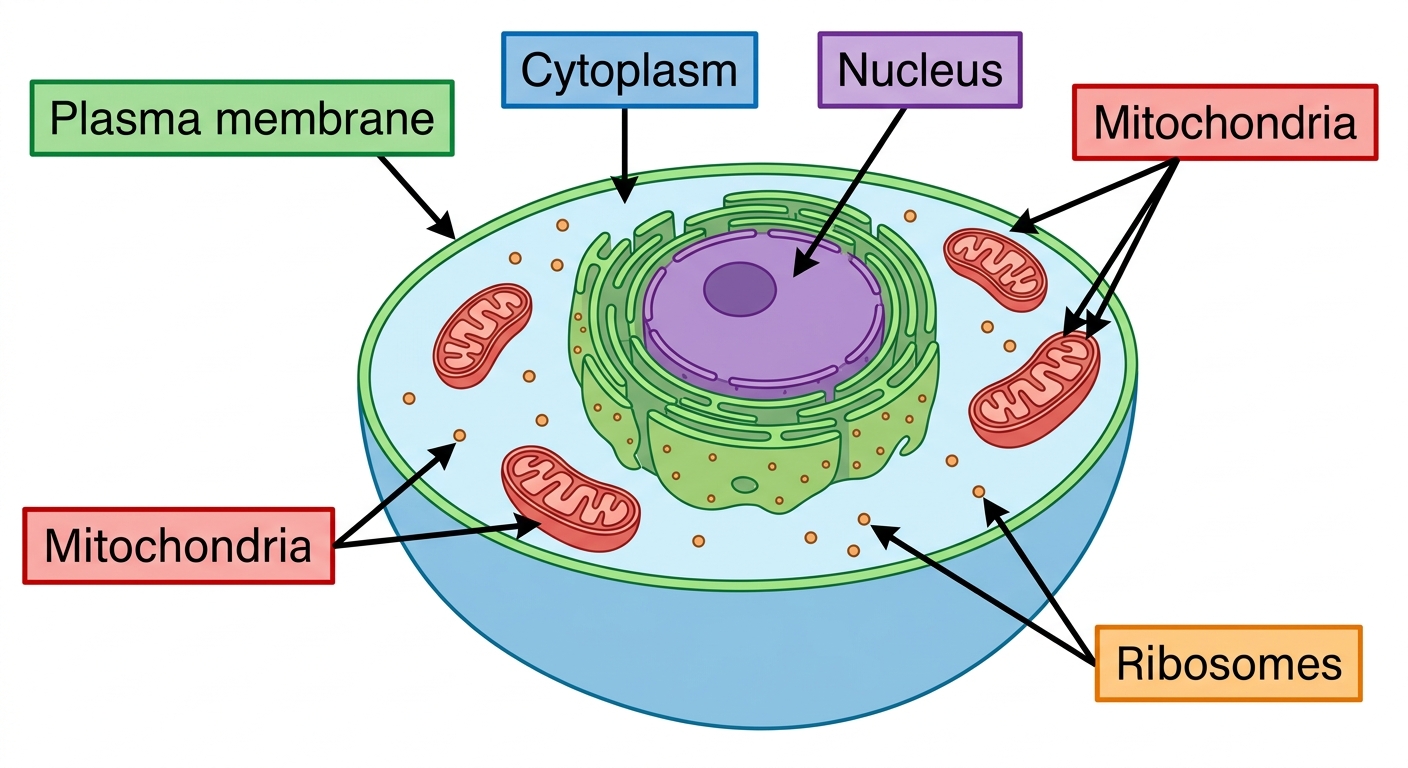
The shows an animal cell. What is the main function of the organelles labelled 'Mitochondria'?
revisionprep.com
Summary Answer
Not available for this question.
Model Answer
Not available for this question.
Marking Scheme
Not available for this question.
Examiner Insights
Not available for this question.
Plant, animal and fungal cells; atypical cells
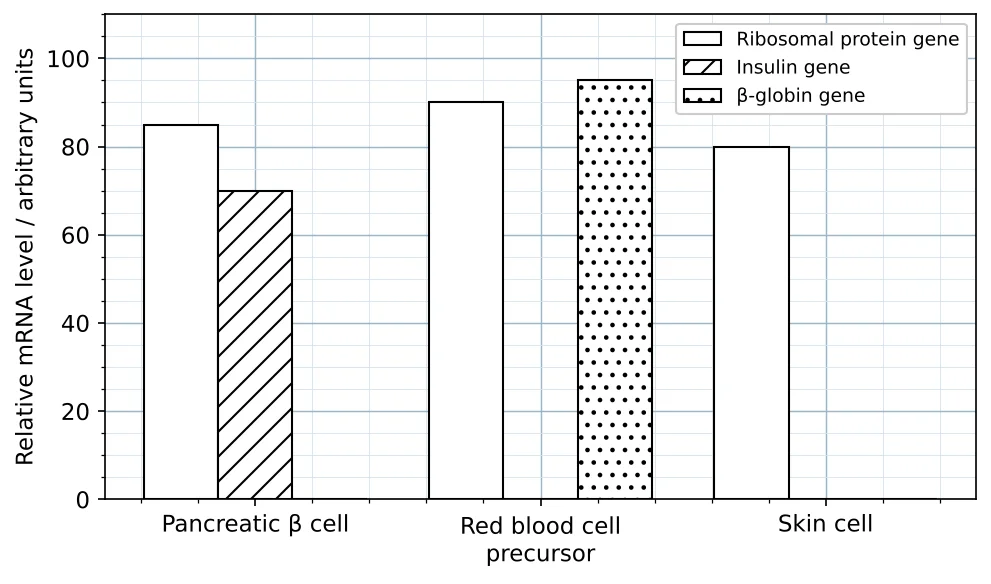
The bar chart shows the relative amounts of mRNA from three genes in three types of human cell.
Which conclusion is supported by the data?
revisionprep.com
Summary Answer
Not available for this question.
Model Answer
Not available for this question.
Marking Scheme
Not available for this question.
Examiner Insights
Not available for this question.
Role of ribosomes, mitochondria, and chloroplasts
The numbers of chloroplasts in cells from different layers of a leaf are shown.
The results are shown in Table 1.
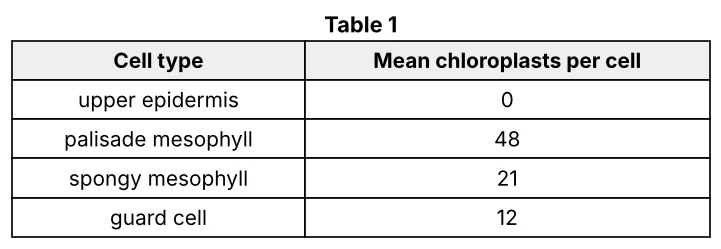
Calculate the percentage difference in chloroplast number between palisade and spongy cells, relative to spongy cells.
Explain why palisade cells contain the most chloroplasts.
Suggest why the upper epidermis cells have no chloroplasts.
Chloroplasts and mitochondria both contain their own membranes. State two other structural features of a chloroplast visible in an electron micrograph.
A 1 mm² area of leaf contains about 3000 palisade cells. Calculate the number of chloroplasts in the palisade cells of this area.
Suggest how the mean number of chloroplasts per cell could be found reliably.
revisionprep.com
Summary Answer
Not available for this question.
Model Answer
Not available for this question.
Marking Scheme
Not available for this question.
Examiner Insights
Not available for this question.
Plant, animal and fungal cells; atypical cells
Acetabularia is a marine green alga up to 6 cm tall. Each individual is a single cell with one nucleus, located in its base. In an experiment the cells were treated in different ways (Table 1).

State why Acetabularia is described as atypical in size.
Explain what the experiment shows about the role of the nucleus.
Discuss whether Acetabularia supports or challenges the cell theory.
Suggest why the experiment should be carried out on many cells for each treatment.
Calculate how many times taller a 6 cm Acetabularia cell is than a typical 60 µm plant cell.
revisionprep.com
Summary Answer
Not available for this question.
Model Answer
Not available for this question.
Marking Scheme
Not available for this question.
Examiner Insights
Not available for this question.
Role of ribosomes, mitochondria, and chloroplasts
'Petite' mutant yeast cells have mitochondria that cannot carry out aerobic respiration. Normal and petite yeast were grown for 24 hours on two food sources.
The results are shown in Table 1.

Explain why petite yeast can grow on glucose but not on ethanol.
Explain why normal yeast grows more on glucose than petite yeast.
Predict the products of glucose breakdown by petite yeast.
Suggest why the mutants are called 'petite'.
Calculate the growth of petite yeast on glucose as a percentage of the growth of normal yeast.
State one variable that must be kept the same for the two types of yeast.
revisionprep.com
Summary Answer
Not available for this question.
Model Answer
Not available for this question.
Marking Scheme
Not available for this question.
Examiner Insights
Not available for this question.
That's every free question here — 6 of 106.
+100 more questions, plus Mock Papers & Worksheets, are waiting in Premium.