Evolution and Speciation · Paper 1 — Free Biology HL Practice Questions
Free questions
Open in full, with answers, mark scheme and examiner insights.
Speciation: Allopatric and sympatric
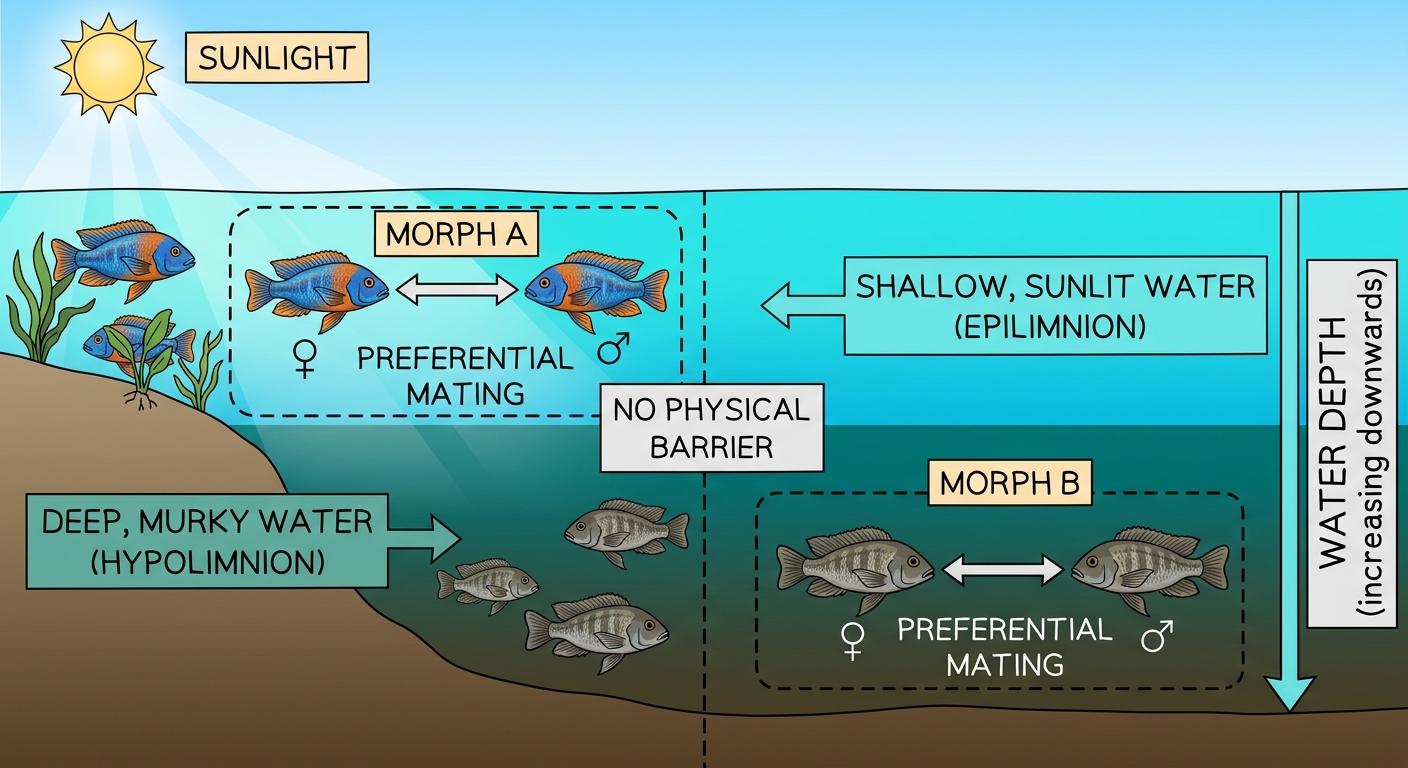
A species of cichlid fish in a lake has two distinct colour morphs: one inhabiting shallow, sunlit water and one inhabiting deep, murky water. Females of each morph preferentially mate with males of the same colour morph. No physical barrier separates the two groups. Which type of speciation is most likely occurring, and what is the primary driving mechanism?
revisionprep.com
Summary Answer
Not available for this question.
Model Answer
Not available for this question.
Marking Scheme
Not available for this question.
Examiner Insights
Not available for this question.
Adaptive radiation
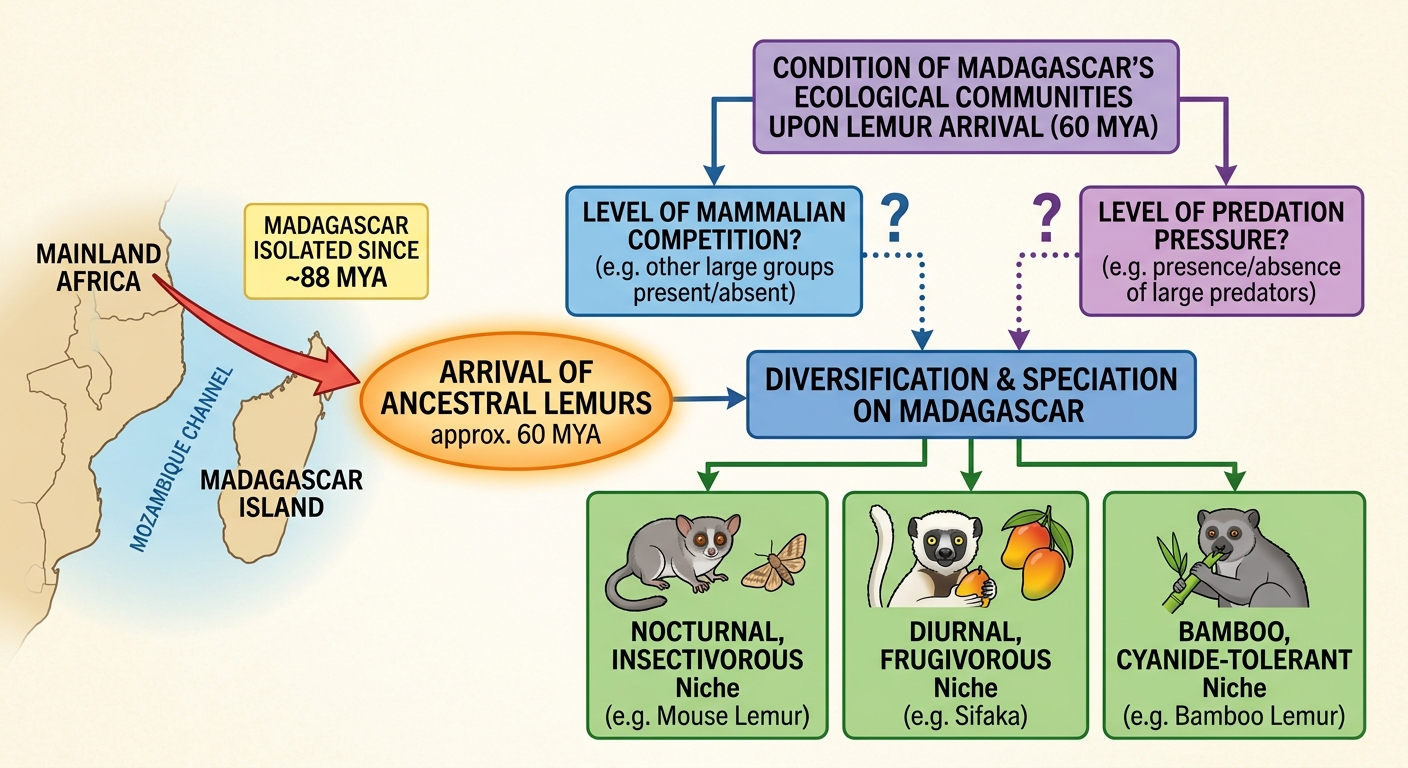
The lemurs of Madagascar have diversified into over 100 species occupying distinct niches: some are nocturnal insectivores, others are diurnal frugivores, and some specialise on bamboo containing toxic cyanide compounds. Their single common ancestor colonised Madagascar approximately 60 million years ago, long after the island had become isolated from Africa. Which factor most directly enabled this adaptive radiation?
revisionprep.com
Summary Answer
Not available for this question.
Model Answer
Not available for this question.
Marking Scheme
Not available for this question.
Examiner Insights
Not available for this question.
Speciation: Allopatric and sympatric
Two populations of a flowering plant grow 300 m apart, one on serpentine soil and one on normal soil. Insects carry pollen freely between the two sites. The graph shows the percentage of plants in flower in each population during the year.
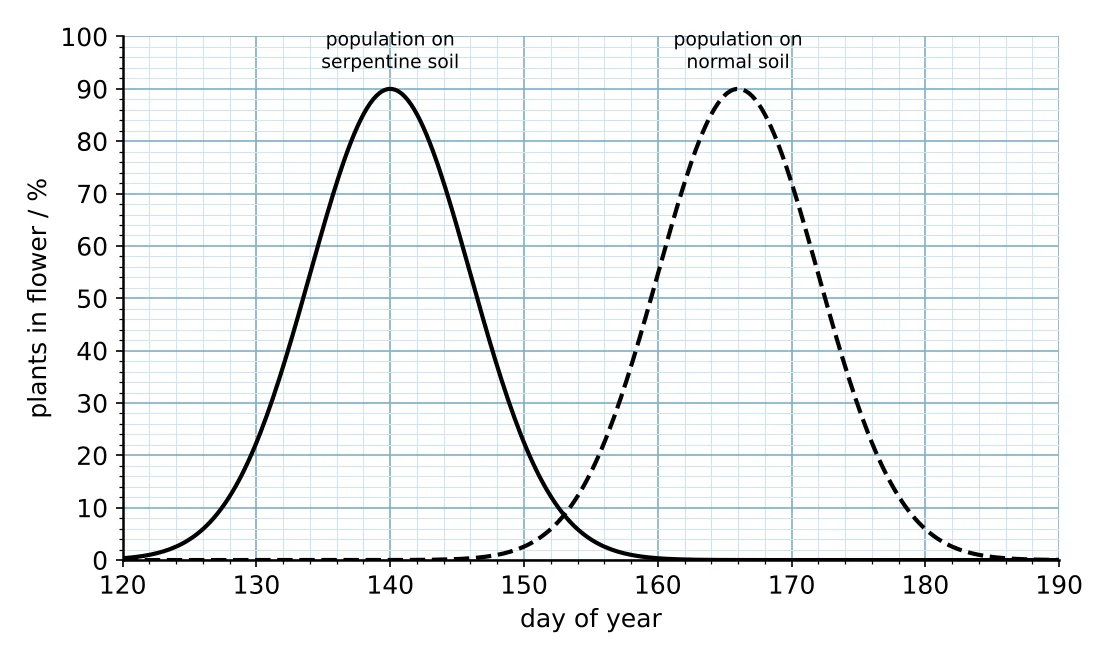
State the day on which the population on serpentine soil had the most plants in flower.
Determine the day on which the same percentage of plants was in flower in both populations, and state that percentage.
Identify the type of reproductive isolation suggested by the graph.
Hand-pollinated crosses between the populations produce hybrid seeds that germinate normally. Explain how differences in flowering time could still lead to speciation without a geographical barrier.
Serpentine soil dries out earlier in the year than normal soil. Suggest how this could have selected for a different flowering time.
revisionprep.com
Summary Answer
Not available for this question.
Model Answer
Not available for this question.
Marking Scheme
Not available for this question.
Examiner Insights
Not available for this question.
Adaptive radiation
A genus of flightless beetles is found only on four volcanic islands, A to D. DNA evidence shows that all the species descend from a single ancestor that reached the oldest island. The species differ in diet, body size and the habitats they use, from coastal sand to mountain forest. The graph shows the number of endemic species on each island and the age of each island.
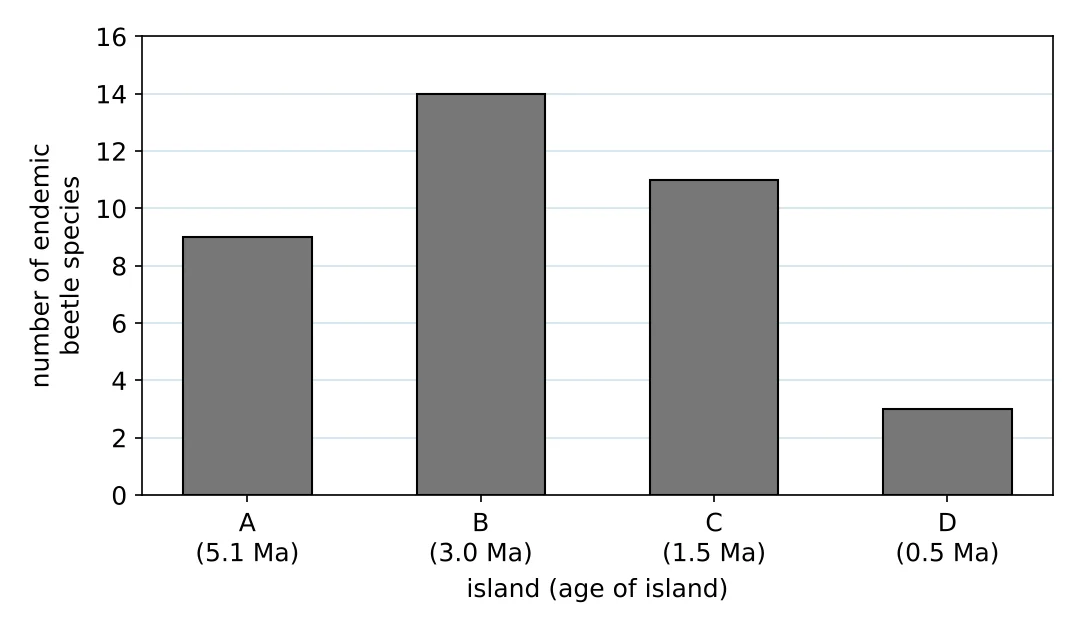
State the number of species on island C.
Describe the relationship between the age of an island and the number of beetle species on it.
Suggest one reason why island D has the fewest species.
Suggest why the oldest island, A, has fewer species than island B.
Explain why this group of beetles is described as an adaptive radiation.
revisionprep.com
Summary Answer
Not available for this question.
Model Answer
Not available for this question.
Marking Scheme
Not available for this question.
Examiner Insights
Not available for this question.
Adaptive radiation
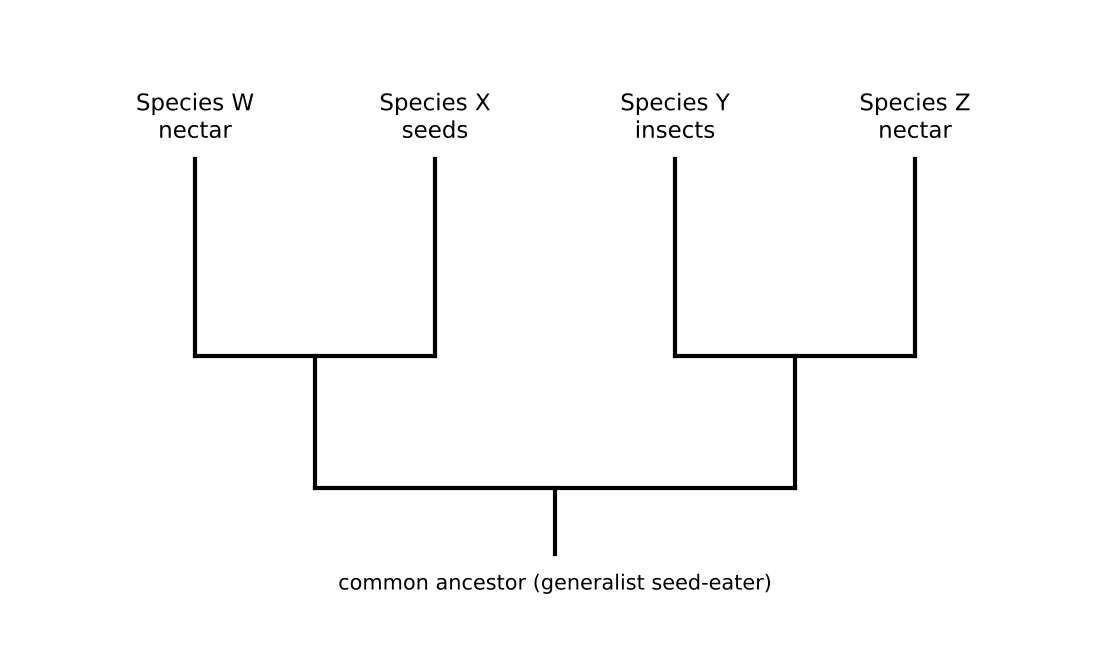
The shows the relationships of four bird species in an island radiation and the main food of each species. Which conclusion is best supported by the ?
revisionprep.com
Summary Answer
Not available for this question.
Model Answer
Not available for this question.
Marking Scheme
Not available for this question.
Examiner Insights
Not available for this question.
Evidence for evolution: base sequences, selective breeding, homologous structures
Short DNA sequences called SINEs occasionally insert into new positions in a genome. Once inserted, a SINE is inherited by all descendants and is very rarely lost; the chance of the same SINE inserting independently at exactly the same position in two lineages is extremely small. The table shows whether five SINEs (1 to 5) are present (+) or absent (−) at particular positions in five mammals.
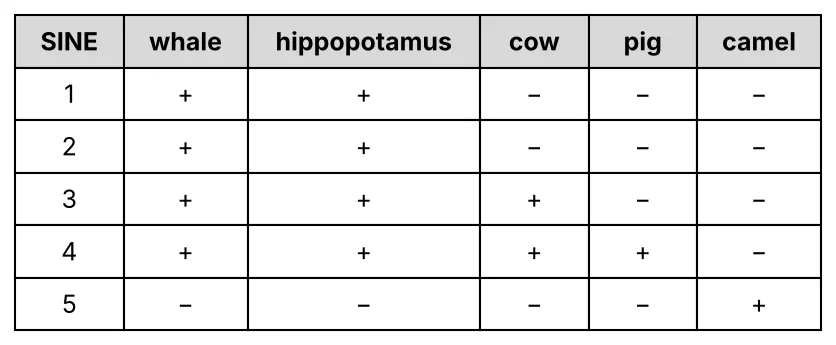
Identify the living mammal most closely related to whales, according to the table.
Deduce the order in which SINEs 1, 3 and 4 were inserted, with a reason.
Explain why a shared SINE at the same position is strong evidence of common ancestry.
Whales have flippers and no hind legs; hippopotamuses have four legs. Explain why this does not contradict the SINE evidence.
revisionprep.com
Summary Answer
Not available for this question.
Model Answer
Not available for this question.
Marking Scheme
Not available for this question.
Examiner Insights
Not available for this question.
That's every free question here — 6 of 153.
+147 more questions, plus Mock Papers & Worksheets, are waiting in Premium.