Origins of Cells · Paper 1 — Free Biology HL Practice Questions
Free questions
Open in full, with answers, mark scheme and examiner insights.
Endosymbiotic theory
A biologist investigating the origin of mitochondria records the following observations: mitochondria possess circular DNA and 70S ribosomes, divide by binary fission, and have an inner membrane with a lipid composition distinct from the outer membrane. Which statement best explains all four observations as a unified set of evidence?
revisionprep.com
Summary Answer
Not available for this question.
Model Answer
Not available for this question.
Marking Scheme
Not available for this question.
Examiner Insights
Not available for this question.
Origin of eukaryotic cells
The bar chart shows the approximate number of mitochondria in five types of human cell.
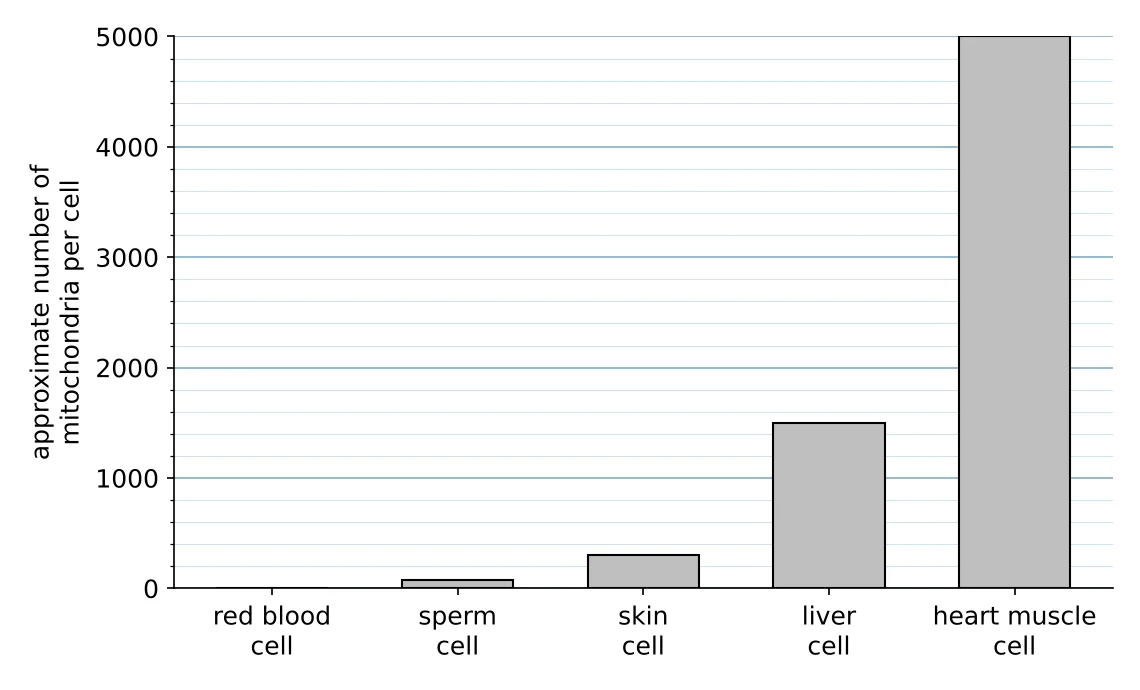
Identify the cell type that has no mitochondria.
Suggest a reason for the difference between liver cells and skin cells.
Mature red blood cells cannot regain mitochondria. Explain why, using the endosymbiotic theory.
The number of mitochondria in a muscle cell increases with endurance training. Explain how new mitochondria are produced.
revisionprep.com
Summary Answer
Not available for this question.
Model Answer
Not available for this question.
Marking Scheme
Not available for this question.
Examiner Insights
Not available for this question.
Endosymbiotic theory
The bar chart shows the percentage sequence identity between the 16S rRNA gene in the chloroplast genome of pea (Pisum sativum) and the same gene in four prokaryotes.
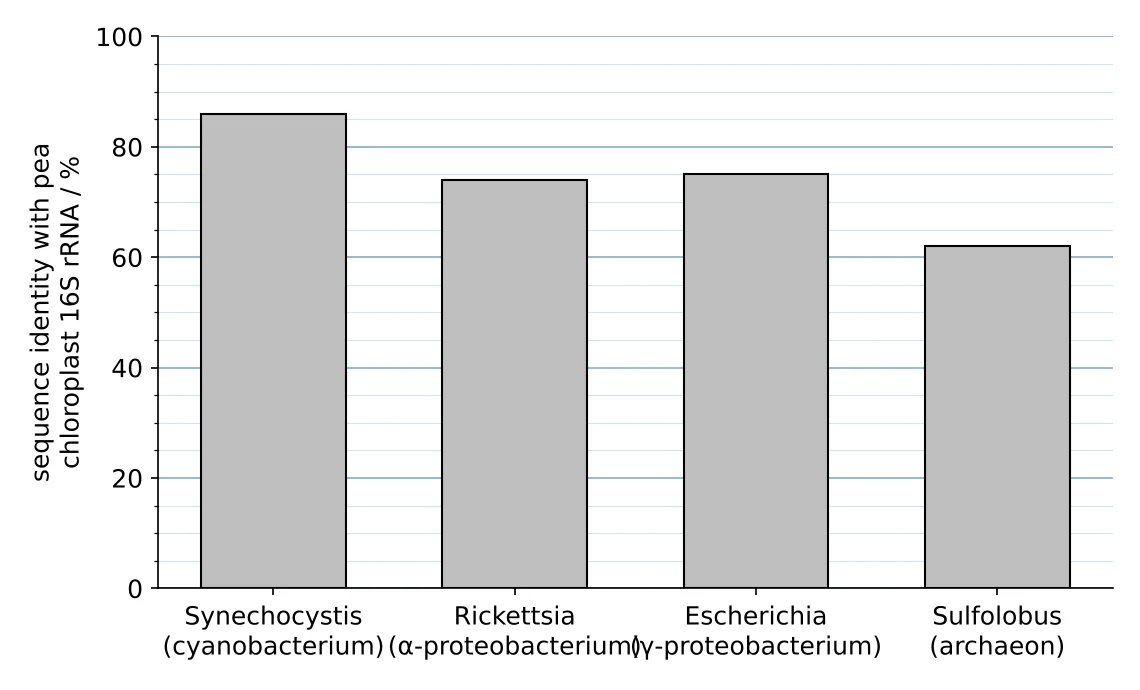
Identify the prokaryote whose 16S rRNA gene is most similar to that of the pea chloroplast.
Explain how the data support the endosymbiotic origin of chloroplasts.
The endosymbiotic event is thought to have occurred well over a billion years ago. Suggest why the identity with the closest prokaryote is not 100%.
The 16S rRNA gene from pea mitochondria shows 79% identity with Rickettsia but 72% with Synechocystis. Deduce what this shows about the origin of mitochondria compared with chloroplasts.
revisionprep.com
Summary Answer
Not available for this question.
Model Answer
Not available for this question.
Marking Scheme
Not available for this question.
Examiner Insights
Not available for this question.
Origin of eukaryotic cells
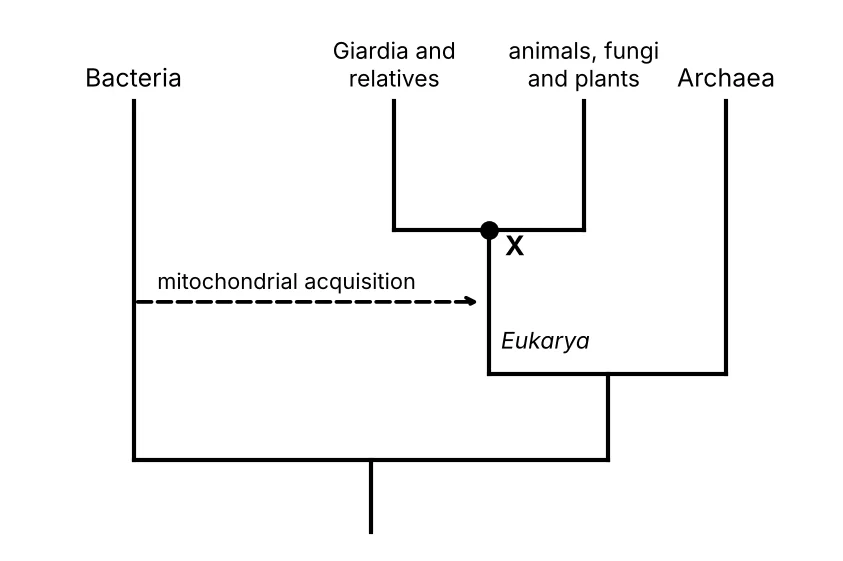
The tree shows the three domains of life, based on rRNA sequences. The dashed arrow shows where mitochondria were acquired. Node X marks the last common ancestor of all living eukaryotes.
Which conclusion about mitochondrial evolution is most strongly supported by this tree?
revisionprep.com
Summary Answer
Not available for this question.
Model Answer
Not available for this question.
Marking Scheme
Not available for this question.
Examiner Insights
Not available for this question.
Endosymbiotic theory
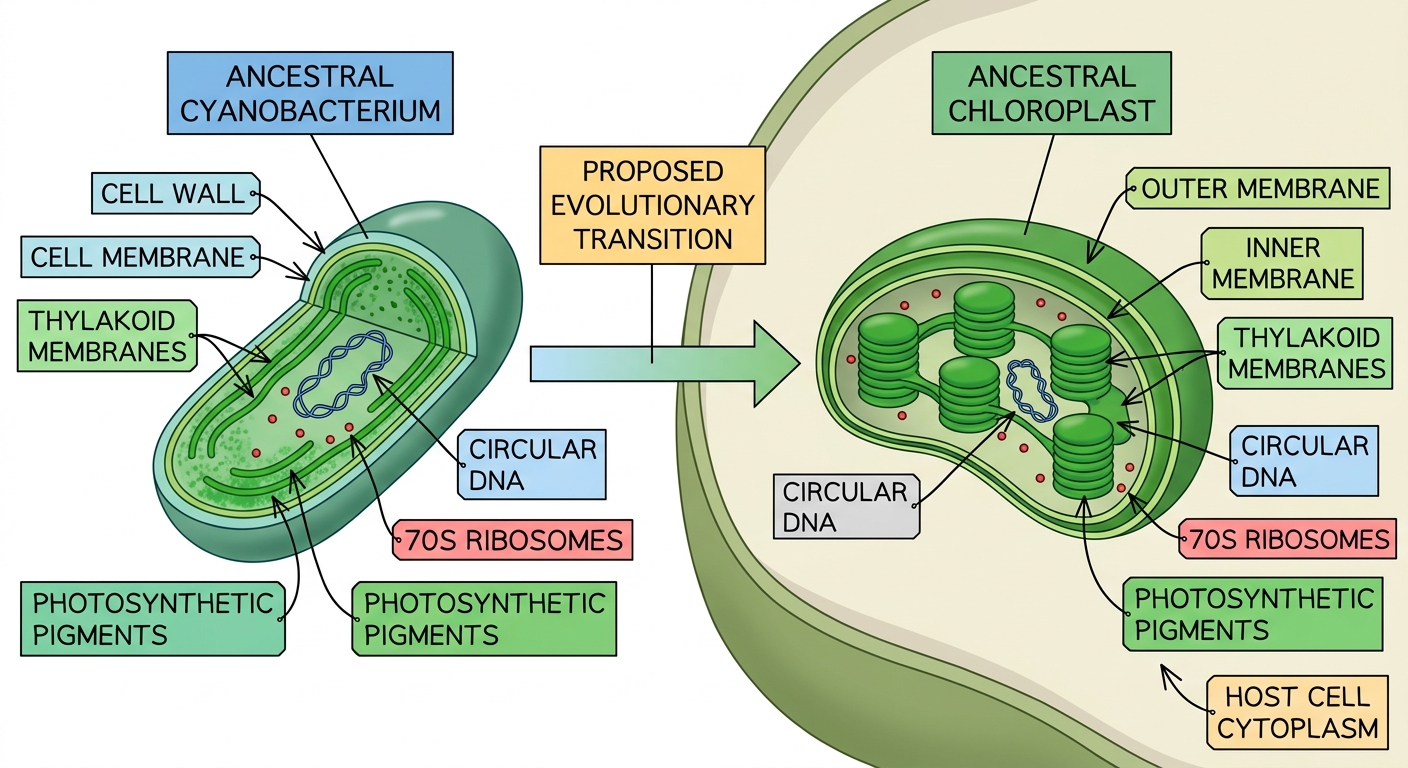
The shows the proposed change from an ancestral cyanobacterium to a chloroplast. Which feature shown would be expected in a chloroplast whether it arose by endosymbiosis or by infolding of the host cell's own membranes, and so gives the weakest evidence for endosymbiosis?
revisionprep.com
Summary Answer
Not available for this question.
Model Answer
Not available for this question.
Marking Scheme
Not available for this question.
Examiner Insights
Not available for this question.
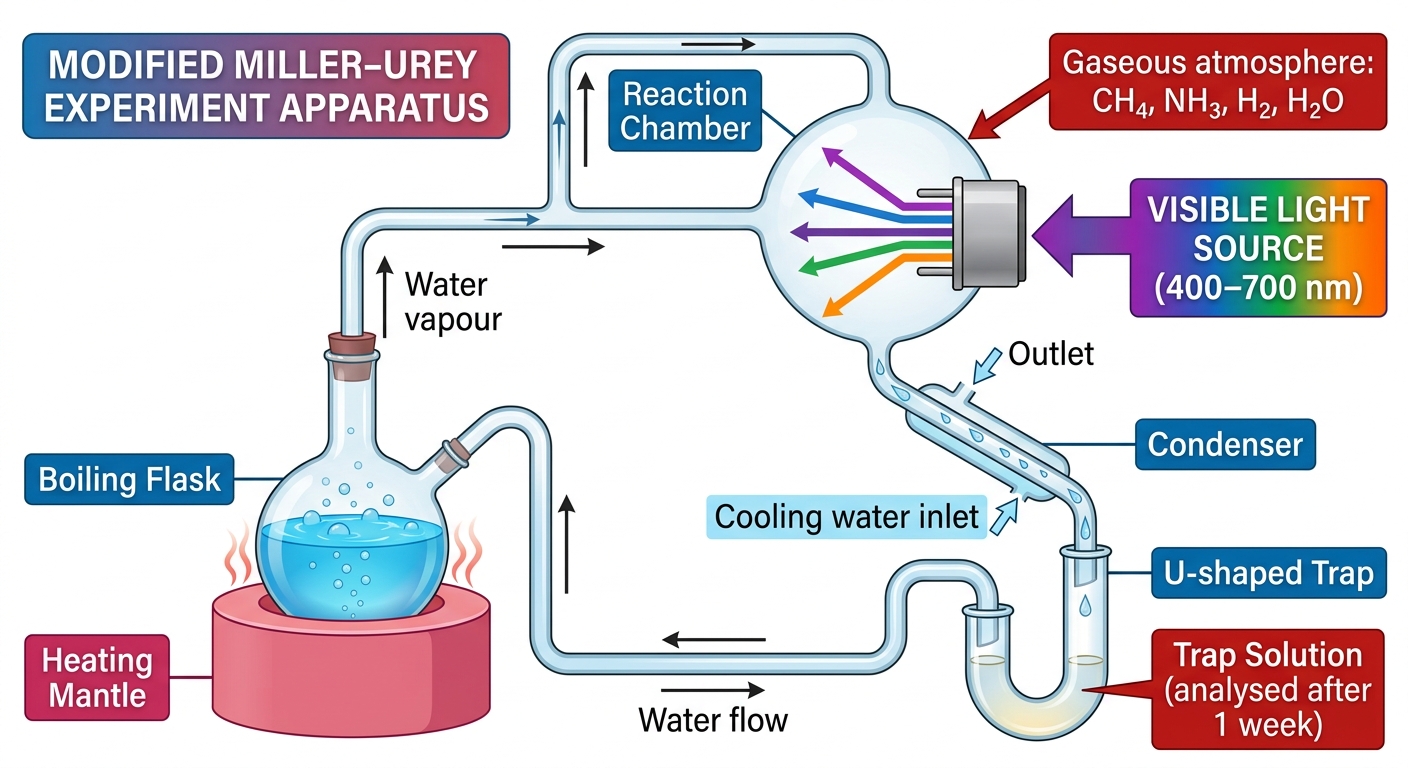
Miller-Urey experiment
In the Miller-Urey experiment, an electrical spark provides energy to break bonds in gases such as , , , and , generating reactive radicals that recombine to form organic monomers. A student repeats the experiment but replaces the electrical spark with a lamp emitting only visible light (wavelengths 400–700 nm, photon energies 1.8–3.1 eV). The bond dissociation energies of C–H and N–H bonds are approximately 4.3 eV and 4.0 eV respectively. After one week, which outcome is most likely when the trap solution is analysed?
revisionprep.com
Summary Answer
Not available for this question.
Model Answer
Not available for this question.
Marking Scheme
Not available for this question.
Examiner Insights
Not available for this question.
That's every free question here — 6 of 100.
+94 more questions, plus Mock Papers & Worksheets, are waiting in Premium.