Cell Structure · Paper 2 — Free Biology HL Practice Questions
Free questions
Open in full, with answers, mark scheme and examiner insights.
Plant, animal and fungal cells; atypical cells
Cells were examined from three eukaryotic sources: a mesophyll cell from a leaf, a cheek cell from a human, and a hypha of the bread mould Rhizopus.
State the main structural component of the cell wall in the mesophyll cell and in the Rhizopus hypha.
State, for each of the three cells, whether each structure is usually present or absent: chloroplasts, centrioles, large permanent vacuole.
A student finds a cell with a cell wall and no chloroplasts and concludes it must be a fungal cell. Explain why this conclusion may be wrong.
revisionprep.com
Summary Answer
Not available for this question.
Model Answer
Not available for this question.
Marking Scheme
Not available for this question.
Examiner Insights
Not available for this question.
Prokaryotic vs eukaryotic cells
The diagram shows a prokaryotic cell drawn from an electron micrograph. In the original printed diagram, the scale bar is 18 mm long and the cell, from end to end excluding structure D, is 72 mm long.
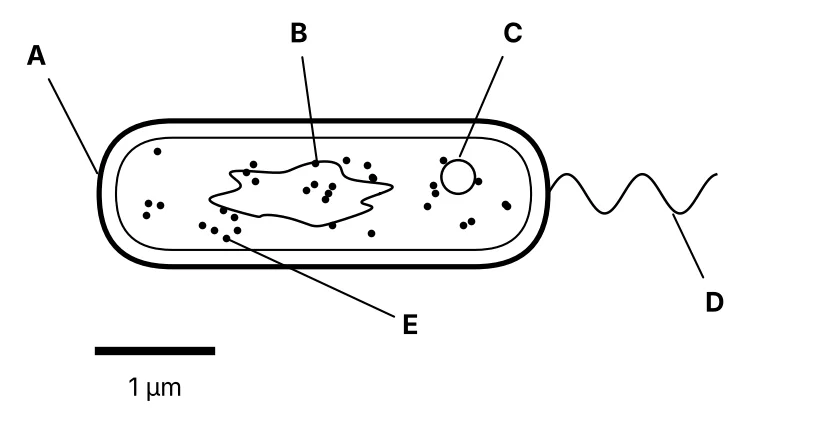
Identify the structures labelled A, B and D.
Calculate the actual length of the cell in µm.
Calculate the magnification of the diagram.
Structure E is one of many small granules in the cytoplasm. Outline how these granules in this cell differ from the equivalent structures in a liver cell.
revisionprep.com
Summary Answer
Not available for this question.
Model Answer
Not available for this question.
Marking Scheme
Not available for this question.
Examiner Insights
Not available for this question.
Plant, animal and fungal cells; atypical cells
Some cells do not fit the typical pattern of one nucleus per cell. Data were collected on four cell types.
The data are shown in Table 1.
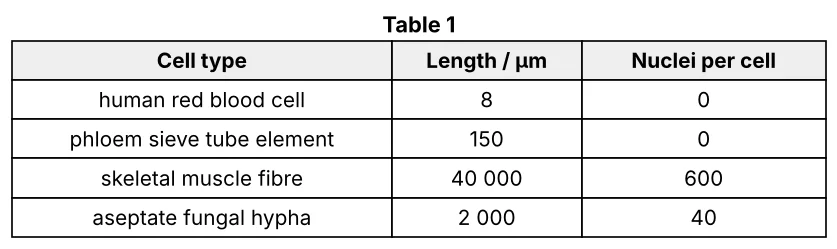
Calculate the mean length of muscle fibre per nucleus.
Explain how the sieve tube element survives without a nucleus.
Suggest one advantage of the absence of a nucleus in the red blood cell.
Explain how skeletal muscle fibres and aseptate hyphae come to contain many nuclei.
Discuss whether these cells should be called 'atypical' rather than 'abnormal'.
Calculate the mean length of hypha per nucleus and compare it with your answer to (a).
State one structural feature, other than the number of nuclei, that distinguishes the fungal hypha from the muscle fibre.
Suggest why it is an advantage for a very long cell to contain many nuclei.
revisionprep.com
Summary Answer
Not available for this question.
Model Answer
Not available for this question.
Marking Scheme
Not available for this question.
Examiner Insights
Not available for this question.
Role of ribosomes, mitochondria, and chloroplasts
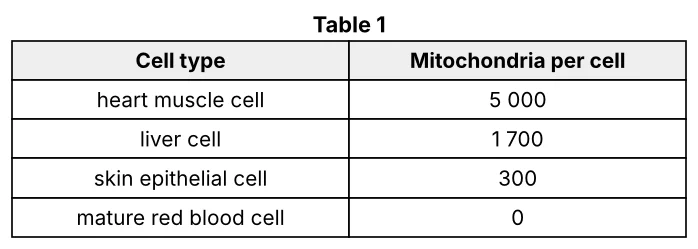
The number of mitochondria per cell was estimated from electron micrographs of four human cell types.
The results are shown in Table 1.
State the function of mitochondria.
Calculate how many times more mitochondria a heart muscle cell has than a skin epithelial cell.
Explain the difference between the heart and skin cells.
Explain how red blood cells obtain ATP and why this does not use the oxygen they carry.
Calculate the percentage difference in mitochondria per cell between the liver cell and the heart muscle cell, relative to the liver cell.
Predict, with a reason, how the number of mitochondria in the midpiece of a sperm cell compares with that in a skin epithelial cell.
Suggest one reason why the values in Table 1 are described as estimates.
Suggest why liver cells need large numbers of mitochondria.
revisionprep.com
Summary Answer
Not available for this question.
Model Answer
Not available for this question.
Marking Scheme
Not available for this question.
Examiner Insights
Not available for this question.
Prokaryotic vs eukaryotic cells
A new antibiotic, Bactin-X, was tested on Escherichia coli (a prokaryote) and on the yeast Saccharomyces cerevisiae (a eukaryote). Both were grown in the same nutrient medium at 37 °C. Bactin-X was added to both cultures at 20 minutes, and the rate of protein synthesis was measured. The results are shown in the graph. Bactin-X binds to 70S ribosomes.
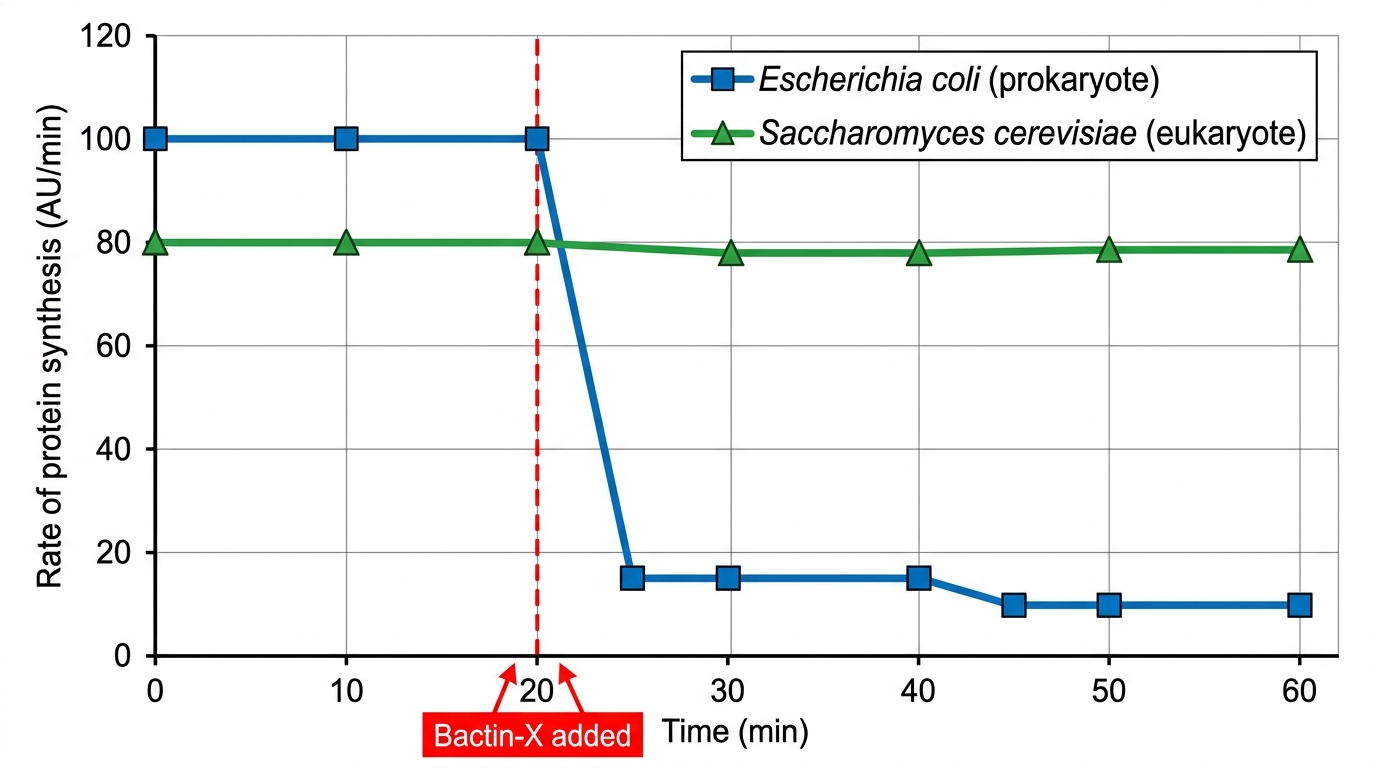
State the rate of protein synthesis in E. coli before Bactin-X was added and at 30 minutes.
Calculate the percentage change in the rate of protein synthesis in E. coli between these two times.
Explain the different effects of Bactin-X on the two organisms.
Describe the effect of Bactin-X on the yeast.
Suggest two reasons why protein synthesis in E. coli did not fall to zero.
Evaluate the use of these results to support the use of Bactin-X to treat bacterial infections in humans.
State one variable that was controlled in this experiment.
revisionprep.com
Summary Answer
Not available for this question.
Model Answer
Not available for this question.
Marking Scheme
Not available for this question.
Examiner Insights
Not available for this question.
Role of ribosomes, mitochondria, and chloroplasts
Yeast cells reproduce by budding. A culture was counted every 1.5 hours (Table 1).

Calculate the mean time taken for the number of cells to double.
Explain how budding produces new yeast cells.
Predict, with a reason, the number of cells after 7.5 hours if conditions stay the same.
Suggest why growth of the culture would eventually slow down.
revisionprep.com
Summary Answer
Not available for this question.
Model Answer
Not available for this question.
Marking Scheme
Not available for this question.
Examiner Insights
Not available for this question.
That's every free question here — 6 of 107.
+101 more questions, plus Mock Papers & Worksheets, are waiting in Premium.