You're viewing 3 free preview questions for Biology HL — subscribe to unlock 105 more, plus the Full Question Bank, Mock Papers & Worksheets.Upgrade
Classification and Cladistics · Paper 2 — Free Biology HL Practice Questions
1MasterySAQ-SThe three domains of life5 marksPaper 2~8 min

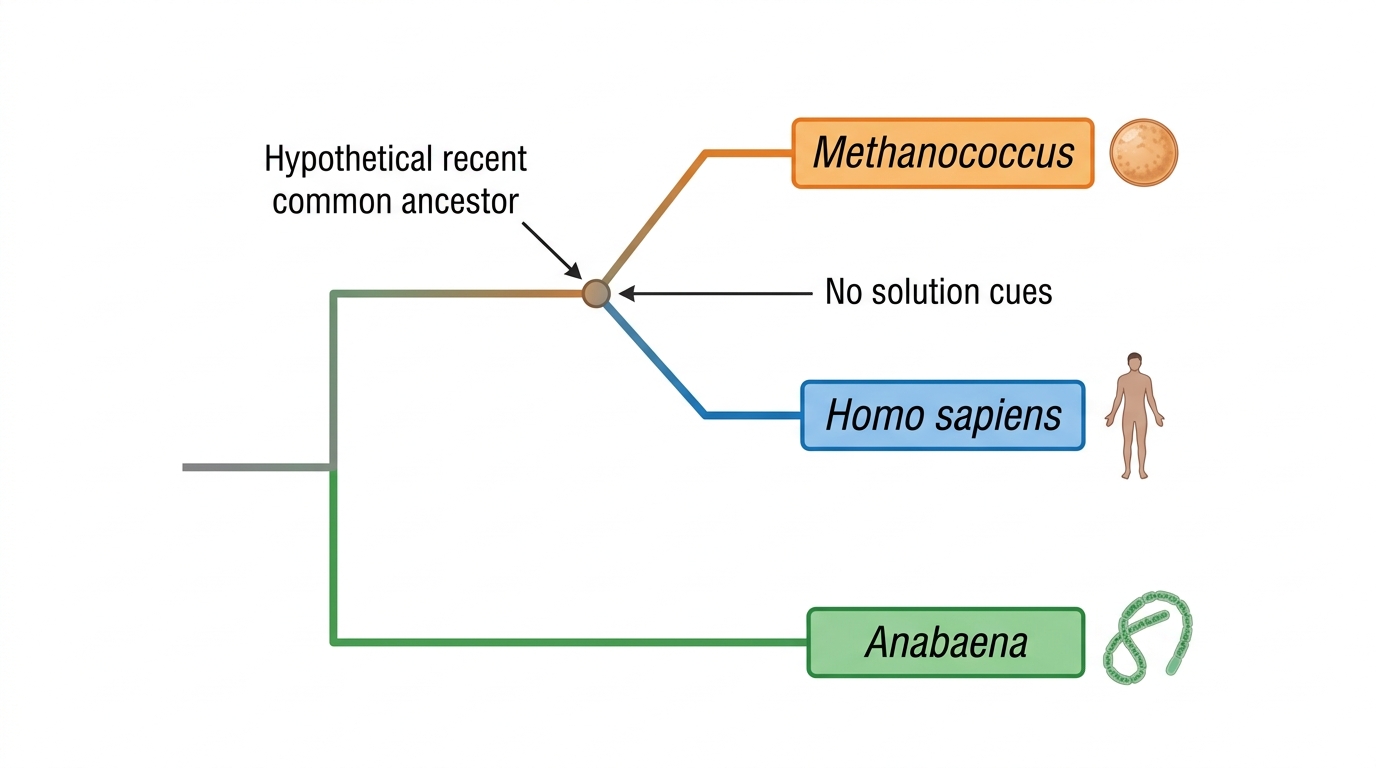
A simplified phylogenetic tree was constructed using rRNA gene sequences from three organisms: a methanogen (Methanococcus), a cyanobacterium (Anabaena), and a human (Homo sapiens). The tree indicates that the methanogen and human share a more recent common ancestor than either shares with the cyanobacterium. The methanogen's rRNA gene sequence is similar to the human sequence; the cyanobacterium's rRNA gene sequence is similar to the human sequence.
(a)
State the domain to which Methanococcus belongs. [1 mark]
(b)
Describe two differences between the cell membrane structure of Methanococcus and that of Anabaena. [2 marks]
(c)
Using the rRNA similarity data and the phylogenetic tree, evaluate whether rRNA sequence analysis a reliable method for determining evolutionary relationships between these three organisms. [2 marks]

Solutions
2MasterySAQ-SThe three domains of life5 marksPaper 2~8 min
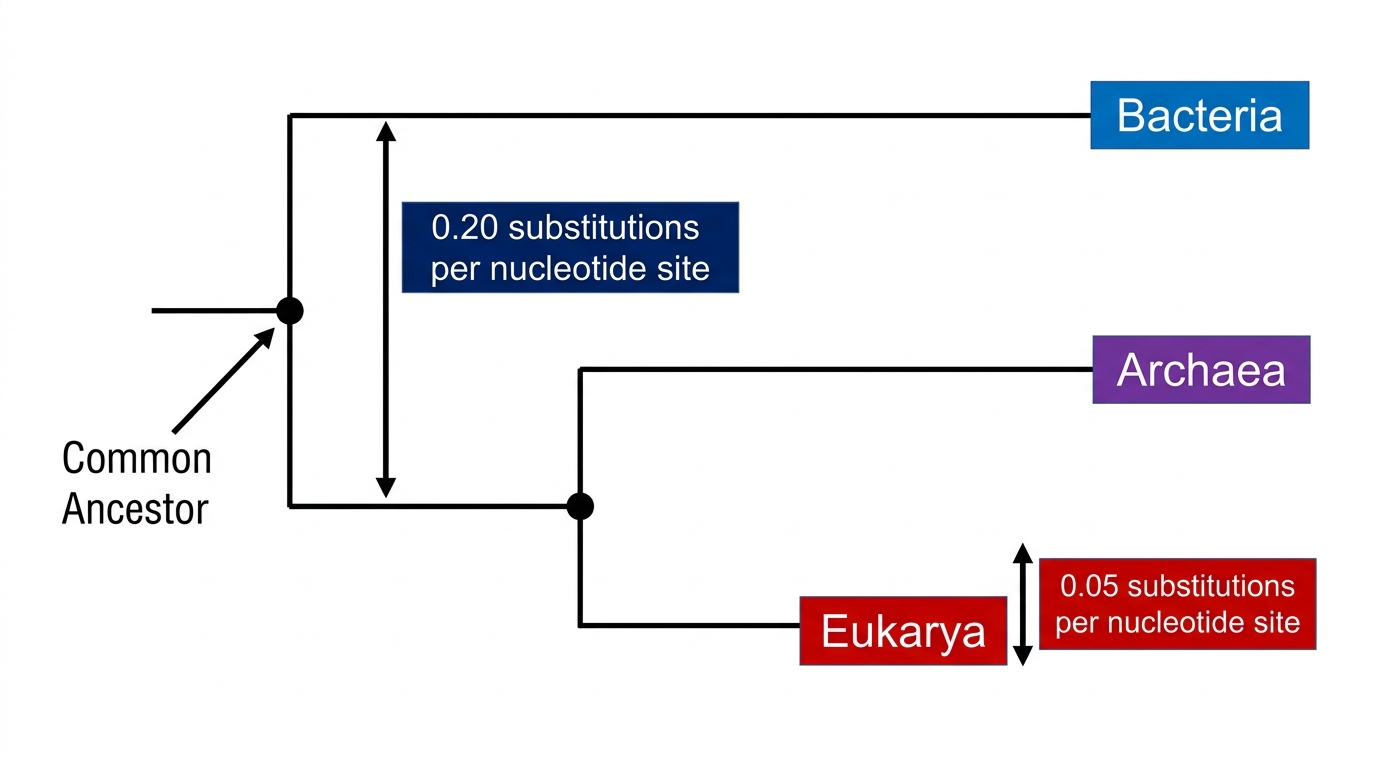
A phylogenetic tree of the three domains of life is constructed using rRNA sequence comparisons. Branch lengths are proportional to genetic distance, measured in substitutions per nucleotide site. The root is placed between Bacteria and the Archaea–Eukarya clade.
- Branch length, Bacteria: substitutions per nucleotide site
- Branch length, Archaea: substitutions per nucleotide site
- Branch length, Eukarya: substitutions per nucleotide site
(a)
State which two domains share the most recent common ancestor, as shown by the tree. [1 mark]
(b)
Calculate how many times greater the substitution rate in Bacteria is compared to Eukarya, assuming a constant molecular clock and that all branches diverged at the same time. [2 marks]
(c)
Evaluate one limitation of using rRNA sequence comparisons alone to determine the evolutionary relationships among the three domains. [2 marks]
Solutions
3ChallengeLAQThe three domains of life10 marksPaper 2~15 min
The three-domain classification system proposes that all life is divided into Bacteria, Archaea, and Eukarya.
(a)
State two structural differences between the cell walls of Archaea and Bacteria. [2 marks]
(b)
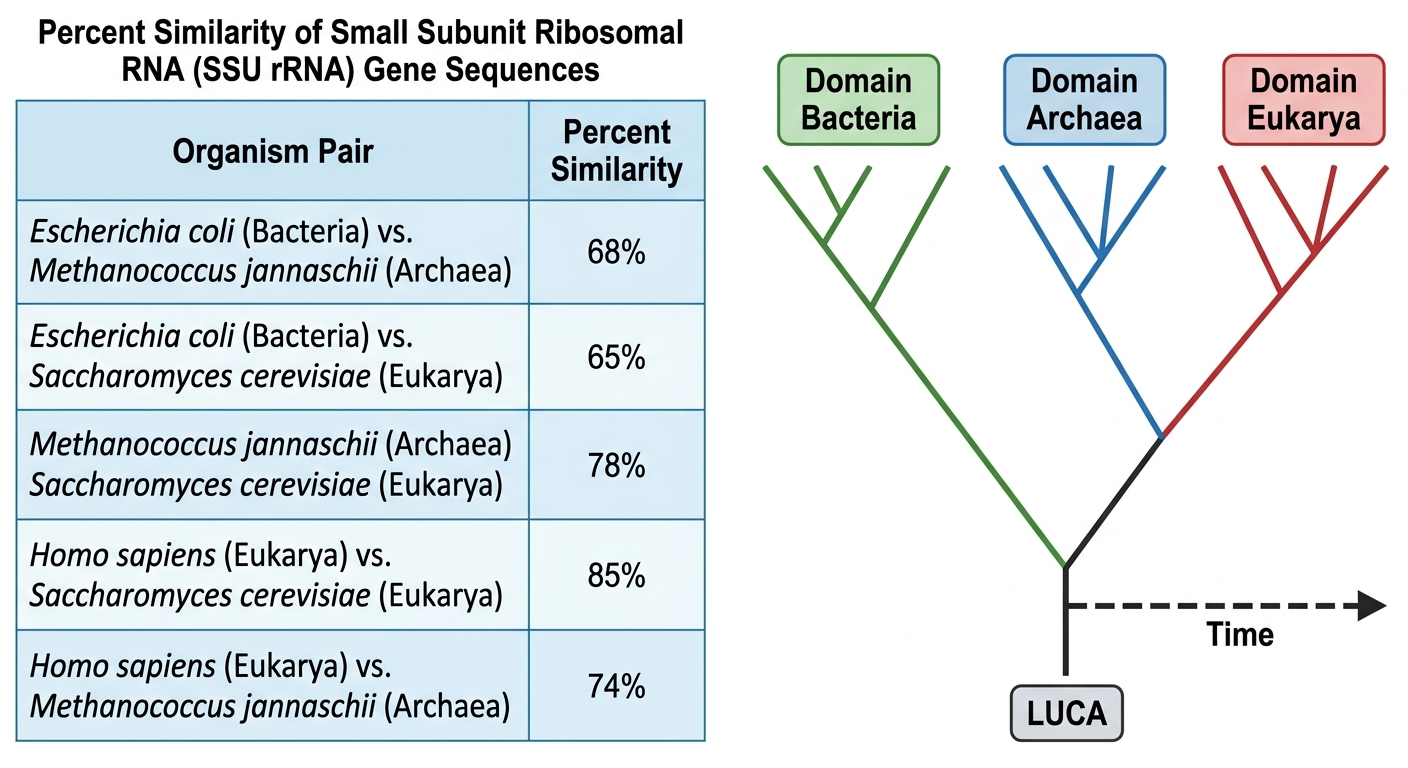
The table below shows the percentage similarity of small subunit ribosomal RNA (SSU rRNA) gene sequences between selected organisms. Explain how these data support the three-domain classification system.
Organism pair — SSU rRNA sequence similarity
Escherichia coli (Bacteria) vs. Methanococcus jannaschii (Archaea) —
Escherichia coli (Bacteria) vs. Saccharomyces cerevisiae (Eukarya) —
Methanococcus jannaschii (Archaea) vs. Saccharomyces cerevisiae (Eukarya) —
Homo sapiens (Eukarya) vs. Saccharomyces cerevisiae (Eukarya) —
Homo sapiens (Eukarya) vs. Methanococcus jannaschii (Archaea) — [3 marks]
(c)
The eocyte hypothesis proposes that Eukarya evolved from within the Archaea through a symbiotic merger with a bacterium, rather than as a separate domain diverging from a common ancestor of Archaea and Bacteria.
Using the data in (b) and your knowledge of eukaryotic cellular structures, evaluate the extent to which the available molecular and structural evidence supports the eocyte hypothesis over a strict three-domain model. [5 marks]
Solutions
That's every free question here — 3 of 108.
+105 more questions, plus Mock Papers & Worksheets, are waiting in Premium.