Diversity of Organisms · Paper 2 — Free Biology HL Practice Questions
Free questions
Open in full, with answers, mark scheme and examiner insights.
Binomial naming (Linnaean system)
A biologist finds a new species of millipede in a cave. It shares the key traits of the genus Polydesmus but differs from every described species in that genus.
State two rules for writing the binomial of the new species in a typed report.
Suggest why the biologist examines museum collections before naming the species.
Explain why the new species is placed in Polydesmus rather than in a new genus.
revisionprep.com
Summary Answer
Not available for this question.
Model Answer
Not available for this question.
Marking Scheme
Not available for this question.
Examiner Insights
Not available for this question.
Genome sequencing, dichotomous keys and eDNA
During the COVID-19 pandemic, laboratories sequenced the whole genome of the virus from many patients. New variants were identified by the base changes they carried.
Explain how whole genome sequencing allowed new variants to be identified.
Suggest two ways this information was useful to health authorities.
State why rapid, low-cost sequencing was essential for this use.
revisionprep.com
Summary Answer
Not available for this question.
Model Answer
Not available for this question.
Marking Scheme
Not available for this question.
Examiner Insights
Not available for this question.
Binomial naming (Linnaean system)
International rules state that the binomials of plants date from Linnaeus's book Species Plantarum, published in 1753, and those of animals from the 10th edition of his Systema Naturae, published in 1758.
Outline why a fixed starting date is useful for naming species.
A plant name was published in 1740. Deduce whether it can be used today.
Suggest why the binomial system has lasted for over 250 years.
revisionprep.com
Summary Answer
Not available for this question.
Model Answer
Not available for this question.
Marking Scheme
Not available for this question.
Examiner Insights
Not available for this question.
Chromosome number, karyotypes and genome size
The bar chart shows genome sizes of five vertebrates. The pufferfish Takifugu rubripes has about the same number of genes as humans.
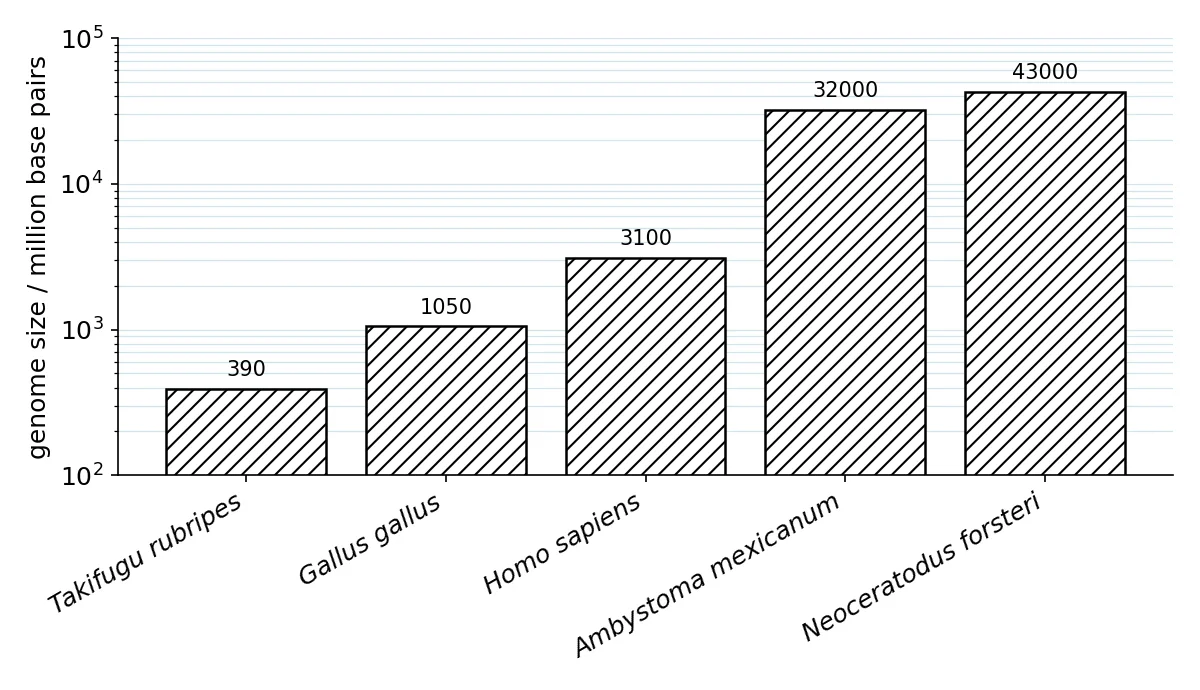
Using the chart, calculate how many times larger the human genome is than the pufferfish genome.
Explain why the pufferfish genome is so much smaller than the human genome, although the gene numbers are similar.
Suggest why the pufferfish genome was useful for finding human genes when it was first sequenced.
Explain why a log scale is used for the vertical axis.
Calculate how many times larger the Neoceratodus forsteri genome is than the human genome.
State what is meant by the genome of an organism.
Suggest why very large genomes, such as that of the axolotl (Ambystoma mexicanum), are difficult to sequence.
Using the chart, discuss whether genome size is related to the complexity of an organism.
revisionprep.com
Summary Answer
Not available for this question.
Model Answer
Not available for this question.
Marking Scheme
Not available for this question.
Examiner Insights
Not available for this question.
Chromosome number, karyotypes and genome size
Illustrative data from ten species of amphibian show genome size and the mean volume of their red blood cells.
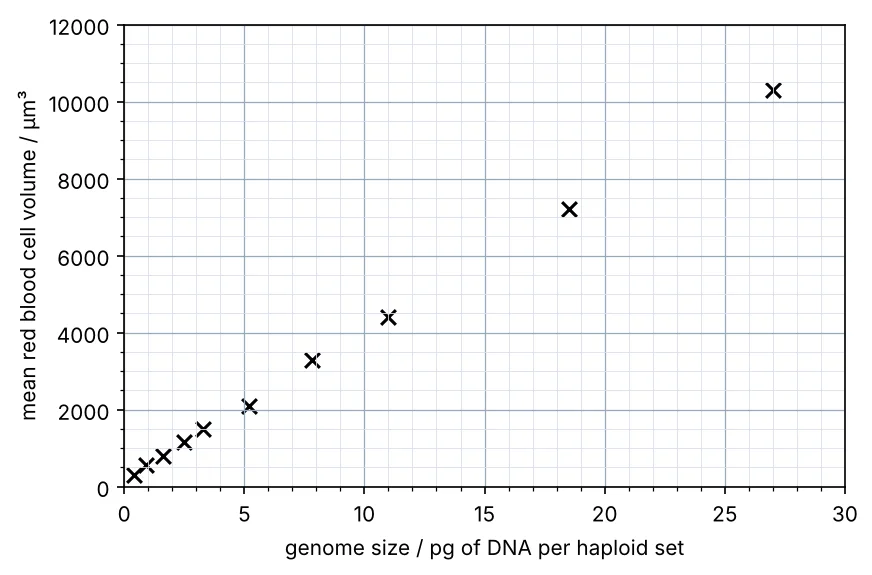
Describe the relationship shown by the graph.
Using the graph, estimate the mean red blood cell volume for a species with a genome of 15 pg.
Suggest why species with larger genomes have larger cells.
Explain why these data do not prove that a larger genome makes an organism more complex.
Calculate how many times larger the mean red blood cell volume is for the species with a genome of 27 pg than for the species with a genome of 0.4 pg.
One picogram of DNA contains about 9.8 × 10⁸ base pairs. Calculate the number of base pairs in a 15 pg genome.
Suggest why the data are described as illustrative.
Evaluate the claim that the genome size of an amphibian can be predicted from its red blood cell volume.
revisionprep.com
Summary Answer
Not available for this question.
Model Answer
Not available for this question.
Marking Scheme
Not available for this question.
Examiner Insights
Not available for this question.
Variation and the species concept
Pairs of fruit fly (Drosophila) populations were compared. For each pair, genetic distance was measured from DNA differences, and a reproductive isolation index was found from mating trials. An index of 0 means the flies mate freely and have fertile offspring; an index of 1 means no fertile offspring are produced.
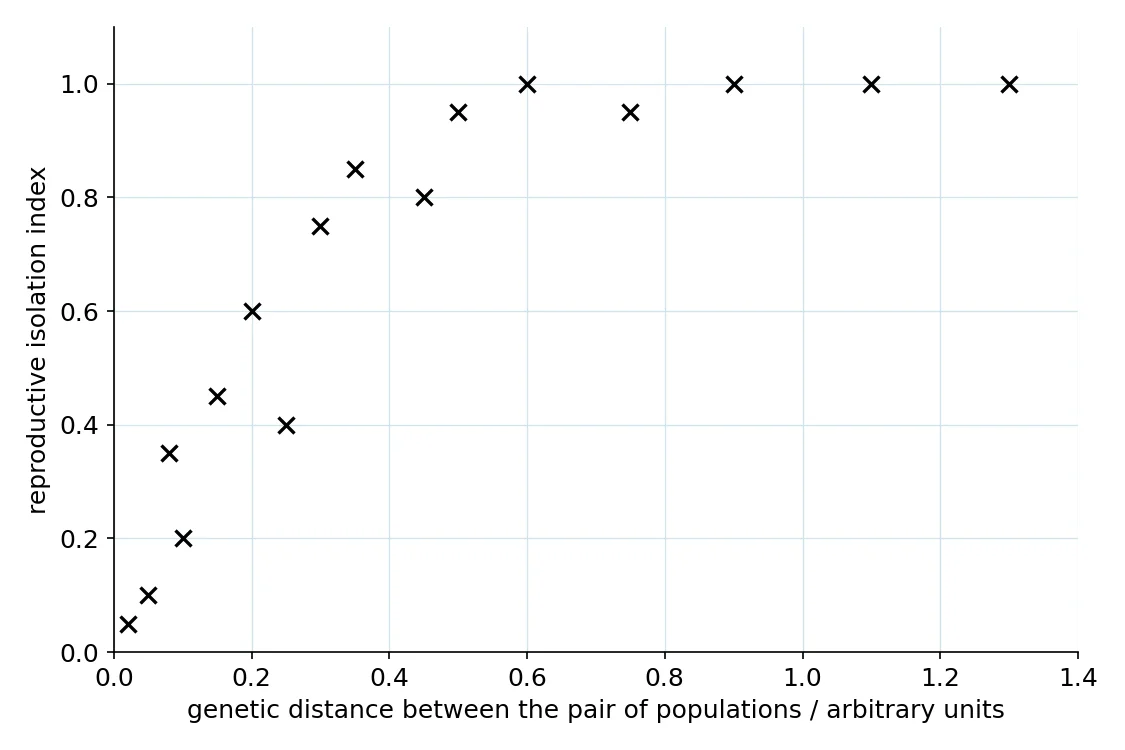
Describe the relationship between genetic distance and reproductive isolation shown in the graph.
Using the graph, determine the lowest genetic distance at which complete reproductive isolation (index 1.0) is seen.
Pairs with a genetic distance of about 0.2 have isolation indices between 0.4 and 0.6. Explain why biologists would find it difficult to decide whether such pairs are one species or two.
Suggest why the points do not lie on a smooth line.
Calculate the mean reproductive isolation index for the three pairs with genetic distances of 0.5, 0.6 and 0.75.
Outline how the mating trials should be designed so that the isolation index is measured fairly.
Discuss whether a fixed value of genetic distance could be used to decide whether two populations are separate species.
revisionprep.com
Summary Answer
Not available for this question.
Model Answer
Not available for this question.
Marking Scheme
Not available for this question.
Examiner Insights
Not available for this question.
That's every free question here — 6 of 163.
+157 more questions, plus Mock Papers & Worksheets, are waiting in Premium.