You're viewing 3 free preview questions for Biology HL — subscribe to unlock 141 more, plus the Full Question Bank, Mock Papers & Worksheets.Upgrade
Evolution and Speciation · Paper 2 — Free Biology HL Practice Questions
1MasterySAQ-SSpeciation: Allopatric and sympatric6 marksPaper 2~9 min

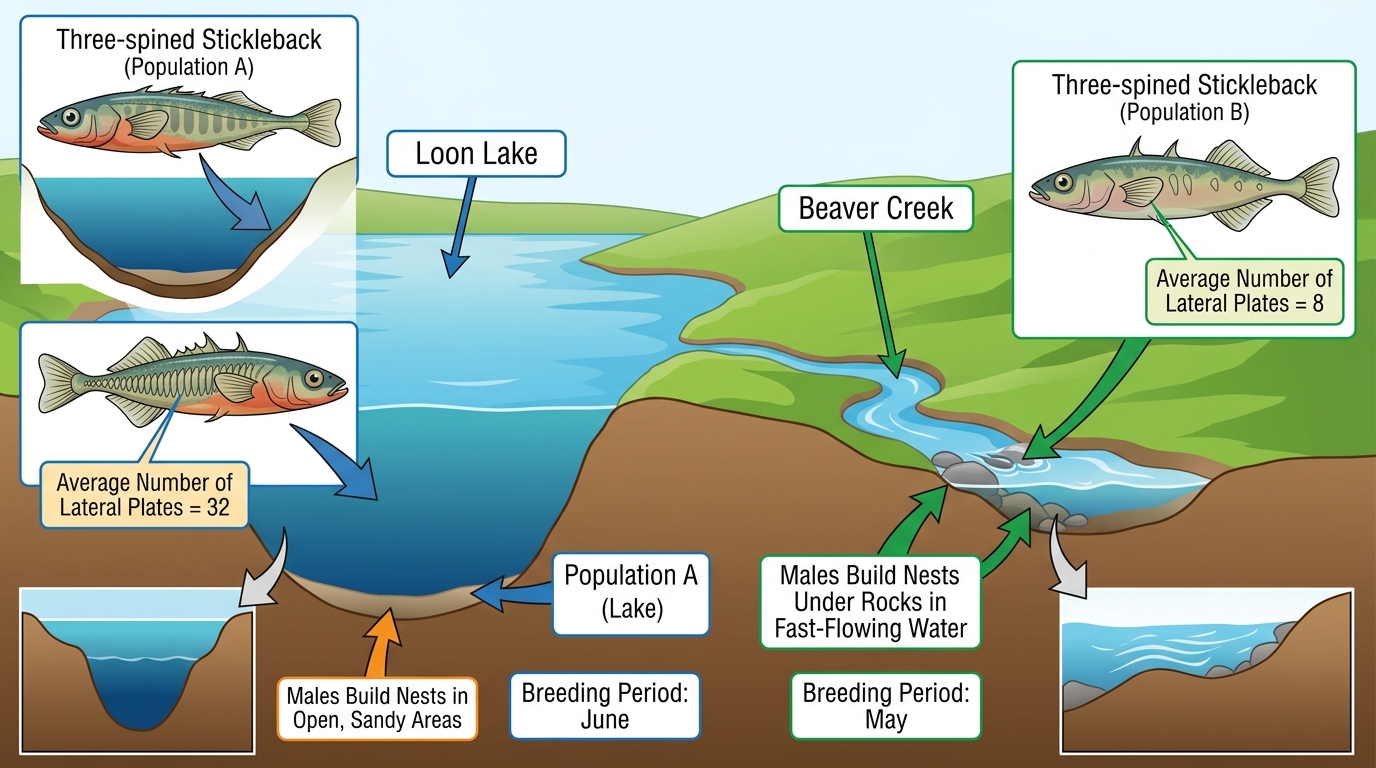
The three-spined stickleback (Gasterosteus aculeatus) is a small fish found in both marine and freshwater environments in the Northern Hemisphere. After the last Ice Age (approximately 10,000 years ago), many marine stickleback populations became trapped in newly formed freshwater lakes and streams. These isolated populations have since diverged into distinct freshwater forms.
Data from a study of two stickleback populations in British Columbia, Canada, are shown below:
- Population A: Found in a large, deep lake (Loon Lake). Males build nests in open, sandy areas. Breeding occurs in June. Average number of lateral bony plates .
- Population B: Found in a small, shallow stream (Beaver Creek) that flows into Loon Lake. Males build nests under rocks in fast-flowing water. Breeding occurs in May. Average number of lateral bony plates .
(a)
State the process that initially isolated these stickleback populations from the ancestral marine population. [1 mark]
(b)
Explain how differences in nesting site and breeding time could each contribute to reproductive isolation between Population A and Population B. [2 marks]
(c)
Evaluate the claim that the difference in lateral plate number between the two populations is entirely due to genetic drift, using evidence from the data and your knowledge of evolutionary mechanisms. [3 marks]

Solutions
2MasterySAQ-SSpeciation: Allopatric and sympatric6 marksPaper 2~9 min
The apple maggot fly (Rhagoletis pomonella) originally infested only hawthorn (Crataegus) fruits in North America. Around 1850, a population began to infest introduced apple (Malus domestica) fruits. Today, the two host races are genetically distinct and show partial reproductive isolation. Mating occurs on the host fruit on which the female lays her eggs.
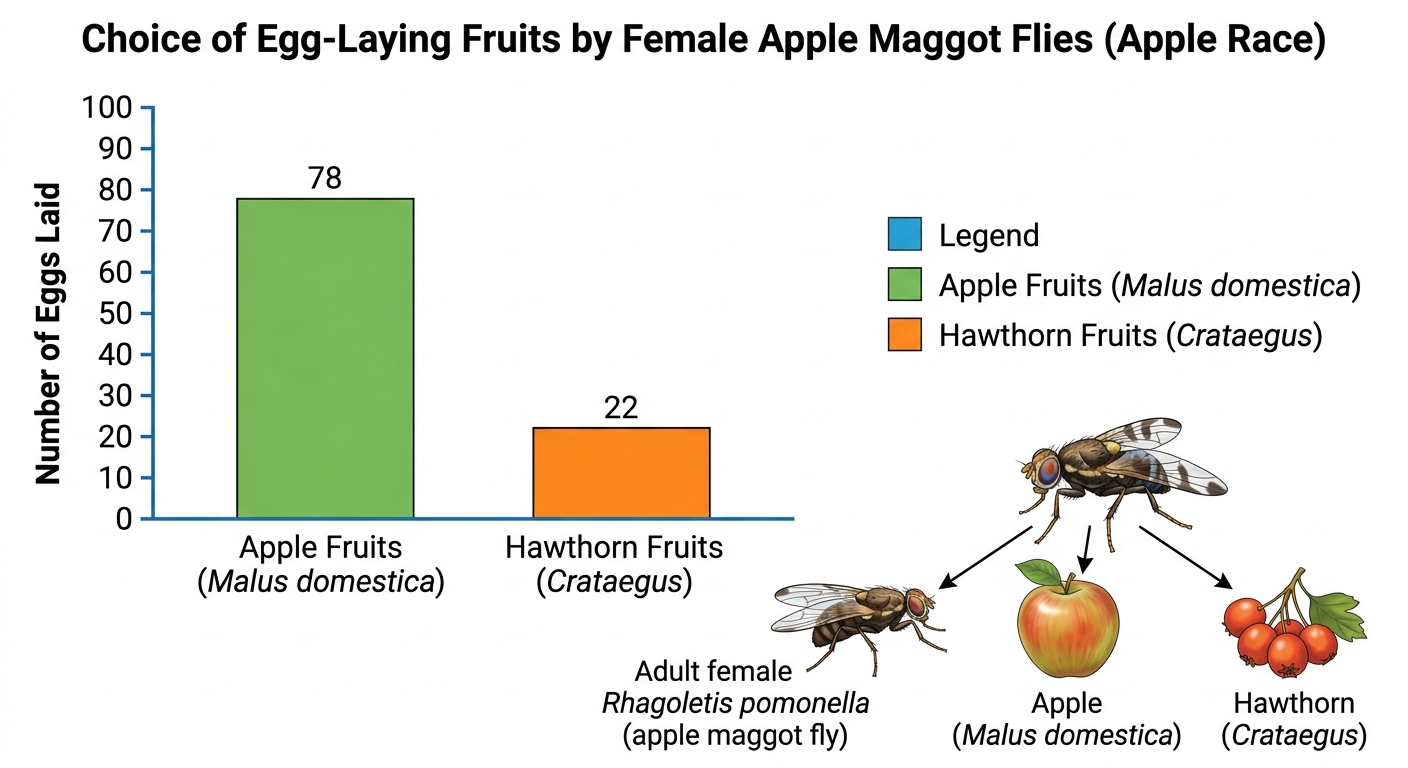
In a laboratory experiment, female flies from the apple race were given a free choice of fruits on which to lay eggs. Results:
- Apple fruits: eggs laid
- Hawthorn fruits: eggs laid
(a)
State the type of speciation occurring in Rhagoletis pomonella. [1 mark]
(b)
Calculate the percentage of eggs laid on apple fruits by the apple-race females. [1 mark]
(c)
Using your answer to (b) and the information provided, explain how host-fruit preference contributes to reproductive isolation between the two races. [2 marks]
(d)
Evaluate the extent to which natural selection alone could drive complete speciation in Rhagoletis pomonella, given that the two races remain the same geographic area and gene flow has not been entirely eliminated. [2 marks]
Solutions
3ChallengeLAQMechanisms of evolution: Natural selection, genetic drift, gene flow10 marksPaper 2~15 min
Data
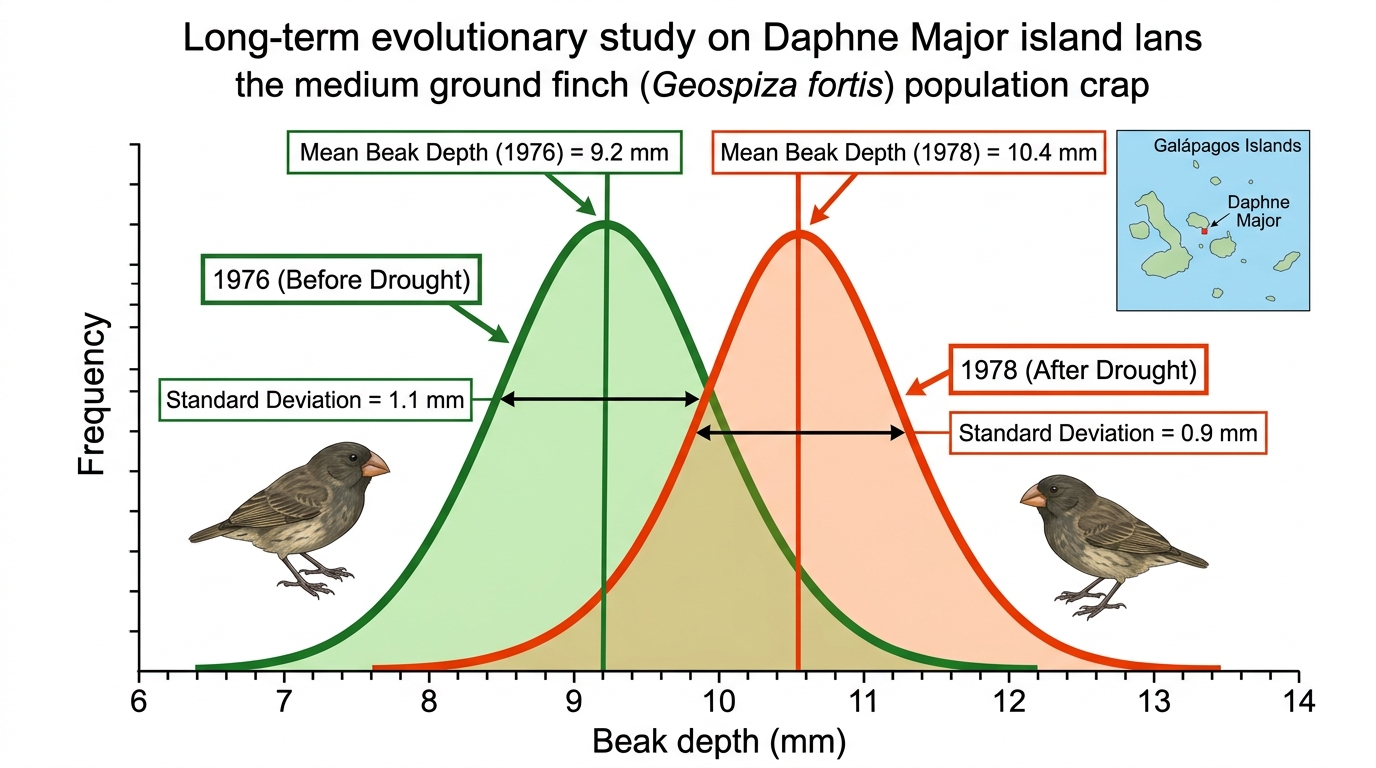
- Before drought (1976): mean beak depth , standard deviation , population size
- After drought (1978): mean beak depth , standard deviation , population size
- Heritability () of beak depth
- Effective population size during drought:
- A second island population (Isla Santa Cruz) maintained mean beak depth over the same period with no drought
The Grant family's long-term study of Darwin's finches (Geospiza spp.) on Daphne Major island in the Galápagos has provided direct evidence for natural selection in the wild. In 1977, a severe drought reduced seed availability. Small, soft seeds were rapidly depleted, leaving primarily large, hard seeds. Researchers measured beak depth in the medium ground finch (Geospiza fortis) population before and after the drought.
(a)
Calculate the response to selection () for beak depth, using the breeder's equation , where the selection differential is the difference between the mean beak depth of surviving parents and the mean of the original population. Assume the mean beak depth of surviving parents equals the 1978 mean. [2 marks]
(b)
Explain how phenotypic variation, heritability, and differential survival each contributed to the observed shift in mean beak depth between 1976 and 1978. [3 marks]
(c)
Using the data provided, evaluate whether natural selection or genetic drift was the dominant mechanism driving the change in beak depth in the G. fortis population Daphne Major during the drought. [3 marks]
(d)
A researcher proposes using to determine whether the beak-depth allele frequency difference between Daphne Major and Isla Santa Cruz after the drought reflects local adaptation or genetic drift. The total heterozygosity across both populations is and the average within-population heterozygosity is . Calculate and deduce what this value indicates about the relative roles of selection and drift in differentiating the two populations. [2 marks]
Solutions
That's every free question here — 3 of 144.
+141 more questions, plus Mock Papers & Worksheets, are waiting in Premium.