Nucleic Acids · Paper 2 — Free Biology HL Practice Questions
Free questions
Open in full, with answers, mark scheme and examiner insights.
Base-sequence diversity and the universal genetic code
A gene from a virus is placed in bacteria, which then make the viral protein.
(a) Explain why the bacteria make a protein with the same amino acid sequence as in the virus. [2]
revisionprep.com
Summary Answer
Not available for this question.
Model Answer
Not available for this question.
Marking Scheme
Not available for this question.
Examiner Insights
Not available for this question.
DNA double helix and complementary base pairing
Diagrams of DNA in IB papers use a circle for phosphate, a pentagon for the sugar and a rectangle for the base.
Draw a labelled diagram of a section of DNA with two base pairs, using these symbols.
State the type of bond that links each sugar to the next phosphate in the backbone.
Explain why the two strands of your diagram must be drawn running in opposite directions.
revisionprep.com
Summary Answer
Not available for this question.
Model Answer
Not available for this question.
Marking Scheme
Not available for this question.
Examiner Insights
Not available for this question.
Nucleotide structure and the sugar–phosphate backbone
Compound Q is a nucleotide analogue that lacks a hydroxyl group on carbon 3′. Its effect on DNA synthesis by a viral reverse transcriptase and by a human DNA polymerase was measured in test tubes (mean ± SD, n = 4, hypothetical data).
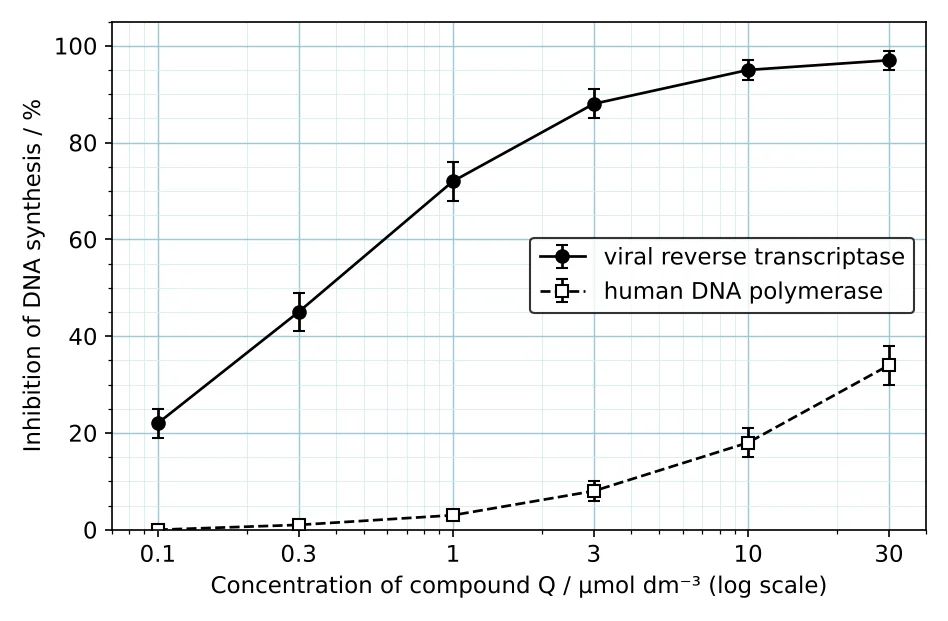
State the percentage inhibition of the viral enzyme at 1 µmol dm⁻³ of compound Q.
Describe the effect of compound Q on the viral enzyme.
Calculate the ratio of inhibition of the viral enzyme to inhibition of the human enzyme at 3 µmol dm⁻³.
Explain how compound Q inhibits DNA synthesis.
Suggest a suitable concentration of compound Q for treating an infection, giving a reason.
Evaluate whether these results show that compound Q would be safe to use as a medicine.
Explain why the concentrations were chosen on a scale that increases about three times at each step.
revisionprep.com
Summary Answer
Not available for this question.
Model Answer
Not available for this question.
Marking Scheme
Not available for this question.
Examiner Insights
Not available for this question.
Structure of DNA and RNA
In the late 1940s, the masses of DNA and of protein in the nuclei of different cells were measured. Unlike mammals, birds have nucleated red blood cells. The table shows data of the type obtained (pg = picogram).
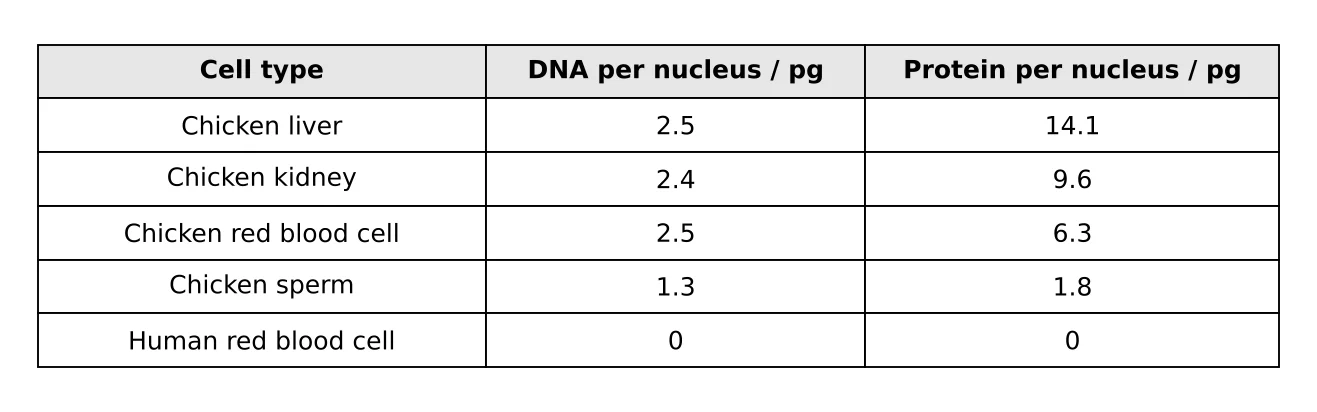
Calculate the mean mass of DNA per nucleus in the chicken body cells shown.
Calculate the ratio of DNA per nucleus in chicken sperm to the mean for chicken body cells.
Compare the variation in DNA per nucleus with the variation in protein per nucleus.
Explain how the data support the hypothesis that DNA is the genetic material.
Explain the value for chicken sperm.
Suggest why there is no DNA in a human red blood cell.
Evaluate the strength of these data as evidence that DNA is the genetic material.
revisionprep.com
Summary Answer
Not available for this question.
Model Answer
Not available for this question.
Marking Scheme
Not available for this question.
Examiner Insights
Not available for this question.
Differences between DNA and RNA
A research team investigates a newly discovered virus, Virion xanthus, whose genome is single-stranded RNA. The viral enzyme reverse transcriptase synthesises a complementary DNA strand (cDNA) from the RNA template. Base composition analysis of the viral RNA genome gives: adenine (A), guanine (G), cytosine (C), and uracil (U).
Calculate the percentage of adenine present in the newly synthesised cDNA strand. Show your working.
The cDNA strand does not obey the complementary base-pairing rule (i.e. and within the strand). Explain why this the case for a single-stranded cDNA molecule.
DNA polymerase then synthesises a second DNA strand complementary to the cDNA, producing a double-stranded DNA (dsDNA) molecule. The dsDNA is treated with an enzyme that degrades any remaining single-stranded DNA. Determine the expected percentage of guanine (G) in the final dsDNA product, and justify your answer using complementary base pairing.
State one structural difference between the viral RNA genome and the cDNA strand.
revisionprep.com
Summary Answer
Not available for this question.
Model Answer
Not available for this question.
Marking Scheme
Not available for this question.
Examiner Insights
Not available for this question.
Directionality, purines and pyrimidines, nucleosomes, Hershey–Chase and Chargaff (AHL)
Samples of chromatin and of naked DNA from the same cells were digested with a nuclease. The percentage of DNA remaining undigested was measured over time (mean ± SD, n = 3, hypothetical data). In these cells 147 base pairs of DNA are wrapped around each histone core.
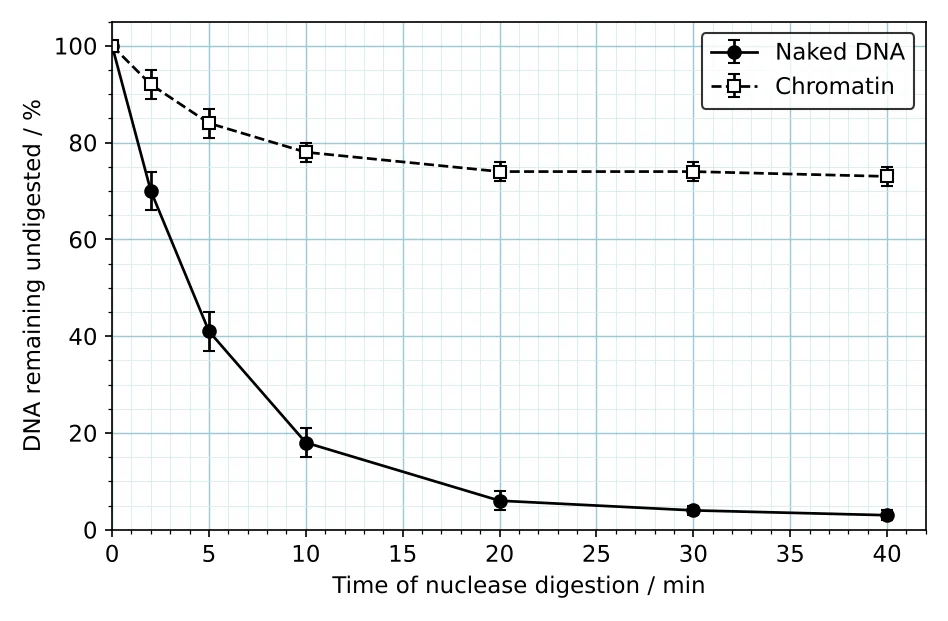
State the percentage of chromatin DNA remaining after 10 minutes.
Compare the digestion of naked DNA and chromatin.
Calculate the mean rate of digestion of naked DNA in the first 5 minutes.
Explain why the digestion of chromatin stops at about 73 %.
Using the plateau value, deduce the length of the nucleosome repeat and of the linker DNA in these cells.
Explain how the structure of histones allows them to protect DNA in this way.
Evaluate the method used to estimate the length of linker DNA.
revisionprep.com
Summary Answer
Not available for this question.
Model Answer
Not available for this question.
Marking Scheme
Not available for this question.
Examiner Insights
Not available for this question.
That's every free question here — 6 of 150.
+144 more questions, plus Mock Papers & Worksheets, are waiting in Premium.