You're viewing 3 free preview questions for Biology HL — subscribe to unlock 102 more, plus the Full Question Bank, Mock Papers & Worksheets.Upgrade
Viruses · Paper 2 — Free Biology HL Practice Questions
1MasterySAQ-SReplication of viruses2 marksPaper 2~3 min

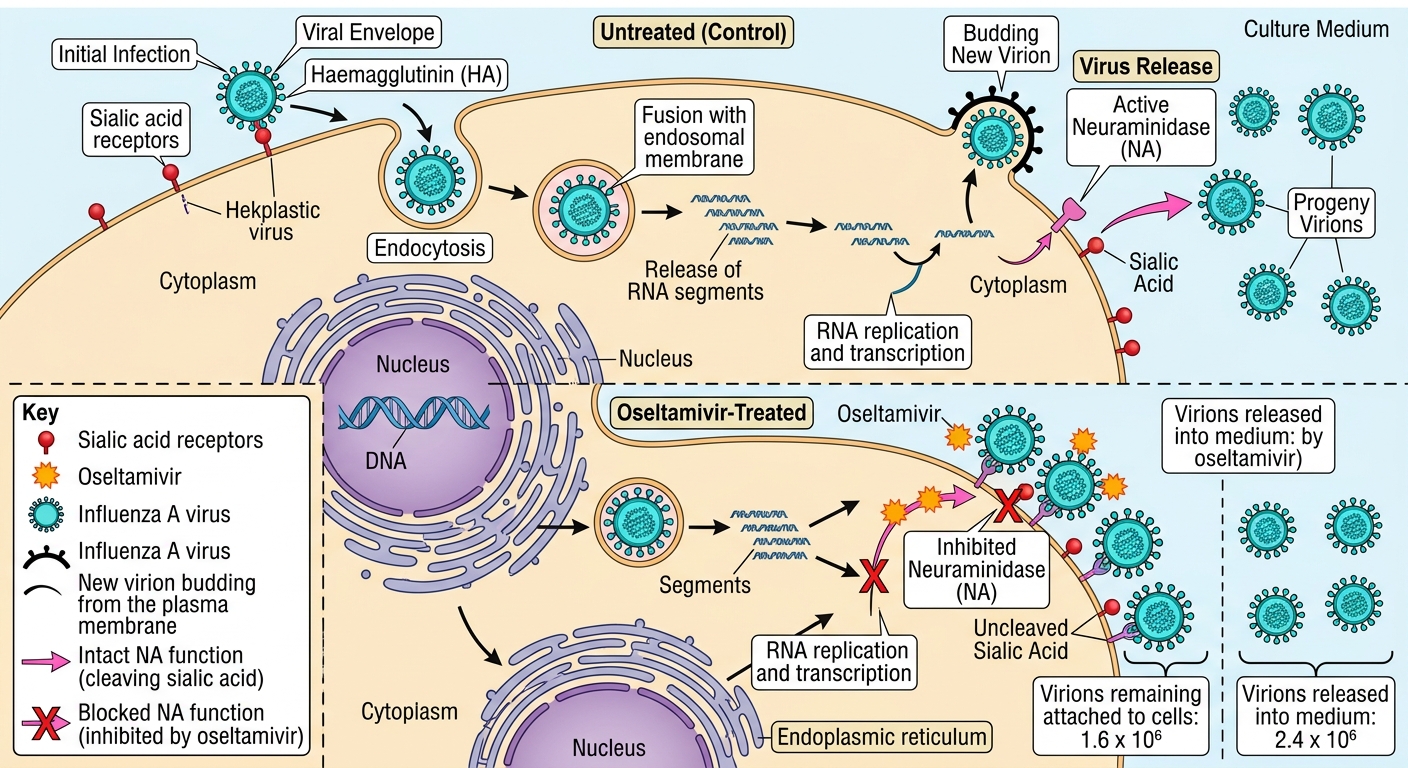
Influenza A virus is an enveloped virus with a segmented single-stranded RNA genome. The virus binds to sialic acid receptors on host respiratory epithelial cells via its haemagglutinin (HA) glycoprotein. After endocytosis, the low pH of the endosome triggers fusion of the viral envelope with the endosomal membrane, releasing the viral RNA segments into the cytoplasm. The viral RNA-dependent RNA polymerase (RdRp) replicates the viral genome and transcribes mRNA. New viral particles assemble at the host cell plasma membrane, where neuraminidase (NA) cleaves sialic acid to release progeny virions.
A researcher treats infected cell cultures with oseltamivir, a competitive inhibitor of neuraminidase. After 24 hours, the number of viral particles released into the culture medium and the number remaining attached to the host cell surface are measured.
(a)
State the role of the viral envelope during replication of Influenza A, with reference to events in the endosome. [1 mark]
(b)
In an oseltamivir-treated culture, virions are released into the medium and virions remain attached to cells. Calculate the percentage of total virions that remain attached to the host cell surface. [1 mark]

Solutions
2MasterySAQ-SReplication of viruses5 marksPaper 2~8 min
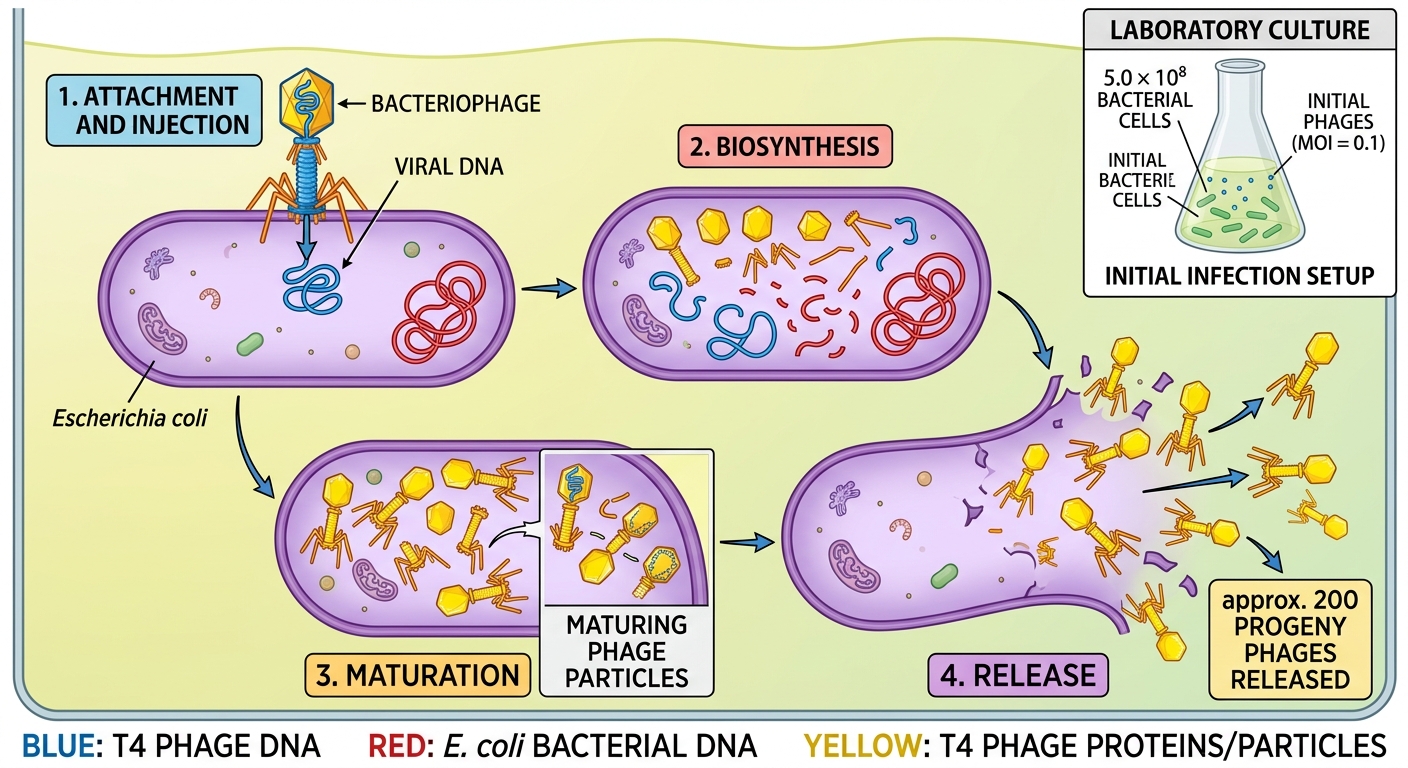
A laboratory culture of Escherichia coli is infected with bacteriophage T4. The phage injects its double-stranded DNA into the host cell, which then replicates the phage genome and synthesises phage proteins. New phage particles are assembled, and the host cell is lysed by phage-encoded lysozyme, releasing approximately 200 progeny phages per infected cell. This the lytic cycle.
The culture initially contains bacterial cells and is infected at a multiplicity of infection (MOI) of (1 phage per 10 bacterial cells).
(a)
State the role of lysozyme in the T4 lytic cycle. [1 mark]
(b)
Calculate the total number of progeny phages produced after one complete lytic cycle, assuming all infected cells lyse successfully. [2 marks]
(c)
Some T4-related phages can enter a lysogenic cycle instead of a lytic cycle. Evaluate the consequences of lysogeny versus the lytic cycle for both phage survival and host cell fate under conditions of nutrient limitation. [2 marks]
Solutions
3ChallengeLAQReplication of viruses8 marksPaper 2~12 min
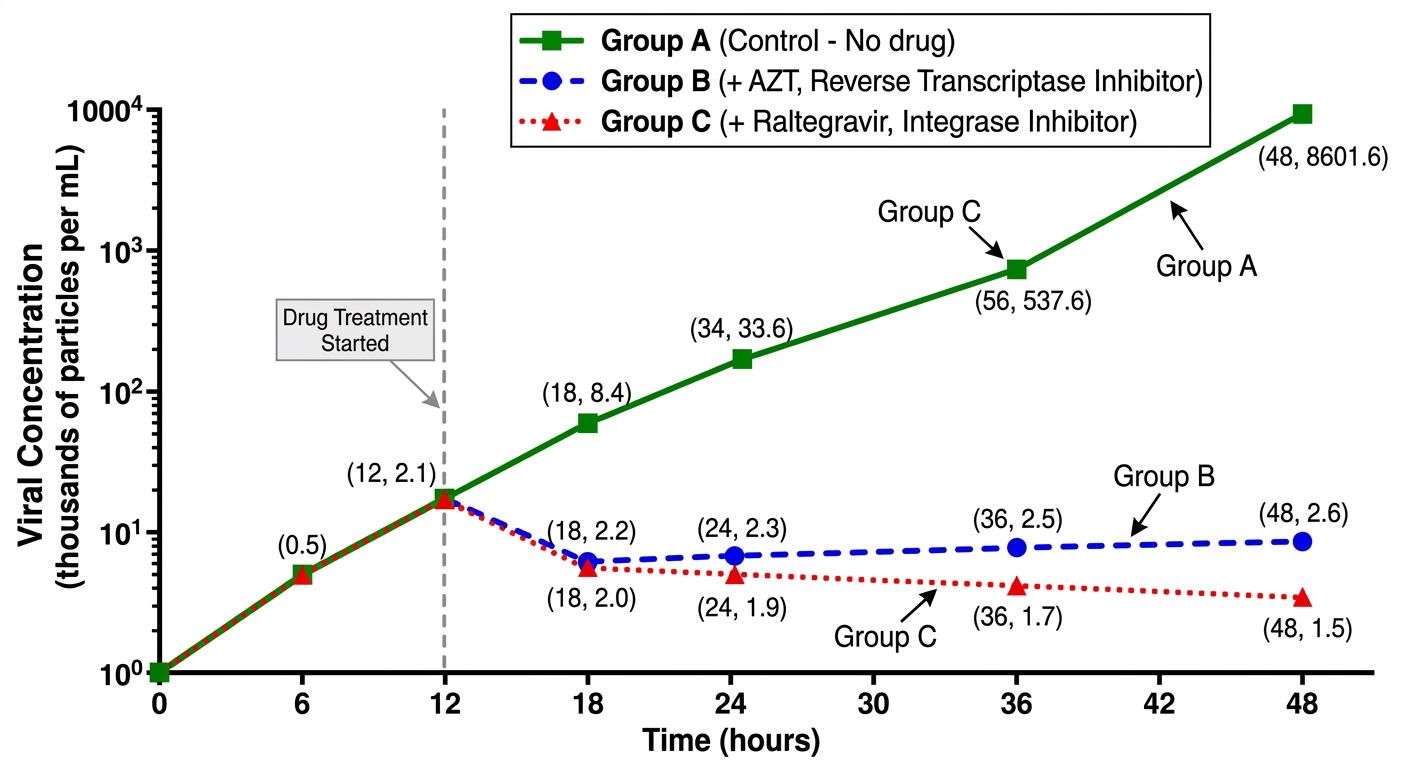
A culture of T-cells was infected with HIV at time . The concentration of free virions in the culture medium was measured every for . At the culture was divided into three treatment groups:
- Group A: no drug (control)
- Group B: treated with zidovudine (AZT), a nucleoside analogue that inhibits reverse transcriptase
- Group C: treated with raltegravir, an inhibitor of viral integrase
Viral concentrations (thousands of virions ) are shown below.
Time (h) — 0 — 6 — 12 — 18 — 24 — 36 — 48
Group A — 0.0 — 0.5 — 2.0 — 8.0 — 32.0 — 512.0 — 8192.0
Group B — 0.0 — 0.5 — 2.0 — 2.1 — 2.2 — 2.4 — 2.6
Group C — 0.0 — 0.5 — 2.0 — 1.9 — 1.7 — 1.4 — 1.1
(a)
Calculate the doubling time of the viral population in Group A between and , and between and . [2 marks]
(b)
Explain the difference between the two doubling times calculated in (a) with reference to the HIV replication cycle. [2 marks]
(c)
Analyse the effect of AZT (Group B) and raltegravir (Group C) on viral concentration over the period, identifying one similarity and one difference between the two treatments. [2 marks]
(d)
Evaluate the relative effectiveness of AZT and raltegravir inhibiting HIV replication, using data from the table to support your answer. [2]
(e) A patient is treated with a combination of AZT and raltegravir from the time of infection. Predict the likely viral concentration trend over and justify your prediction by discussing the mechanisms of both drugs and the concept of viral resistance. [2 marks]
Solutions
That's every free question here — 3 of 105.
+102 more questions, plus Mock Papers & Worksheets, are waiting in Premium.