You're viewing free preview questions. Upgrade to access more Biology HL questions.Upgrade
Water · Paper 2 — Free Biology HL Practice Questions
1MasterySAQ-SRole of water in living organisms5 marksPaper 2~8 min

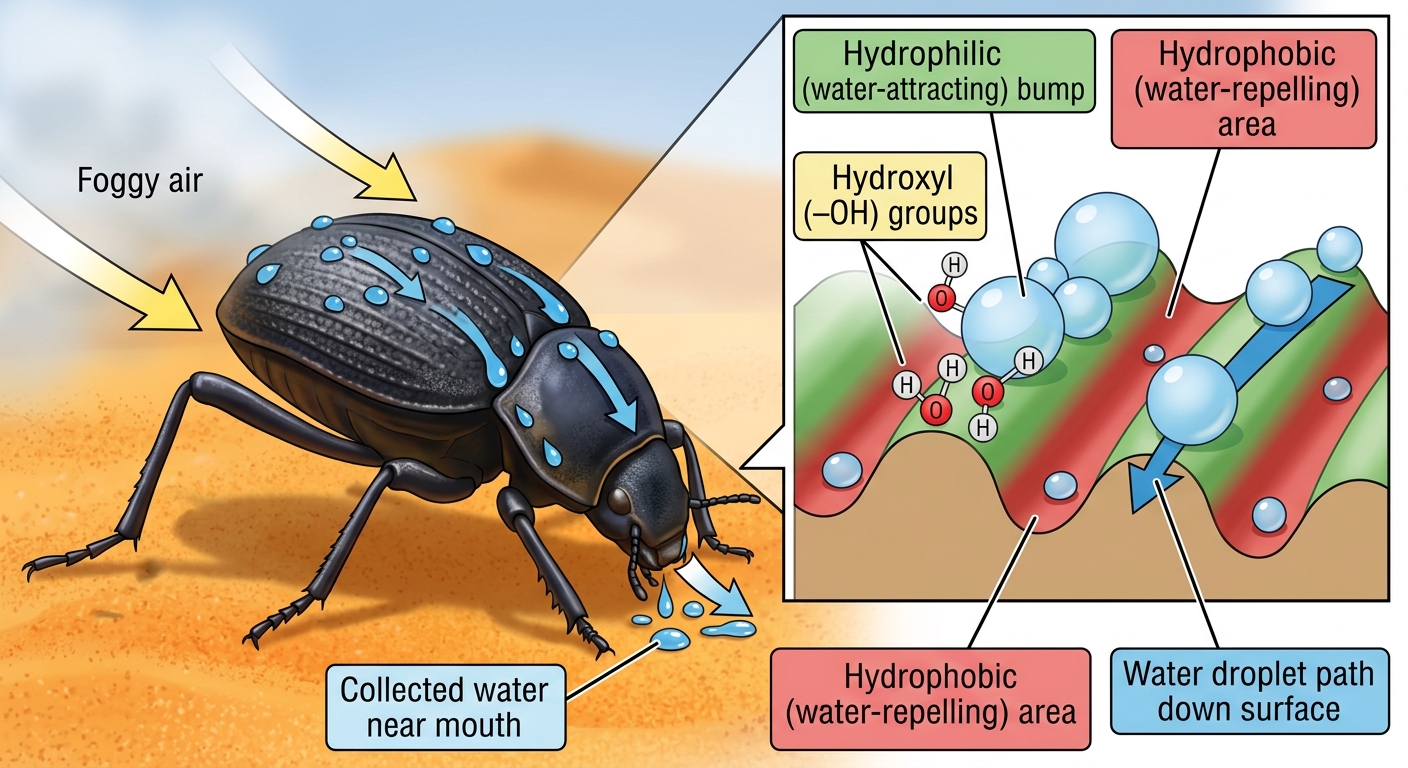
The Namib Desert beetle (Stenocara gracilipes) survives in one of Earth's driest environments by harvesting water from coastal fog. The beetle's wing surface has alternating hydrophobic (waxy) regions and hydrophilic bumps rich in hydroxyl () groups. When fog rolls in, water droplets condense on the hydrophilic bumps. The beetle tilts its body forward and water rolls down the wing into its mouth.
(a)
Describe how the property of cohesion in water contributes to the movement of water droplets down the beetle's wing. [2 marks]
(b)
Explain how the hydroxyl () groups on the hydrophilic bumps promote condensation of water vapour onto the wing surface. [2 marks]
(c)
The beetle collects 15 spherical droplets, each with a radius of .
Show that the total volume of water collected is approximately .
[1 mark]

Solutions
2MasterySAQ-SRole of water in living organisms5 marksPaper 2~8 min
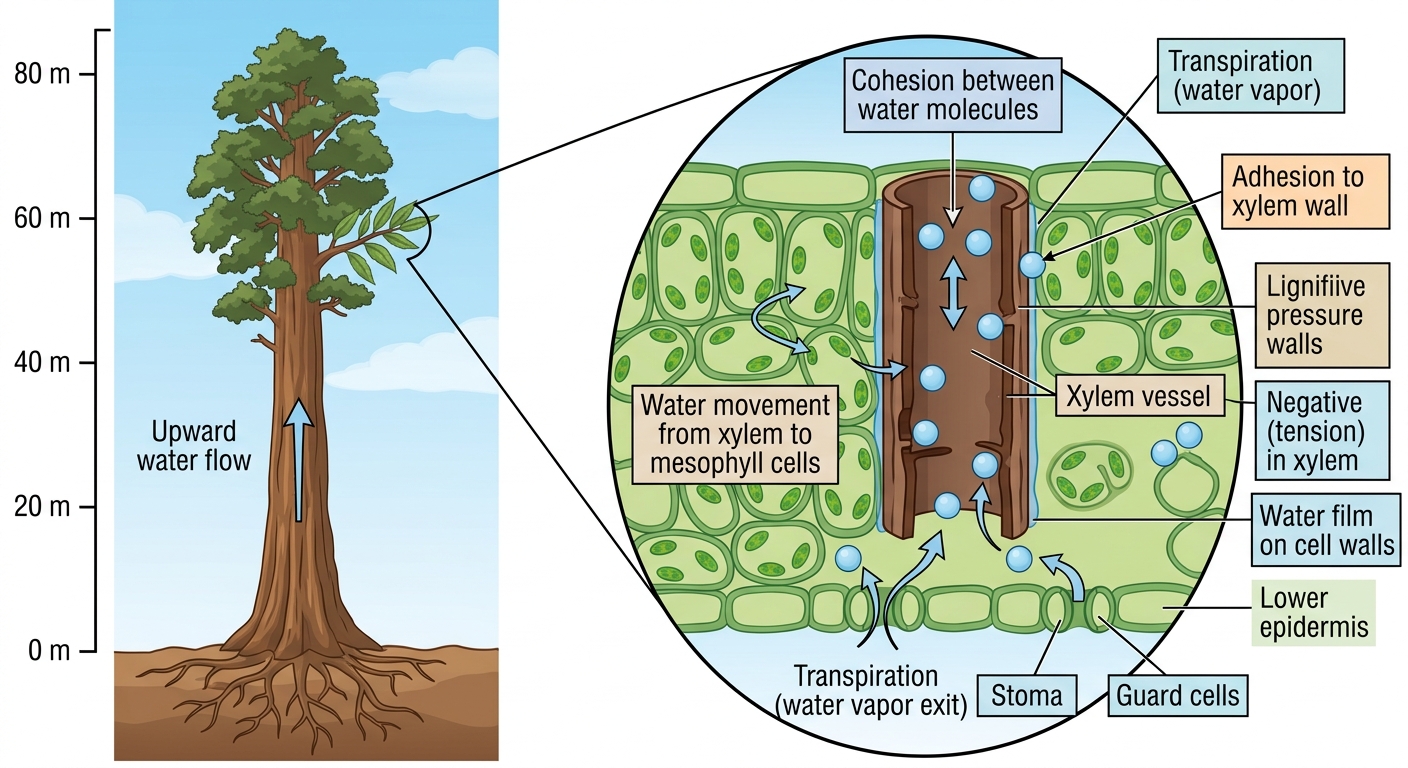
The vascular system of a giant sequoia (Sequoiadendron giganteum) transports water from roots to leaves over high. Xylem vessels are composed of dead cells with heavily lignified walls. Transpiration from leaf surfaces creates a negative pressure (tension) that pulls water upward through the xylem.
(a)
Describe how adhesion contributes to water transport in xylem vessels. [2 marks]
(b)
Describe how the cohesion-tension theory explains the upward movement of water from roots to leaves. [2 marks]
(c)
The tension measured in xylem vessels near the top of a giant sequoia is approximately , compared with near the base. Evaluate whether the cohesion-tension mechanism alone is sufficient to account for water transport to a height of , given that a water column of requires approximately to lift against gravity. [1 mark]
Solutions
3MasterySAQ-SRole of water in living organisms5 marksPaper 2~8 min
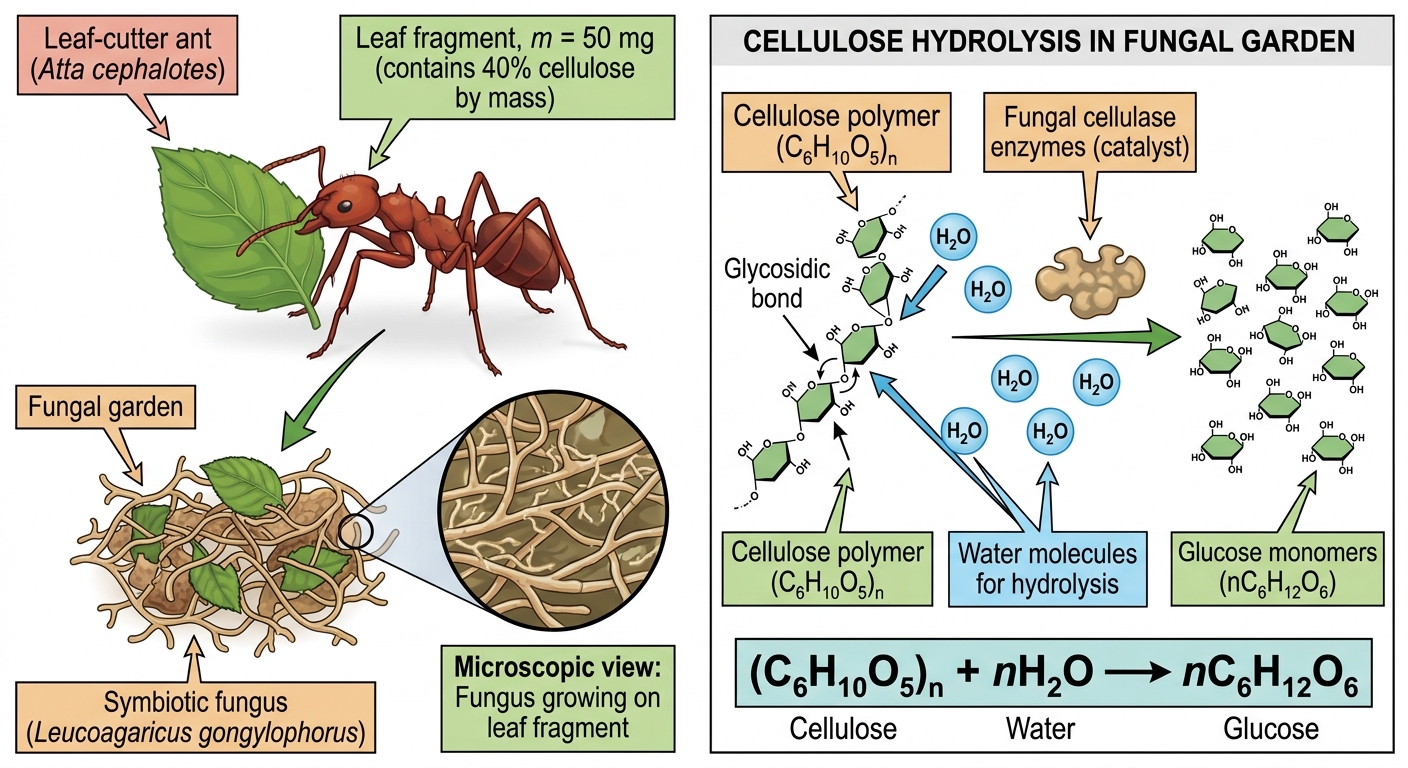
In the Amazon rainforest, leaf-cutter ants (Atta cephalotes) cultivate a symbiotic fungus (Leucoagaricus gongylophorus) on freshly cut leaf fragments. The fungus breaks down cellulose into glucose using water in a hydrolysis reaction:
Each ant carries of leaf material per trip. The leaf material contains cellulose by mass. The molar mass of a glucose monomer is . Avogadro's constant is .
(a)
State the role of water in the hydrolysis of cellulose. [1 mark]
(b)
Calculate the number of glucose molecules produced from one ant trip, assuming all cellulose is hydrolysed. Show your working. [3 marks]
(c)
Using the biochemical information above, explain why the relationship between the ants and the fungus is described as mutualistic rather than parasitic. [1 mark]
Solutions
4MasterySAQ-SRole of water in living organisms6 marksPaper 2~9 min
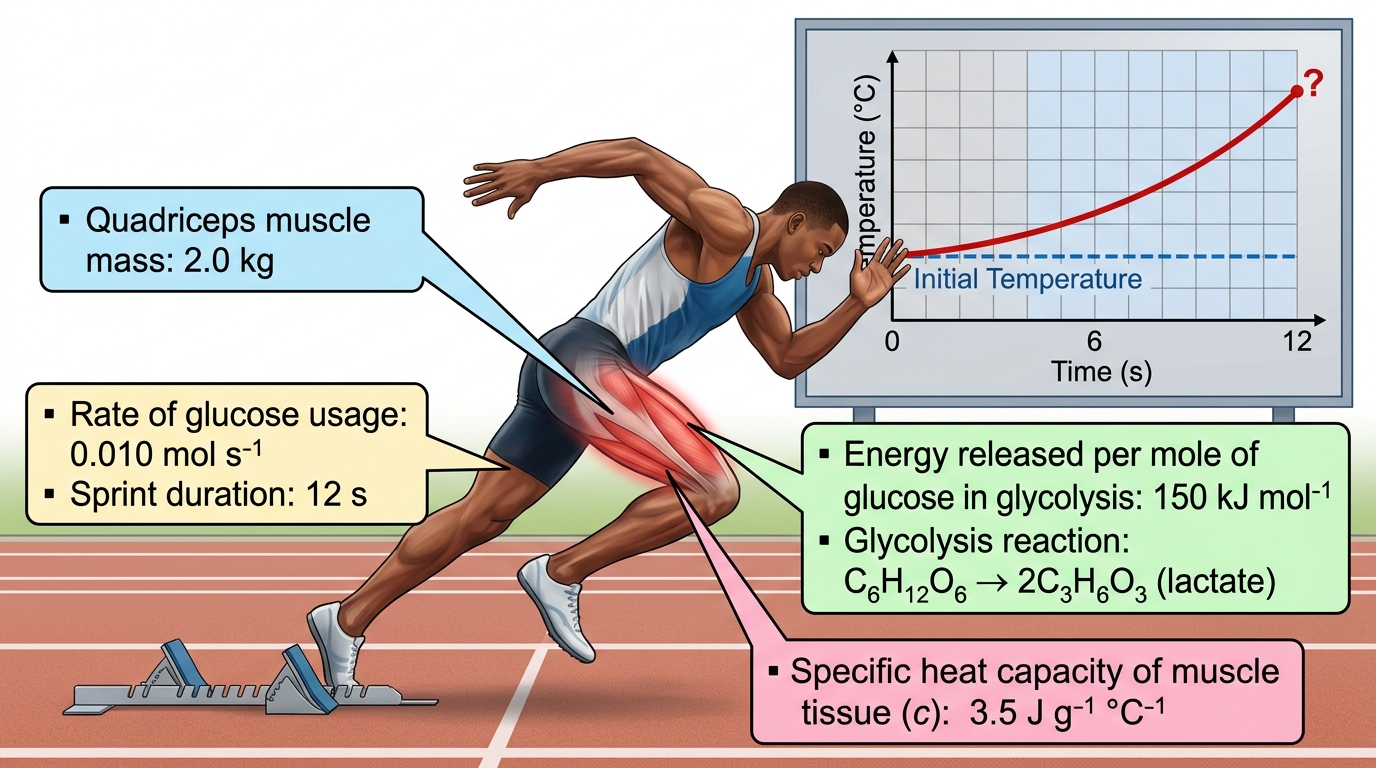
During a 100-metre sprint, human skeletal muscle cells undergo rapid glycolysis, producing lactate according to:
The specific heat capacity of muscle tissue is . A sprinter's quadriceps muscle has a mass of . The energy released per mole of glucose during glycolysis . The sprinter uses of glucose per second and the sprint lasts . Assume all energy is retained as heat in the muscle.
(a)
State the property of water that enables muscle tissue to resist large temperature changes. [1 mark]
(b)
Calculate the temperature increase in the quadriceps muscle at the end of the sprint. Show your working. [3 marks]
(c)
Explain how the cytoplasm of muscle cells, which is approximately water, limits the risk of enzyme denaturation during the sprint. [2 marks]
Solutions
5MasterySAQ-SRole of water in living organisms8 marksPaper 2~12 min
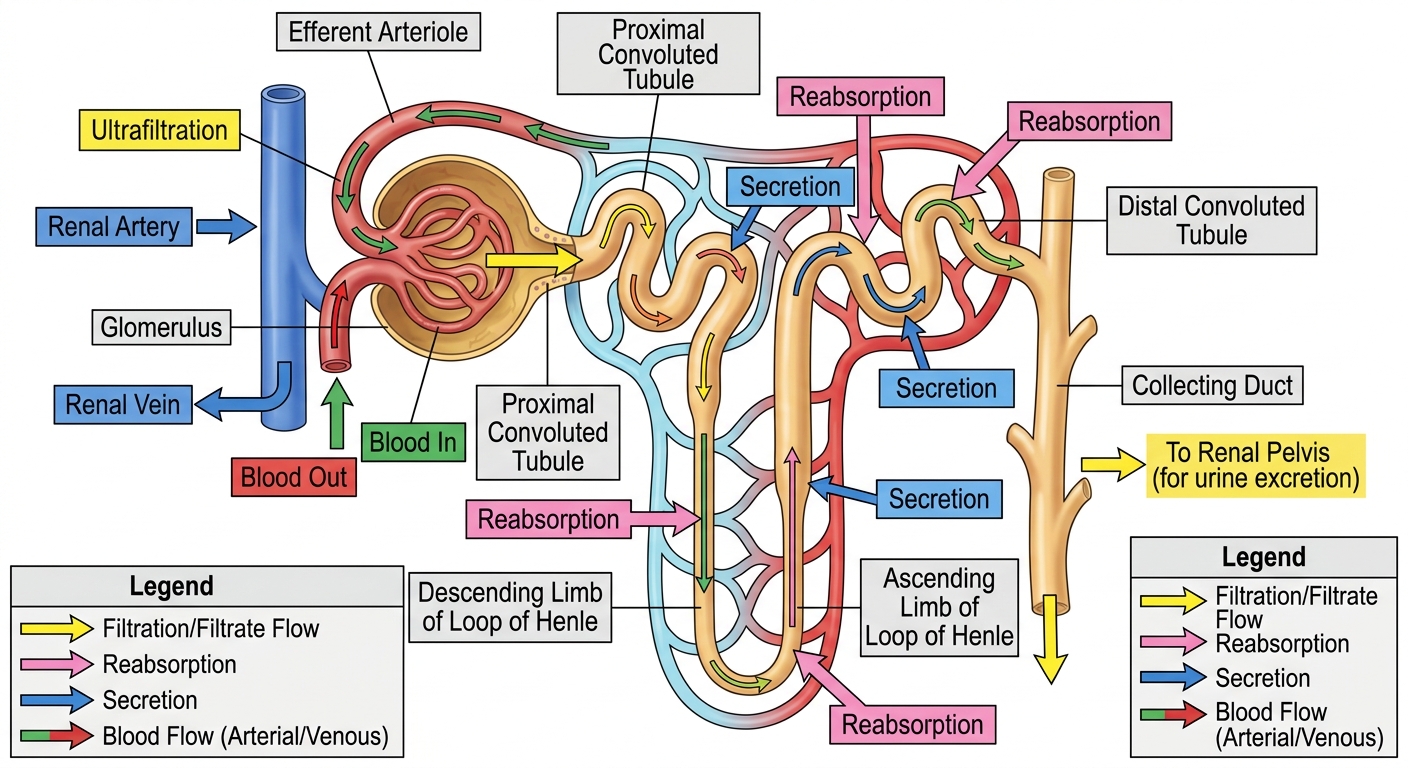
The blood plasma of a dehydrated patient has an osmolarity of . The patient is given an intravenous drip of of distilled water over 30 minutes. The patient's total blood plasma volume is . The kidneys filter blood at a rate of , and the nephrons reabsorb of filtered water under normal conditions. Normal blood plasma osmolarity is .
(a)
State the molecular property of water that allows it to act as a solvent for ions in blood plasma. [1 mark]
(b)
Calculate the volume of water that would be excreted as urine in the 30-minute period if the kidneys do not adjust their reabsorption rate in response to the drip. Show your working. [3 marks]
(c)
After the drip is administered, the patient's plasma osmolarity falls below . Evaluate how the hypothalamus and kidneys would respond to restore normal osmolarity, referring to the hormone involved. [4 marks]
Solutions
6MasterySAQ-SRole of water in living organisms7 marksPaper 2~11 min
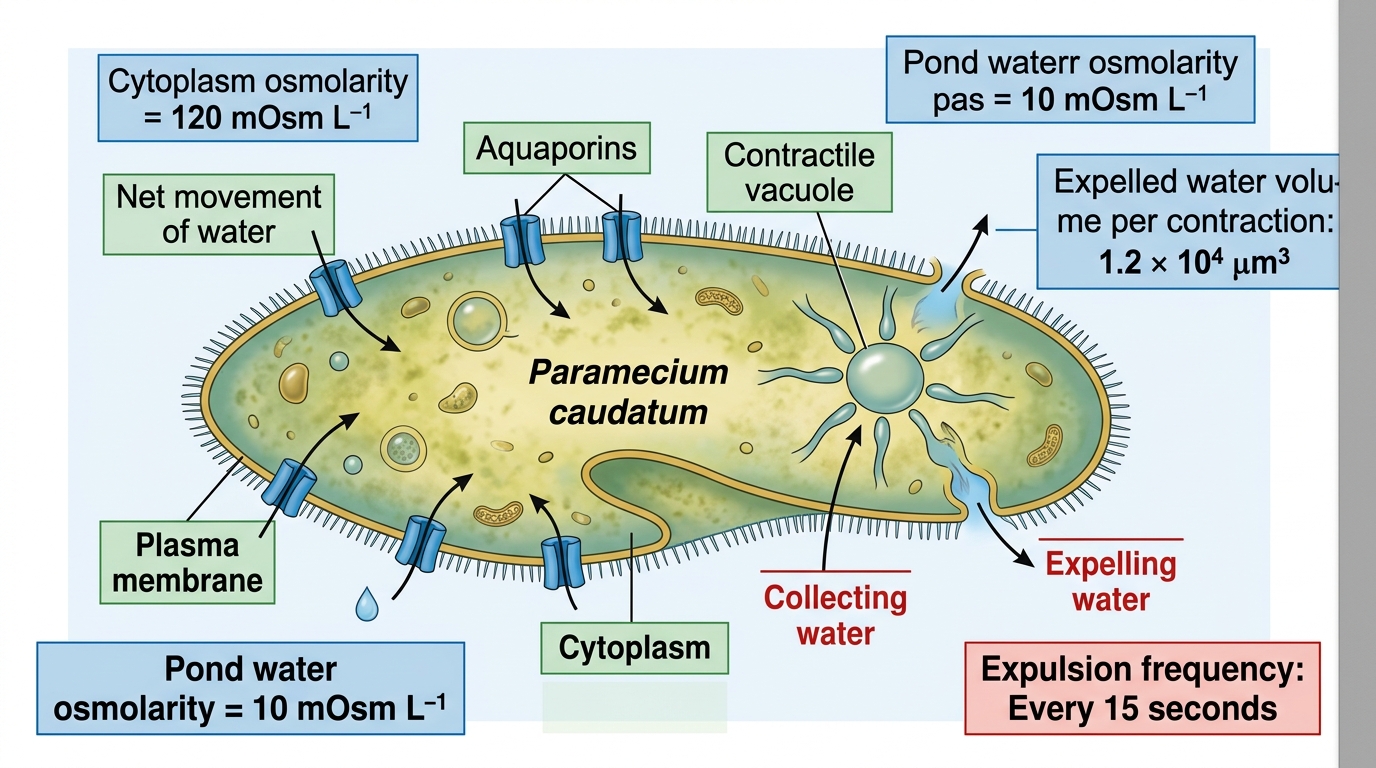
The plasma membrane of the freshwater protozoan Paramecium caudatum contains aquaporins that facilitate the movement of water by osmosis. The contractile vacuole collects excess water from the cytoplasm and expels it to the environment every seconds. The osmolarity of the cytoplasm is and the surrounding pond water has an osmolarity of . The contractile vacuole expels of water per contraction.
(a)
State why water continuously enters Paramecium from its environment. [1 mark]
(b)
Calculate the total volume of water expelled by the contractile vacuole per minute. Show your working. [2 marks]
(c)
Explain how the polar nature of water molecules enables their movement through aquaporins. [2 marks]
(d)
The contractile vacuole requires ATP to function. Evaluate the consequences for Paramecium if aquaporin expression in the plasma membrane were significantly reduced. [2 marks]
Solutions
7MasterySAQ-SRole of water in living organisms6 marksPaper 2~9 min
The southern blue-ringed octopus (Hapalochlaena maculosa) produces tetrodotoxin, a potent polar neurotoxin, in specialised venom gland cells. These cells contain a high density of rough endoplasmic reticulum (rER) and Golgi apparatus. The toxin is released into seawater when the octopus is threatened and dissolves readily in the blood and interstitial fluid of predators.
(a)
Describe how the polarity of water molecules enables tetrodotoxin to dissolve in the octopus's salivary fluid. [2 marks]
(b)
Outline the pathway by which tetrodotoxin is synthesised and secreted from a venom gland cell, referring to the organelles involved. [2 marks]
(c)
A predator's red blood cells (initial volume ) are exposed to seawater containing tetrodotoxin, which is hypotonic relative to the predator's blood. The final volume of each red blood cell is .
(i) Calculate the percentage change in volume of the red blood cells. [1]
(ii) Deduce, with reference to osmosis, whether the predator's red blood cells would lyse if exposure continued. [2 marks]
(ii) Deduce, with reference to osmosis, whether the predator's red blood cells would lyse if exposure continued. [2 marks]
Solutions
8MasterySAQ-SRole of water in living organisms5 marksPaper 2~8 min
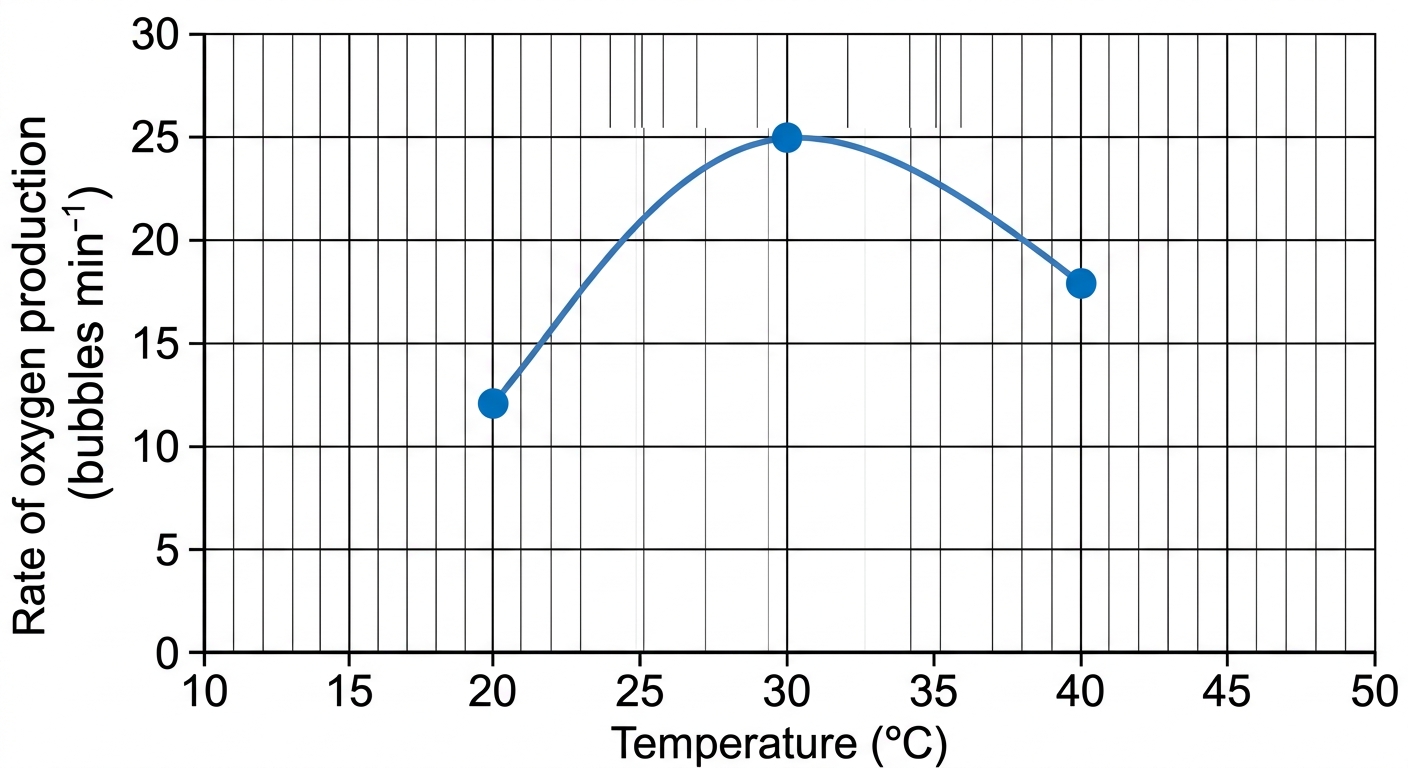
A researcher studies the effect of temperature on the rate of photosynthesis in the aquatic plant Elodea canadensis. The plant is placed in sodium hydrogen carbonate solution at each temperature to ensure availability, and exposed to constant light intensity. Rate of oxygen production is measured in bubbles per minute.
Temperature () — Rate of production (bubbles )
20 — 12
30 — 25
40 — 18
(a)
State two roles of water in the light-dependent reactions of photosynthesis. [2 marks]
(b)
Explain why the rate of oxygen production is lower at than at . [2 marks]
(c)
The researcher claims that counting oxygen bubbles is an unreliable measure of photosynthetic rate. Evaluate this claim. [1 mark]
Solutions
9MasterySAQ-SRole of water in living organisms5 marksPaper 2~8 min
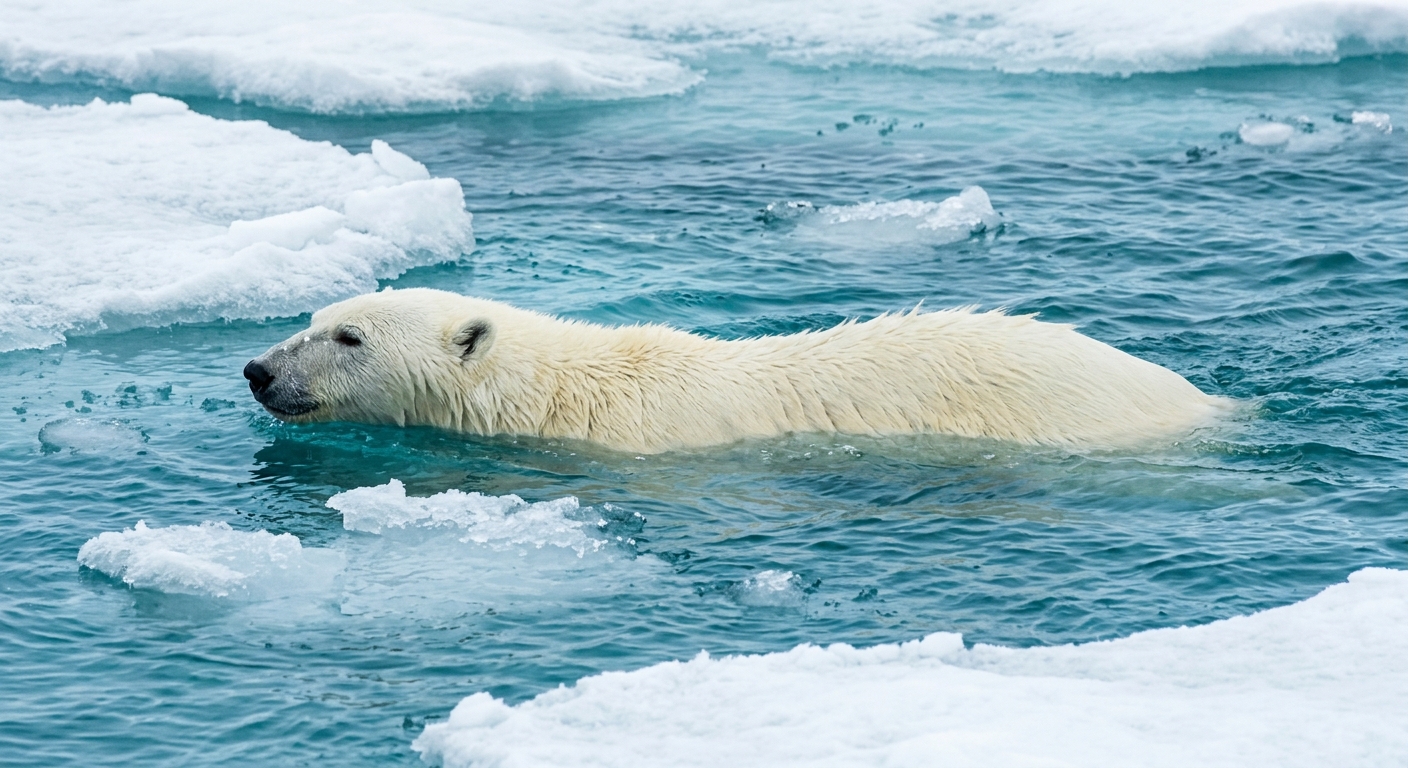
In the Arctic Ocean, the polar bear (Ursus maritimus) relies on blubber for insulation. The bear's fur is coated in oil from sebaceous glands, making it water-repellent. The bear consumes seals, which have a high salt content. The bear's kidneys can concentrate urine to an osmolarity of . The osmolarity of seawater is . Ice has a density of and seawater has a density of .
(a)
State the property of water that causes ice to float on seawater. [1 mark]
(b)
Calculate the volume of seawater that contains the same mass of water as of ice. Show your working. [2 marks]
(c)
Explain why ice formation in the bear's fur could be detrimental to its insulation, and suggest why the bear's sebaceous gland secretions reduce this risk. [2 marks]
Solutions
10MasterySAQ-SRole of water in living organisms6 marksPaper 2~9 min
During endurance exercise, human muscle cells produce large amounts of lactic acid via anaerobic respiration. The lactic acid dissociates to release ions, which would rapidly lower blood pH if not buffered. The bicarbonate buffering system in blood plasma uses the equilibrium:
The concentration of ions at pH is .
(a)
Describe the role of water as a reactant in the bicarbonate buffering system. [2 marks]
(b)
Explain how the addition of ions from lactic acid shifts the bicarbonate equilibrium, and state how increased produced as a result is removed from the blood. [2 marks]
(c)
A runner's blood pH drops from to after a sprint. Calculate the concentration of ions at pH and determine the fold-increase relative to the concentration at pH . [2 marks]
Solutions
11MasterySAQ-SRole of water in living organisms6 marksPaper 2~9 min
Researchers compared enzyme activity of a thermophilic bacterium (Thermus aquaticus) and a mesophilic bacterium (Escherichia coli) across a range of temperatures. The T. aquaticus enzyme retained full activity at , while the E. coli enzyme denatured above .
(a)
Explain, in terms of tertiary structure and molecular interactions, why the T. aquaticus enzyme retains activity at while the E. coli enzyme does not. [2 marks]
(b)
Water's high latent heat of vaporisation is important for thermoregulation. Describe how evaporative cooling uses this property of water. [2 marks]
(c)
The specific heat capacity of water is . Calculate the energy required to raise the temperature of of water from to . [2 marks]
Solutions
12MasterySAQ-SRole of water in living organisms7 marksPaper 2~11 min
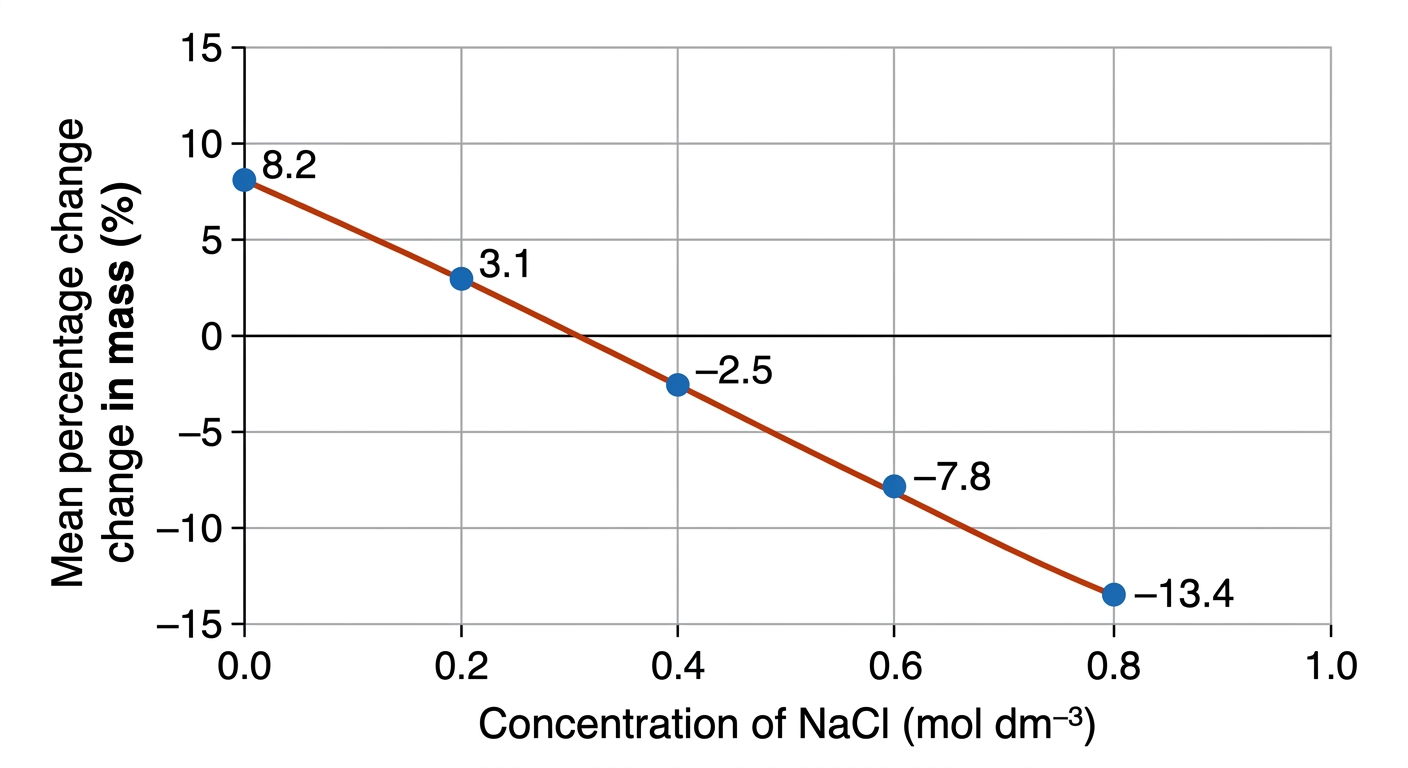
A student investigates the effect of sodium chloride (NaCl) concentration the rate of water uptake by potato tissue. Cylinders of potato of equal mass are placed in a series of NaCl solutions of different concentrations. After 60 minutes, the cylinders are removed, blotted dry, and re-weighed.
Concentration of NaCl / — Mean percentage change in mass / %
—
—
—
—
—
(a)
Describe the relationship between the concentration of NaCl and the mean percentage change in mass of the potato cylinders. [2 marks]
(b)
Calculate the concentration of NaCl that would be isotonic with the potato tissue. Show your working. [3 marks]
(c)
Explain why the potato cylinders placed in NaCl solution gained mass. [2 marks]
Solutions
13MasterySAQ-SRole of water in living organisms7 marksPaper 2~11 min
A student investigates the hydrolysis of starch by amylase in a buffered solution at and . Maltose concentration is measured over time. After 10 minutes, the reaction is stopped by heating to .
(a)
State two roles of water in the hydrolysis of starch. [2 marks]
(b)
The student repeats the experiment adding of sodium chloride (NaCl) to the reaction mixture. The rate of maltose production decreases by . Describe how the increased ionic strength of the solution affects the hydrogen bonding network of water and the hydration shells around the enzyme. [2 marks]
(c)
Explain how high NaCl concentration could reduce the catalytic activity of amylase by affecting its tertiary structure. [1 mark]
(d)
The student proposes that the reduction in amylase activity caused by NaCl is reversible, whereas the reduction caused by heating to is irreversible. Evaluate this proposal, referring to the types of bonds disrupted in each case. [2 marks]
Solutions
14MasterySAQ-SProperties of water10 marksPaper 2~15 min
A gardener notices that on a cold autumn night, a shallow pond freezes over while the deeper part of the same pond remains liquid. The density of ice is and the density of liquid water at is .
(a)
Describe how the molecular structure of water results in ice being less dense than liquid water. [2 marks]
(b)
Calculate the volume of of ice. [2 marks]
(c)
Explain how the property of ice floating on water benefits aquatic organisms during winter. [2]
Total: [6 marks]
Solutions
15MasterySAQ-SWater potential in plants4 marksPaper 2~6 min
A plant physiologist measures the water potential of a soil sample and finds it to be . She then measures the water potential of the root cells of a plant growing in the soil and finds it to be .
(a)
State the direction of water movement between the soil and the root cells. [1 mark]
(b)
Calculate the water potential gradient between the soil and the root cells. [1 mark]
(c)
The plant is watered, and the soil water potential becomes . The root cells maintain their water potential at .
(i) Calculate the new water potential gradient between the soil and the root cells. [1]
(ii) Explain how the rate of water uptake by the roots would change compared to the original conditions. [2 marks]
(ii) Explain how the rate of water uptake by the roots would change compared to the original conditions. [2 marks]
Solutions
16MasterySAQ-SProperties of water6 marksPaper 2~9 min
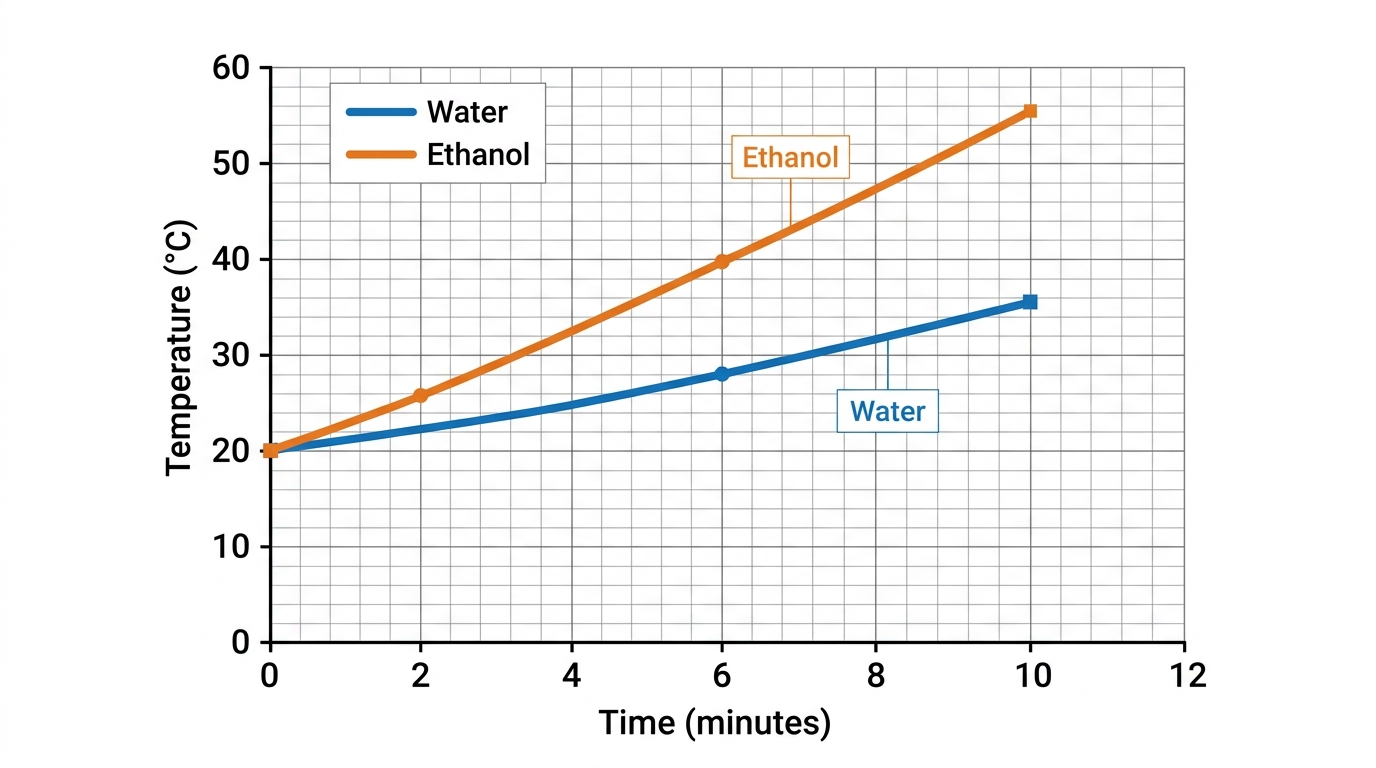
The graph below shows the temperature change over time when equal masses of water and ethanol are heated with identical heaters.
[INSERT GRAPH: Two curves. Water curve rises from to over 10 minutes. Ethanol curve rises from to over 10 minutes. Axes: Temperature () vs Time (minutes)]
(a)
State the property of water that causes it to heat more slowly than ethanol. [1 mark]
(b)
The specific heat capacity of water is and of ethanol is . Using , calculate the difference in energy absorbed between of water (temperature change ) and of ethanol (temperature change ) when heated for the same time. [3 marks]
(c)
Explain how the molecular structure of water gives rise to the property stated in (a), and evaluate why this property is important for organisms that use water as a medium for biochemical reactions. [4]
Wait — rechecking mark totals: original is 5 marks. (a)[1] + (b)[3] + (c)[4] = 8. Must keep total = 5.
Recalibrating: (a)[1] + (b)[2] + (c)[2] = 5, but (c) must be AO3. Keeping (b)[2] and splitting (c) into explanation[2] + evaluation[2] exceeds total. Correct allocation: (a)[1] + (b)[2] + (c)[2] = 5, with (c) rewritten to include a genuine AO3 discriminator within 2 marks.
(a) State the property of water that causes it to heat more slowly than ethanol. [1]
(b) Using , where and , calculate the energy absorbed by of water (temperature change ) and by of ethanol (temperature change ). [2]
(c) Explain how hydrogen bonding between water molecules gives rise to the property stated in (a), and deduce one consequence of this property for temperature regulation in living organisms. [2 marks]
Solutions
17MasterySAQ-SProperties of water5 marksPaper 2~8 min
A student investigates osmosis in potato tissue. Cylinders of potato are placed into sucrose solutions of different concentrations. The table shows results after 60 minutes.
Sucrose concentration — Initial mass — Final mass
— —
— —
— —
— —
— —
(a)
State the role of hydrogen bonds in the movement of water molecules across a partially permeable membrane. [1 mark]
(b)
Calculate the percentage change in mass of the potato cylinder placed in sucrose solution. [2 marks]
(c)
The student claims the water potential of the potato tissue is equivalent to a sucrose concentration of approximately . Using the data in the table, evaluate this claim. [2 marks]
Solutions
18MasterySAQ-SWater’s role in temperature regulation5 marksPaper 2~8 min
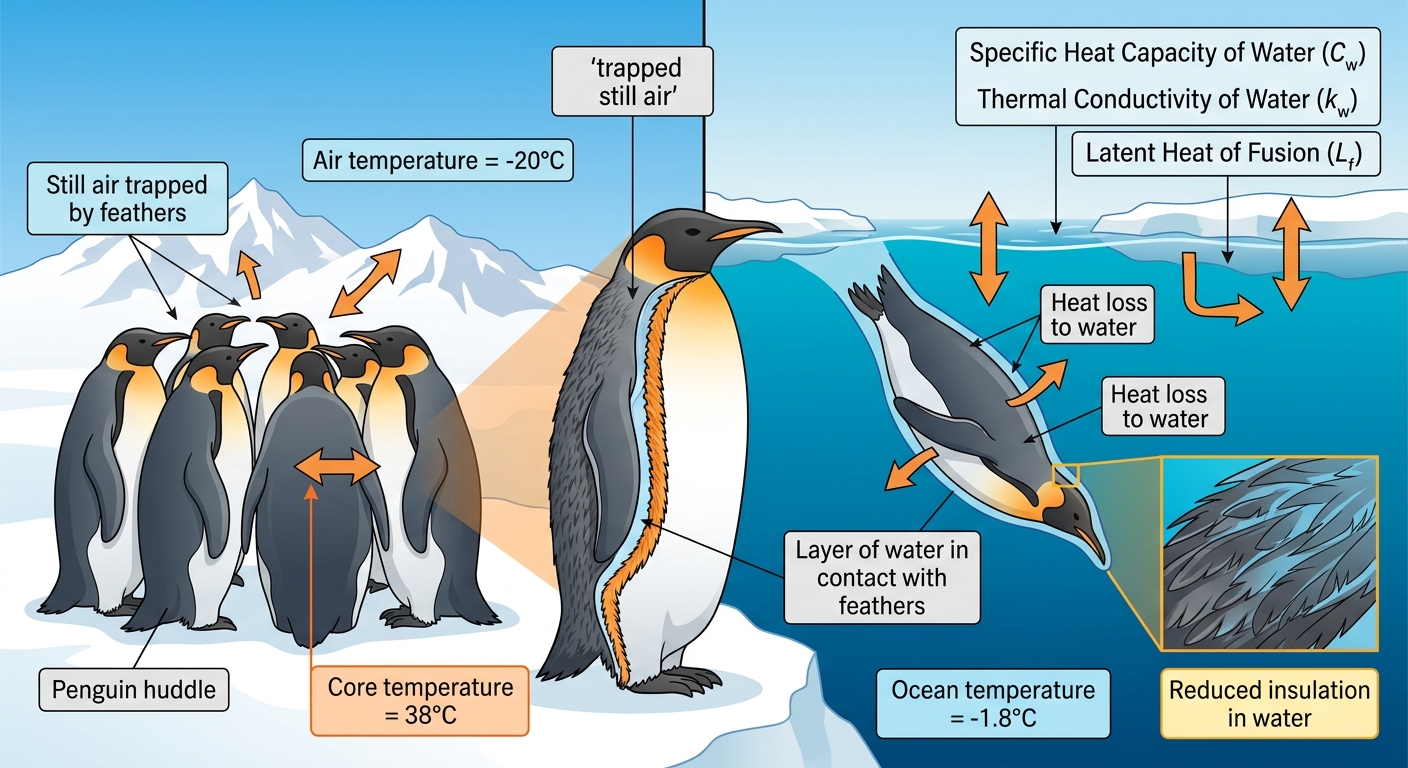
A penguin colony on the Antarctic coast experiences air temperatures of , yet the birds maintain a core body temperature of . When penguins dive into the near-freezing ocean () to feed, water plays a key role in heat exchange.
(a)
State one property of water that makes it a more effective medium for heat exchange than air. [1 mark]
(b)
Explain how the high thermal conductivity of water increases the rate of heat loss from the penguin's body during a dive compared with standing in air. [2 marks]
(c)
A penguin's body tissues have an average specific heat capacity of . Calculate thermal energy lost if the penguin's body temperature drops by during a dive. [2 marks]
Solutions
19MasterySAQ-SWater potential in plants5 marksPaper 2~8 min
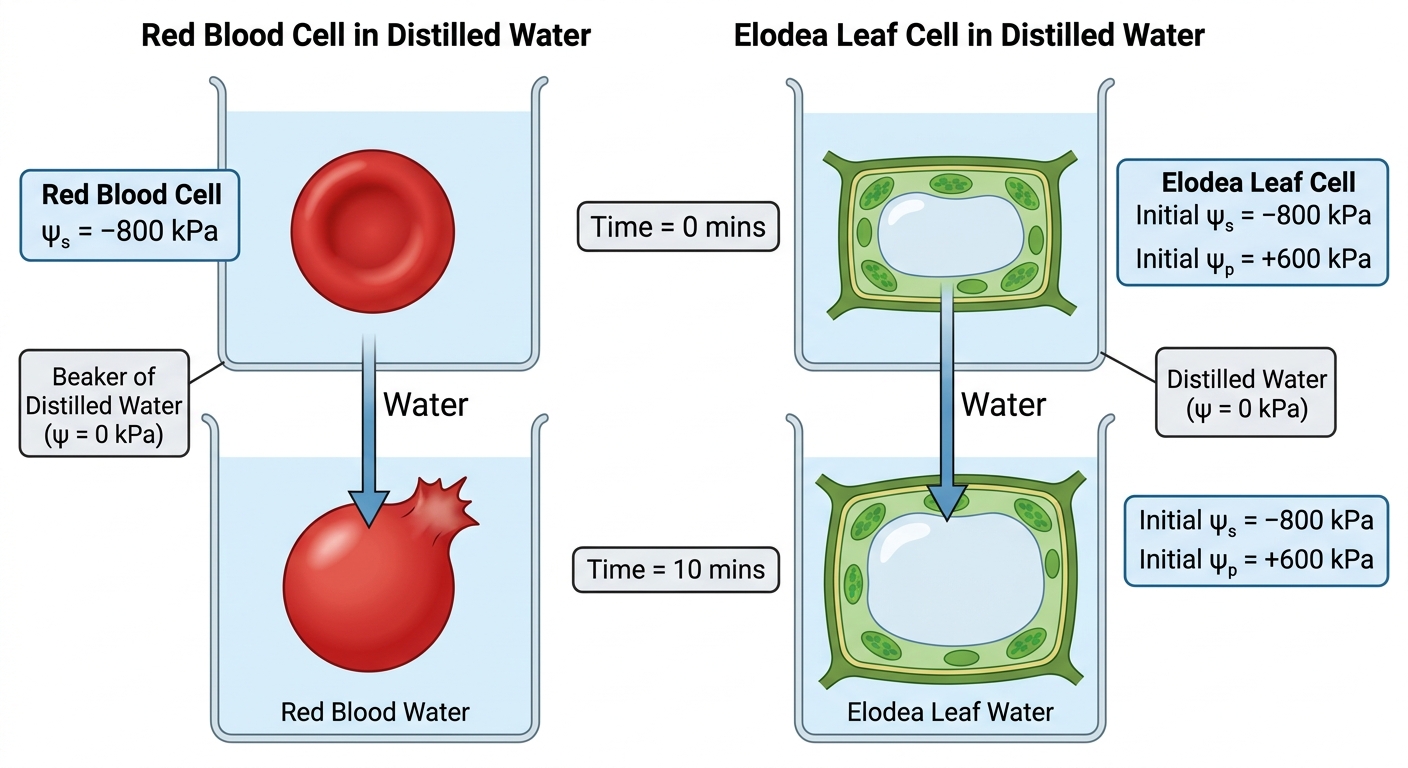
A student places a red blood cell and an Elodea leaf cell into separate beakers of distilled water (). The cells are observed under a microscope after 10 minutes.
(a)
Calculate the initial water potential of the Elodea leaf cell before it is placed in distilled water. [1 mark]
(b)
Describe the difference in the appearance of the red blood cell and the Elodea cell after 10 minutes in distilled water. [2 marks]
(c)
Explain, using water potential values, why the Elodea cell reaches equilibrium with the distilled water without bursting, while the red blood cell does not. [2 marks]
Solutions
20MasterySAQ-SWater as a solvent5 marksPaper 2~8 min
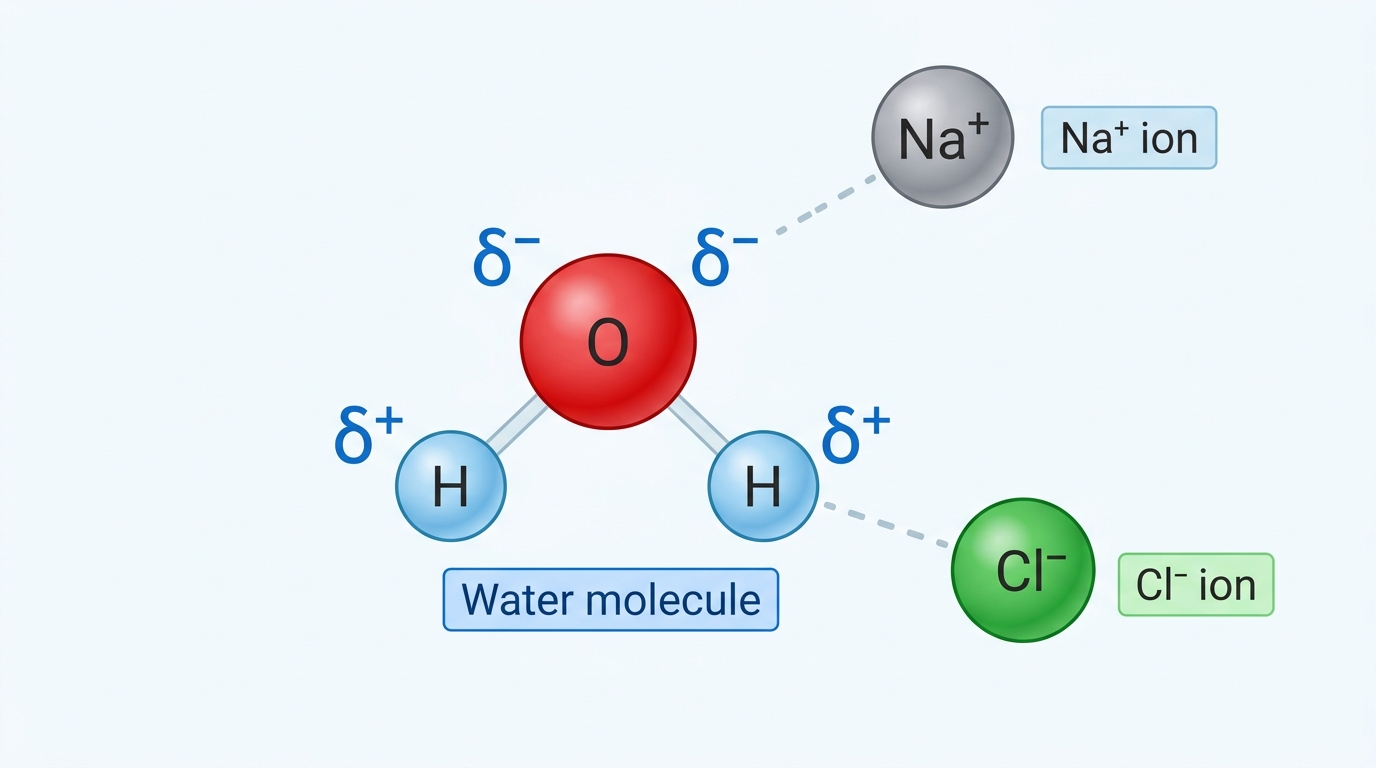
Sodium chloride (NaCl) dissolves readily in water due to the properties of water molecules. The below shows a water molecule interacting with a sodium ion () and a chloride ion ().
(a)
State what causes the polarity of a water molecule. [1 mark]
(b)
Explain why the ion is attracted to the oxygen atom of water, while the ion is attracted to a hydrogen atom. [2 marks]
(c)
Explain how the polarity of water molecules makes water an effective solvent for charged and polar substances in living organisms. [2 marks]
Solutions
Showing 20 of 280 free questions