Cell and Nuclear Division · Paper 1 — Free Biology SL Practice Questions
Free questions
Open in full, with answers, mark scheme and examiner insights.
Mitosis vs meiosis
The micrograph shows cells from an onion root tip. In the cell in the centre, each chromosome consists of two sister chromatids and the chromosomes are aligned at the equator, with no pairing of homologous chromosomes. Which stage of cell division is shown?
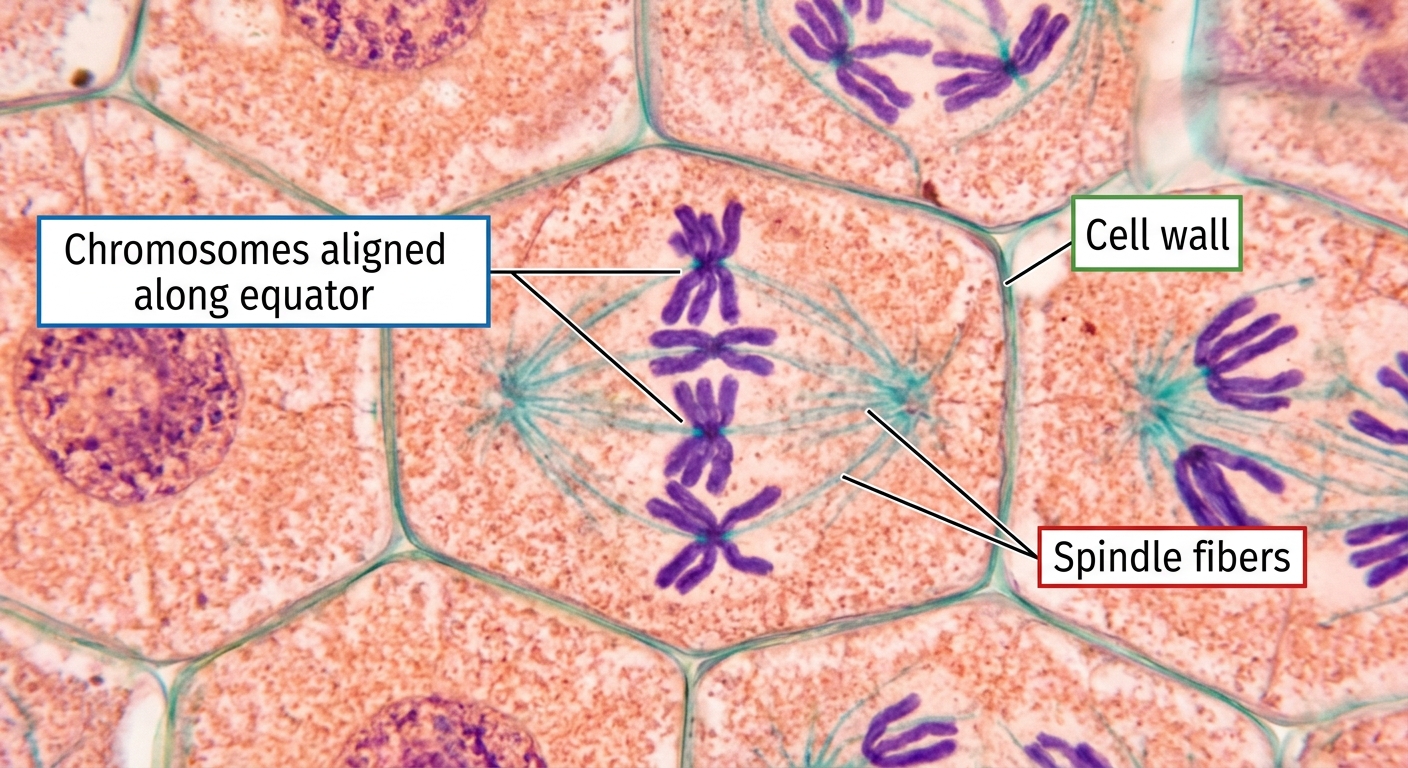
revisionprep.com
Summary Answer
Not available for this question.
Model Answer
Not available for this question.
Marking Scheme
Not available for this question.
Examiner Insights
Not available for this question.
Phases of mitosis and meiosis
A cell in prophase of mitosis is compared with a cell in prophase I of meiosis from the same animal. Which event happens only in prophase I?
revisionprep.com
Summary Answer
Not available for this question.
Model Answer
Not available for this question.
Marking Scheme
Not available for this question.
Examiner Insights
Not available for this question.
Mitosis vs meiosis
Cytochalasin B stops actin filaments from forming. Human cells in culture were treated with different concentrations of cytochalasin B for 24 hours. The percentage of cells with two nuclei (binucleate cells) was recorded. The results are shown in the table.

Describe the effect of cytochalasin B on the percentage of binucleate cells.
Explain why treated cells can still complete nuclear division.
Untreated cells have 46 chromosomes. Determine the number of chromosomes in each nucleus of a binucleate cell and in the whole binucleate cell.
Predict, with a reason, whether cytochalasin B would have the same effect on dividing onion root tip cells.
revisionprep.com
Summary Answer
Not available for this question.
Model Answer
Not available for this question.
Marking Scheme
Not available for this question.
Examiner Insights
Not available for this question.
Phases of mitosis and meiosis
One chromosome in a dividing animal cell was tracked by fluorescence microscopy. The graph shows the distance between the centromere of one of its chromatids and the pole it moves towards.
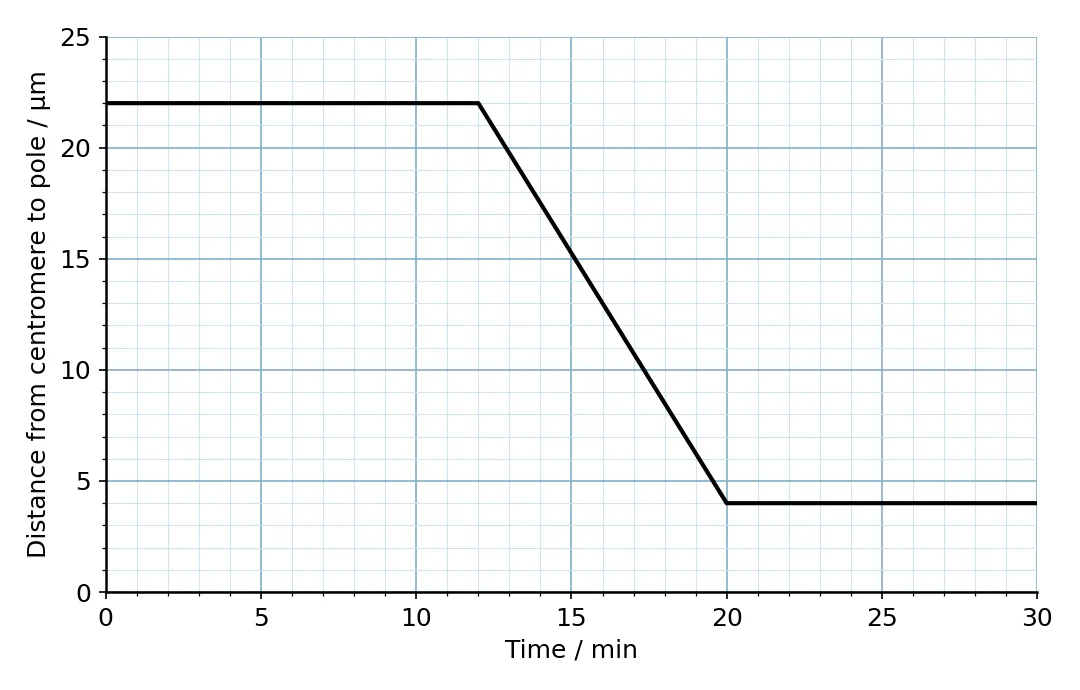
State the time at which anaphase began.
Calculate the mean speed of the centromere towards the pole during anaphase.
State the stage of mitosis between 0 and 12 minutes and outline what must be true of the chromosomes before anaphase can begin.
Outline how the chromatid is moved towards the pole.
revisionprep.com
Summary Answer
Not available for this question.
Model Answer
Not available for this question.
Marking Scheme
Not available for this question.
Examiner Insights
Not available for this question.
Phases of mitosis and meiosis
In mice, the protein SYCP1 holds homologous chromosomes closely together along their length during prophase I. Spermatocytes from normal mice and from mice lacking SYCP1 were compared. The results are shown in the table.
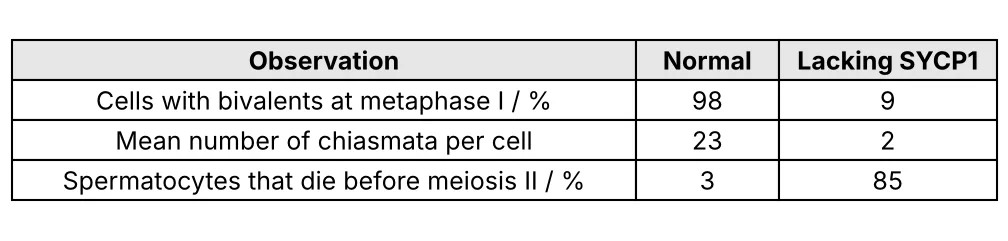
Calculate the percentage decrease in the mean number of chiasmata per cell when SYCP1 is lost.
Explain why loss of SYCP1 reduces crossing over.
Explain why few mutant cells have bivalents at metaphase I.
Suggest why most mutant spermatocytes die, and the likely effect on gametes if they did not.
revisionprep.com
Summary Answer
Not available for this question.
Model Answer
Not available for this question.
Marking Scheme
Not available for this question.
Examiner Insights
Not available for this question.
Chromosome number and genetic variation
Using DNA markers, researchers identified where the extra chromosome 21 came from in 400 children with Down syndrome. The results are shown in the table.
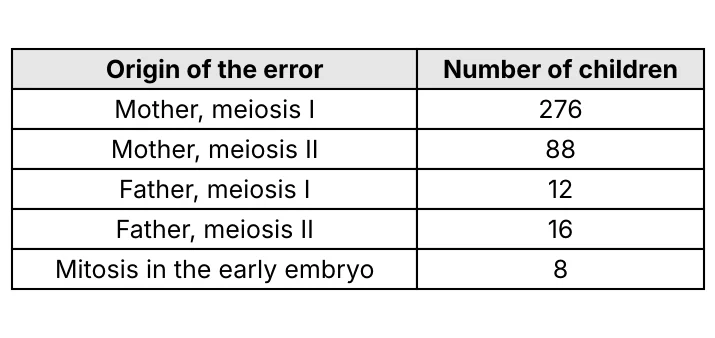
Calculate the percentage of cases in which the error happened in the mother.
Suggest why errors in the mother occur mostly at meiosis I.
Explain how an error in mitosis in the early embryo could produce a child with only some cells containing 47 chromosomes.
State the number of chromosomes in an egg produced after a meiosis I error that leads to Down syndrome.
revisionprep.com
Summary Answer
Not available for this question.
Model Answer
Not available for this question.
Marking Scheme
Not available for this question.
Examiner Insights
Not available for this question.
That's every free question here — 6 of 56.
+50 more questions, plus Mock Papers & Worksheets, are waiting in Premium.