Inheritance · Paper 1 — Free Biology SL Practice Questions
Free questions
Open in full, with answers, mark scheme and examiner insights.
Mendelian inheritance
Students investigated methods of carrying out controlled crosses in pea plants. Flowers on white-flowered plants () were given one of three treatments. Each flower was then pollinated by hand with pollen from a true-breeding purple-flowered plant (). The seeds were sown and the flower colour of the offspring recorded. The table shows the results.

State the flower colour expected for every offspring of a successful cross.
Calculate the number of white-flowered offspring from treatment C.
Explain the results for treatment C.
Suggest a reason for the white-flowered offspring from treatment B.
Identify the independent variable in this investigation.
State which treatment should be used to carry out a controlled cross, giving a reason.
revisionprep.com
Summary Answer
Not available for this question.
Model Answer
Not available for this question.
Marking Scheme
Not available for this question.
Examiner Insights
Not available for this question.
Punnett squares and genetic ratios
A pea plant cross produces offspring in the genotypic ratio 25% : 50% : 25% , where (yellow seeds) is dominant over (green seeds). Which parental cross produces this result?
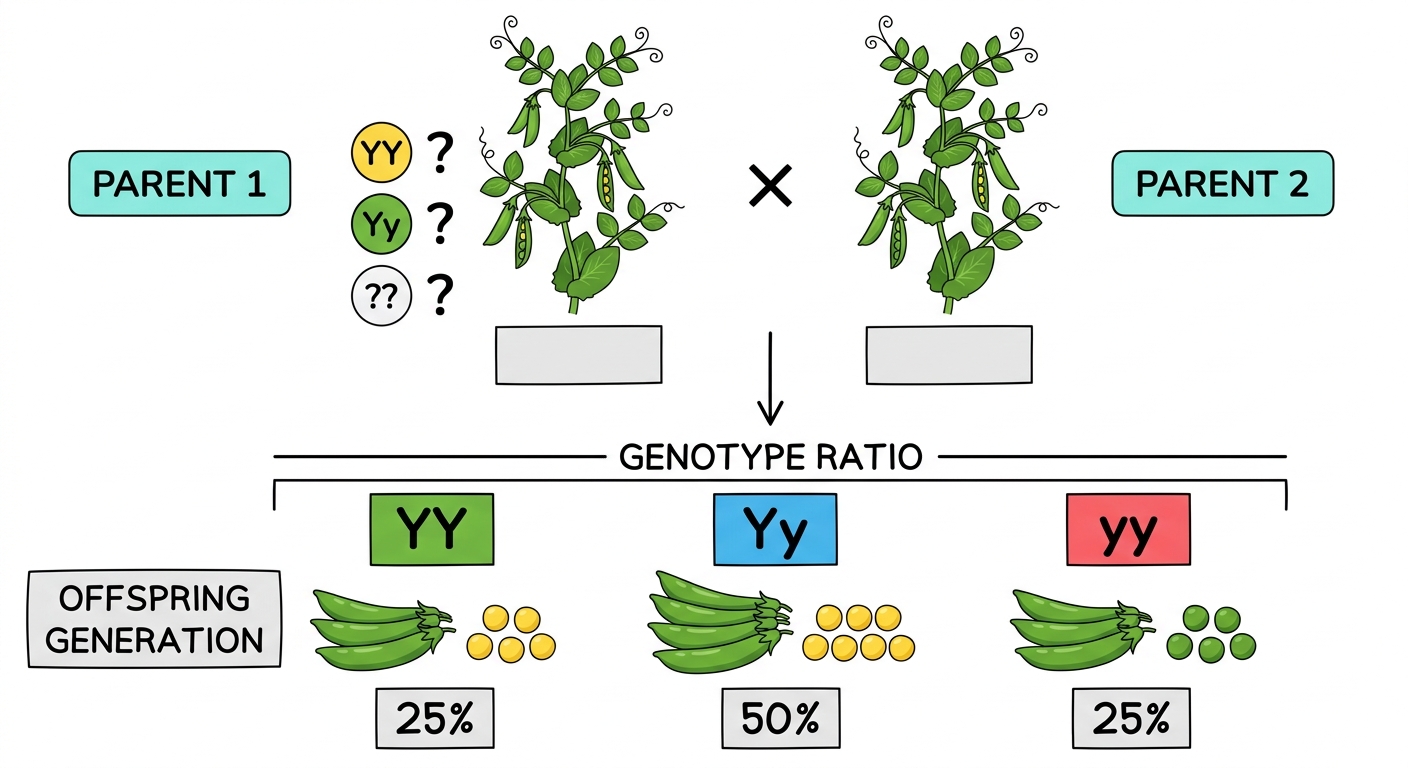
revisionprep.com
Summary Answer
Not available for this question.
Model Answer
Not available for this question.
Marking Scheme
Not available for this question.
Examiner Insights
Not available for this question.
Mendelian inheritance
In Mendel's experiment, true-breeding tall () pea plants were crossed with true-breeding short () pea plants. All offspring were tall. When plants were self-pollinated, short plants reappeared in the generation in a ratio of approximately 3 tall : 1 short. According to the Law of Segregation, which statement best explains the reappearance of short plants in the generation?
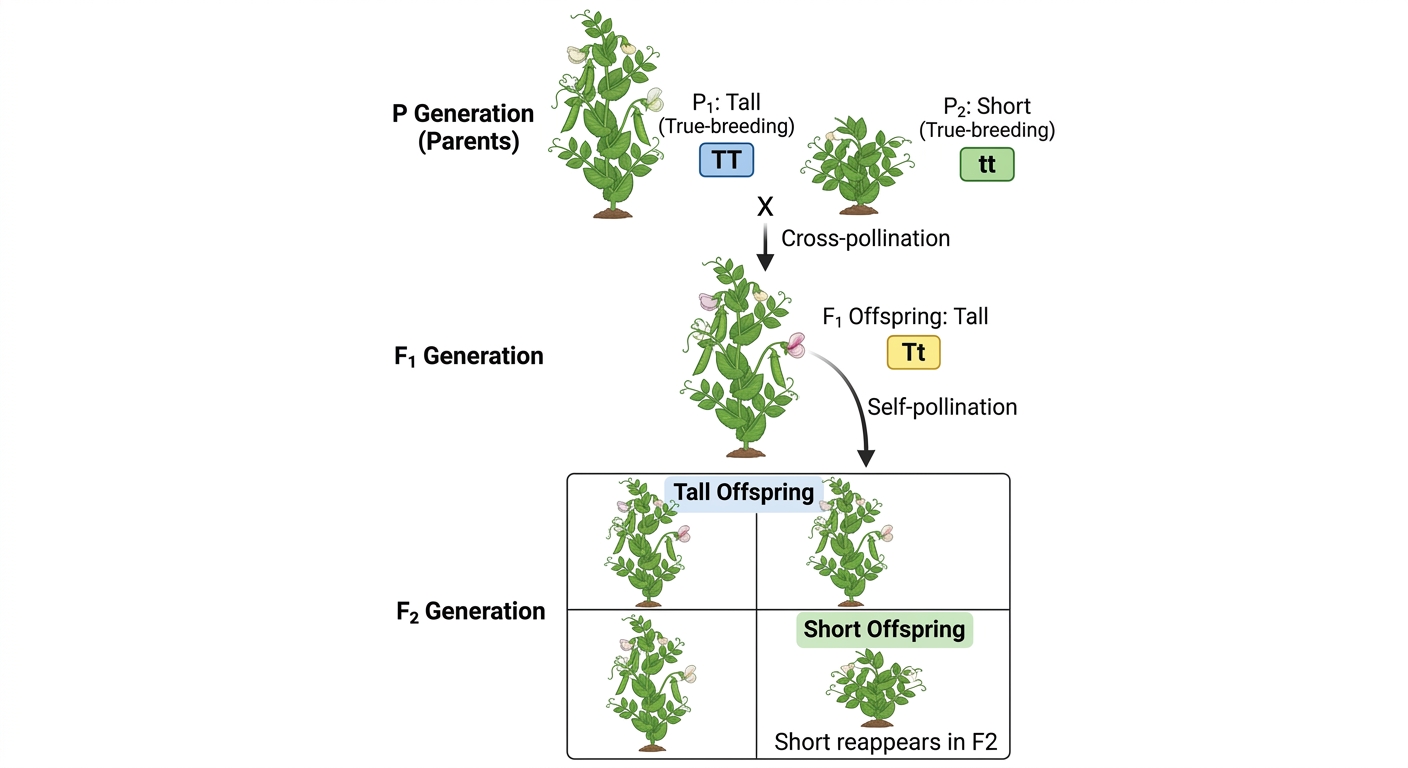
revisionprep.com
Summary Answer
Not available for this question.
Model Answer
Not available for this question.
Marking Scheme
Not available for this question.
Examiner Insights
Not available for this question.
Punnett squares and genetic ratios
Students investigated a cross between two fruit flies (Drosophila melanogaster) that were both heterozygous for wing shape. Normal wings () are dominant to vestigial wings (). Five vials were set up, each with one male and one female parent. The parents were removed after 7 days and the offspring in each vial were counted when they emerged. The table shows the results.
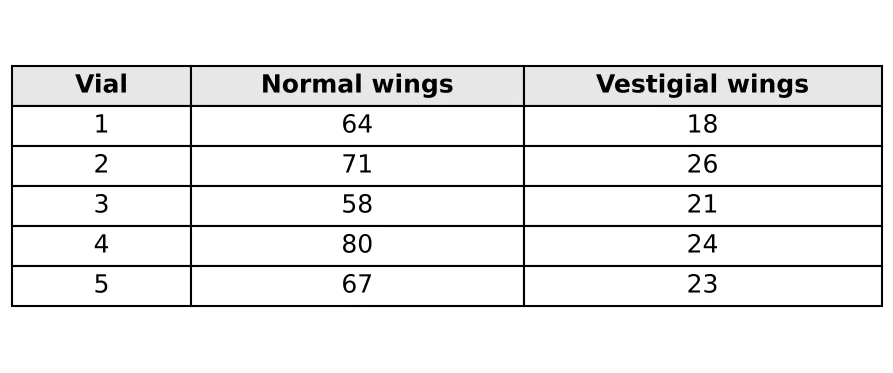
State the expected ratio of normal-winged to vestigial-winged offspring.
Calculate the ratio of normal-winged to vestigial-winged flies for all five vials combined, in the form , to two decimal places.
Explain why the ratios in individual vials differ more from the expected ratio than the combined ratio does.
Identify two variables that should be kept the same in every vial.
Suggest why the parent flies were removed after 7 days.
revisionprep.com
Summary Answer
Not available for this question.
Model Answer
Not available for this question.
Marking Scheme
Not available for this question.
Examiner Insights
Not available for this question.
Mendelian inheritance
True-breeding round-seeded () pea plants are crossed with wrinkled-seeded () plants, and the F1 are self-pollinated to give an F2. Each round-seeded F2 plant is then test-crossed with a wrinkled-seeded () plant. What fraction of these test crosses are expected to produce some wrinkled-seeded offspring?
revisionprep.com
Summary Answer
Not available for this question.
Model Answer
Not available for this question.
Marking Scheme
Not available for this question.
Examiner Insights
Not available for this question.
Punnett squares and genetic ratios
In guinea pigs, short hair () is dominant to long hair (). A heterozygous short-haired guinea pig is crossed with a long-haired guinea pig. What is the probability that, of their first two offspring, exactly one has short hair?
revisionprep.com
Summary Answer
Not available for this question.
Model Answer
Not available for this question.
Marking Scheme
Not available for this question.
Examiner Insights
Not available for this question.
That's every free question here — 6 of 52.
+46 more questions, plus Mock Papers & Worksheets, are waiting in Premium.