Mutations and Gene Editing · Paper 1 — Free Biology SL Practice Questions
Free questions
Open in full, with answers, mark scheme and examiner insights.
Gene mutations: substitutions, insertions and deletions
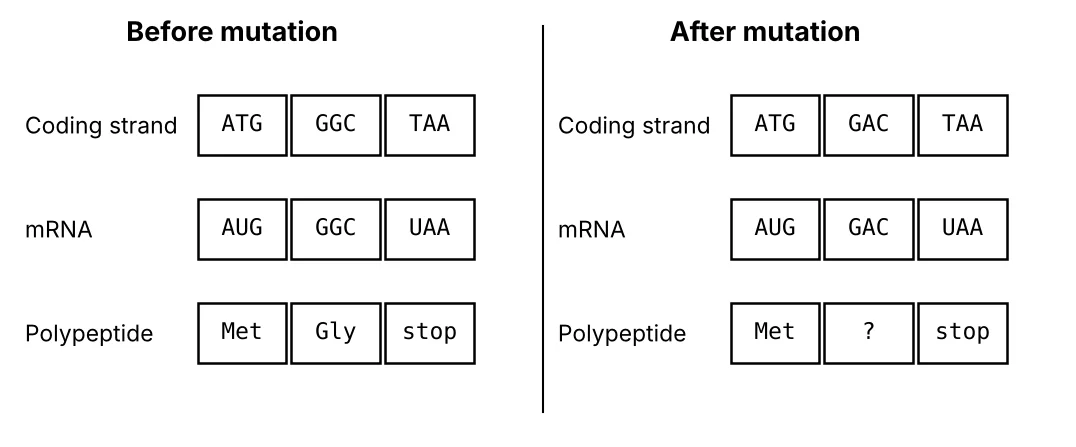
The shows the coding strand of a short gene, its mRNA and the polypeptide, before and after a mutation. GAC codes for aspartic acid.
Which statement describes the mutation?
revisionprep.com
Summary Answer
Not available for this question.
Model Answer
Not available for this question.
Marking Scheme
Not available for this question.
Examiner Insights
Not available for this question.
Causes and effects of mutations
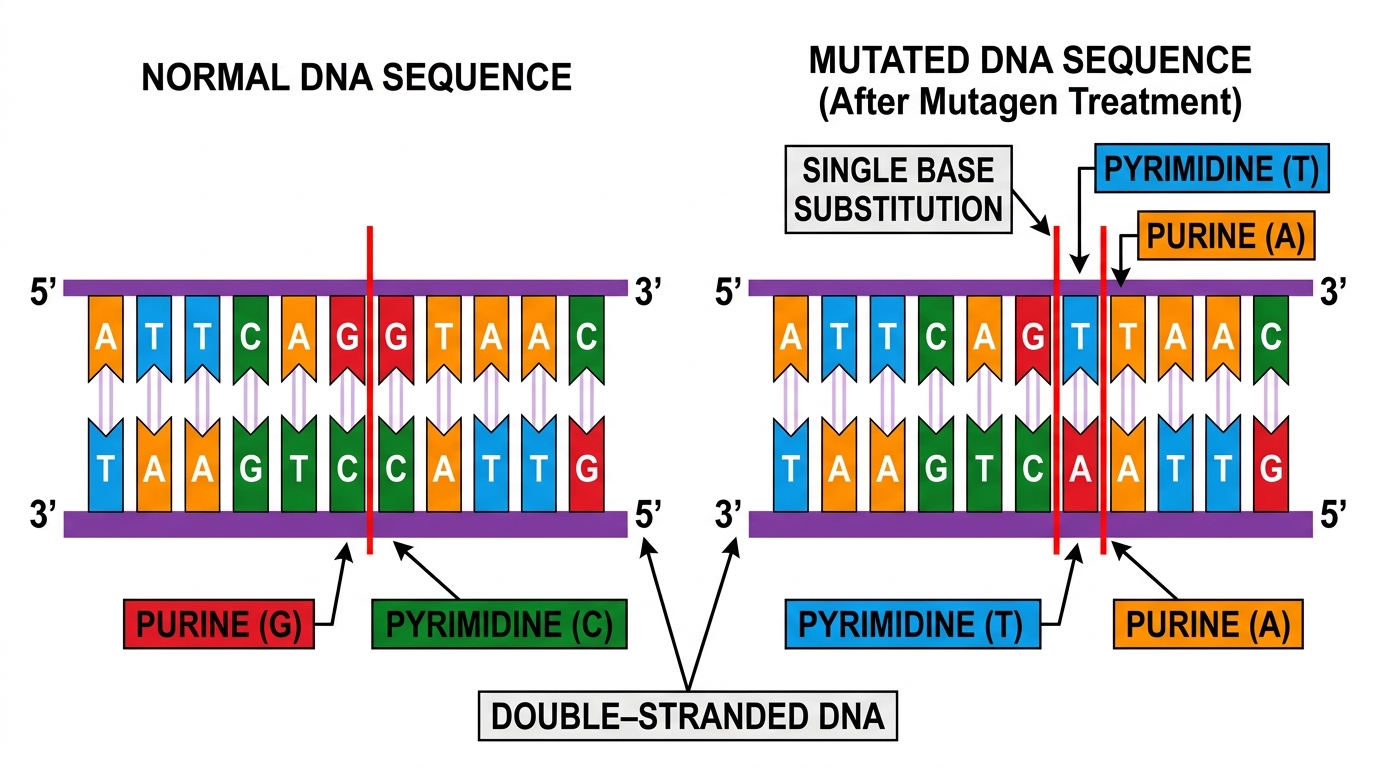
The shows a section of DNA before and after treatment with a chemical mutagen.
Which statement describes the mutation?
revisionprep.com
Summary Answer
Not available for this question.
Model Answer
Not available for this question.
Marking Scheme
Not available for this question.
Examiner Insights
Not available for this question.
Gene mutations: substitutions, insertions and deletions
A gene has 300 codons, including the stop codon. A single base is deleted from codon 297.
Which is the most likely effect on the polypeptide?
revisionprep.com
Summary Answer
Not available for this question.
Model Answer
Not available for this question.
Marking Scheme
Not available for this question.
Examiner Insights
Not available for this question.
Causes and effects of mutations
In the Ames test, bacteria that cannot make the amino acid histidine are spread on plates with no histidine. Only bacteria in which a new mutation restores histidine production can grow into colonies (revertant colonies). The bar chart shows the mean number of revertant colonies per plate with different concentrations of chemical K, and with a known mutagen (positive control). With no chemical K, the mean was 24 colonies per plate.
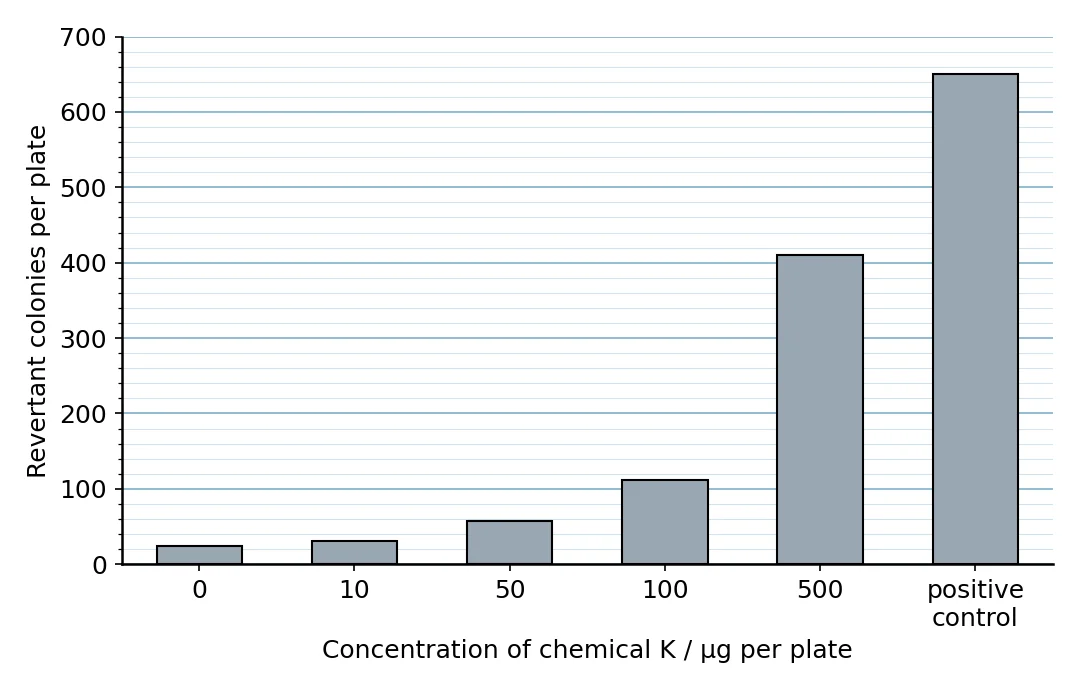
Explain why some revertant colonies grow on plates with no chemical K.
Calculate the percentage increase in revertant colonies at 100 µg per plate compared with 0 µg per plate.
Evaluate the hypothesis that chemical K is a mutagen.
Identify one variable that must be kept the same on every plate, and explain why.
revisionprep.com
Summary Answer
Not available for this question.
Model Answer
Not available for this question.
Marking Scheme
Not available for this question.
Examiner Insights
Not available for this question.
Causes and effects of mutations
Researchers sequence one gene of known length in 1000 bacteria from a population exposed to a mutagen for an unknown time. Fifty bacteria carry a new mutation in the gene.
Why can the mutation rate per base pair per generation not be calculated from these data alone?
revisionprep.com
Summary Answer
Not available for this question.
Model Answer
Not available for this question.
Marking Scheme
Not available for this question.
Examiner Insights
Not available for this question.
Gene editing technologies (e.g. CRISPR)
Bacteria were exposed to a virus that kills cells unless they carry a resistance mutation. In set A, 10 separate small cultures were grown from a few cells each, then each was plated with the virus. In set B, 10 samples were taken from one large culture and plated with the virus. The bar charts show the number of resistant colonies on each plate.
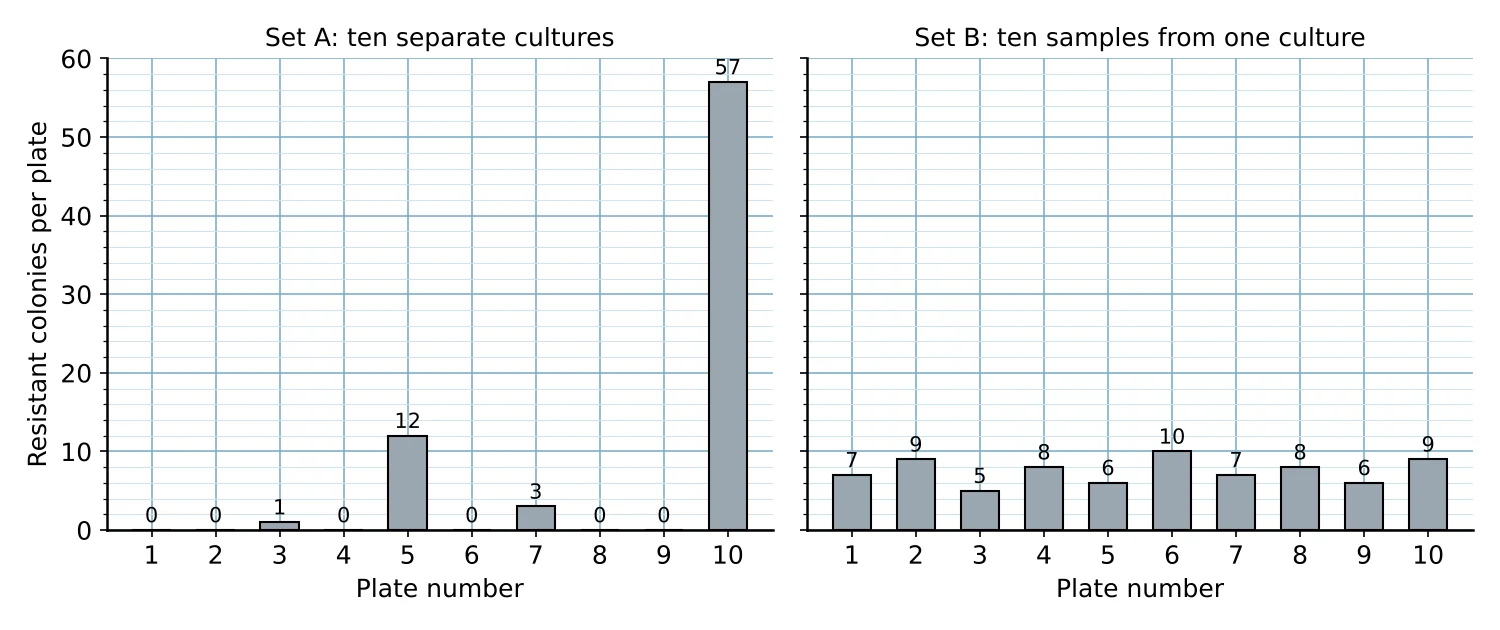
Calculate the mean number of resistant colonies for set A and for set B.
Compare the spread of the results in the two sets.
Explain the large variation in set A if resistance mutations arise at random times while the cultures are growing.
Predict the pattern in set A if the virus itself caused resistance in a small proportion of cells.
Suggest why each culture in set A was started from only a few cells.
revisionprep.com
Summary Answer
Not available for this question.
Model Answer
Not available for this question.
Marking Scheme
Not available for this question.
Examiner Insights
Not available for this question.
That's every free question here — 6 of 58.
+52 more questions, plus Mock Papers & Worksheets, are waiting in Premium.