Water Potential · Paper 1 — Free Biology SL Practice Questions
Free questions
Open in full, with answers, mark scheme and examiner insights.
Concept of water potential in plants
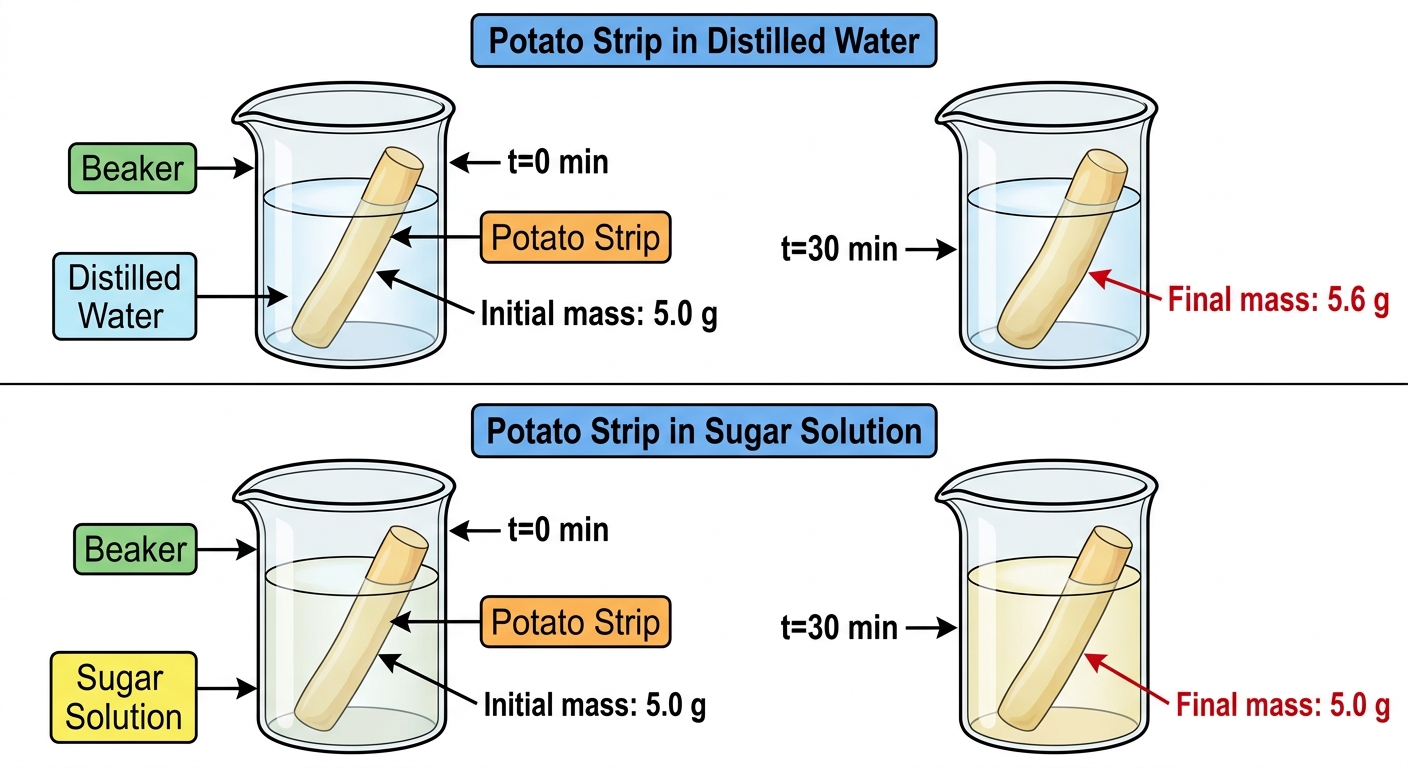
A potato strip of initial mass 5.0 g gains mass to 5.6 g in distilled water, as shown. An identical strip shows no change in mass in a sugar solution. What can be concluded about the sugar solution?
revisionprep.com
Summary Answer
Not available for this question.
Model Answer
Not available for this question.
Marking Scheme
Not available for this question.
Examiner Insights
Not available for this question.
Concept of water potential in plants
Human red blood cells are placed in 0.9 % sodium chloride solution, which is isotonic with plasma. What happens to them?
revisionprep.com
Summary Answer
Not available for this question.
Model Answer
Not available for this question.
Marking Scheme
Not available for this question.
Examiner Insights
Not available for this question.
Concept of water potential in plants
Red blood cells from humans and from trout, a freshwater fish, were placed in sodium chloride solutions for 30 minutes at 20 °C. The percentage of cells that burst (haemolysed) was found from the amount of haemoglobin released, measured with a colorimeter. The graph shows the results.
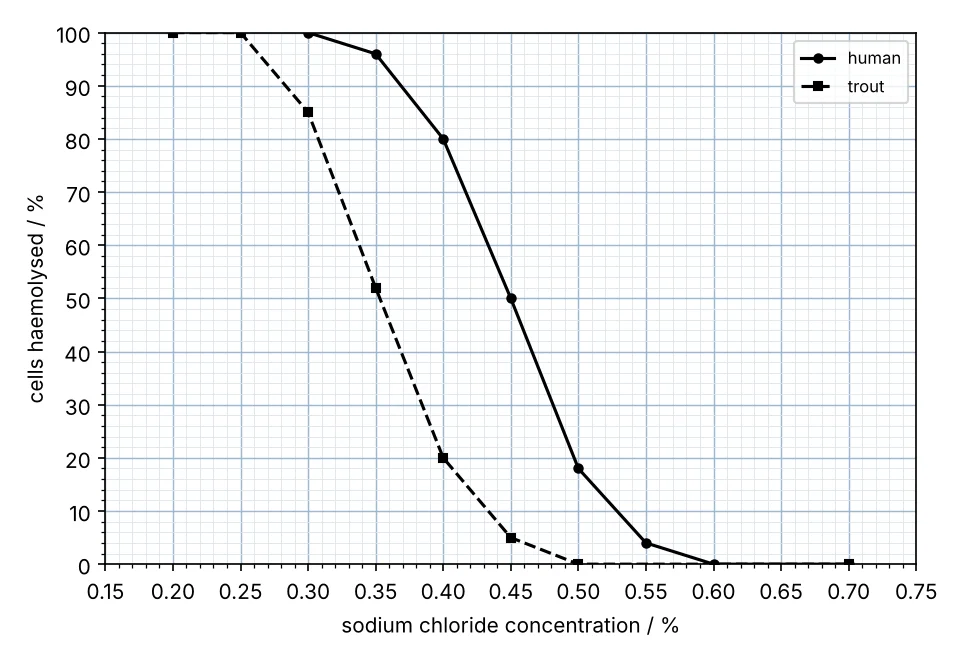
State the sodium chloride concentration at which 50% of the human red blood cells haemolyse.
Explain why more human cells haemolyse as the sodium chloride concentration falls.
Compare the results for trout and for human red blood cells, and suggest a reason for the difference.
Identify two variables, other than temperature, that should be controlled in this investigation.
Suggest why the curves are S-shaped rather than changing suddenly from 0% to 100%.
revisionprep.com
Summary Answer
Not available for this question.
Model Answer
Not available for this question.
Marking Scheme
Not available for this question.
Examiner Insights
Not available for this question.
Concept of water potential in plants
Onion bulbs are made of fleshy scale leaves. Epidermis from an outer and an inner scale leaf of the same bulb was placed in sucrose solutions for 30 minutes, and 50 cells of each sample were examined under a microscope. The results are shown in the table.

Estimate the sucrose concentration at which 50% of the cells are plasmolysed for the outer and for the inner scale leaf.
Deduce which scale leaf has the higher solute concentration in its cells. Give a reason.
Suggest why 50 cells were examined in each sample rather than a few.
Identify two variables that should be controlled in this investigation.
Explain why a cell becomes plasmolysed in a concentrated sucrose solution.
revisionprep.com
Summary Answer
Not available for this question.
Model Answer
Not available for this question.
Marking Scheme
Not available for this question.
Examiner Insights
Not available for this question.
Concept of water potential in plants
A student cut discs of turnip root and placed three discs in each of five sucrose solutions for 30 minutes. The table shows the percentage change in mass of each disc.
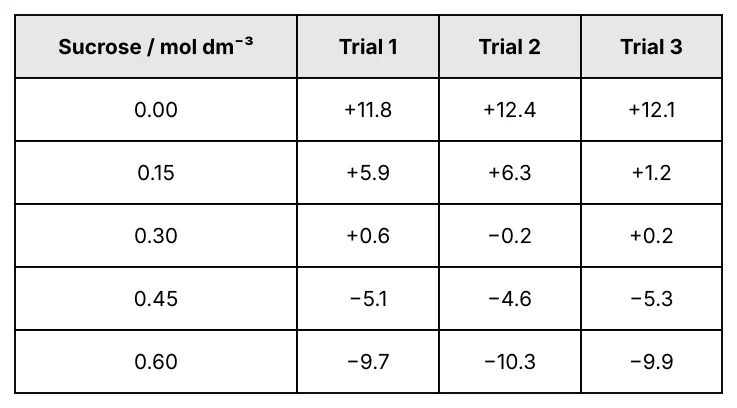
Identify the anomalous result and suggest one possible cause of it.
Calculate the mean percentage change in mass at 0.15 mol dm⁻³, excluding the anomalous result.
The student plotted the means and found that the line crossed zero at 0.31 mol dm⁻³. She concluded that 'turnip cells contain 0.31 mol dm⁻³ sucrose'. Evaluate this conclusion.
All the discs were cut from one turnip. Suggest why this was done and how it limits the conclusion.
Predict, with a reason, how the estimate of the isotonic concentration would change if the discs were left in the solutions for 24 hours instead of 30 minutes.
revisionprep.com
Summary Answer
Not available for this question.
Model Answer
Not available for this question.
Marking Scheme
Not available for this question.
Examiner Insights
Not available for this question.
Importance in plant hydration and transport
The graph shows the stem diameter of a maize plant and its transpiration rate over 12 hours, 6 hours in daylight and 6 hours at night.
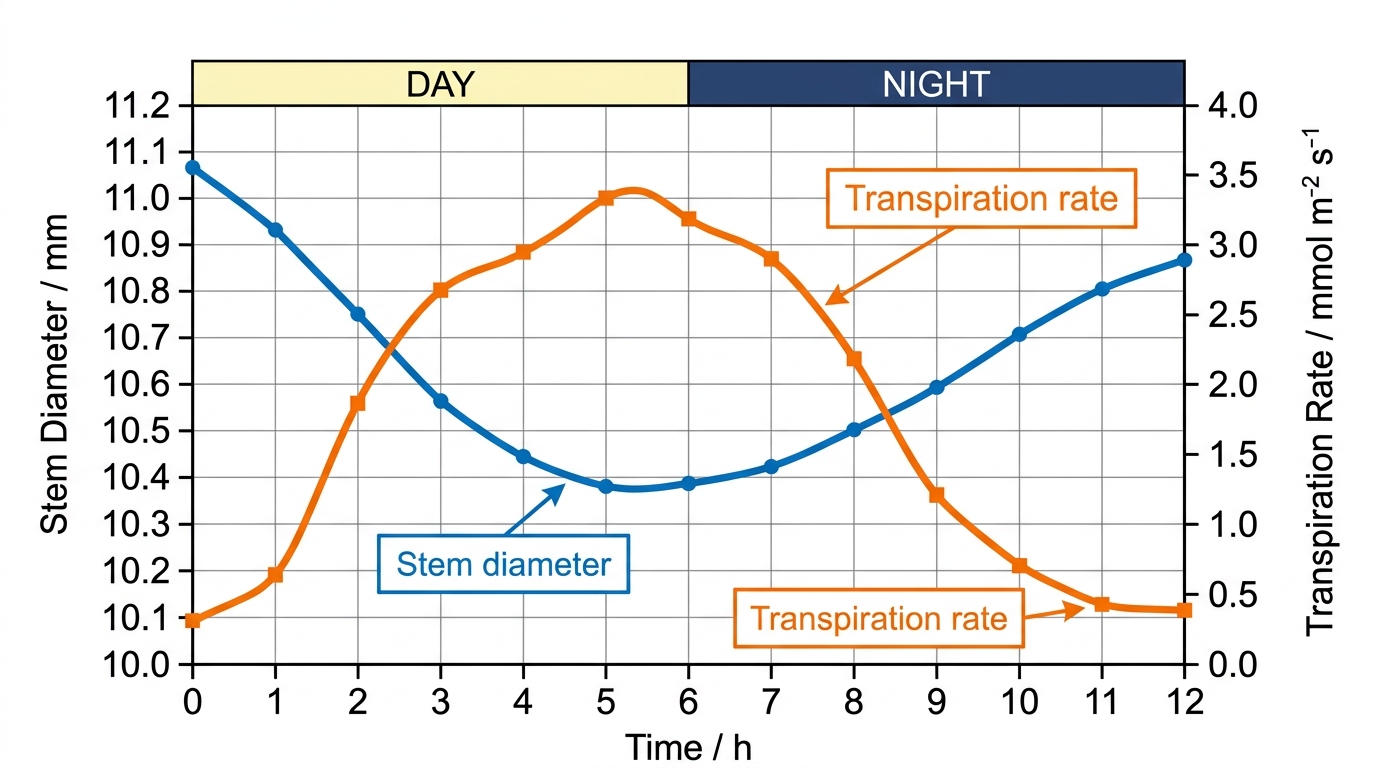
Describe the relationship between transpiration rate and stem diameter.
Calculate the percentage decrease in stem diameter from 0 hours to its minimum.
Explain why the stem diameter decreases when the transpiration rate is high.
Explain why the stem diameter increases at night.
revisionprep.com
Summary Answer
Not available for this question.
Model Answer
Not available for this question.
Marking Scheme
Not available for this question.
Examiner Insights
Not available for this question.
That's every free question here — 6 of 109.
+103 more questions, plus Mock Papers & Worksheets, are waiting in Premium.