Climate Change · Paper 2 — Free Biology SL Practice Questions
Free questions
Open in full, with answers, mark scheme and examiner insights.
Mitigation strategies and global agreements
Farmland in a tropical region was abandoned and left to regenerate naturally into forest. After 15 years, ecologists measured the carbon in regrowing vegetation at different distances from the edge of the nearest intact forest. The table shows the results.
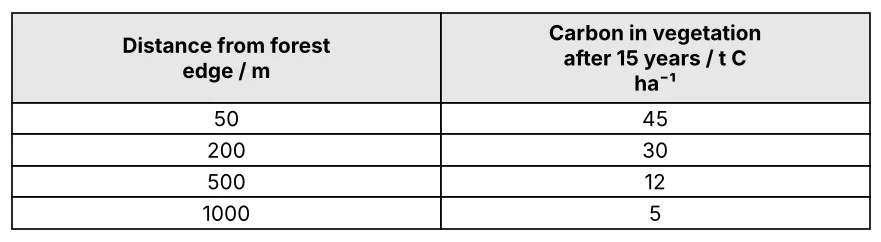
Describe the relationship between distance from the forest edge and carbon stored.
Suggest a biological explanation for this relationship.
Calculate the mean rate of removal, in t ha yr, at m from the edge. (: C , )
Suggest one action that would speed up regeneration on land far from the forest edge.
revisionprep.com
Summary Answer
Not available for this question.
Model Answer
Not available for this question.
Marking Scheme
Not available for this question.
Examiner Insights
Not available for this question.
Causes and effects of climate change
Off the coast of Peru, winds normally drive upwelling of cold, nutrient-rich water from the deep ocean. The table compares a normal year with a year in which the winds weakened and upwelling almost stopped.

Calculate the percentage decrease in anchovy catch.
Explain the change in chlorophyll concentration.
Predict the effect of weak upwelling on seabirds that feed on anchovies.
Climate change may alter ocean currents and change the timing of upwelling. Suggest why a change in timing could harm marine animals even if the total upwelling in a year is unchanged.
revisionprep.com
Summary Answer
Not available for this question.
Model Answer
Not available for this question.
Marking Scheme
Not available for this question.
Examiner Insights
Not available for this question.
Mitigation strategies and global agreements
The table shows typical carbon stores in four ecosystems.

Identify the ecosystem with the highest proportion of its carbon held in the soil.
Explain why boreal forest soils hold more carbon than tropical rainforest soils.
A wildfire in a boreal forest releases all of the carbon in the biomass and of the soil carbon. Calculate the percentage of the forest's total carbon store that is released.
Using the data, suggest which ecosystem should be the highest priority for protection to keep carbon out of the atmosphere, and give one reason.
revisionprep.com
Summary Answer
Not available for this question.
Model Answer
Not available for this question.
Marking Scheme
Not available for this question.
Examiner Insights
Not available for this question.
Causes and effects of climate change
The graph shows the mean net ecosystem production (NEP) of a large region of boreal forest from 1980 to 2020. A positive value means the forest gained carbon; a negative value means it lost carbon. Over the same period summers became warmer and drier, and the area burned by fire and killed by insect outbreaks increased.
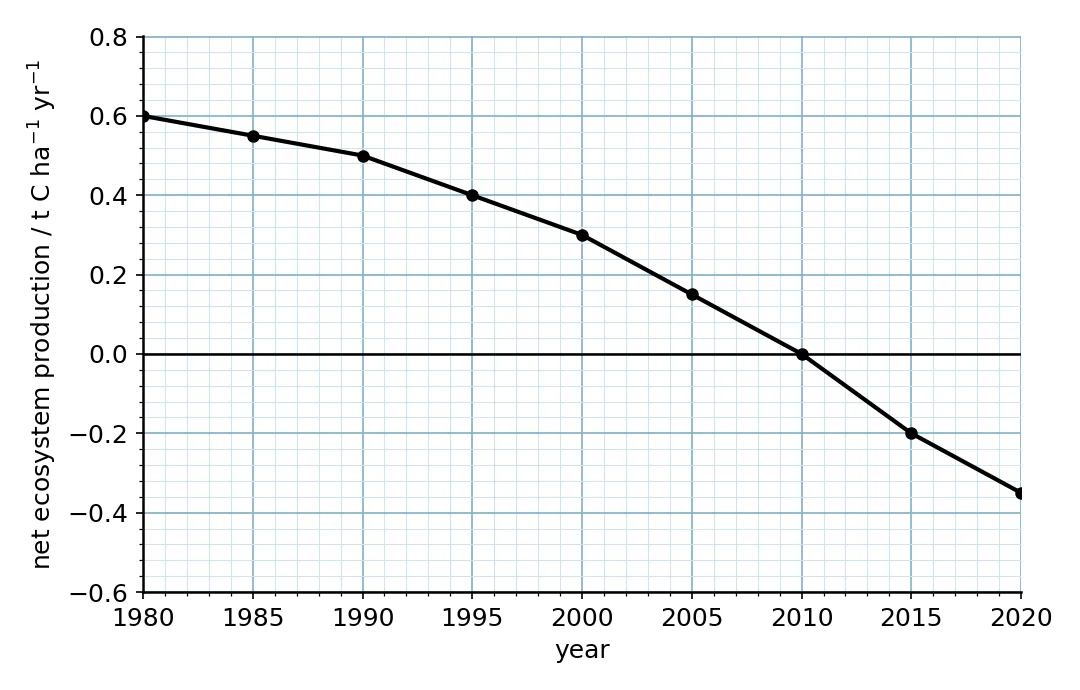
State the year in which the forest changed from net accumulation of carbon to net loss.
Calculate the mean rate of change in NEP between 1990 and 2020.
Explain how drier summers, fires and insect outbreaks can turn a forest from a carbon sink into a carbon source.
Explain why this change is described as a tipping point.
Suggest two ways in which warming could increase insect damage to boreal forests.
Fire suppression is proposed to protect the region's forests. Predict, with a reason, its effect on net ecosystem production, and outline one limitation of this approach.
revisionprep.com
Summary Answer
Not available for this question.
Model Answer
Not available for this question.
Marking Scheme
Not available for this question.
Examiner Insights
Not available for this question.
Mitigation strategies and global agreements
A government proposes planting conifer forest on ha of open tundra that is snow-covered for six months of the year. The new forest would fix t C ha yr.
In late winter and spring, snow-covered open ground reflects about of incoming sunlight. Snow-covered conifer forest reflects about , because dark needles stand above the snow.
State the term for the fraction of incoming solar radiation that a surface reflects.
Calculate the mass of that the forest would remove each year. (: C , )
Explain how the forest could warm the region even though it removes .
Suggest why tree planting in the tropics is more effective at reducing warming than tree planting in snowy high latitudes.
revisionprep.com
Summary Answer
Not available for this question.
Model Answer
Not available for this question.
Marking Scheme
Not available for this question.
Examiner Insights
Not available for this question.
Greenhouse gases and global warming
A savanna grassland burns every 2 years, releasing t C ha each fire. Between fires the grasses regrow, fixing t C ha yr. A nearby forest burns once, releasing t C ha; it then regrows, fixing t C ha yr.
Deduce whether the savanna's fire cycle adds carbon to the atmosphere over one 2-year cycle.
Calculate how many years the forest needs to take up the carbon released by the fire.
Explain why the forest fire contributes more to global warming than the savanna fires, even if the forest eventually regrows.
Incomplete burning also releases some methane. Explain why savanna fires can cause net warming even when the carbon released is taken up again.
revisionprep.com
Summary Answer
Not available for this question.
Model Answer
Not available for this question.
Marking Scheme
Not available for this question.
Examiner Insights
Not available for this question.
That's every free question here — 6 of 55.
+49 more questions, plus Mock Papers & Worksheets, are waiting in Premium.