You're viewing 3 free preview questions for Biology SL — subscribe to unlock 47 more, plus the Full Question Bank, Mock Papers & Worksheets.Upgrade
DNA Replication · Paper 2 — Free Biology SL Practice Questions
1MasterySAQ-SDNA structure and replication mechanism5 marksPaper 2~8 min

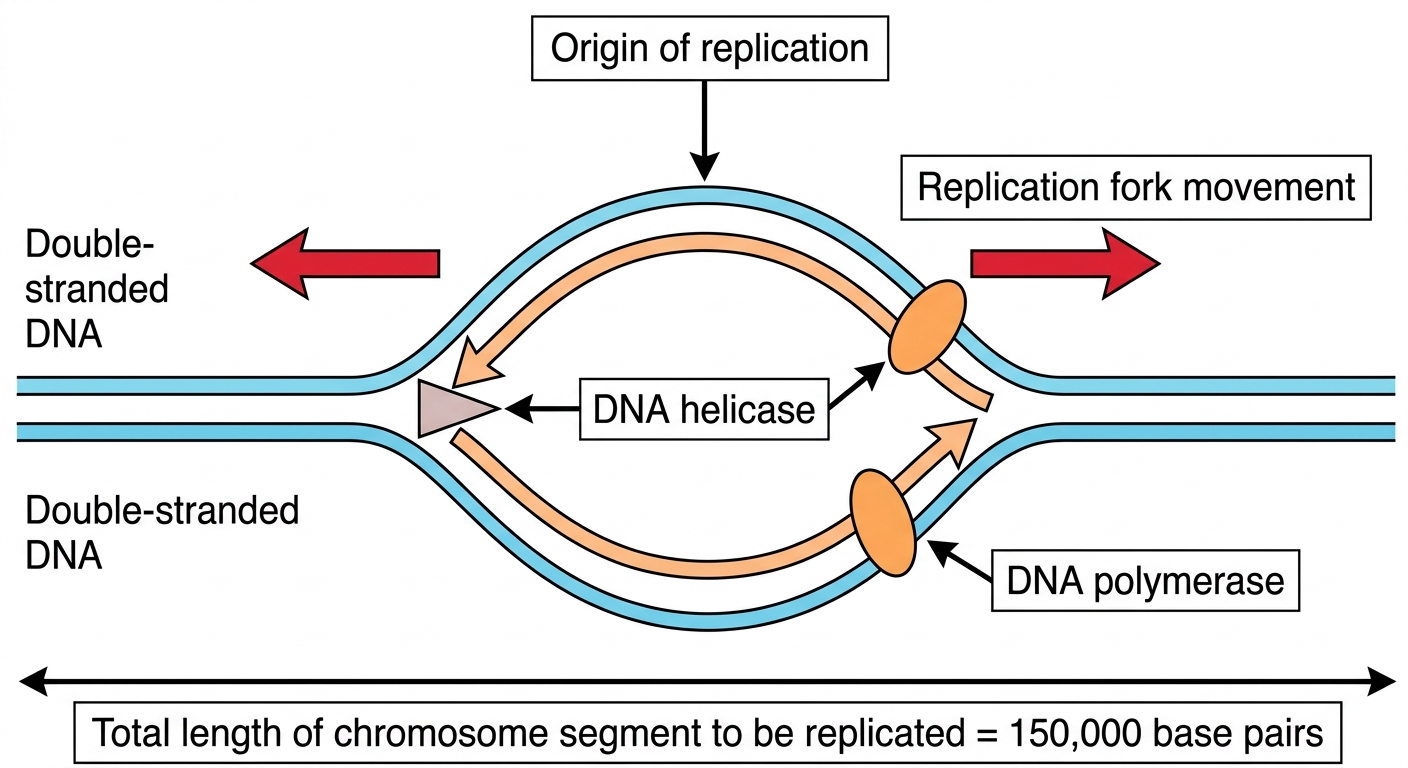
DNA replication is a highly coordinated process involving multiple enzymes. In a eukaryotic cell, replication begins at multiple origins of replication along the chromosome. The below (not to scale) shows a replication bubble with two replication forks moving in opposite directions away from a single origin.
(a)
State the role of DNA helicase in DNA replication. [1 mark]
(b)
A replication fork moves at a rate of base pairs per second. A chromosome segment of base pairs is replicated from a single origin located at the centre of the segment, with two forks moving in opposite directions at equal speed. Calculate the minimum time, in minutes, required to completely replicate this segment. [2 marks]
(c)
Explain why eukaryotic chromosomes use multiple origins of replication rather than a single origin. [2 marks]

Solutions
2MasterySAQ-SEnzymes involved in DNA replication8 marksPaper 2~12 min
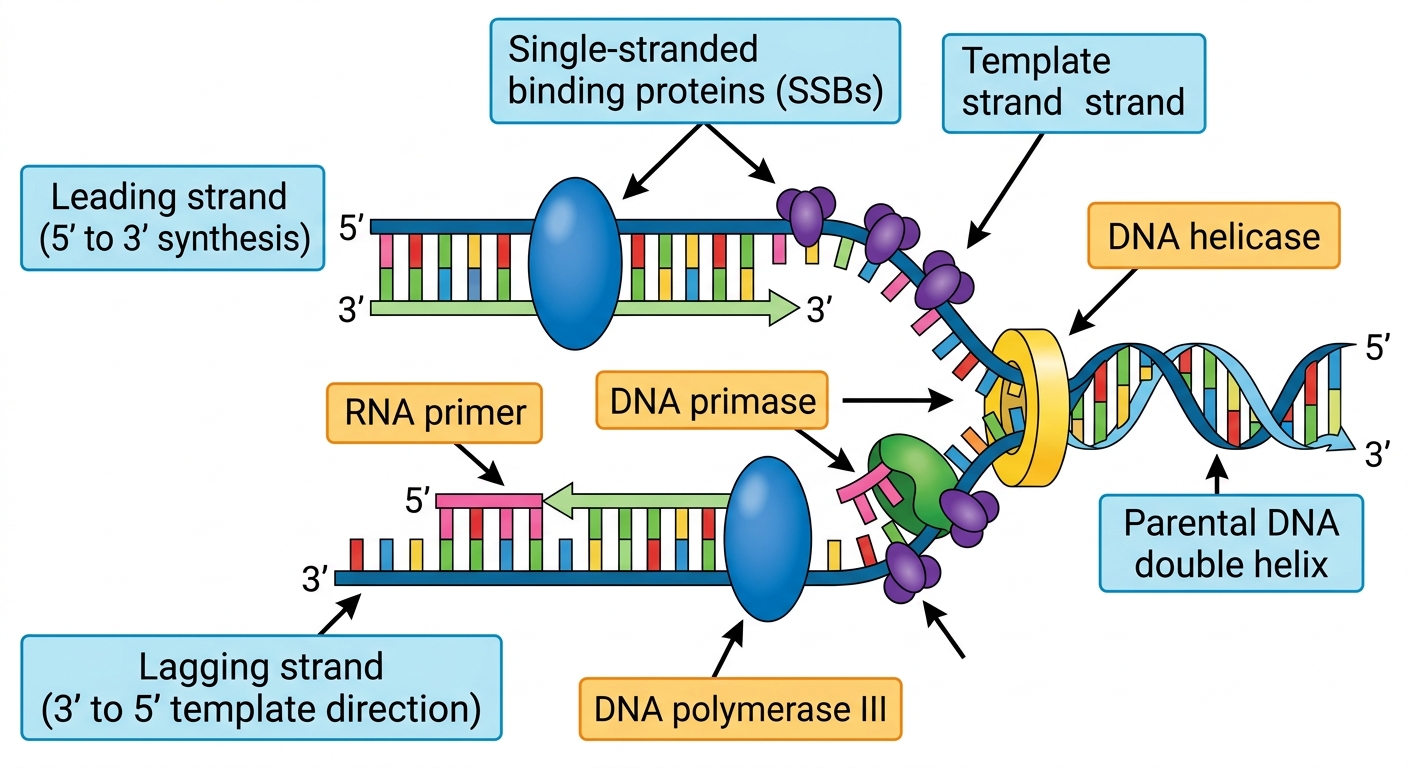
A student analyses a of a replication fork in E. coli. The shows the following labelled components: DNA helicase, single-stranded binding proteins (SSBs), DNA primase, DNA polymerase III, and the leading and lagging strands.
(a)
Describe the sequence of events involving helicase, SSBs, and primase at the replication fork, starting from the moment the parental DNA is first opened. [3 marks]
(b)
An Okazaki fragment on the lagging strand is nucleotides long. DNA primase synthesises an RNA primer of nucleotides, and DNA polymerase III adds nucleotides at a rate of . Assume primer synthesis occurs at the same rate.
Calculate the time, in seconds, required to complete synthesis of this Okazaki fragment, including primer synthesis. Show your working. [2 marks]
(c)
Explain why the lagging strand must be synthesised as discontinuous fragments, and state one consequence of this for the final structure of the replicated strand. [3 marks]
Solutions
3ChallengeSAQ-LDNA structure and replication mechanism7 marksPaper 2~11 min
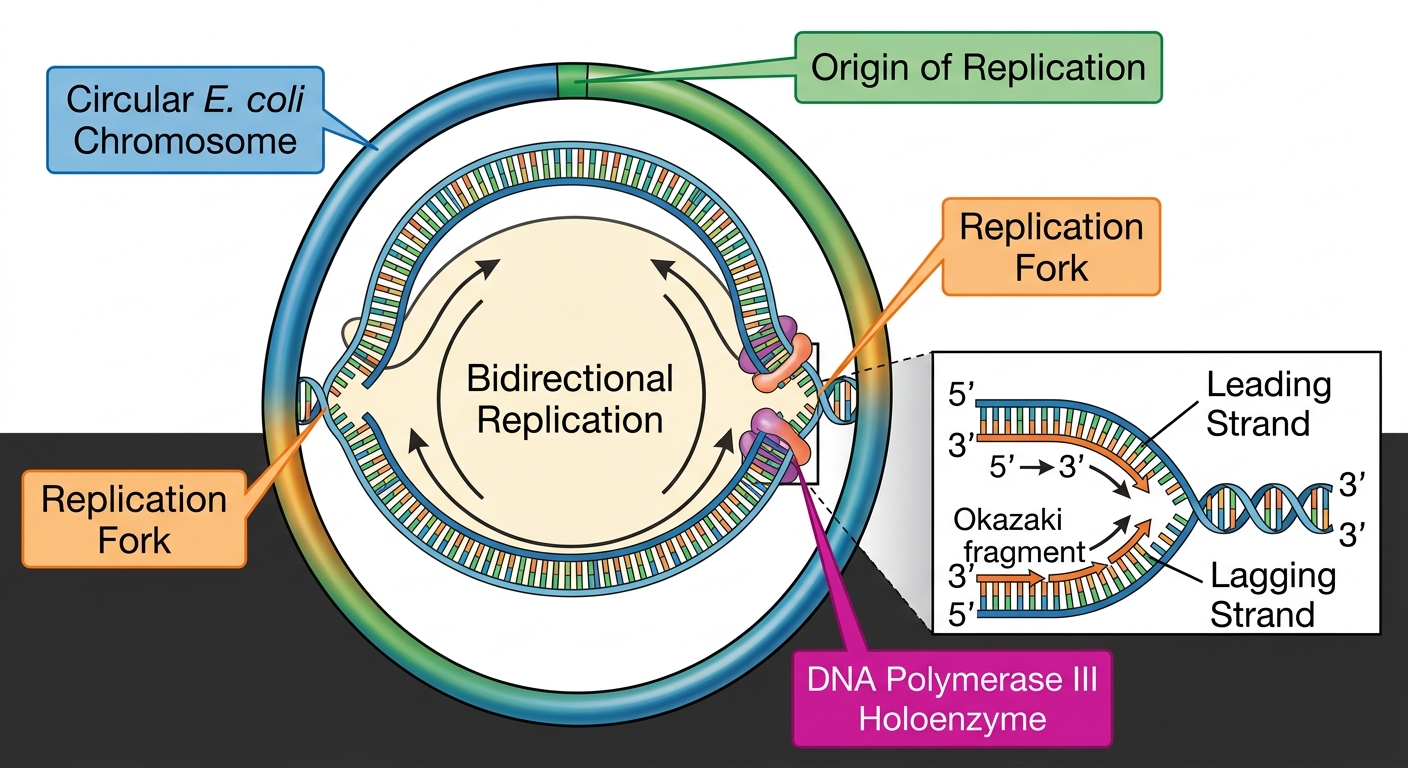
The bacterium Escherichia coli has a single circular chromosome of base pairs. Replication proceeds bidirectionally from a single origin of replication (oriC). Each replication fork adds nucleotides at .
(a)
Calculate the minimum time, in seconds, required to replicate the entire E. coli chromosome. Show all working. [3 marks]
(b)
Explain, with reference to two specific features of the replication mechanism, why the actual replication time exceeds this calculated minimum. [2 marks]
(c)
The two strands of the DNA double helix run antiparallel, yet DNA polymerase III can only synthesise in the direction. Evaluate the significance of this constraint for the mechanism of replication, using structural evidence from the double helix. [2 marks]
Solutions
That's every free question here — 3 of 50.
+47 more questions, plus Mock Papers & Worksheets, are waiting in Premium.