Inheritance · Paper 2 — Free Biology SL Practice Questions
Free questions
Open in full, with answers, mark scheme and examiner insights.
Mendelian inheritance
In pea plants (Pisum sativum), round seed shape () is dominant to wrinkled (). A farmer crosses a heterozygous round-seeded plant with a wrinkled-seeded plant.
State the law of segregation in terms of the gametes produced by the heterozygous parent.
Using a Punnett grid, determine the expected percentage of offspring with wrinkled seeds.
From one pod the farmer counts 4 wrinkled and 8 round seeds. Explain why this differs from the expected ratio.
revisionprep.com
Summary Answer
Not available for this question.
Model Answer
Not available for this question.
Marking Scheme
Not available for this question.
Examiner Insights
Not available for this question.
Mendelian inheritance
In pea plants, round seeds () are dominant to wrinkled seeds (). The diagram shows a cross between a heterozygous round-seeded plant and a wrinkled-seeded plant.
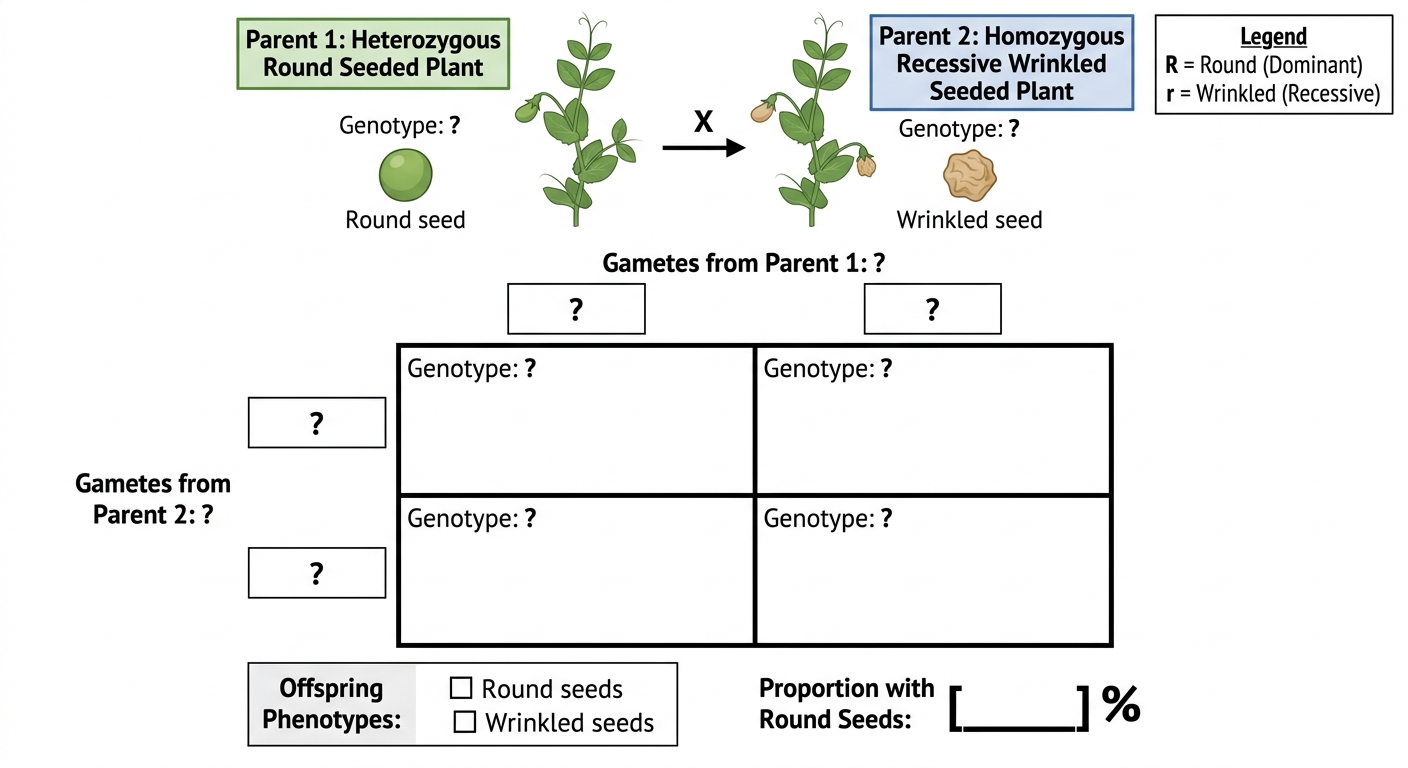
State the genotypes of the two parents.
Complete a Punnett grid for the cross, showing the gametes and the offspring genotypes.
State the expected percentage of offspring with round seeds.
Explain why a cross with a wrinkled-seeded plant is used to find the genotype of a round-seeded plant.
revisionprep.com
Summary Answer
Not available for this question.
Model Answer
Not available for this question.
Marking Scheme
Not available for this question.
Examiner Insights
Not available for this question.
Mendelian inheritance
In pea plants, purple flowers () are dominant to white flowers (). The diagram shows a cross between a purple-flowered plant and a white-flowered plant, which produced 100 offspring, all with purple flowers.
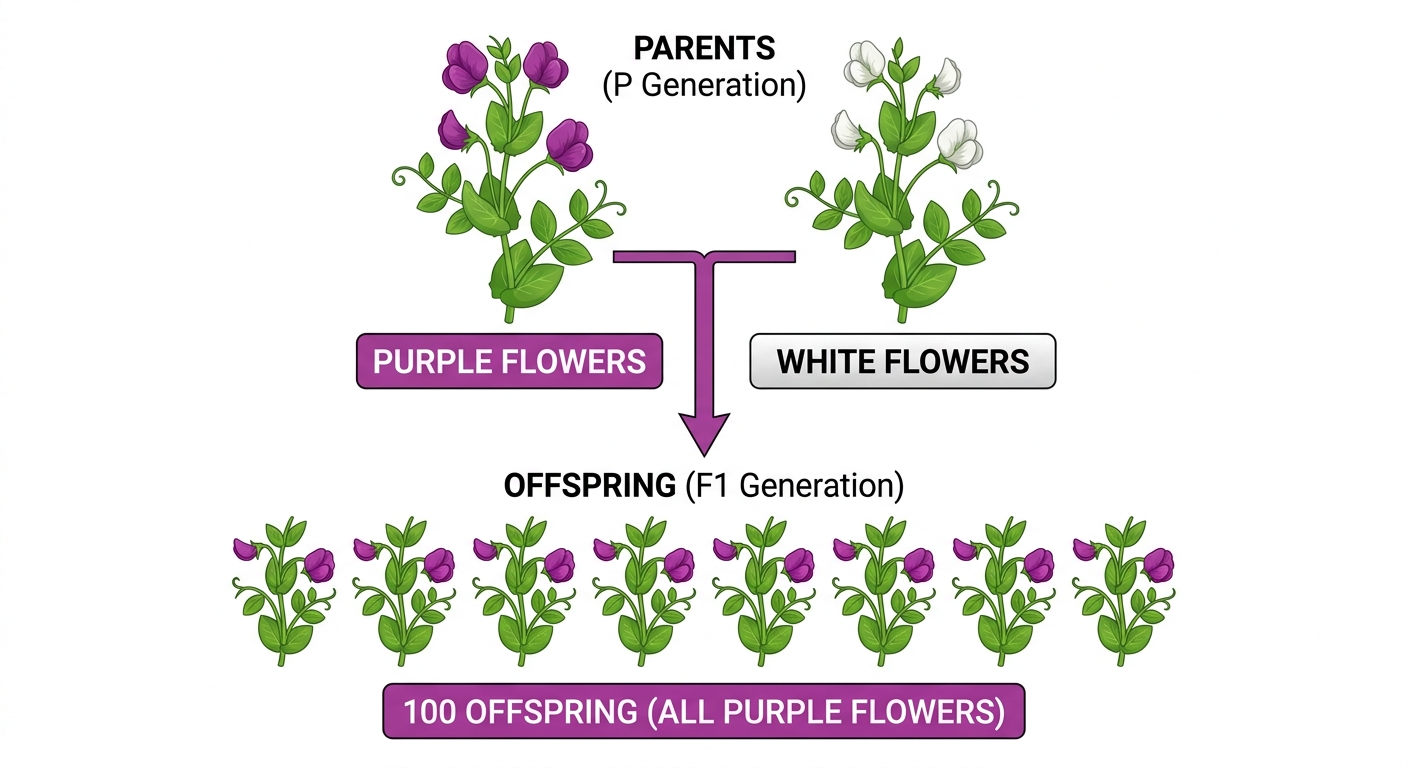
Deduce the genotype of the purple-flowered parent, giving a reason.
State the genotype of the offspring.
State the expected ratio of offspring phenotypes if the purple-flowered parent had been heterozygous.
Explain why 100 offspring give strong evidence for your answer to (a).
revisionprep.com
Summary Answer
Not available for this question.
Model Answer
Not available for this question.
Marking Scheme
Not available for this question.
Examiner Insights
Not available for this question.
Punnett squares and genetic ratios
This question is about multiple alleles and ABO blood groups.
Outline how single-nucleotide polymorphisms give rise to multiple alleles of a gene in a gene pool.
Describe the inheritance of ABO blood groups as an example of multiple alleles and codominance.
Explain, using genetic diagrams, how a man of blood group A and a woman of blood group B could have children of all four blood groups, and how blood group data can show that a man cannot be the father of a child.
revisionprep.com
Summary Answer
Not available for this question.
Model Answer
Not available for this question.
Marking Scheme
Not available for this question.
Examiner Insights
Not available for this question.
Mendelian inheritance
Plants of yarrow (Achillea) were collected from three wild populations. Each plant was divided into cuttings, so all cuttings from one plant form a clone with the same genotype. Cuttings of each clone were grown in three gardens at different altitudes. The bar chart shows the mean height of ten cuttings of each clone in each garden; the error bars show ± one standard deviation. (Data are hypothetical, based on classic transplant experiments.)
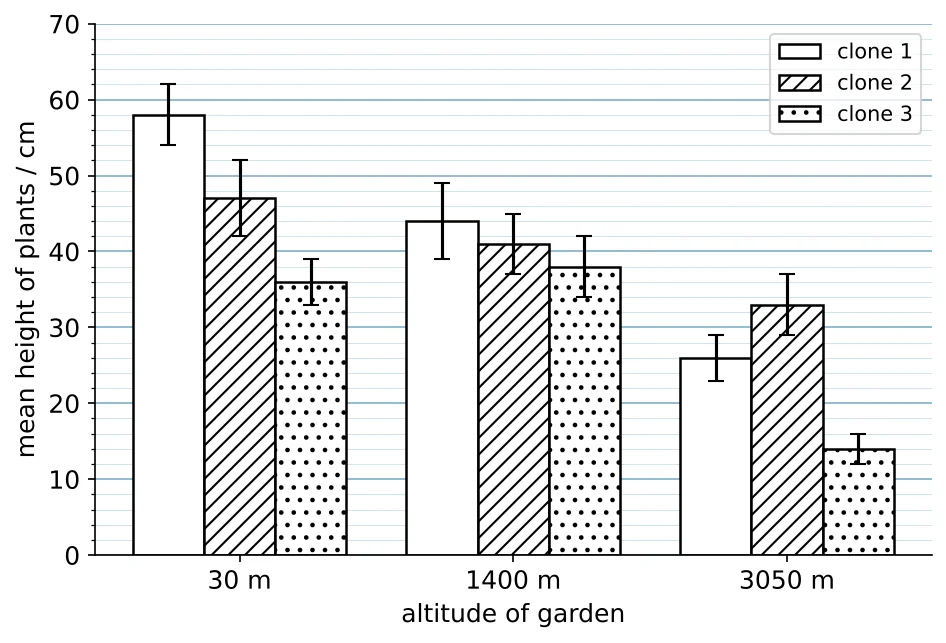
State which clone was tallest in the garden at 30 m.
Calculate the percentage decrease in the mean height of clone 1 between 30 m and 3050 m.
Explain why cuttings of the same clone were grown at each altitude.
Compare the response of clone 2 to altitude with the response of clone 1.
Deduce, with reference to the error bars, whether the three clones differ in height at 1400 m.
Explain how the data show that the phenotype of yarrow depends on both genotype and environment.
Suggest one factor, other than altitude itself, that could differ between the gardens and affect growth.
Suggest one way to improve the reliability of the results.
revisionprep.com
Summary Answer
Not available for this question.
Model Answer
Not available for this question.
Marking Scheme
Not available for this question.
Examiner Insights
Not available for this question.
Sex-linked inheritance and pedigree charts
The pedigree shows a family in which some members have a rare condition. II-4 has no family history of the condition.
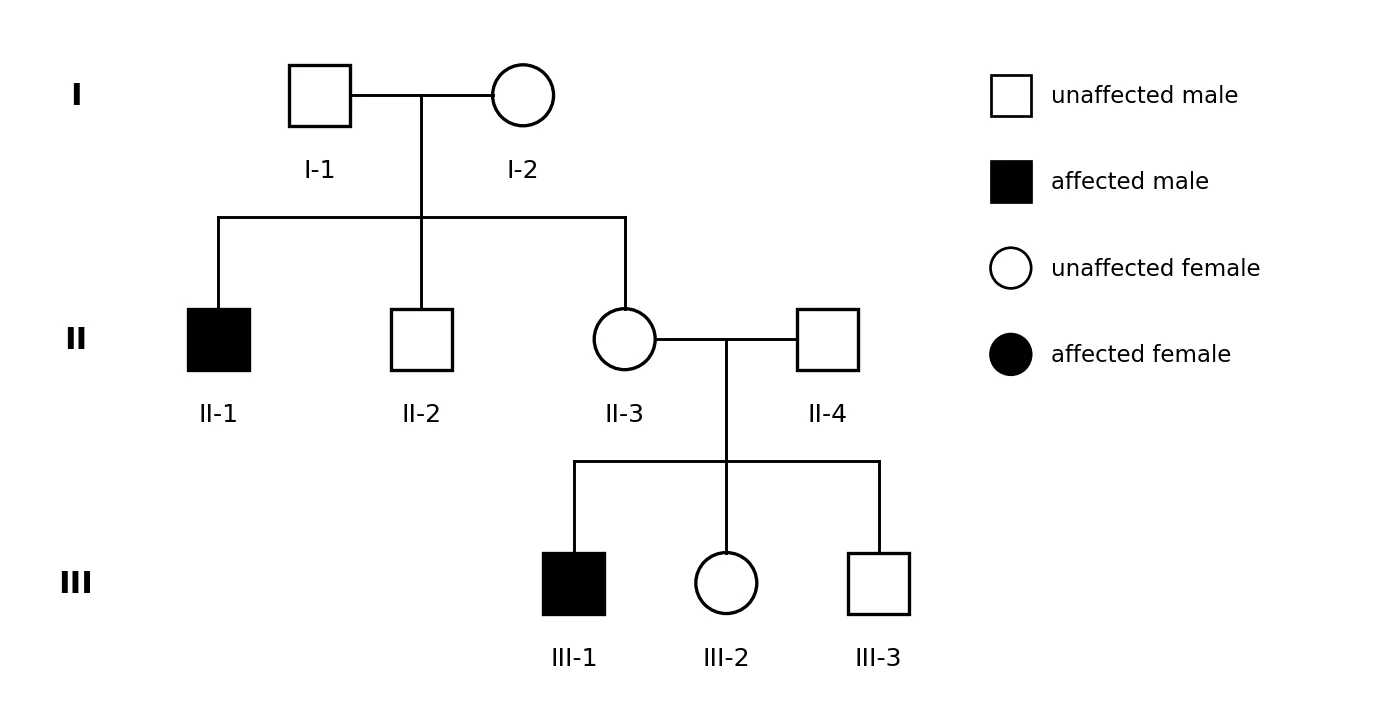
Deduce whether the allele causing the condition is dominant or recessive.
Explain why the pedigree suggests the condition is X-linked, but does not prove it.
Assuming the condition is X-linked recessive, state the genotypes of I-2 and II-3, using and .
State the probability that III-2 is a carrier.
Calculate the probability that a son of III-2 and an unaffected man is affected.
revisionprep.com
Summary Answer
Not available for this question.
Model Answer
Not available for this question.
Marking Scheme
Not available for this question.
Examiner Insights
Not available for this question.
That's every free question here — 6 of 52.
+46 more questions, plus Mock Papers & Worksheets, are waiting in Premium.