You're viewing 3 free preview questions for Biology SL — subscribe to unlock 45 more, plus the Full Question Bank, Mock Papers & Worksheets.Upgrade
Mutations and Gene Editing · Paper 2 — Free Biology SL Practice Questions
1MasterySAQ-STypes of mutations: Point, frameshift, chromosomal5 marksPaper 2~8 min

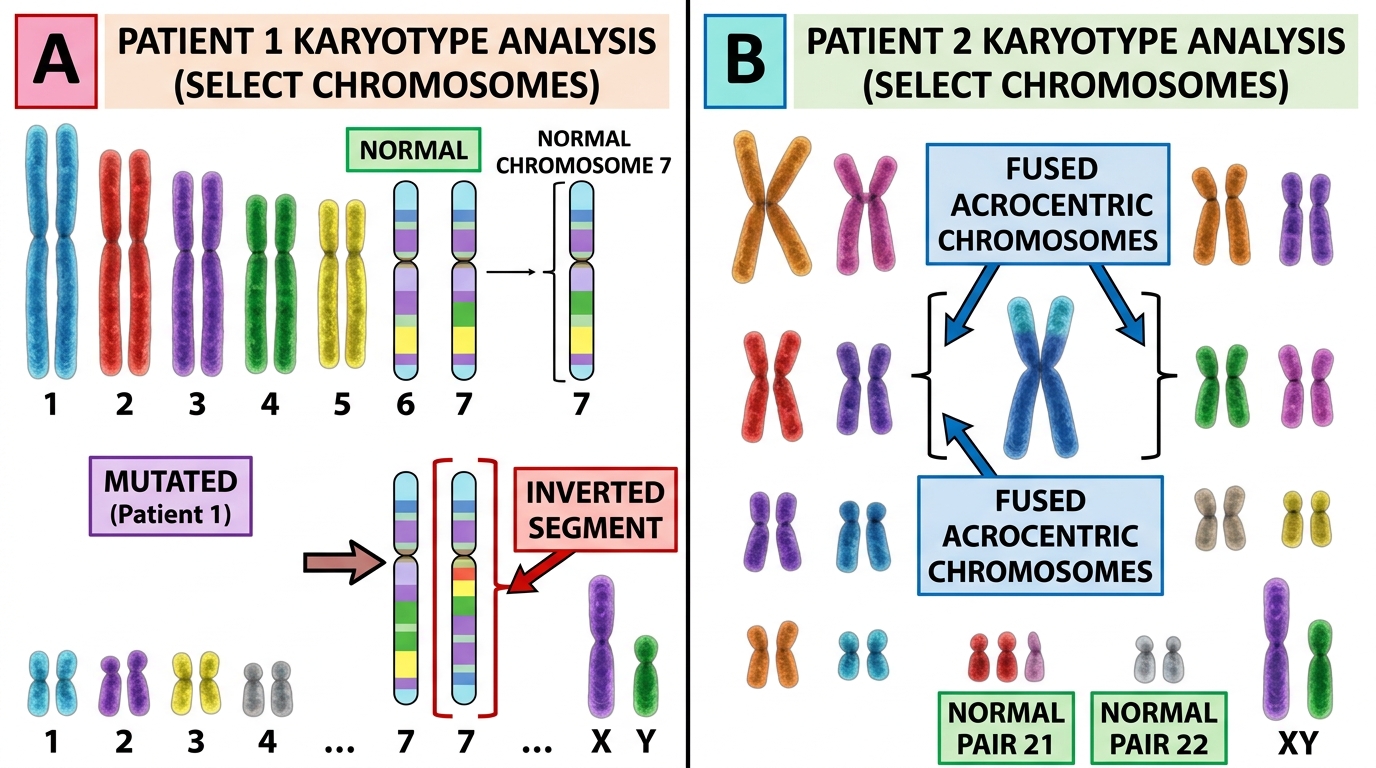
A karyotype analysis of a human patient reveals a chromosomal mutation. The patient has 46 chromosomes, but one copy of chromosome 7 has a segment that is inverted relative to the normal sequence. A different patient has 45 chromosomes formed by the fusion of two acrocentric chromosomes at their centromeres.
(a)
State the type of chromosomal mutation present in the first patient. [1 mark]
(b)
Explain why the second patient has 45 chromosomes despite retaining a full complement of genetic material. [2 marks]
(c)
Evaluate the claim that a point mutation in an exon always has a greater effect on the protein product than a point mutation in an intron of the same gene. In your answer, refer to specific mechanisms by which each mutation type can affect or fail to affect the protein. [2 marks]

Solutions
2MasterySAQ-SGene editing technologies (e.g. CRISPR)5 marksPaper 2~8 min
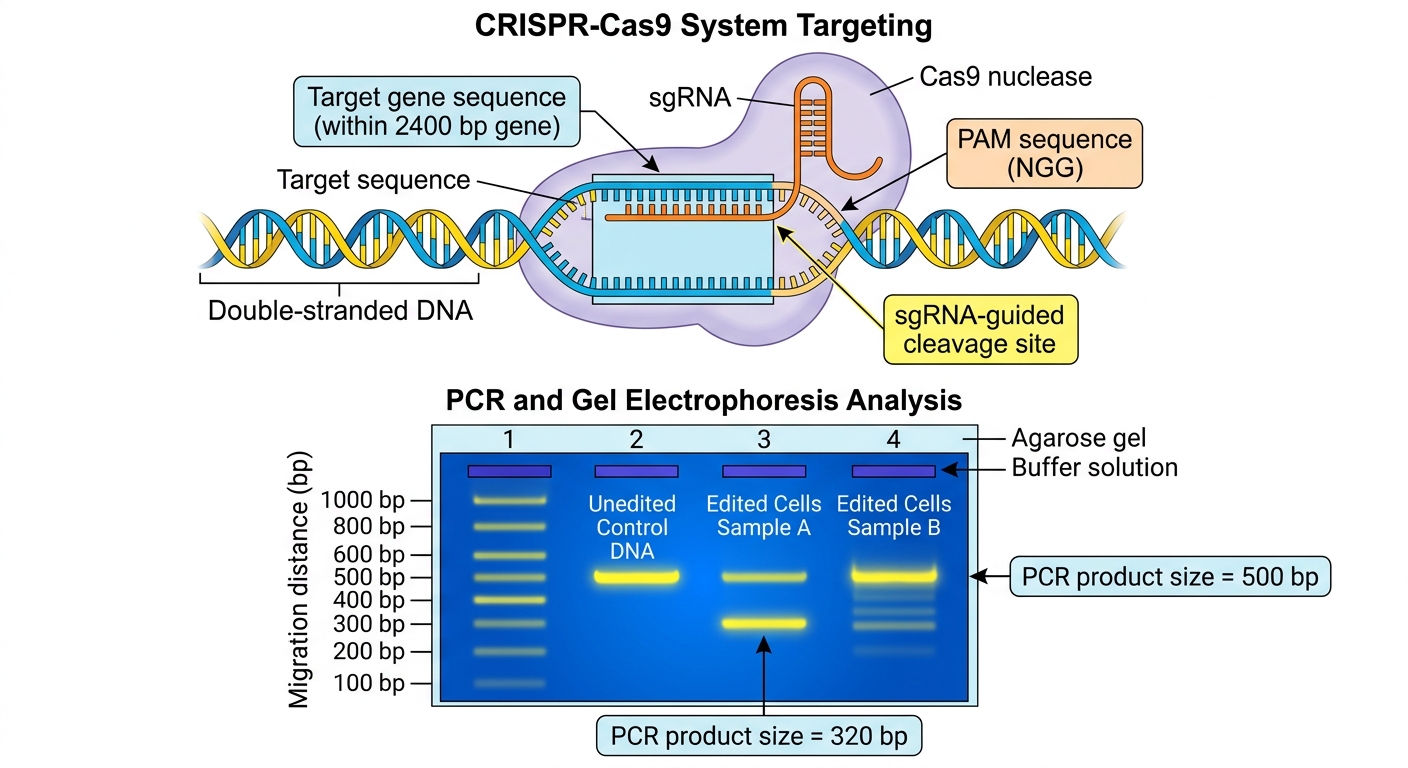
A researcher uses the CRISPR-Cas9 system to disrupt a gene in human cells grown in culture. She designs a single guide RNA (sgRNA) that targets a sequence near the start of the gene. After editing, she uses PCR with primers flanking the target site to amplify the region. The PCR products are separated by gel electrophoresis. Cells that were not exposed to CRISPR-Cas9 produce a single band at . Cells exposed to CRISPR-Cas9 produce two bands: one at and one at .
(a)
State how the sgRNA enables the Cas9 protein to cut at one specific location in the genome. [1 mark]
(b)
Determine the size, in base pairs, of the deletion introduced by the CRISPR-Cas9 cut, and state one assumption required for this calculation. [2 marks]
(c)
Explain why the simultaneous presence of both the band the band indicates incomplete editing of the cell population, and predict what result would be expected if editing were efficient. [2 marks]
Solutions
3ChallengeSAQ-LTypes of mutations: Point, frameshift, chromosomal8 marksPaper 2~12 min
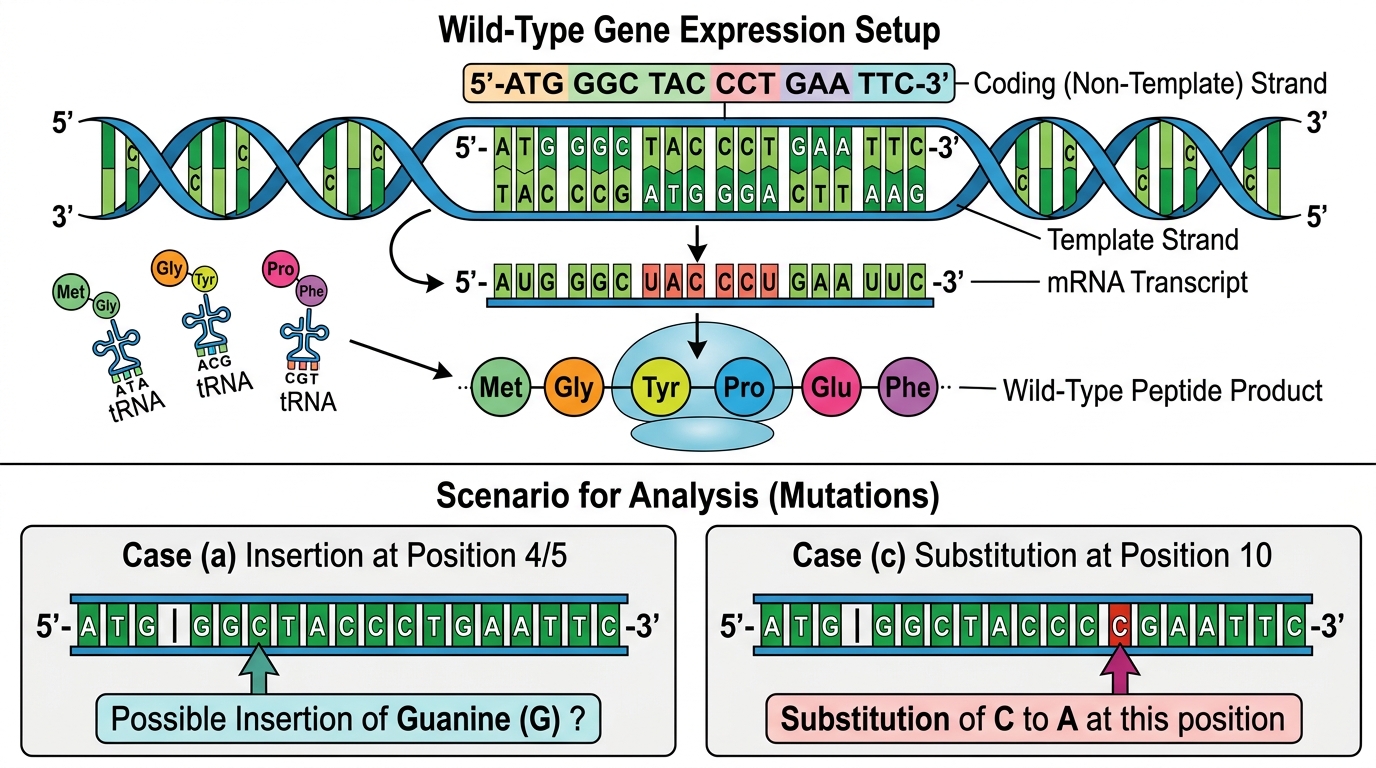
A research team studies a gene in the bacterium E. coli that codes for an enzyme involved in lactose metabolism. The following segment of the coding strand (non-template strand) of the wild-type gene is shown:
The wild-type peptide produced from this segment is: Met–Gly–Tyr–Pro–Glu–Phe.
After exposure to a chemical mutagen, two mutant strains are isolated, both unable to metabolise lactose.
- Mutant 1: a single guanine (G) nucleotide is inserted between the 4th and 5th nucleotides of the coding strand shown above.
- Mutant 2: a single base substitution changes the cytosine (C) at position 10 of the coding strand to adenine (A).
Use the genetic code in the IB Data Booklet where required.
(a)
State the type of mutation present in Mutant 1. [1 mark]
(b)
Determine the mRNA sequence produced from the mutant 1 coding strand deduce the amino acid sequence of the resulting peptide from the point of insertion onwards. Show your working. [3 marks]
(c)
Explain why the mutation in Mutant 2 would have a different effect on protein function compared to the mutation in Mutant 1. [2 marks]
(d)
Evaluate the claim that frameshift mutations are generally more harmful to an organism than point mutations, using the specific examples from this question to support your answer. [2 marks]
Solutions
That's every free question here — 3 of 48.
+45 more questions, plus Mock Papers & Worksheets, are waiting in Premium.