You're viewing 3 free preview questions for Biology SL — subscribe to unlock 45 more, plus the Full Question Bank, Mock Papers & Worksheets.Upgrade
Natural Selection · Paper 2 — Free Biology SL Practice Questions
1MasterySAQ-SMechanisms of natural selection7 marksPaper 2~11 min

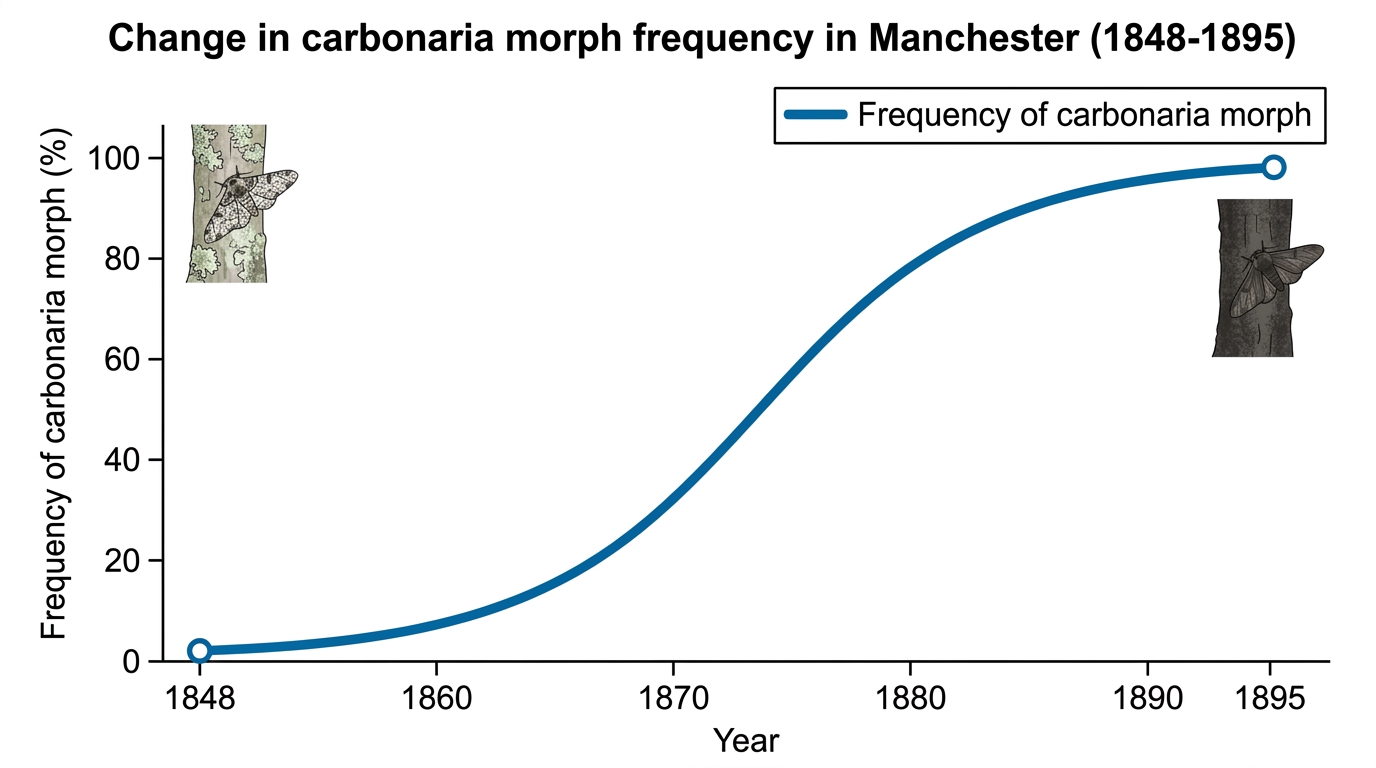
The peppered moth (Biston betularia) is a classic example of natural selection. Before industrialisation, most peppered moths in England had light, speckled colouration (typica morph); a dark melanic morph (carbonaria morph) was very rare. During the Industrial Revolution, soot from factories darkened tree trunks and killed light-coloured lichens. Bird predation experiments showed that on soot-darkened trees, typica moths were eaten more frequently than carbonaria moths.
- Frequency of carbonaria morph in Manchester in 1848:
- Frequency of carbonaria morph in Manchester in 1895:
- Generation time of peppered moth: year
(a)
State three necessary components of natural selection. [3 marks]
(b)
Calculate the average annual percentage-point increase in the frequency of the carbonaria morph from 1848 to 1895. Show your working. [2 marks]
(c)
After clean-air legislation in the late 20th century reduced industrial pollution, carbonaria morph frequency declined again. Evaluate whether this reversal supports or contradicts the conclusion that the original rise in carbonaria frequency was caused by natural selection rather than by a non-heritable change individual moth colouration. [2 marks]

Solutions
2MasterySAQ-SMechanisms of natural selection7 marksPaper 2~11 min
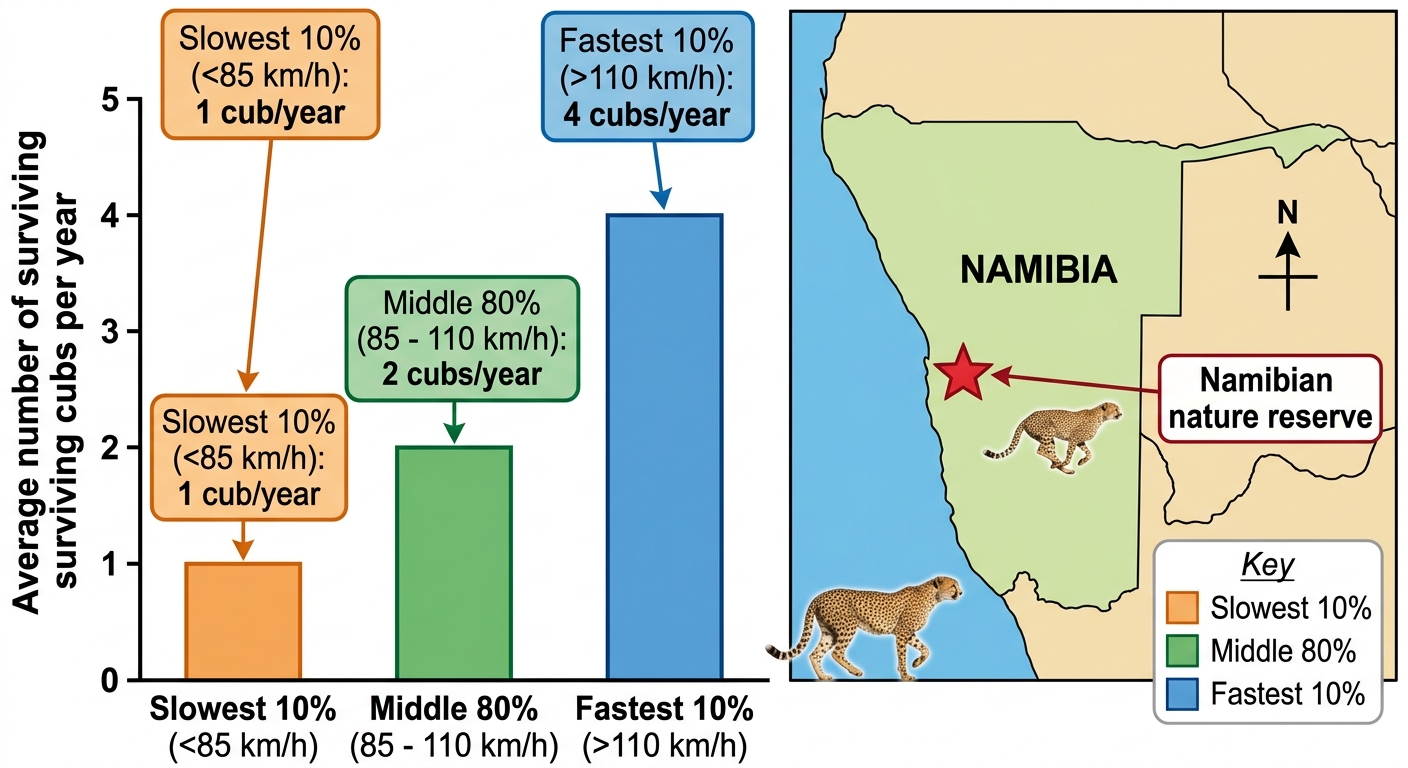
A population of cheetahs (Acinonyx jubatus) lives in a nature reserve in Namibia. A researcher measures the running speed of adult cheetahs. The fastest of cheetahs (those running over ) produce, on average, surviving cubs per year. The slowest (those running under ) produce, on average, surviving cub per year. The remaining produce, on average, surviving cubs per year. Running speed is a heritable, polygenic trait.
(a)
State the type of natural selection acting on running speed in this population. [1 mark]
(b)
Calculate the mean number of surviving cubs per year per cheetah for the whole population of individuals. [2 marks]
(c)
Explain how this selection pressure will change the mean running speed of the population over successive generations. [2 marks]
(d)
Predict the effect of this selection the genetic diversity of running speed alleles in the population over many generations, and justify your prediction. [2 marks]
Solutions
3ChallengeSAQ-LMechanisms of natural selection7 marksPaper 2~11 min
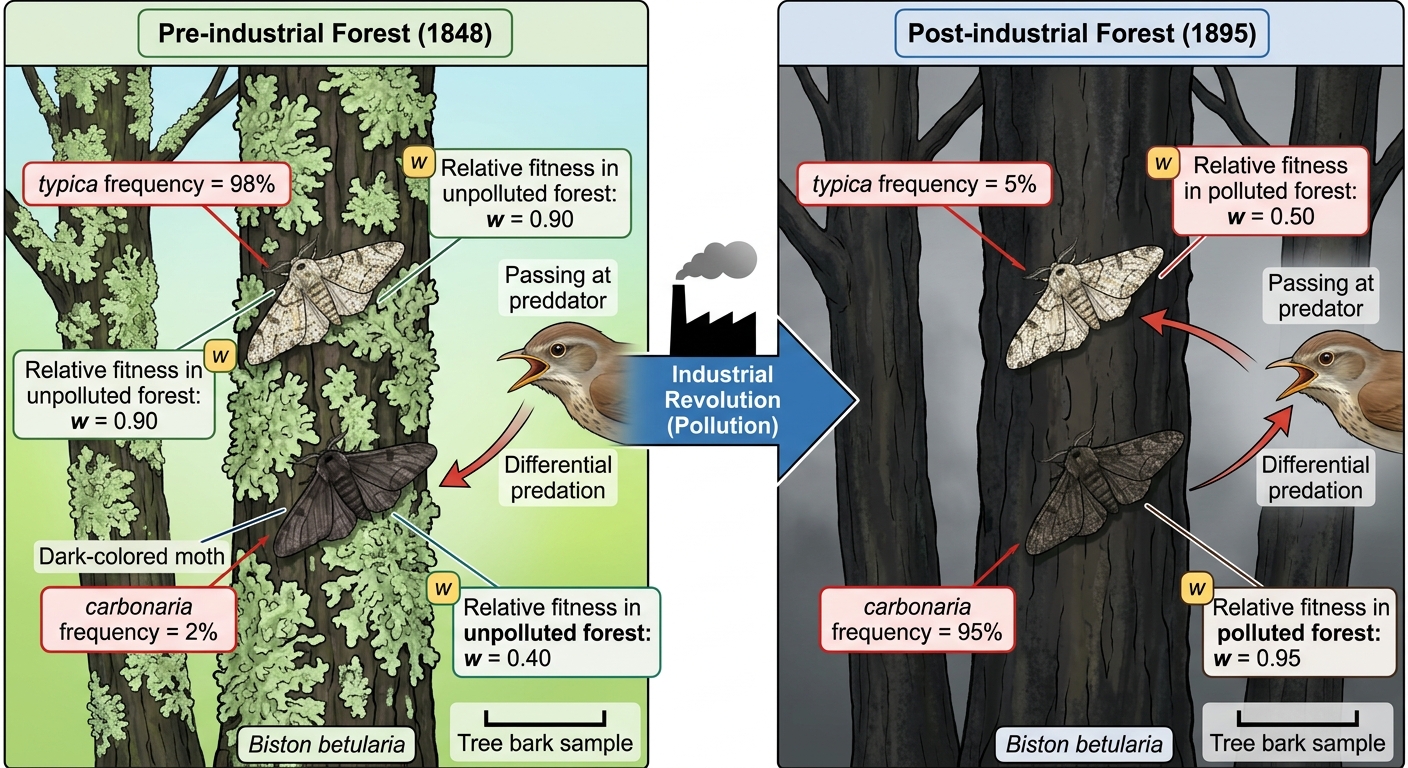
The peppered moth (Biston betularia) is a classic example of natural selection driven by industrial pollution. In 19th-century England, two phenotypes existed: light-coloured (typica) and dark-coloured (carbonaria). Before industrialisation, typica moths were camouflaged against lichen-covered bark. After pollution darkened tree trunks with soot, carbonaria increased in frequency.
Observed frequencies:
Period — carbonaria frequency — typica frequency
Pre-industrial (1848) — —
Post-industrial (1895) — —
Relative fitness values ():
Phenotype — Polluted forest — Unpolluted forest
carbonaria — —
typica — —
Generation time of Biston betularia: 1 year.
(a)
State the selection coefficient () against the typica phenotype in the polluted forest, using . [1 mark]
(b)
The change in frequency of a favoured allele per generation under selection can be approximated by:
where is the current frequency of the carbonaria allele, is the selection coefficient against typica, and is mean population fitness.
Using , , and (approximation), calculate the predicted frequency of the carbonaria allele after one generation of selection in the polluted forest. [2 marks]
(c)
Explain how the three conditions necessary for natural selection — variation, heritability, and differential reproductive success — account for the observed increase in carbonaria frequency between 1848 and 1895. [3 marks]
(d)
The relative fitness of carbonaria in unpolluted forests is , compared with for typica. Evaluate whether the carbonaria allele would be expected to reach fixation in a landscape containing both polluted and unpolluted forest patches, using the fitness data provided. [1 mark]
Solutions
That's every free question here — 3 of 48.
+45 more questions, plus Mock Papers & Worksheets, are waiting in Premium.