You're viewing 3 free preview questions for Biology SL — subscribe to unlock 45 more, plus the Full Question Bank, Mock Papers & Worksheets.Upgrade
Protein Synthesis · Paper 2 — Free Biology SL Practice Questions
1MasterySAQ-SRole of mRNA, tRNA, and ribosomes7 marksPaper 2~11 min

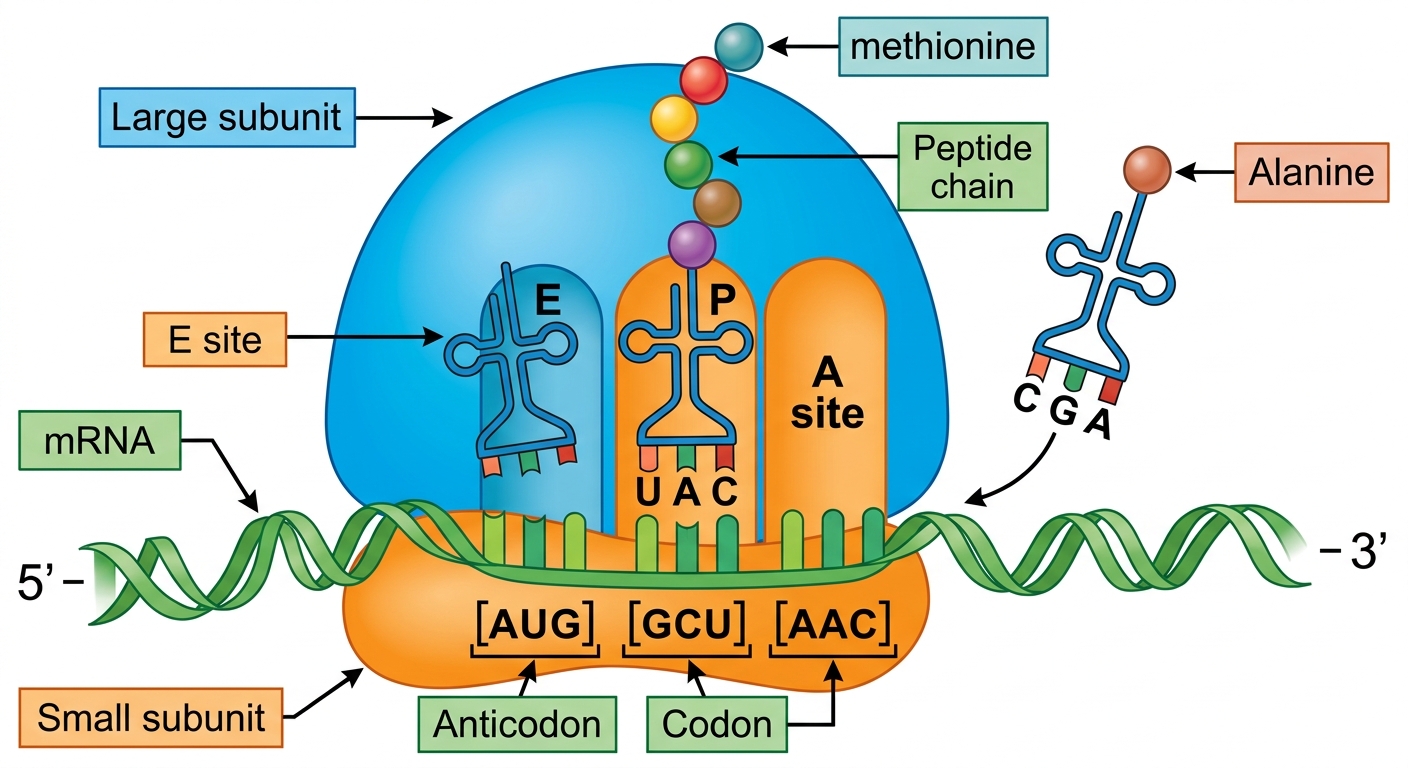
The below shows a ribosome during translation in a prokaryotic cell. The mRNA sequence is .
A large and small ribosomal subunit are shown with mRNA threaded between them. Three tRNA binding sites are visible: the E site (empty), the P site (occupied by a tRNA with anticodon carrying methionine and a growing peptide), and the A site (approached by a tRNA carrying alanine). The codons are , , and .
(a)
State the anticodon sequence, written , of the tRNA that binds to the third codon AAC. [1 mark]
(b)
Describe how the structure of tRNA enables it to carry a specific amino acid and to recognise a specific mRNA codon. [2 marks]
(c)
The third codon is . Calculate the total number of hydrogen bonds formed between this codon and its complementary anticodon, using the rules bonds and bonds. [2 marks]
(d)
The wobble hypothesis states that the third base of anticodon can form non-Watson–Crick base pairs with the third base of a codon. Explain one advantage this gives to a cell during translation. [2 marks]

Solutions
2ChallengeSAQ-LTranscription and translation processes7 marksPaper 2~11 min
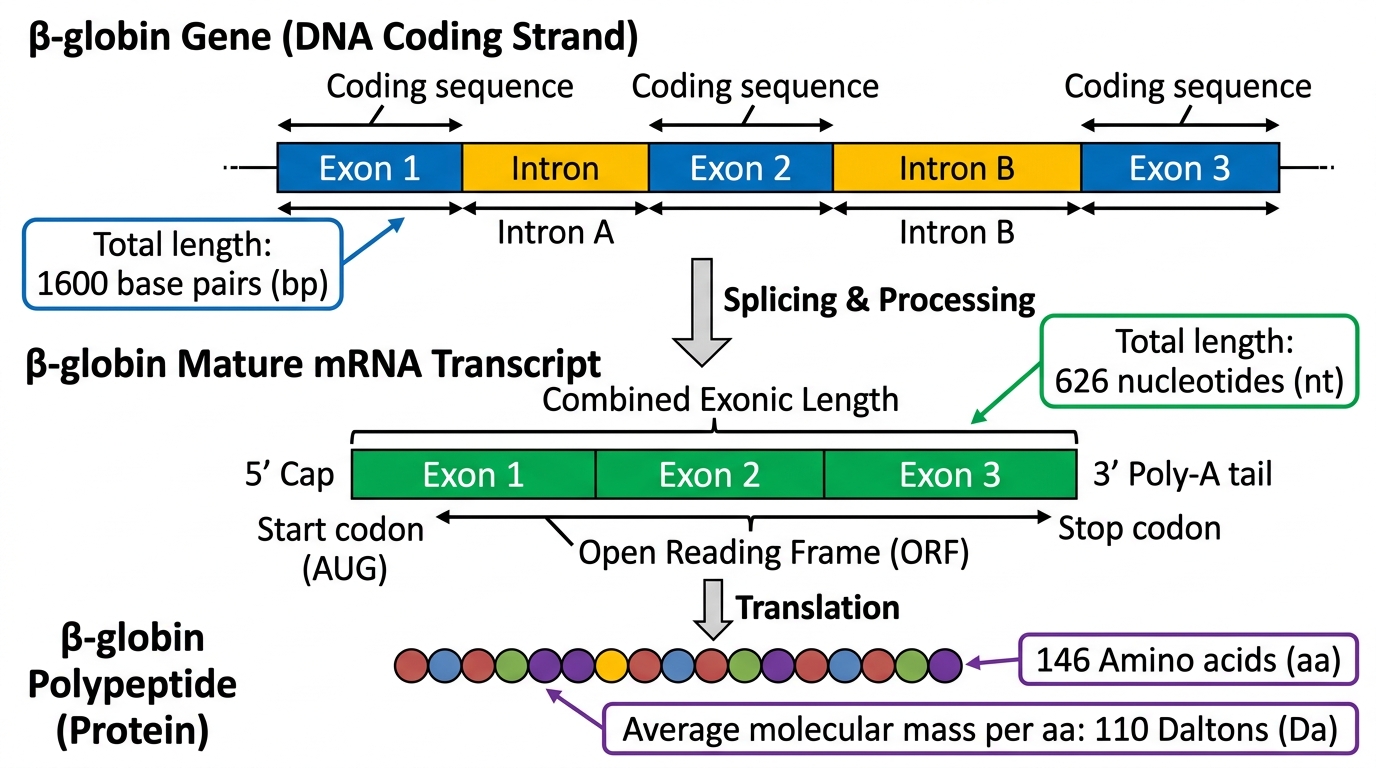
A study was conducted on the expression of the -globin gene in human erythroblast precursor cells. Researchers isolated mRNA from these cells and used it as a template for complementary DNA (cDNA) synthesis. The cDNA was then sequenced. The following data were obtained from the coding strand of the -globin gene and the corresponding mature mRNA transcript.
- Length of -globin gene (coding strand):
- Length of -globin mature mRNA (after processing):
- Number of amino acids in the final -globin polypeptide:
- The gene contains three exons and two introns.
(a)
Calculate the number of nucleotides in the combined introns of the -globin gene. Show your working. [2 marks]
(b)
Explain why the number of nucleotides in the mature mRNA () is greater than three times the number of amino acids in the polypeptide. [2 marks]
(c)
Evaluate whether the data support the conclusion that all exonic sequences in the -globin gene are translated into the polypeptide. [3 marks]
Solutions
3ChallengeSAQ-LTranscription and translation processes7 marksPaper 2~11 min
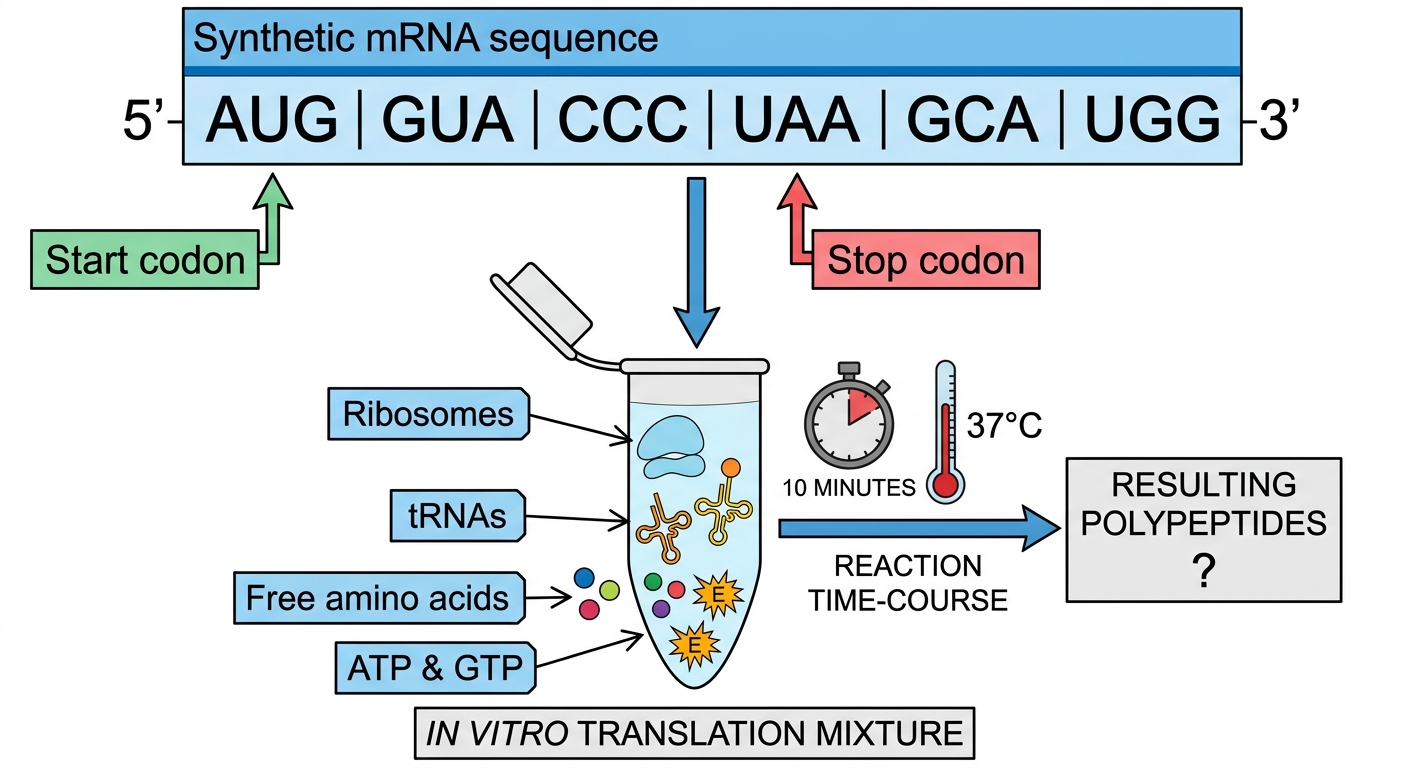
In an investigation of translation efficiency, researchers used an in vitro translation system containing ribosomes, tRNAs, amino acids, ATP, and GTP. They added a synthetic mRNA with the sequence .
(a)
Determine the amino acid sequence of the polypeptide produced from this mRNA. Use three-letter amino acid abbreviations and show your codon assignments. [3 marks]
(b)
Explain the molecular events at the ribosome that prevent the codons GCA and UGG from being translated. [2 marks]
(c)
A mutation in a tumour suppressor gene introduces a premature stop codon near the middle of the coding sequence. Evaluate whether the resulting truncated protein is likely to be functional, referring to protein structure and function. [2 marks]
Solutions
That's every free question here — 3 of 48.
+45 more questions, plus Mock Papers & Worksheets, are waiting in Premium.