Carbohydrates and Lipids · Paper 1 — Free Biology SL Practice Questions
Free questions
Open in full, with answers, mark scheme and examiner insights.
Monosaccharides, condensation and polysaccharides
Maltase catalyses the hydrolysis of maltose, producing two glucose monomers. Which type of bond is broken during this reaction, and between which two molecular components?
revisionprep.com
Summary Answer
Not available for this question.
Model Answer
Not available for this question.
Marking Scheme
Not available for this question.
Examiner Insights
Not available for this question.
Glycoproteins and cell–cell recognition
Red blood cells of people with blood group A and blood group B carry different antigens on the outer surface of their plasma membranes. These antigens are glycoproteins and glycolipids. What is the difference between the A and B antigens?
revisionprep.com
Summary Answer
Not available for this question.
Model Answer
Not available for this question.
Marking Scheme
Not available for this question.
Examiner Insights
Not available for this question.
Monosaccharides, condensation and polysaccharides
A student investigated the effect of amylase concentration on the hydrolysis of starch at . Samples were removed every 10 s and tested with iodine solution; the time when iodine no longer turned blue-black was recorded. Each concentration was tested three times. The graph shows the mean times.
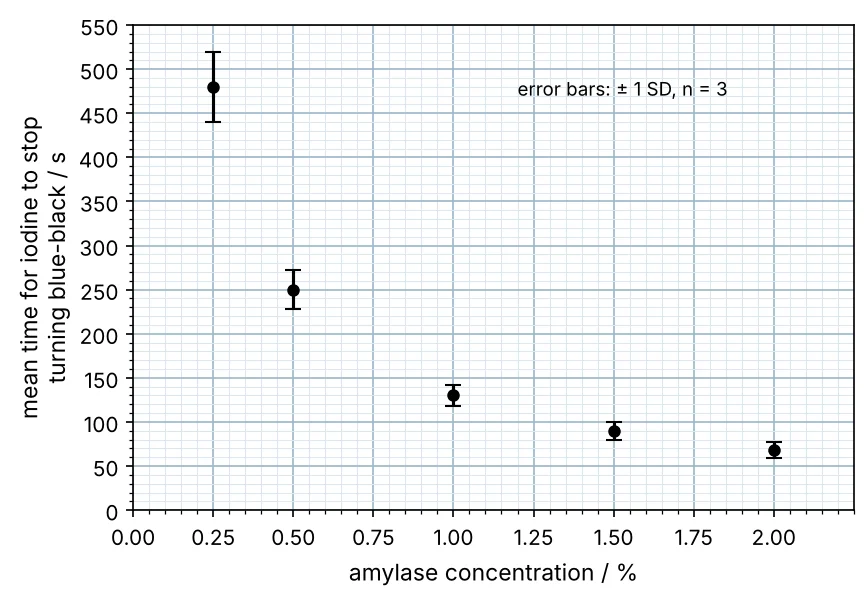
State the independent variable in this investigation.
Calculate, using rate , how many times faster starch was hydrolysed at 1.0% amylase than at 0.5% amylase.
Explain the effect of increasing the amylase concentration on the time taken.
Evaluate the method of judging the end-point, and suggest one improvement.
revisionprep.com
Summary Answer
Not available for this question.
Model Answer
Not available for this question.
Marking Scheme
Not available for this question.
Examiner Insights
Not available for this question.
Lipids: triglycerides, phospholipids, steroids; energy storage and insulation
A lectin extracted from horse gram seeds (Dolichos biflorus) is a protein that binds a specific monosaccharide. A suspension of red blood cells of each ABO group was mixed with the lectin, and the percentage of cells that agglutinated was measured. Five blood samples of each group were tested.
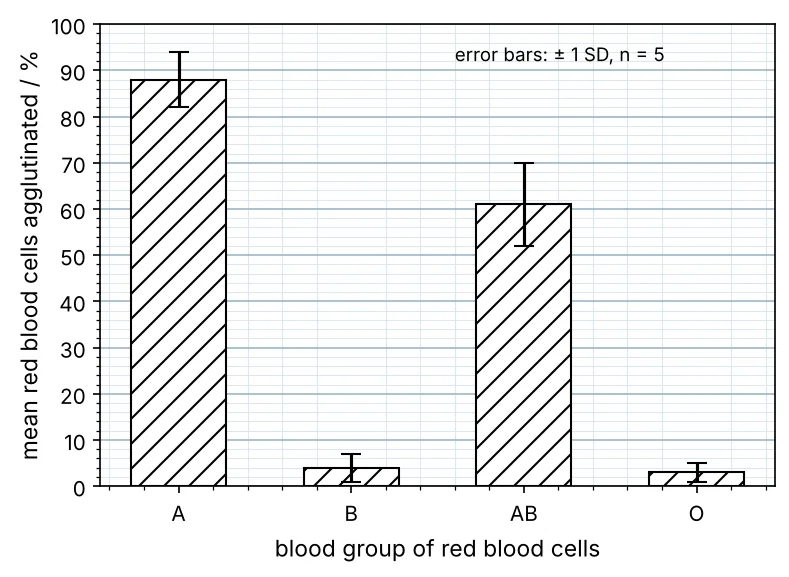
Calculate how many times greater the mean agglutination of group A cells was than that of group B cells.
Explain the results for group A and group O cells.
Suggest why group AB cells agglutinated less than group A cells.
Evaluate the use of this lectin as a test to distinguish group A blood from group B blood.
revisionprep.com
Summary Answer
Not available for this question.
Model Answer
Not available for this question.
Marking Scheme
Not available for this question.
Examiner Insights
Not available for this question.
Monosaccharides, condensation and polysaccharides
The table below shows the composition of three food samples, X, Y, and Z, as percentages of dry mass.
Food sample — Carbohydrate (%) — Lipid (%) — Protein (%) X — 5 — 80 — 15 Y — 70 — 5 — 25 Z — 45 — 40 — 15
A student hypothesised that food sample X would provide the most energy per gram because it has the highest lipid content. To test this, the student burned samples of each food and measured the temperature increase in of water.
Food sample — Temperature increase (°C) X — 12.5 Y — 8.2 Z — 10.8
The energy released can be calculated using:
where is the mass of water in grams, , and is the temperature change in °C. The density of water is .
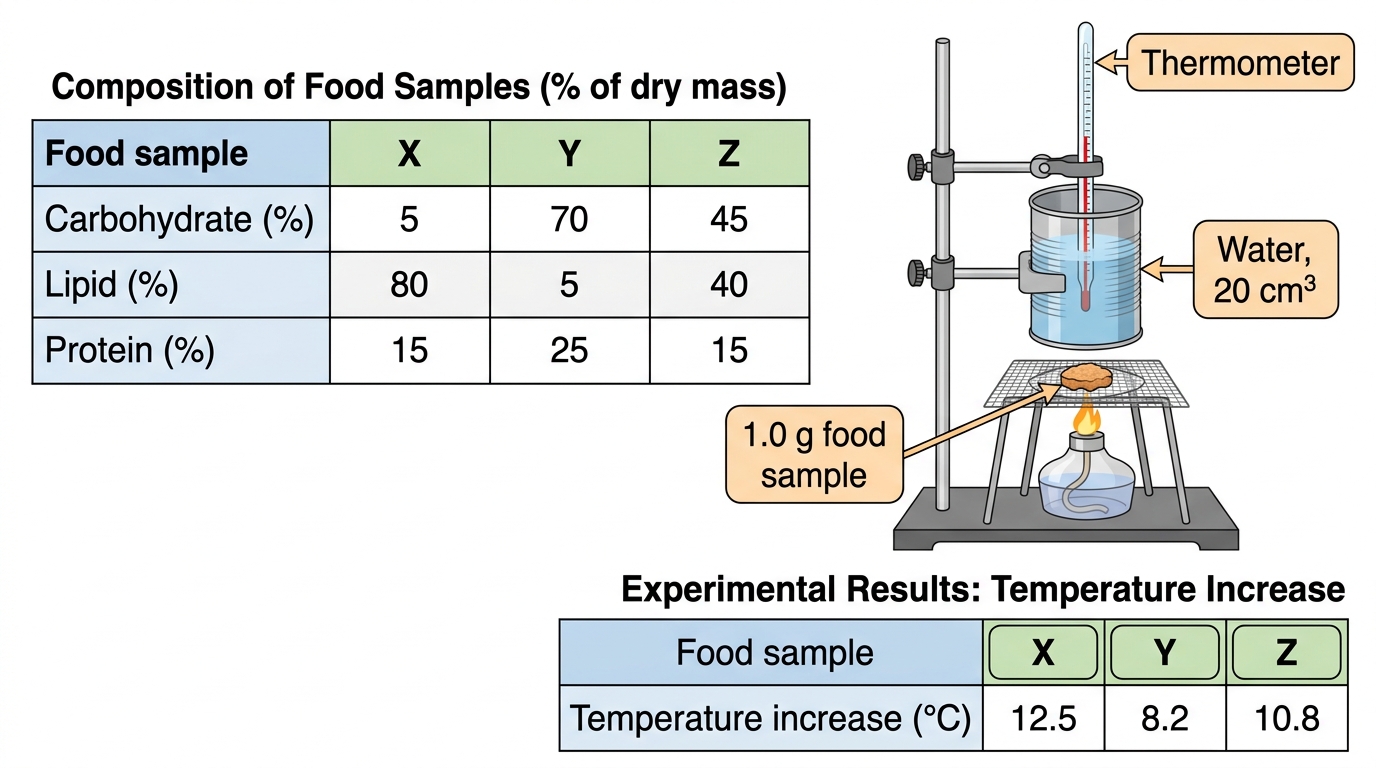
Calculate the energy released per gram for food sample X, giving your answer in .
Explain whether the data support the student's hypothesis.
Explain two reasons why the experimental results may not accurately reflect the true energy content of the food samples.
Evaluate the relationship between the chemical structures of carbohydrates and lipids and their roles as energy storage molecules in living organisms.
revisionprep.com
Summary Answer
Not available for this question.
Model Answer
Not available for this question.
Marking Scheme
Not available for this question.
Examiner Insights
Not available for this question.
Glycoproteins and cell–cell recognition
Glycoproteins in blood plasma carry carbohydrate chains that end in sialic acid. When sialic acid is removed, the monosaccharide galactose is exposed at the end of the chain. In a hypothetical experiment, three labelled glycoprotein preparations were injected into the blood of mice and the percentage remaining in the blood was measured (mean of four mice; error bars ± 1 SD).
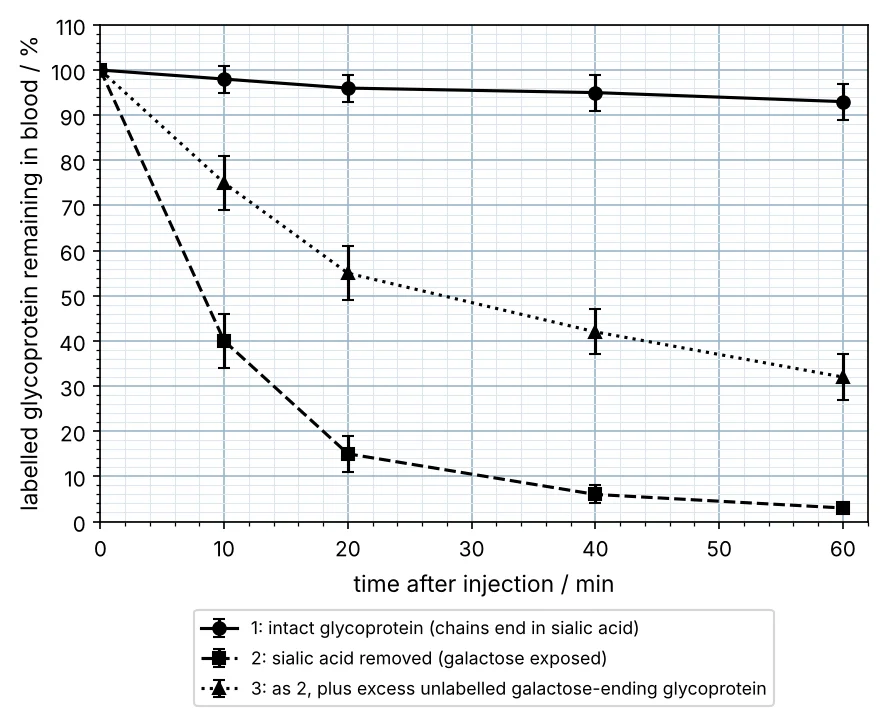
Calculate the percentage decrease in preparation 2 in the blood during the first 10 minutes.
Liver cells carry receptor proteins that bind galactose at the end of carbohydrate chains. Explain the difference between the results for preparations 1 and 2.
Explain the results for preparation 3.
Evaluate the claim that these data show that the glycoprotein is removed from the blood by liver cells.
revisionprep.com
Summary Answer
Not available for this question.
Model Answer
Not available for this question.
Marking Scheme
Not available for this question.
Examiner Insights
Not available for this question.
That's every free question here — 6 of 43.
+37 more questions, plus Mock Papers & Worksheets, are waiting in Premium.