Cell Specialization · Paper 1 — Free Biology SL Practice Questions
Free questions
Open in full, with answers, mark scheme and examiner insights.
Stem cells and differentiation
At the 8-cell stage of a mouse embryo, the cells can be separated. Each separated cell can develop into a complete embryo, including its own placenta. Which term describes the cells at this stage?
revisionprep.com
Summary Answer
Not available for this question.
Model Answer
Not available for this question.
Marking Scheme
Not available for this question.
Examiner Insights
Not available for this question.
Cell size and surface area-to-volume ratio
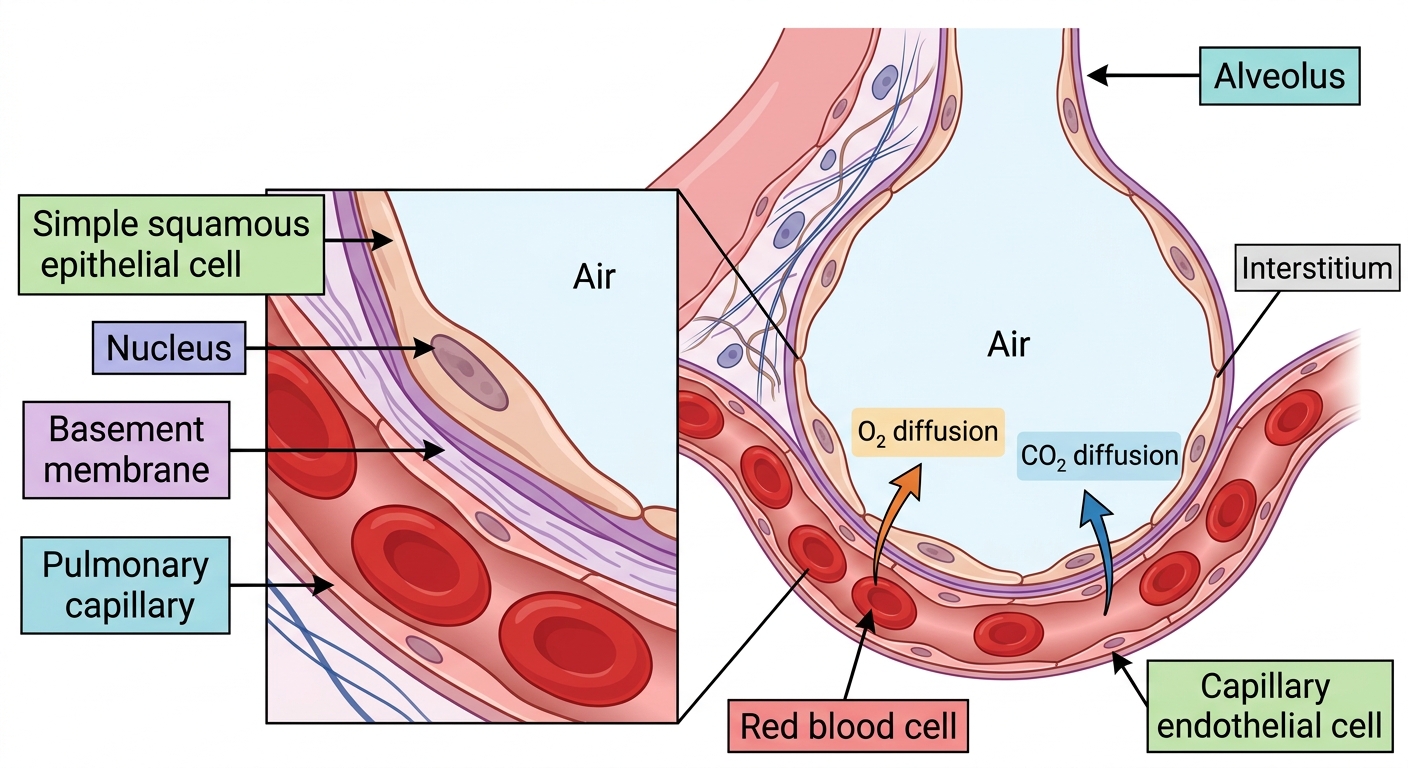
The shows part of the wall of an alveolus. The thin cells lining the air space are type I pneumocytes. Which feature of type I pneumocytes makes gas exchange efficient?
revisionprep.com
Summary Answer
Not available for this question.
Model Answer
Not available for this question.
Marking Scheme
Not available for this question.
Examiner Insights
Not available for this question.
Stem cells and differentiation
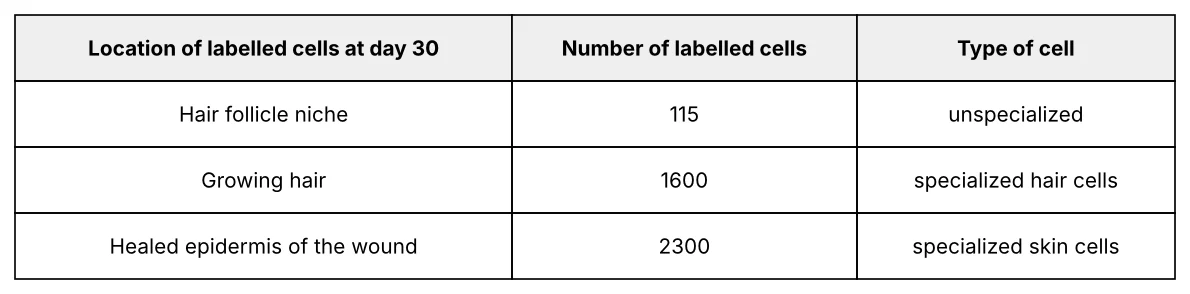
Stem cells in the hair follicle niche of adult mice were labelled with a fluorescent marker that is passed on to every daughter cell. A small wound was then made in the skin beside the follicles. After 30 days, labelled cells were counted. The table shows the results.
At day 0 the niche held 120 labelled cells.
State the location of one other stem cell niche in adult humans.
Calculate the percentage of labelled cells at day 30 that were still unspecialized.
Explain how the data show both properties of stem cells.
Deduce, with a reason, whether these hair follicle stem cells are pluripotent or multipotent.
revisionprep.com
Summary Answer
Not available for this question.
Model Answer
Not available for this question.
Marking Scheme
Not available for this question.
Examiner Insights
Not available for this question.
Adaptations of specialized cells (alveolar, cardiac muscle, sperm, egg)
A researcher measured ATP use per gram of muscle at rest and during maximal activity. The table shows the results.

Calculate the fold increase in ATP use from rest to maximal activity for each tissue.
Explain why cardiac muscle uses ATP at a relatively high rate even at rest.
Suggest why mitochondria alone cannot supply the ATP for the rise in skeletal muscle.
revisionprep.com
Summary Answer
Not available for this question.
Model Answer
Not available for this question.
Marking Scheme
Not available for this question.
Examiner Insights
Not available for this question.
Stem cells and differentiation
Rats with the same type of spinal cord injury were given one of three cell types 24 hours after injury: iPSCs made from each rat's own skin cells; embryonic stem cells (ESCs) from a different rat strain; or adult neural stem cells (NSCs) from the brain. After 8 weeks, the percentage of transplanted cells that had become neurons and the distance axons had regrown past the injury were measured ( per group). The graphs show the results.
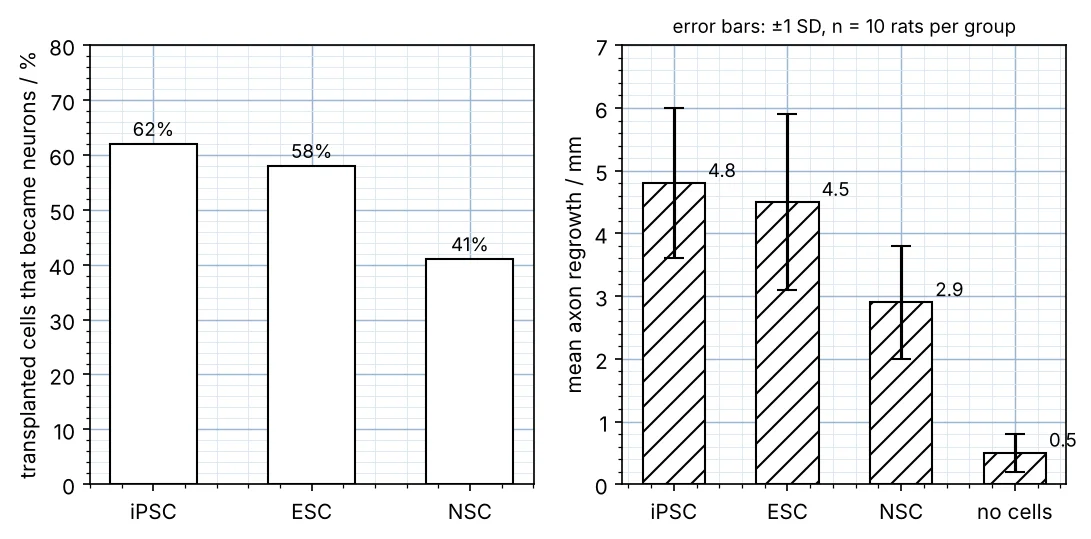
Calculate the percentage increase in mean axon regrowth for the iPSC group compared with the NSC group.
Explain why the iPSCs and ESCs produced a higher percentage of neurons than the NSCs.
Evaluate the claim that iPSCs are the most promising cell type for treating human spinal cord injury.
revisionprep.com
Summary Answer
Not available for this question.
Model Answer
Not available for this question.
Marking Scheme
Not available for this question.
Examiner Insights
Not available for this question.
Adaptations of specialized cells (alveolar, cardiac muscle, sperm, egg)
A muscle biopsy from a patient with a neuromuscular disorder is compared with a healthy control. ATP is needed for contraction and for pumping calcium ions back into the sarcoplasmic reticulum. The table shows the results.
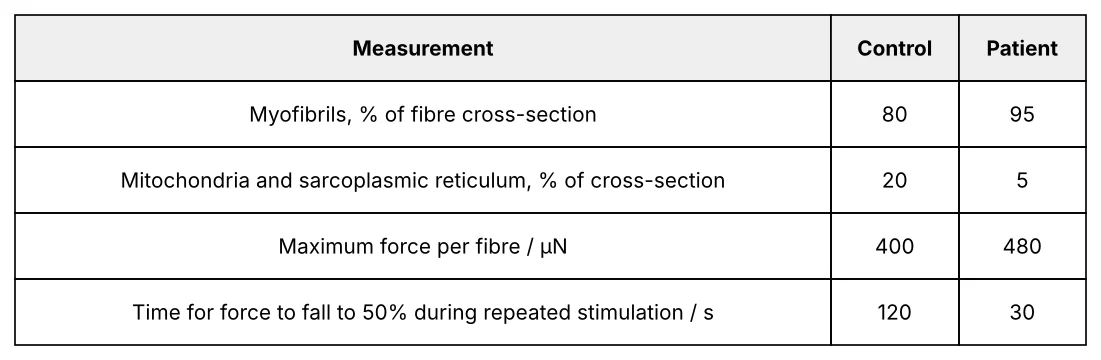
Calculate the percentage increase in myofibril area and the percentage decrease in mitochondria and sarcoplasmic reticulum area in the patient.
Explain how the structural differences account for the patient's higher maximum force and faster fatigue.
Evaluate whether the patient's muscle fibres are better adapted for producing force than healthy fibres.
revisionprep.com
Summary Answer
Not available for this question.
Model Answer
Not available for this question.
Marking Scheme
Not available for this question.
Examiner Insights
Not available for this question.
That's every free question here — 6 of 62.
+56 more questions, plus Mock Papers & Worksheets, are waiting in Premium.