Gas Exchange · Paper 1 — Free Biology SL Practice Questions
Free questions
Open in full, with answers, mark scheme and examiner insights.
Respiratory structures in animals and plants
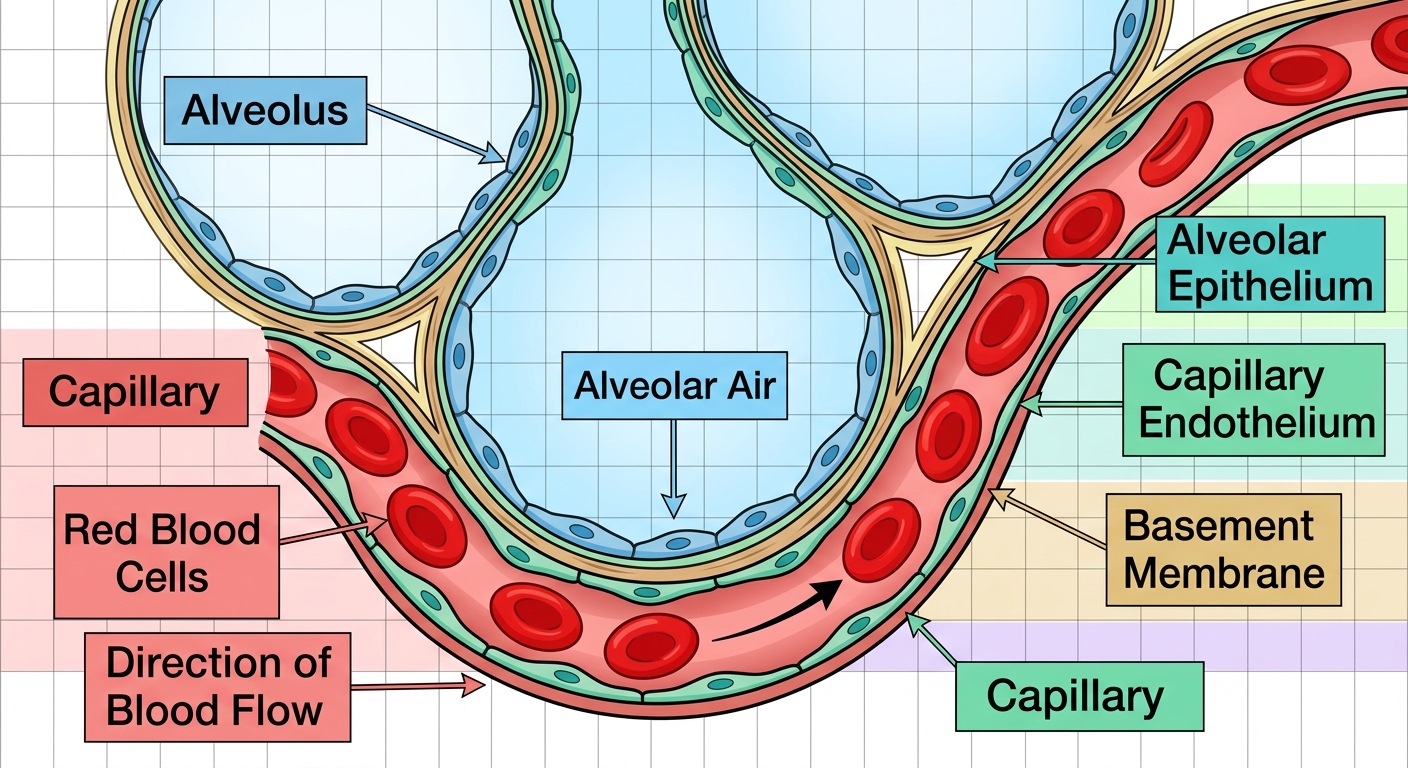
A student examines a prepared slide of mammalian lung tissue and observes that the alveolar walls are composed of a single layer of squamous epithelial cells. Which statement best explains why this single-cell thickness is important for gas exchange?
revisionprep.com
Summary Answer
Not available for this question.
Model Answer
Not available for this question.
Marking Scheme
Not available for this question.
Examiner Insights
Not available for this question.
Properties of gas-exchange surfaces; maintaining concentration gradients
Cubes of agar containing a pink pH indicator were placed in dilute acid. As acid diffused in, the indicator turned colourless. A student recorded the time taken for each cube to lose its pink colour completely. The table shows the results.
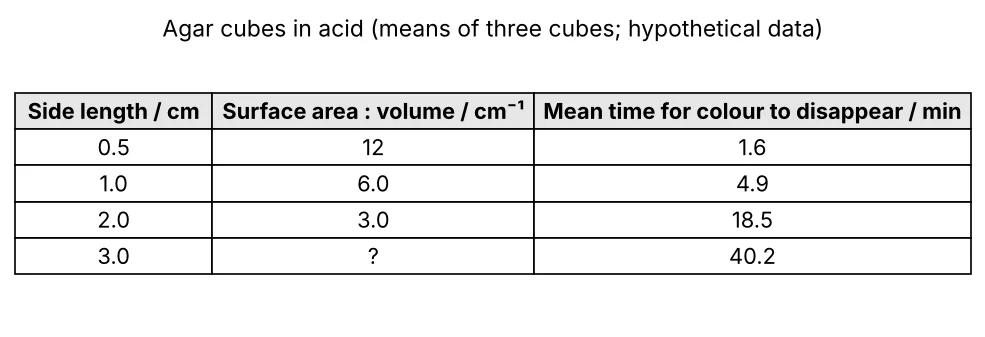
Calculate the surface area to volume ratio of the 3.0 cm cube.
Describe the relationship between surface area to volume ratio and the time taken for the colour to disappear.
Using these results, explain why large multicellular organisms need specialised gas-exchange systems.
Identify one source of uncertainty in this method and suggest how it could be reduced.
revisionprep.com
Summary Answer
Not available for this question.
Model Answer
Not available for this question.
Marking Scheme
Not available for this question.
Examiner Insights
Not available for this question.
Respiratory structures in animals and plants
A student investigated the effect of temperature on the rate of abdominal ventilation movements in desert locusts (Schistocerca gregaria). Each locust was kept in a chamber at the test temperature for 15 minutes before the number of abdominal pumping strokes in one minute was counted. The graph shows the results (hypothetical data).
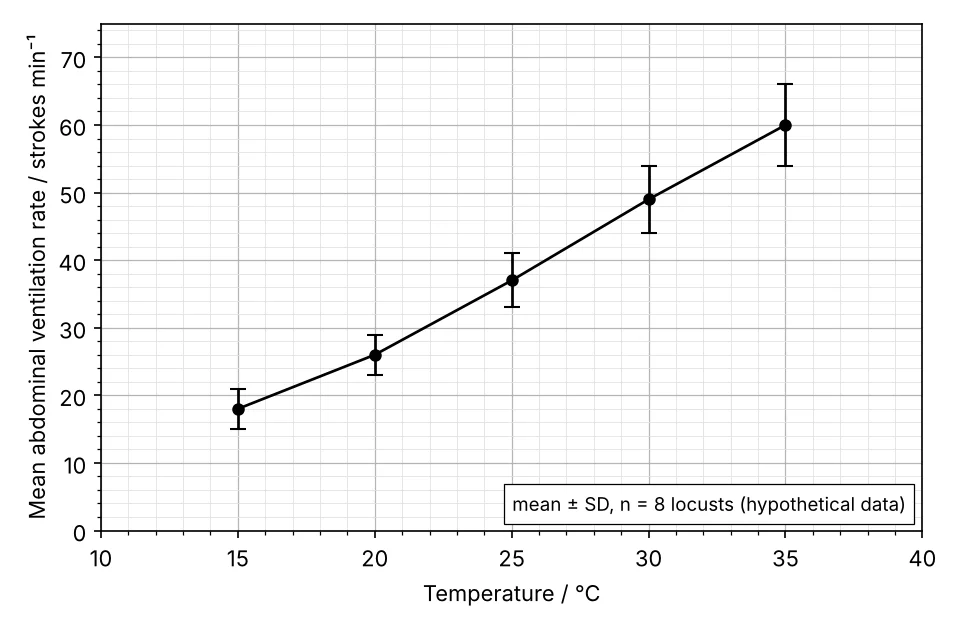
State the mean ventilation rate at 30 °C.
Calculate the percentage increase in the mean ventilation rate from 20 °C to 35 °C.
Explain why the ventilation rate increases as temperature rises.
Suggest two variables, other than temperature, that should be kept constant in this investigation.
revisionprep.com
Summary Answer
Not available for this question.
Model Answer
Not available for this question.
Marking Scheme
Not available for this question.
Examiner Insights
Not available for this question.
Properties of gas-exchange surfaces; maintaining concentration gradients
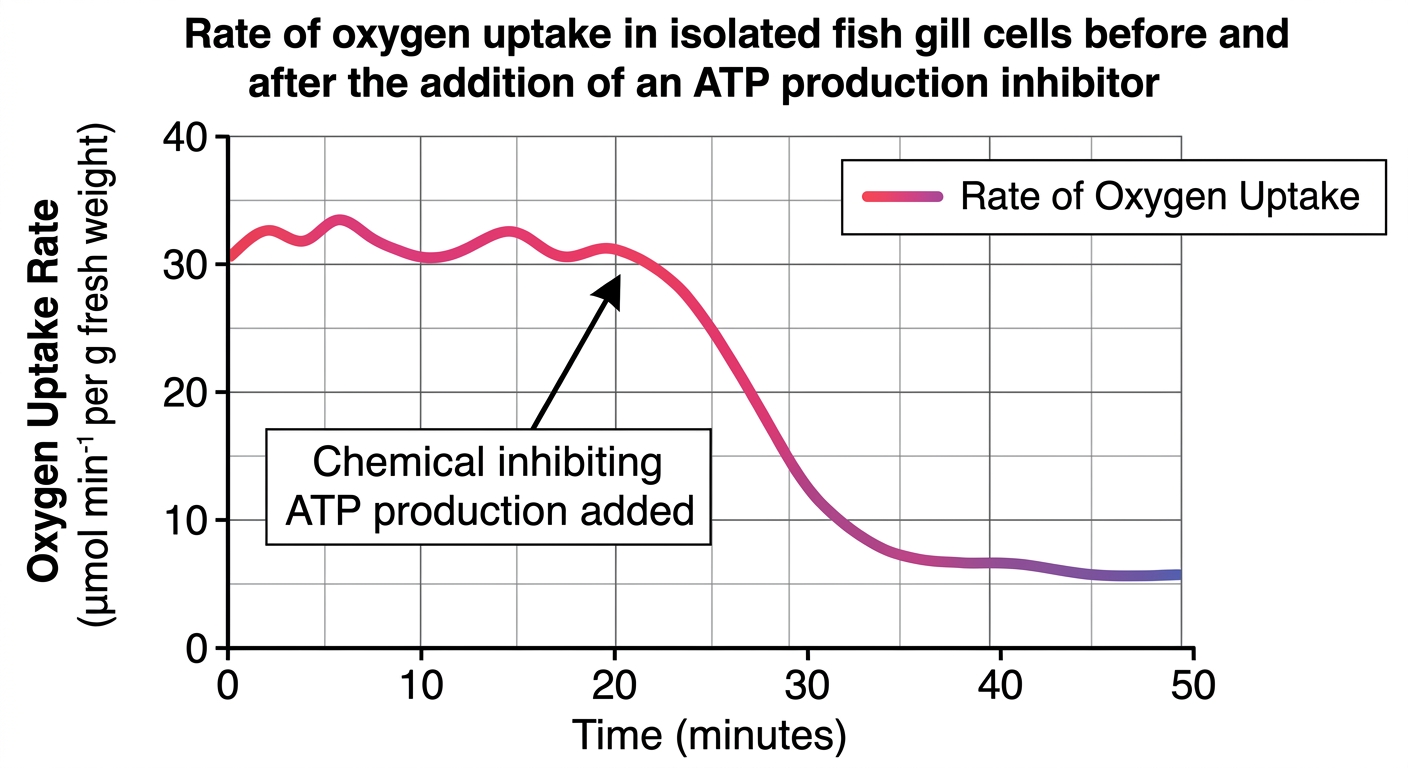
A researcher measures the rate of oxygen uptake in isolated fish gill cells. She adds a chemical that blocks ATP synthesis, and the rate of oxygen uptake decreases significantly. Which conclusion is best supported by this result?
revisionprep.com
Summary Answer
Not available for this question.
Model Answer
Not available for this question.
Marking Scheme
Not available for this question.
Examiner Insights
Not available for this question.
Respiratory structures in animals and plants
Mayfly nymphs live in streams and exchange gases through thin, plate-like gills on the abdomen. A biologist measured the gill area of nymphs of one species collected from ten streams with different mean concentrations of dissolved oxygen. The scatter graph shows the results (hypothetical data).
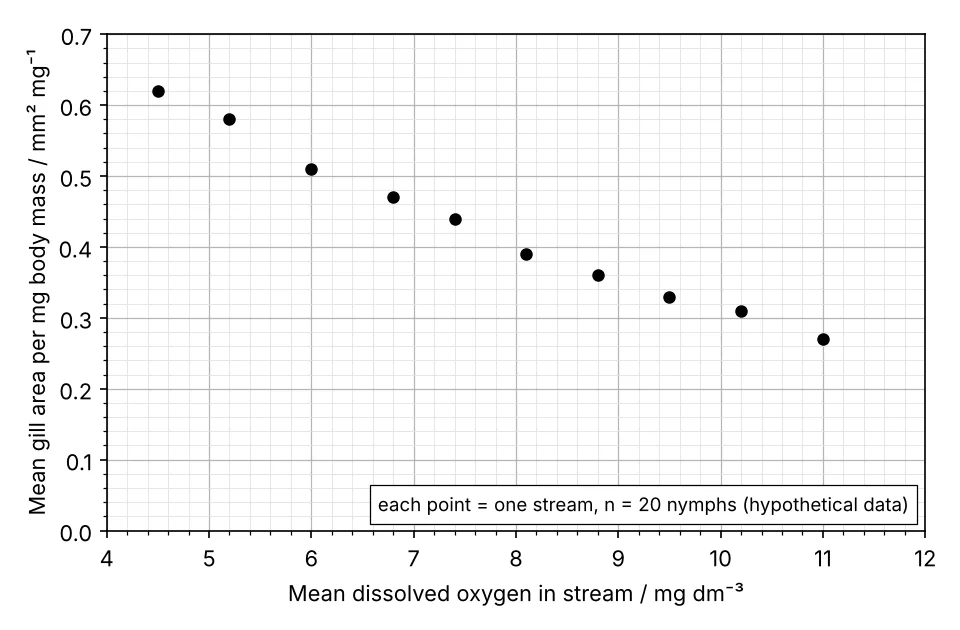
State the type of correlation shown by the data.
Estimate, from the graph, the mean gill area per mg of body mass for nymphs from a stream with 7.0 mg dm⁻³ of dissolved oxygen.
Calculate the percentage by which the gill area per mg of nymphs from the stream with 4.5 mg dm⁻³ exceeds that of nymphs from the stream with 11.0 mg dm⁻³.
Suggest how larger gills benefit nymphs living in streams with low dissolved oxygen.
The biologist concluded that low oxygen concentration causes mayfly nymphs to grow larger gills. Evaluate this conclusion.
revisionprep.com
Summary Answer
Not available for this question.
Model Answer
Not available for this question.
Marking Scheme
Not available for this question.
Examiner Insights
Not available for this question.
Properties of gas-exchange surfaces; maintaining concentration gradients
A computer model was used to predict the partial pressure of oxygen (pO₂) in alveolar air at different rates of alveolar ventilation, with the rate of oxygen use kept constant. The graph shows the predictions. Blood arriving at the alveoli has a pO₂ of 5.3 kPa.
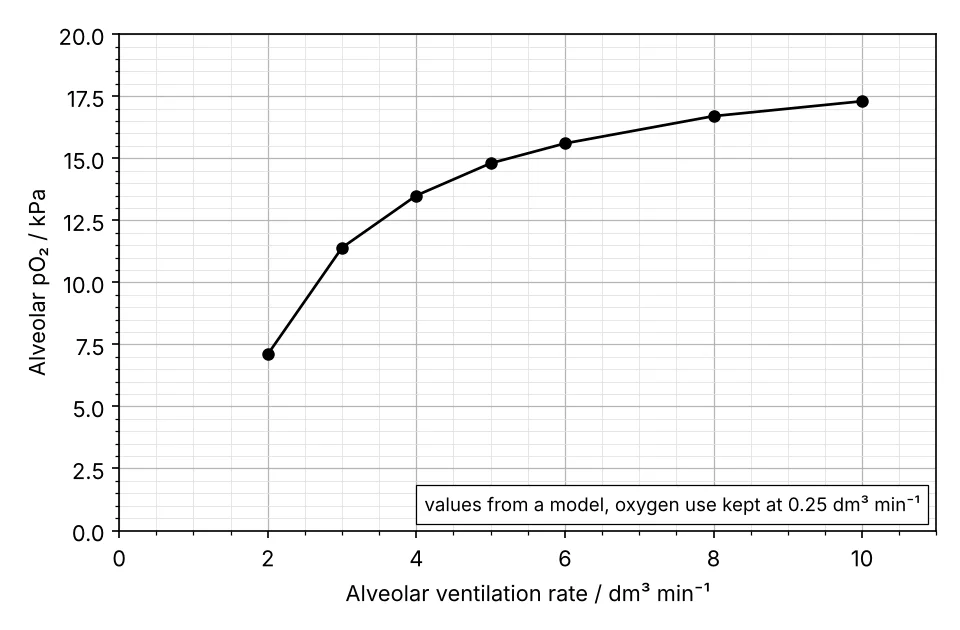
State the alveolar pO₂ predicted at an alveolar ventilation rate of 4 dm³ min⁻¹.
Calculate the pO₂ gradient between alveolar air and arriving blood at ventilation rates of 2 dm³ min⁻¹ and 8 dm³ min⁻¹, and hence how many times steeper the gradient is at 8 dm³ min⁻¹.
Explain why alveolar pO₂ rises as the ventilation rate increases.
Describe the shape of the curve and suggest why further increases in ventilation give smaller and smaller increases in alveolar pO₂.
revisionprep.com
Summary Answer
Not available for this question.
Model Answer
Not available for this question.
Marking Scheme
Not available for this question.
Examiner Insights
Not available for this question.
That's every free question here — 6 of 83.
+77 more questions, plus Mock Papers & Worksheets, are waiting in Premium.