Organelles and Compartmentalization · Paper 1 — Free Biology SL Practice Questions
Free questions
Open in full, with answers, mark scheme and examiner insights.
Compartmentalization of processes in eukaryotic cells
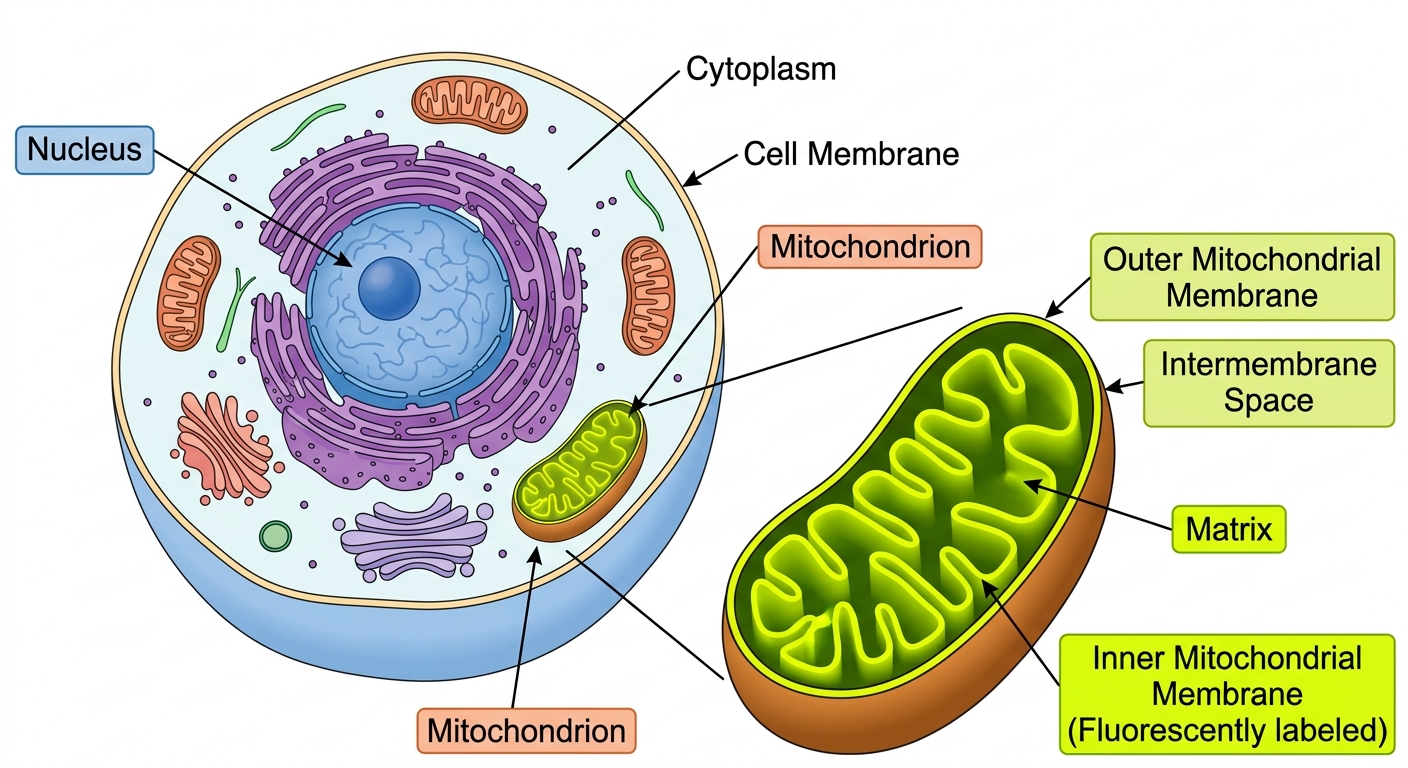
The shows a mitochondrion inside an animal cell. Which feature of the mitochondrion supports the theory that it was once a free-living prokaryote?
revisionprep.com
Summary Answer
Not available for this question.
Model Answer
Not available for this question.
Marking Scheme
Not available for this question.
Examiner Insights
Not available for this question.
Role of organelles in cellular function
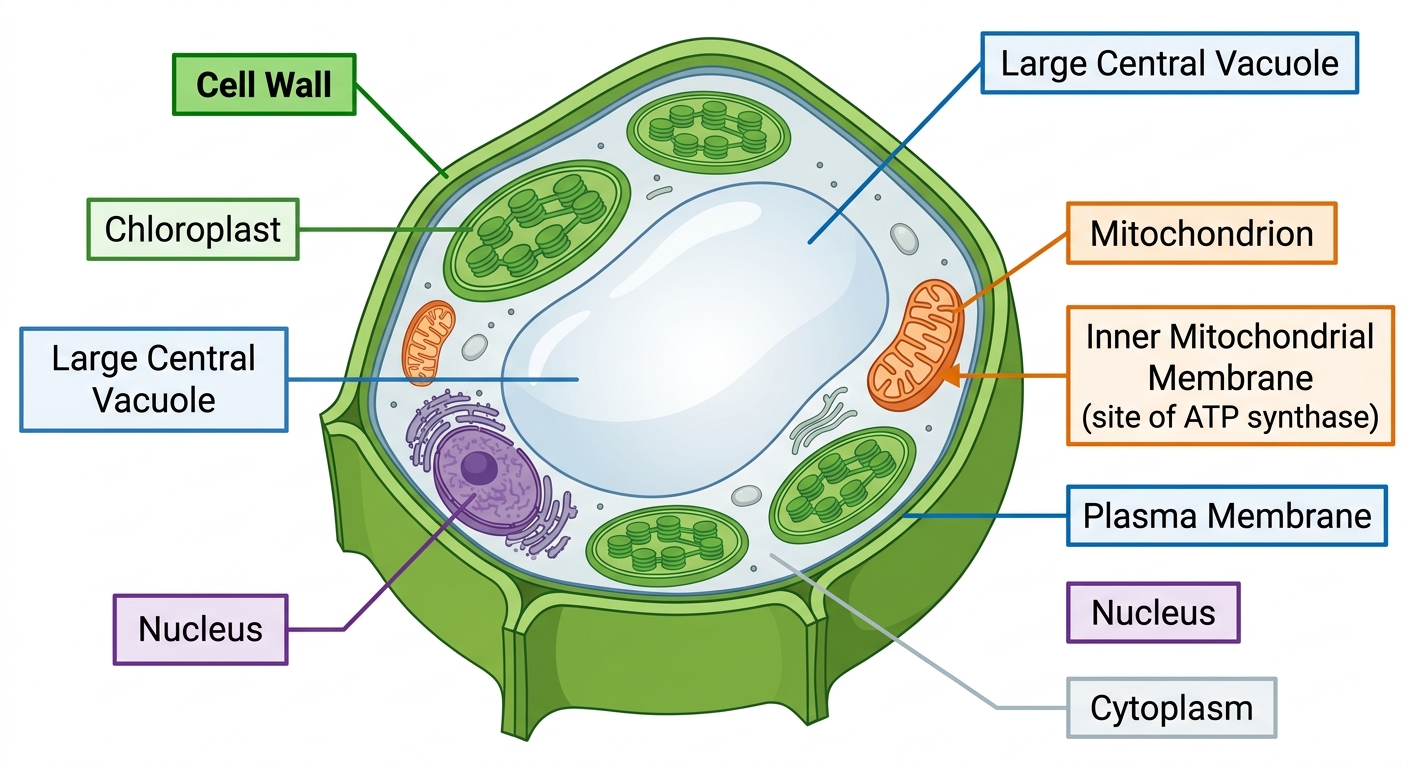
The shows a palisade cell from a leaf. Which labelled organelle would be absent from a root cell of the same plant?
revisionprep.com
Summary Answer
Not available for this question.
Model Answer
Not available for this question.
Marking Scheme
Not available for this question.
Examiner Insights
Not available for this question.
Compartmentalization of processes in eukaryotic cells
Pancreatic cells make the digestive enzyme trypsinogen and release it into the culture medium. The bar chart shows how much was released in 60 minutes by untreated cells and by cells treated with brefeldin A, a drug that stops transport vesicles forming from the Golgi apparatus.
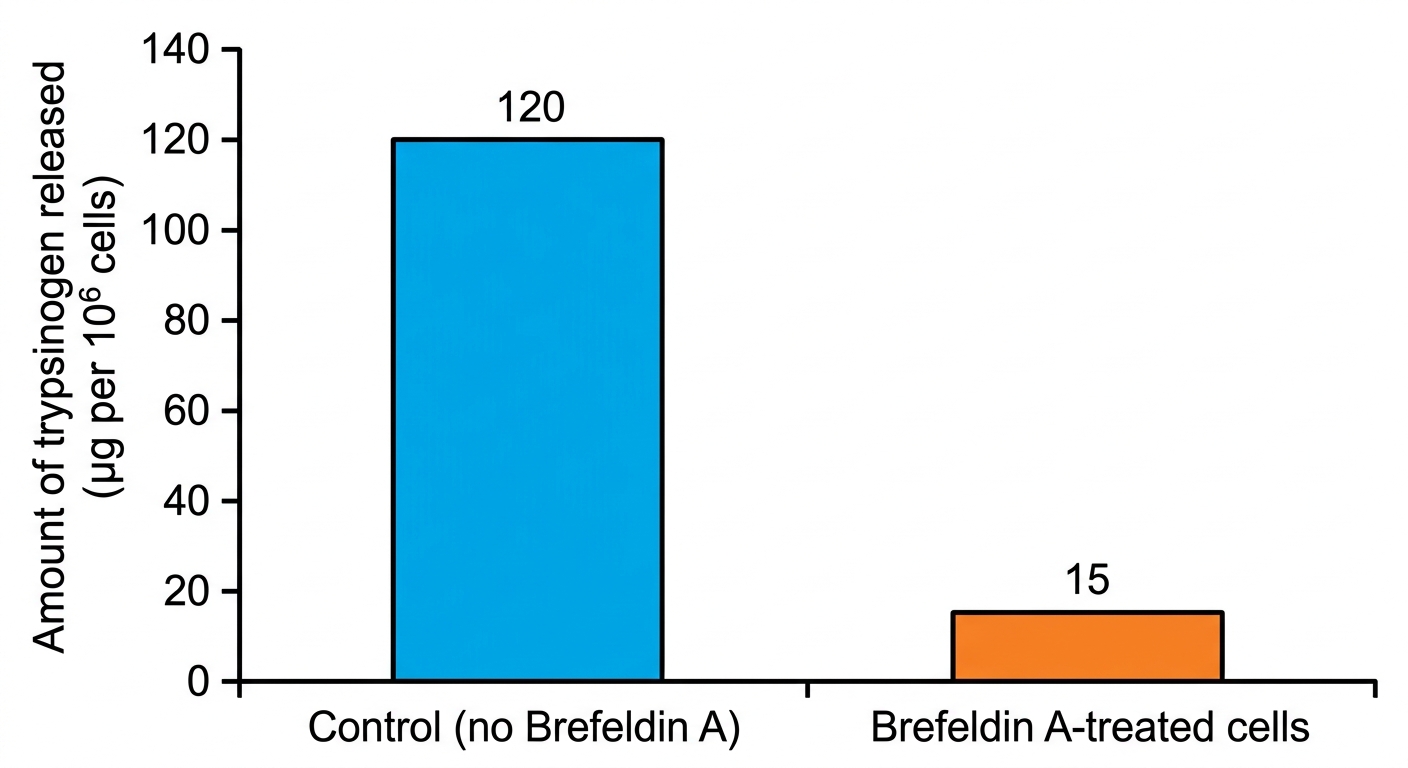
State the organelle on which trypsinogen is synthesised.
Calculate the percentage reduction in trypsinogen released caused by brefeldin A.
Explain why trypsinogen stays inside the treated cells.
Trypsinogen is an inactive form of a protease. Suggest why the cell makes it in an inactive form.
revisionprep.com
Summary Answer
Not available for this question.
Model Answer
Not available for this question.
Marking Scheme
Not available for this question.
Examiner Insights
Not available for this question.
Role of organelles in cellular function
The diagram compares liver cells and mature red blood cells, which have similar volumes. Both were given excess glucose and oxygen at 37 °C.
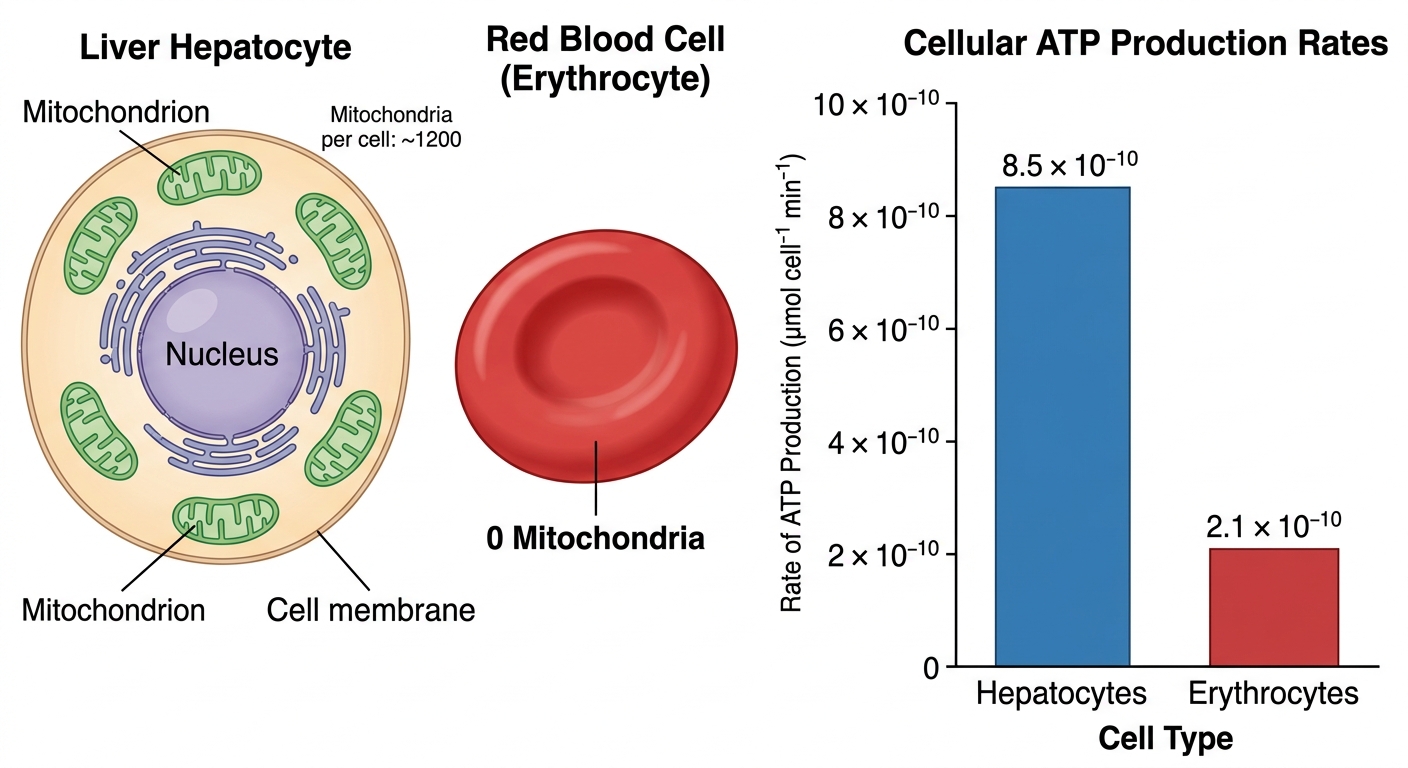
State one advantage to a red blood cell of having no mitochondria.
Using the bar chart, calculate how many times faster ATP is produced by a liver cell than by a red blood cell.
Explain why the liver cell produces ATP faster, even though both cells have the same supply of glucose and oxygen.
Red blood cells carry oxygen to tissues. Suggest why it is an advantage that they do not respire aerobically.
Mature red blood cells also have no nucleus. State one consequence of this for the cell.
revisionprep.com
Summary Answer
Not available for this question.
Model Answer
Not available for this question.
Marking Scheme
Not available for this question.
Examiner Insights
Not available for this question.
Compartmentalization of processes in eukaryotic cells
Spinach leaf cells were homogenised and centrifuged. The share of three enzymes in each fraction is shown. Enzyme P is used in photosynthesis, enzyme Q in aerobic respiration, and acid phosphatase is a hydrolytic enzyme. The experiment was repeated with a longer, more vigorous homogenisation.
The table shows the results.
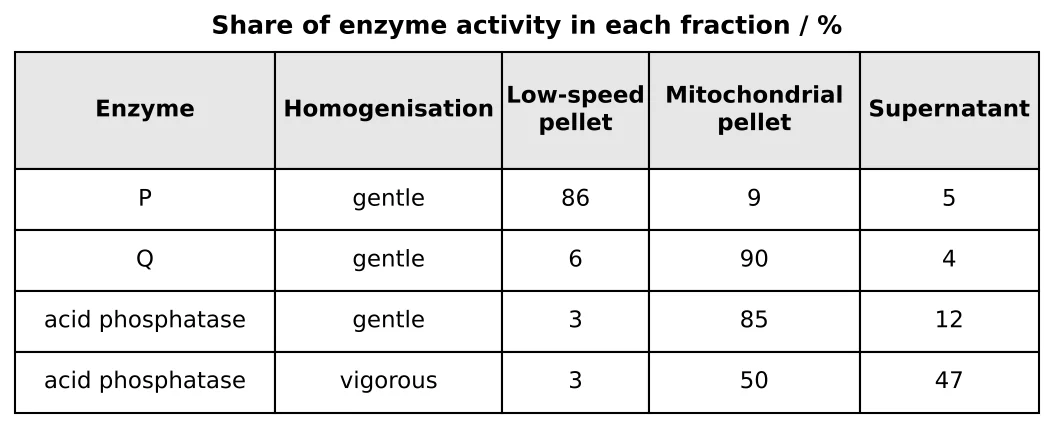
State the organelle most likely to contain enzyme P.
Deduce which organelle contains acid phosphatase, giving a reason.
Explain the change in the distribution of acid phosphatase after vigorous homogenisation.
Suggest why the homogenate is kept ice-cold throughout the procedure.
revisionprep.com
Summary Answer
Not available for this question.
Model Answer
Not available for this question.
Marking Scheme
Not available for this question.
Examiner Insights
Not available for this question.
Role of organelles in cellular function
A student grew the single-celled alga Euglena in the light and in the dark for two weeks, then counted organelles in electron micrographs of 20 cells from each culture.
The bar chart shows the results.
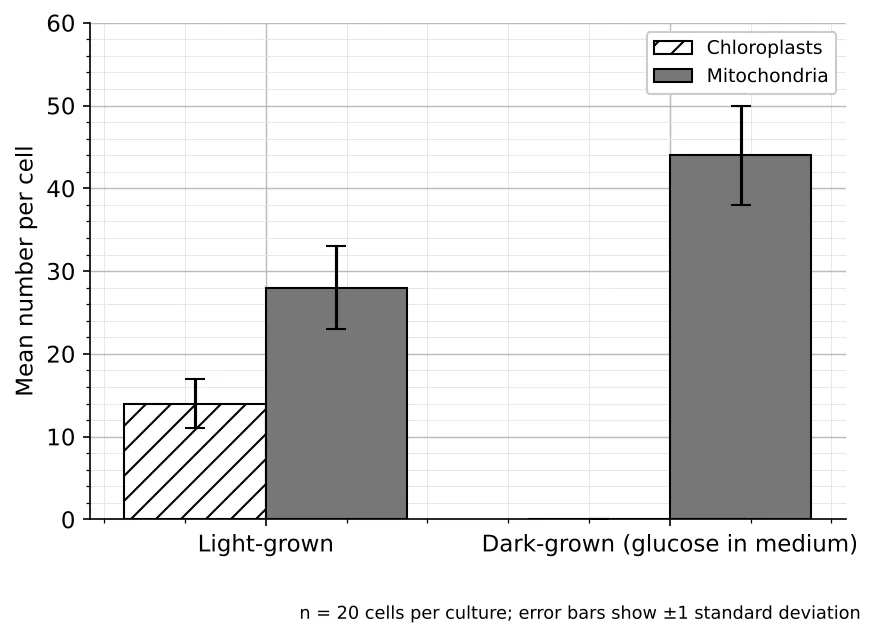
Describe the differences between the two cultures.
Explain why dark-grown cells have more mitochondria.
Suggest why the dark-grown cells do not keep chloroplasts.
Predict, with a reason, the change in chloroplast number when dark-grown cells are moved into light.
Suggest why the student counted organelles in 20 cells from each culture rather than in one cell.
revisionprep.com
Summary Answer
Not available for this question.
Model Answer
Not available for this question.
Marking Scheme
Not available for this question.
Examiner Insights
Not available for this question.
That's every free question here — 6 of 81.
+75 more questions, plus Mock Papers & Worksheets, are waiting in Premium.